
By Muhammad Hasab al-Rasoul
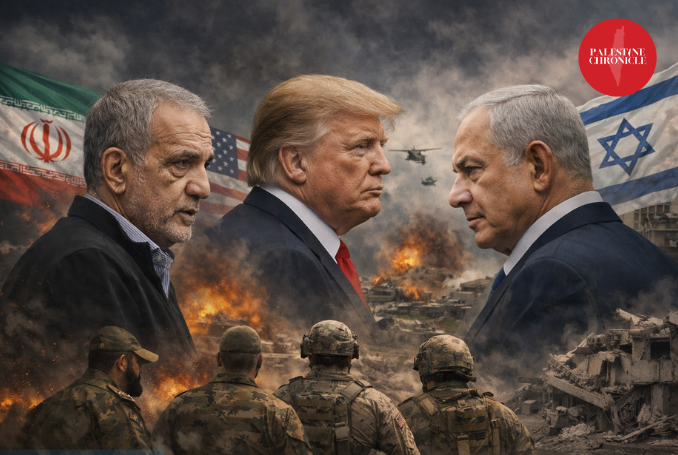 US–Israeli escalation and Iranian retaliation redefine the region’s balance, as survival and regime change collide in a widening war. (Photo illustration: Palestine Chronicle)
A superpower is rarely defeated in a single battle. It is worn down gradually through accumulating costs, time, and internal pressure. Military superiority may provide deterrence, but the true test of power lies in the ability to sustain a prolonged war.
Amid the rapid transformations unfolding across the region, the name of Chinese Professor Jiang Xiuqin has emerged as one of the voices offering a bold, forward-looking interpretation of the American-Israeli war on Iran.
Jiang, a Chinese academic and Yale University graduate, gained attention through his Predictive History platform, where he analyzes the behavior of empires during moments of ascent and strategic testing.
In 2024, Jiang made three predictions: the return of Donald Trump to the US presidency, the outbreak of war with Iran, and the possibility that the United States could lose such a war. With the first two predictions having already materialized, the third has drawn increasing attention. Jiang’s argument focuses not on the size of military arsenals, but on the endurance and resilience of the actors involved.
Attrition as Strategy
Jiang begins from the premise that the current confrontation is not a conventional war likely to end quickly, but rather a conflict defined by gradual erosion. In this framework, Iran’s strategy relies on attrition.
The Vietnam War offers an instructive historical example. The United States did not lose that war due to a lack of military capability, but because the conflict evolved into a prolonged struggle in which the Vietnamese leadership succeeded in exhausting American political and economic resources. Over time, military superiority lost its functional advantage.
At the same time, comparisons with Vietnam must be approached carefully. Iran today possesses capabilities that Vietnam never had. These include a sophisticated ballistic missile arsenal, an advanced drone program, and electronic warfare capacities. In addition, Iran maintains regional alliances and holds strategic leverage through the Strait of Hormuz, a passage through which roughly one-third of global oil supplies transit.
Taken together, these capabilities enhance Iran’s ability not only to defend itself but also to impose a broader war of attrition on its adversaries—potentially far deeper and more complex than the guerrilla warfare experienced in Vietnam.
In this context, the central issue is not the outcome of a single battle. Rather, it is the cumulative burden of time, financial costs, and internal pressures that determines whether military superiority can be sustained.
The Gulf as an Arena of Mutual Attrition
The Gulf region represents a central strategic arena in this conflict. Its importance extends beyond maritime navigation and energy production; it also underpins global economic systems and technological supply chains.
A prolonged war would place Washington under dual pressure. The disruption of energy flows and trade routes could weaken global markets while simultaneously increasing the financial and military burdens of sustained conflict.
At the same time, the Gulf states themselves would face mounting challenges. Economic stability, social cohesion, and security arrangements could all be affected if supply chains and maritime routes are disrupted.
Political discourse within the Gulf has already begun to reflect this tension. Prominent regional figures, including former Qatari Prime Minister Hamad bin Jassim, Saudi Prince Turki al-Faisal, and Emirati businessman Khalaf Al Habtoor, have suggested that the war is not fundamentally a Gulf conflict but rather a confrontation driven by the interests of Washington and Tel Aviv. Such statements reflect a growing current within Gulf political thinking.
Beyond the military dimension, food security could become one of the most sensitive issues. Gulf countries import nearly 90 percent of their food supplies through maritime routes that pass the Strait of Hormuz. While officials insist that strategic reserves can cover four to six months of consumption, prolonged disruptions could create serious economic and social pressures.
Under such conditions, the region could shift from being a sphere of influence to becoming an additional arena of economic and political strain.
The American Home Front
Attrition in this conflict is not confined to the battlefield or the economy. The domestic political environment in the United States may prove equally decisive.
Public opposition to foreign wars has grown steadily over the past two decades. War fatigue, economic concerns, and domestic priorities have strengthened calls to limit overseas military engagements.
The political movement that helped return Donald Trump to the presidency—the MAGA coalition—was built in part around the slogan “America First.” That message emphasized reducing foreign entanglements and focusing on domestic challenges.
A prolonged war of attrition could therefore clash with the political foundation that brought Trump back to power. Without a swift and decisive victory, domestic opposition may expand, increasing pressure on the administration and Congress.
Signs of such tension are already visible. Public opinion polls show increasing reluctance among Americans to support new military interventions abroad. Meanwhile, a recent congressional vote on war powers revealed deep divisions, passing by a narrow margin of 53 to 47.
Historically, external crises often trigger a temporary “rally around the flag” effect. Yet prolonged conflicts—especially those perceived as unrelated to national survival—have the potential to transform early unity into frustration and political backlash, particularly as casualties mount and financial costs escalate.
Israel and the Limits of Endurance
Israel, the United States’ primary partner in the conflict, operates under a military doctrine that favors swift, decisive wars rather than prolonged confrontations.
Historically, Israeli strategy has relied on rapid victories designed to minimize prolonged economic disruption and societal strain. A long war of attrition would challenge this model.
Israeli society has often demonstrated sensitivity to human losses as well as psychological and economic pressures associated with sustained conflict. Reactions during the early stages of the current war already indicate rising concerns regarding the potential duration and costs of the confrontation.
Economic indicators reflect these pressures. The Israeli Broadcasting Authority estimated that damage to critical economic infrastructure has already reached billions of shekels. Meanwhile, Reuters, citing informed sources, reported that the first week of the war alone generated direct economic losses exceeding two billion dollars, due to disrupted industrial activity, displacement from northern regions, and a sharp decline in air traffic.
At the same time, elements within the Israeli right view the conflict as a strategic opportunity. From this perspective, the war represents a chance to neutralize what is perceived as an existential threat from Iran while reshaping regional geopolitics.
This tension highlights a fundamental question: whether Israel’s strategic ambitions align with the economic, social, and psychological capacity of the state and its society to sustain a prolonged war.
China and Russia: Beneficiaries of Strategic Overstretch
The conflict also unfolds within a broader geopolitical context involving Russia and China.
Moscow, already engaged in a prolonged war in Ukraine, may see strategic value in Washington becoming entangled in another costly confrontation. Russian support for Iran could include political backing, technical cooperation, and assistance in areas such as air defense—capabilities refined during the war in Ukraine.
Such cooperation would also align with the strategic partnership agreements between Moscow and Tehran, potentially serving Russia’s broader objective of weakening American global influence.
China’s perspective is shaped by its own long-term geostrategic calculations. Beijing maintains a comprehensive strategic partnership with Iran and views Tehran as an important regional actor within emerging multipolar dynamics.
Although China remains attentive to disruptions in global supply chains, it may also perceive the conflict as an opportunity to accelerate the erosion of American influence.
Under these conditions, both Beijing and Moscow could eventually promote diplomatic initiatives aimed at ending the war. Such efforts would align with broader efforts to reshape the international order toward a more multipolar system.
The Central Question: Sustainability
Taken together, these multiple fronts reveal the deeper structure of the conflict.
In Washington, political divisions and financial burdens are intensifying. In Israel, economic costs and social pressures continue to accumulate. In the Gulf, concerns over food security and regional stability are rising.
In Iran, meanwhile, the state appears to be relying on institutional resilience and societal capacity to absorb shocks, despite facing its own internal economic and political challenges.
The central equation, therefore, is not simply the balance of military power. Rather, it concerns the ability to sustain that power over time without the associated costs eroding internal stability.
When military, economic, and political pressures converge, the question of victory becomes secondary to the question of endurance.
This is the core insight in Jiang Xiuqin’s analysis. Wars of attrition rarely produce dramatic battlefield collapses. Instead, they reshape outcomes through gradual exhaustion.
If Jiang’s prediction of an American defeat were to materialize, it would likely not resemble the sudden collapse of a battlefield force. Instead, it would manifest as a gradual erosion of political prestige and an inability to impose strategic objectives.
Such an outcome could lead to one of two scenarios: a chaotic withdrawal reminiscent of Afghanistan, or a negotiated settlement shaped by the realities of prolonged attrition.
In either case, the defining factor would not be military capability alone, but the capacity to endure the costs of war over time.
(This article was originally published in Al Mayadeen. It was translated and edited by the Palestine Chronicle)

No comments:
Post a Comment