
By Ramzy Baroud
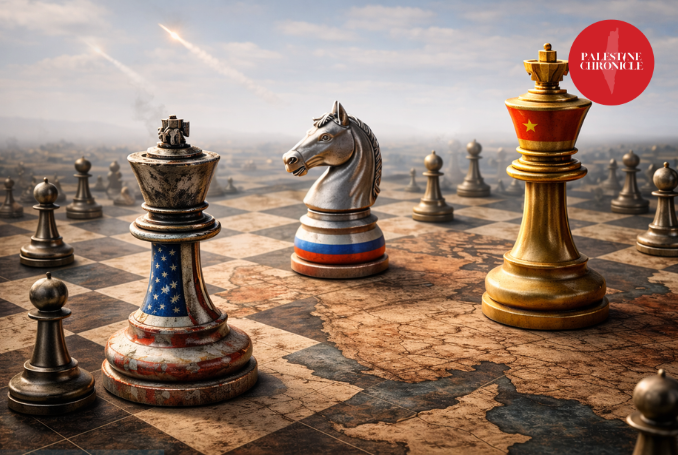
The US-Israeli aggression on Iran is destabilizing the region while weakening Washington and creating strategic openings for Russia and China.
Key Takeaways
- The US-Israeli aggression on Iran lacks legal, political, and strategic justification from the standpoint of American interests.
- Israel seeks to restore deterrence and impose regional hegemony after the political and moral fallout of the Gaza genocide.
- Washington gains little from this war but inherits economic disruption, strategic overstretch, and further erosion of regional credibility.
- Gulf allies are being reminded that American power in the region serves Israel first, not Arab security or stability.
- Russia and China stand to benefit as US attention, legitimacy, and strategic focus are drained by another destructive war.
A Note on the Analytical Framework
This analysis evaluates the US-Israeli aggression on Iran through the lens of realpolitik and traditional American strategic calculations. It asks whether the war advances Washington’s own geopolitical interests.
This should not be mistaken for moral endorsement of those assumptions. The United States has no inherent right to contain rivals, manipulate alliances, or impose dominance across distant regions.
The argument here is simply that even by the narrow standards of American statecraft, the war on Iran represents a profound strategic miscalculation.
The War America Never Needed
The US-Israeli aggression on Iran is among the most dangerous and irrational escalations in recent Middle Eastern history. Unlike previous American wars in the region, this one cannot even hide behind the tired vocabulary of liberal intervention. There is no serious talk of democracy, no convincing invocation of human rights, and no coherent legal claim that could justify such a devastating act of aggression. What remains is naked force, stripped of pretense.
This is, above all else, Israel’s war. It is Israel that has the clearest motive, the deepest desperation, and the greatest political need to expand the battlefield. After months of genocide in Gaza, Israel’s image has been shattered across much of the world. Even where Western governments continued to shield it diplomatically, the war exposed the limits of Israeli power. Israel demonstrated enormous capacity for destruction, but very little ability to convert destruction into lasting strategic gain.
Gaza did not submit. Hezbollah was attacked repeatedly, including in the most recent and ongoing confrontation, yet it was not defeated. Ansarallah in Yemen also remained capable of projecting force and disrupting strategic calculations in the region. Israel’s long-cultivated image as an untouchable military giant has been bruised, perhaps more deeply than at any time in decades. That reality helps explain why Tel Aviv has pushed for a wider war.
For Israel, Iran is not simply another adversary. It is the state that sits at the center of a regional balance Israel has long sought to break. Tel Aviv’s ambition is not merely security in the narrow sense; it is supremacy. It seeks uncontested hegemony, strategic dominance over Arab capitals, and access to a region whose wealth and political geography it hopes to reshape in its favor. A weakened or shattered Iran would remove the most formidable obstacle to that project.
Yet Israel cannot accomplish this alone. Its failures in Gaza, in Lebanon, and against Ansarallah demonstrate that it lacks the capacity to impose decisive outcomes even on non-state actors and neighboring fronts, let alone on a large and heavily armed regional power such as Iran. It therefore turns, as it always has at decisive moments, to the United States.
A War Without American Logic
If the war makes sense from the standpoint of Israeli ambition, it makes far less sense from the standpoint of American interests.
The United States has historically justified its regional wars through carefully manufactured narratives. Iraq was invaded under the lie of weapons of mass destruction. Afghanistan was framed as a war of necessity after 9/11. Syria was repeatedly discussed through the language of chemical weapons, red lines, and humanitarian urgency. Those narratives were dishonest, but they at least attempted to align war with a declared American rationale.
This time, even that performance is largely absent.
There is no credible case that Iran posed an imminent threat to the United States. There is no broad domestic consensus around this war, nor any obvious material gain for Washington. The Trump administration, in particular, has shown little interest in dressing military aggression in the language of values. That leaves the war exposed as what it is: a massive intervention undertaken largely because Israel wants it and because Washington remains structurally incapable of telling Israel no.
From a cold strategic standpoint, the timing is especially irrational. The United States has other priorities that are far more central to its global position: containing China, exhausting Russia, disciplining Europe into continued dependency, and reasserting leverage over the Global South. Opening a new and volatile front in the Middle East disrupts all of these objectives at once.
The economic risks alone are severe. The war has already intensified pressure on oil markets, shaken global shipping, and renewed fears surrounding the Strait of Hormuz, a chokepoint vital to world energy flows. Even if the United States itself is less dependent on Gulf oil than in previous decades, the American economy remains tied to a globalized system in which energy shocks raise prices, disrupt supply chains, and harm consumers.
This means Washington is effectively helping to ignite a crisis that can boomerang directly onto its own economy. At the same time, it is alarming the very Gulf monarchies that have become major investors in the United States. These governments did not seek regional chaos. They sought predictability, protection, and profitable continuity. Instead, they are now watching American power drag the region into deeper uncertainty.
The American Security Myth
Perhaps the most politically revealing dimension of this war is what it says to America’s Arab allies.
For decades, Gulf states accepted the architecture of American military dominance on the assumption that Washington would guarantee their security. Bases, defense contracts, naval patrols, and missile systems were all sold as proof that the United States was the indispensable protector of regional order. But that order was always selective. It was never built around Arab sovereignty. It was built around Israeli supremacy and American profit.
Now the mask is slipping.
As Iran retaliates against US-linked assets and regional infrastructure, Arab governments are learning that American priorities remain unchanged. Washington mobilizes immense force when Israel is threatened, but it does not show the same urgency when Gulf states absorb the consequences of escalation. Even where military support exists, the hierarchy is unmistakable: Israel first, everyone else after.
This realization may have lasting consequences. The myth that the United States exists in the region as an impartial guarantor of stability has never been less credible. Arab elites are being reminded that they are not equal partners in a strategic alliance; they are instruments within a regional order designed elsewhere. That is a profound political loss for Washington, one that cannot easily be repaired with more weapons sales or more official visits.
Why Russia and China Stand to Gain
Every empire in decline eventually reveals its weakness through overreach, and this war bears all the signs of dangerous overextension.
Russia benefits when Washington is forced to divide its military focus, diplomatic energy, and financial resources across multiple theaters. The more the United States is pulled into the Middle East, the harder it becomes to sustain pressure on Moscow in Ukraine and beyond. Rising energy prices also tend to favor Russian exports, creating an additional material benefit for the Kremlin.
China’s gains may prove even more consequential. Beijing has spent years cultivating influence through trade, energy partnerships, infrastructure, and diplomacy rather than permanent war. As the United States once again appears before the world as a force of chaos, China can present itself as the more stable and rational power, especially to countries across the Global South that have grown weary of American militarism.
A prolonged war also threatens the very international environment Washington needs to concentrate on containing China. Instead of narrowing its strategic agenda, the United States is widening it catastrophically. Instead of isolating its rivals, it is handing them opportunities. Russia gains room. China gains relevance. America gains another war without a clear exit and without a clear purpose.
That may be the central irony of this aggression. A war launched to reinforce dominance may end by accelerating decline. Israel may believe it is remaking the Middle East through fire. But for Washington, the likely result is diminished credibility, deeper instability, and a further transfer of strategic advantage to the very powers it claims to be confronting.

– Dr. Ramzy Baroud is a journalist, author and the Editor of The Palestine Chronicle. He is the author of eight books. His latest book, ‘Before the Flood,’ was published by Seven Stories Press. His other books include ‘Our Vision for Liberation’, ‘My Father was a Freedom Fighter’ and ‘The Last Earth’. Baroud is a Non-resident Senior Research Fellow at the Center for Islam and Global Affairs (CIGA).

No comments:
Post a Comment