
By Ramzy Baroud
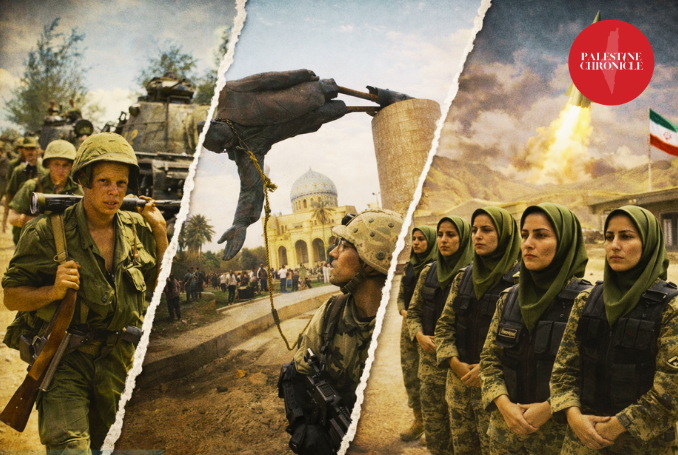 America has once again entered a war shaped by the same illusions that defined its past conflicts—destructive, costly, and ultimately unwinnable. (Design: Palestine Chronicle)
Washington’s war on Iran ignores the lessons written in the devastation of Korea, Vietnam, Iraq, and Afghanistan.
The Historical Record of American War
The history of American war since the mid-twentieth century is not merely a sequence of military campaigns. It is also the history of societies shattered by enormous violence—Korea devastated by aerial bombardment, Vietnam, Laos, and Cambodia scarred by relentless bombing, Iraq broken by sanctions and invasion, Afghanistan ruined by decades of war, and Libya fragmented after NATO intervention.
The Korean War alone killed an estimated three to four million people, the vast majority of them civilians. Entire cities across the peninsula were reduced to rubble by sustained bombing campaigns, and millions were displaced as the peninsula became one of the most heavily bombed regions in modern history.
American air forces dropped roughly 635,000 tons of bombs on Korea, including tens of thousands of tons of napalm. By the end of the conflict, large portions of North Korea’s cities and infrastructure had been destroyed.
Yet despite the immense destruction and the loss of 36,574 American soldiers, the war did not end in victory. It ended with a fragile armistice that remains in place more than seventy years later.
Vietnam revealed the same limits of overwhelming force.
During the war in Vietnam, Laos, and Cambodia, the United States dropped more than 7.5 million tons of bombs, making Indochina the most heavily bombed region in modern history. By 1966 alone, Washington had already dropped more bombs on North Vietnam than it had dropped on Japan during the entire Second World War.
(A grim contemporary parallel can be seen in Gaza, where Israel’s ongoing genocide—carried out largely with American weapons—has subjected one of the world’s most densely populated territories to extraordinary bombardment; measured relative to its tiny size, it can plausibly be argued that Gaza may now rank among the most heavily bombarded places in history.)
The devastation was enormous. Millions of civilians were killed, villages were destroyed, forests were poisoned by chemical defoliants such as Agent Orange, and entire societies were torn apart.
Yet after two decades of war and over 58,000 American deaths, the United States ultimately withdrew without achieving its strategic objectives.
The lesson was unmistakable: overwhelming military power could devastate societies, but it could not easily impose political control over determined populations.
The Post-Vietnam Shift: Controlled Wars
After Vietnam, Washington did not abandon war. Instead, it sought to fight wars under conditions designed to guarantee dominance.
US planners increasingly favored conflicts where the enemy was weakened by sanctions, where broad international coalitions could be assembled, and where internal allies could assist American operations.
The 1991 war against Iraq exemplified this model. Iraq had already been weakened by eight years of war with Iran. After Baghdad invaded Kuwait in August 1990, the United Nations imposed sweeping economic sanctions that isolated Iraq from global trade and financial markets. The United States then assembled a large international coalition and launched a massive air campaign followed by a ground offensive against an adversary whose economy and military capacity had already been severely strained.
Even so, the apparent military success came at enormous human cost. Sanctions imposed during the 1990s devastated Iraqi society, crippling its economy and healthcare system while leaving ordinary Iraqis to bear the consequences.
The 2003 invasion of Iraq followed a similar pattern. Although US forces rapidly overthrew Saddam Hussein’s government, the war unleashed years of local resistance and instability that ultimately forced Washington to scale back its ambitions.
Afghanistan followed the same trajectory. With the support of the Northern Alliance, US forces quickly toppled the Taliban government in 2001. Yet after twenty years of war, the United States withdrew while the Taliban returned to power.
Even NATO’s intervention in Libya in 2011 followed a similar logic. The United States participated directly in the initial bombing campaign, launching cruise missiles and airstrikes that destroyed Libya’s air defenses and paved the way for the NATO operation.
Once the intervention was underway, Washington shifted to a supporting role while NATO allies and local anti-Gaddafi forces moved into the foreground. A senior Obama administration official later described this approach as “leading from behind”—a strategy in which the United States remained the indispensable military power while allowing others to appear as the public face of the war.
But Libya’s collapse into years of instability demonstrated once again that military intervention does not necessarily translate into political success.
Why Iran Is Different
Iran presents a fundamentally different strategic challenge from the states Washington has targeted in previous wars.
Geographically, Iran is vast. With a territory of about 1.6 million square kilometers, it is roughly four times the size of Iraq, and its population exceeds 85 million people.
More importantly, Iran has spent decades developing domestic military capabilities under sanctions. Its missile program is extensive, its drone production advanced, and systems such as the Shahed drone series have gained international attention.
Unlike Iraq under sanctions in the 1990s, Iran is not a hollowed-out state waiting to collapse under pressure. It is a country that has adapted to economic siege by building indigenous capabilities.
Its political system is also far more complex than Western caricatures often suggest. Power in Iran operates through multiple institutions—religious authorities, elected bodies, security structures such as the Revolutionary Guard, and a wide bureaucratic apparatus.
These structures provide resilience that regimes centered around single individuals—such as Saddam Hussein’s Iraq or Muammar Gaddafi’s Libya—did not possess.
A War Built on Illusions
Part of the explanation for this strategic gamble lies in recent events that appear, at least in Washington, to have reinforced a dangerous sense of American invincibility.
The Trump administration entered this confrontation after what it portrayed as a dramatic success in Venezuela. In early 2026, US forces carried out a military operation in Caracas that resulted in the capture and removal of Venezuelan President Nicolás Maduro. The operation was widely condemned by international legal experts and governments as a violation of international law and Venezuelan sovereignty.
Put plainly, it was a kidnapping carried out under the cover of military power.
For the White House, however, the episode appeared to validate a broader narrative: bold action, intelligence operations, and limited military force could remove adversarial governments quickly and decisively.
But Venezuela was never a real war. It did not involve a functioning military confrontation between states. It did not involve a large army, complex regional alliances, or a battlefield capable of absorbing and retaliating against American power. The operation resembled a raid, not a war.
Iran is something entirely different.
Yet the logic driving the current war appears rooted in the same expectation—that economic pressure, internal unrest, and targeted military strikes might trigger the collapse of the Iranian state from within. For years, analysts in Washington and Tel Aviv have argued that Iran’s periodic protests over economic conditions reveal a system vulnerable to sudden collapse.
But this assumption ignores a crucial difference between Iran and the countries Washington previously targeted: Iran is not isolated.
Unlike Iraq in 2003 or Libya in 2011, Iran possesses a network of regional allies capable of widening the battlefield. Hezbollah in Lebanon remains one of the most powerful non-state military actors in the world. Iraqi militias aligned with Tehran have already signaled their readiness to retaliate against US and Israeli targets – in fact, they have. Meanwhile, Ansarallah in Yemen has demonstrated its ability to disrupt global shipping routes and strike Israeli infrastructure.
These alliances fundamentally alter the strategic equation. Instead of a war fought against a single isolated state, the United States risks confronting a network of actors spread across multiple fronts.
At the same time, Washington has not assembled anything resembling the broad international coalitions that supported previous American wars. The 1991 Gulf War involved more than forty countries. NATO formally backed the intervention in Libya in 2011, and the war in Afghanistan quickly expanded into a large international alliance.
In the case of Iran, however, no comparable coalition has emerged. Washington appears to be relying primarily on its own military power and its close partnership with Israel rather than the kind of multinational alignment that characterized earlier interventions.
A War That Cannot Be Won
Which leaves the central illusion behind this war exposed.
Washington appears to believe that the strategies that worked—or appeared to work—against Iraq, Libya, or even Venezuela can simply be repeated against Iran. But the structural conditions that made those interventions possible are largely absent here. Iran is larger, more populous, militarily resilient, and embedded in a network of regional alliances capable of widening the battlefield. It is not the kind of isolated state the United States has historically targeted.
History offers a clear warning. The United States devastated Korea yet settled for stalemate. It bombed Vietnam on an unprecedented scale yet ultimately withdrew. It invaded Iraq and proclaimed victory prematurely, only to face years of insurgency. It spent twenty years in Afghanistan only to see the Taliban return to power. These wars demonstrated a recurring pattern: overwhelming force can destroy societies, but it cannot guarantee political victory.
The same contradiction now confronts Washington in Iran.
But this time the limits are even sharper. A prolonged war would strain global energy markets, disrupt vital trade routes, and place enormous pressure on economies already weakened by years of instability. At the same time, the United States and its allies are already confronting the logistical realities of modern warfare—finite stockpiles of missile defenses, limited production capacity for advanced munitions, and the growing difficulty of sustaining large-scale operations across multiple fronts.
In other words, this is not a war that can be prolonged indefinitely.
It is a war whose strategic limits are already visible—and whose ultimate outcome may prove far more costly for Washington than its architects anticipated.

– Dr. Ramzy Baroud is a journalist, author and the Editor of The Palestine Chronicle. He is the author of eight books. His latest book, ‘Before the Flood,’ was published by Seven Stories Press. His other books include ‘Our Vision for Liberation’, ‘My Father was a Freedom Fighter’ and ‘The Last Earth’. Baroud is a Non-resident Senior Research Fellow at the Center for Islam and Global Affairs (CIGA).

No comments:
Post a Comment