
As the U.S. and Israel kill Middle East children, including 165 schoolgirls in Iran, a U.N. diplomat said the first lady running a meeting on children in conflict was a high point of hypocrisy in U.N. history.
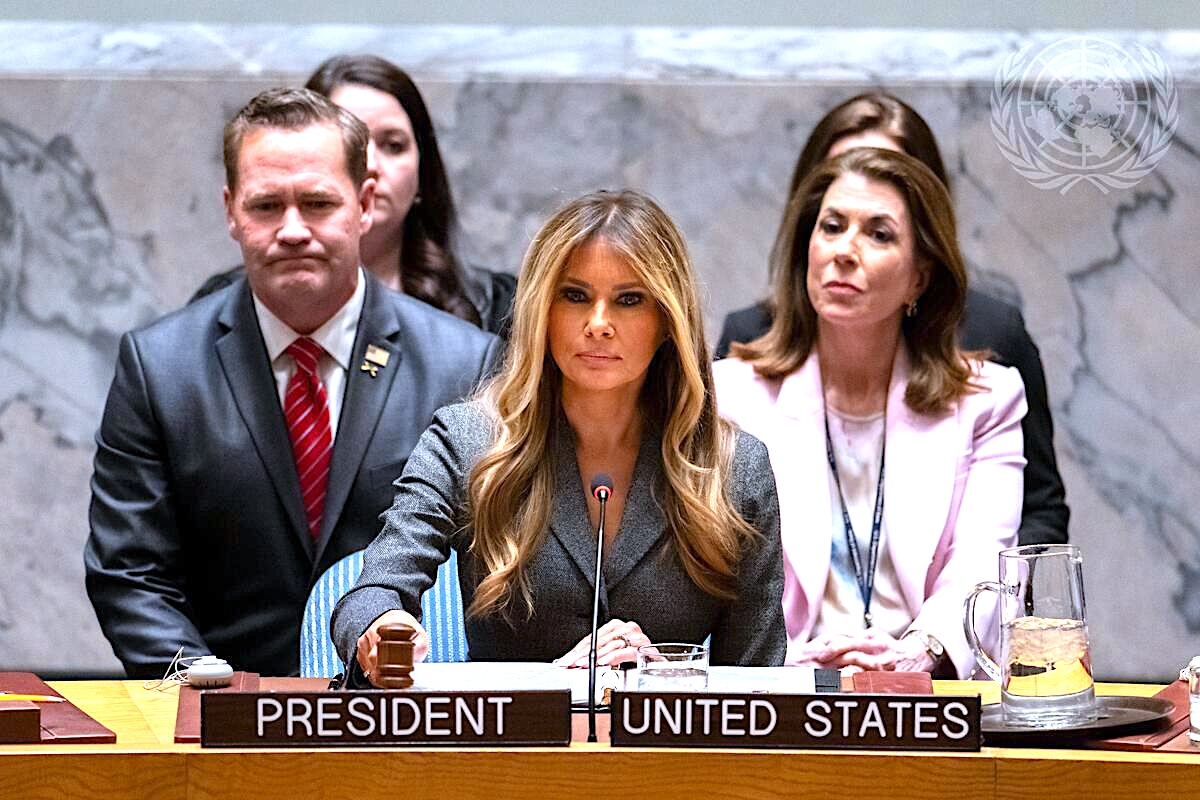
Melania Trump, U.S. first lady and president of the Security Council for the month of March, chairing the Security Council meeting on children, technology and education in conflict Monday. (UN Photo/Manuel Elías)
As the families of an estimated 180 schoolchildren and staff members killed in an Israeli attack on a girls’ school in southern Iran mourned on Monday, first lady Melania Trump presided over a United Nations Security Council meeting where the impact her husband’s military operations in the Middle East was briefly addressed — but only in regard to her pet cause, children and technology.
Melania Trump spoke generally about children living in or fleeing conflict as she opened a meeting on “Children, Technology, and Education in Conflict,” saying the U.S. “stands with all children throughout the world.”
But the meeting was held as the U.S. Department of Defense and Israeli officials were refusing to acknowledge what had been widely reported: On Saturday, as the U.S. and Israel launched airstrikes across Iran, despite diplomatic talks that had recently been making progress, Israel struck the Shajareh Tayyebeh girls’ school in Minab as children gathered for the school day.
The building was destroyed and the roof collapsed, killing at least 180 people, according to PBS NewsHour correspondent Leila Molana-Allen — the majority of whom were girls between the ages of 7 and 12. Nearly 100 people were also injured.
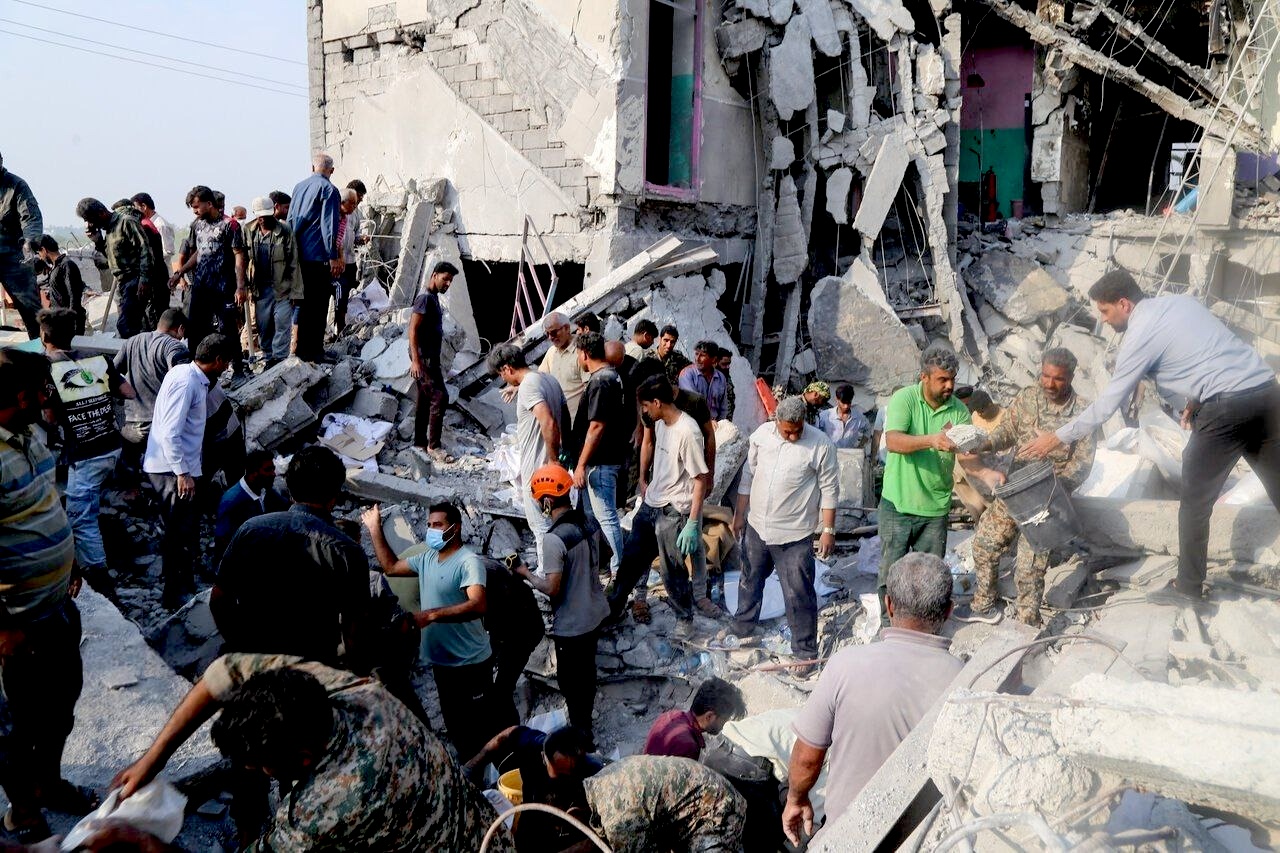
Shajareh Tayyebeh school in Minab, Iran, on Feb. 28 after U.S.-Israeli attacks. (Mehr News Agency / CC BY 4.0)
An Al Jazeera investigation on Tuesday found that the strike — which the Trump administration and the Israel Defense Forces claimed they were unaware of — was likely a “deliberate” attack, based on satellite imagery compiled over more than 10 years, video clips, news reports and official Iranian statements.
The outlet noted that the southeastern region where Minab is located is a hub for the Islamic Revolutionary Guard Corps naval forces. The school that was hit was part of a broad network of institutions that educate the children of IRGC members.
The Euro-Med Human Rights Monitor emphasized in a statement that “allegations regarding the presence of military facilities elsewhere in Hormozgan Province do not alter the school’s civilian character or justify targeting it.”
It said:
“Any deliberate attack on a school or on civilians, as well as any indiscriminate or disproportionate attack that violates the principles of distinction and proportionality, constitutes a grave breach and may amount to a war crime where intent to target the school is established or where the attack is indiscriminate or disproportionate.
The military attack on Iran constitutes an act of aggression and violates the U.N. Charter, which prohibits the threat or use of force against the territorial integrity or political independence of any state.”
The United Nations Educational, Scientific, and Cultural Organization (UNESCO) also said the bombing “constitutes a grave violation of the protection afforded to schools under international humanitarian law.”
“Attacks against educational institutions endanger students and teachers and undermine the right to education,” said the agency.
Ahead of the U.N. Security Council meeting led by the first lady, Iranian Ambassador to the U.N. Amir Saeid Iravani said it was “deeply shameful and hypocritical” for the U.S. to convene a summit on protecting children in conflict as its joint strikes with Israel have killed close to 800 civilians across Iran in recent days.
“For the United States, ‘protecting children’ and ‘maintaining international peace and security’ clearly mean something very different from what the U.N. Charter provides,” said Iravani.
During the meeting, Rosemary DiCarlo, the U.N. undersecretary for political and peacebuilding affairs, noted that the attacks on Iran have underscored how children are impacted by conflict, specifically pointing to the shifts to remote learning that have been made in countries where U.S. military bases are located, such as Israel, the United Arab Emirates, Bahrain and Oman.
About the strike on the school in Minab, DiCarlo, an American, said, “United States authorities have announced that they are looking into these reports.”
The stated goal of the meeting — protecting children’s access to education in conflict zones — has also been undermined by President Donald Trump.
As the Associated Press reported, the U.N. Office of the Special Representative of the Secretary General for Children in Armed Conflict was among the U.N. offices that have suffered funding cuts under the Trump administration, with the White House withdrawing U.S. support for its work in January.
UNESCO and the U.N. Children’s Fund have also faced drastic funding reductions.
The first lady’s status as chair of the meeting on children in conflict, said U.N. diplomat Mohamad Safa, “while the U.S. and Israel killing children in Lebanon and Gaza, and murdered 165 schoolgirls in Iran, is the most hypocritical thing we have seen in the history of the Security Council.”
Melania Trump led the session the same day that Democracy for the Arab World Now called for an emergency General Assembly session to “declare the assault a war of aggression in violation of the UN Charter and to demand the immediate cessation of all hostilities.”
Julia Conley is a staff writer for Common Dreams.

No comments:
Post a Comment