
Since the earliest days of the Zionist project, strategic doctrine has pointed north toward the Litani River – and every attempt to advance has collapsed on the same Lebanese ridge.

The Cradle

The irony is neither subtle nor accidental. Israeli brigades continue to advance along the same narrow axes, Merkava tanks climb the same slopes, and resistance fighters prepare the same ambushes. War after war. Withdrawal after withdrawal. As if repetition itself might eventually produce victory.
It never has.
Today, with Hezbollah’s elite Radwan Force redeployed among the ruins and Kornet anti‑tank teams positioned inside the rubble of a former detention complex where thousands of Lebanese were tortured under Israeli supervision, the occupation army is once again pushing toward Khiam – a battlefield it failed to control in 1978, 2000, 2006, and 2024. What drives this persistence is not operational necessity. It is doctrine. A territorial imagination that predates the occupation state itself and continues to shape its northern wars.
Five wars were over one hill, yet nothing was learned.
A border imagined before it existed
The strategic pull toward the Litani River did not originate in recent security debates. It has a long documentary history. In 1919, Zionist leader Chaim Weizmann argued before British prime minister David Lloyd George that the borders of a future Jewish homeland should extend northward deep into Lebanon, emphasizing the economic and strategic value of water resources. The Litani, he suggested, was indispensable.
The first prime minister of Israel, David Ben Gurion, picked up where Weizmann left off: in 1918, he described the future state’s northern frontier as the Litani; by 1937, he was declaring that across the northern border “the first possibility of our expansion will come up”; and by 1948, he was calling Muslim rule of Lebanon “artificial and easily undermined,” proposing a Christian buffer state with the Litani as its southern border. Zionist forces that year advanced into the Marjayoun district, reached the vicinity of the Litani, and occupied 14 Lebanese villages before being forced to withdraw.
From Weizmann’s letter to Netanyahu’s ‘buffer zone’
The most explicit articulation came in 1954, recorded in the personal diary of then-Israeli prime minister Moshe Sharett. In a meeting with Ben Gurion and chief of staff Moshe Dayan, the latter proposed finding a Lebanese officer, “even just a major,” who could be bribed to declare himself the savior of the Maronite population.
The Israeli army would then enter Lebanon, create a puppet regime, and annex everything south of the Litani. It would take a quarter century for the blueprint to materialize, but materialize it did: Saad Haddad, the South Lebanon Army (SLA), the “security zone,” and the Khiam detention center were all direct descendants of this conversation.
After the 1967 war, defense minister Moshe Dayan declared that the occupation state had achieved “provisionally satisfying frontiers, with the exception of those with Lebanon.” That exception has haunted every Israeli government since. Control of the Litani would increase the occupation state’s annual water supply by roughly 40 percent.
Strikes on the Litani dam and the Wazzani pumping station in the final hours of the 2006 war were therefore widely interpreted as doctrinal moves rather than battlefield accidents. Across generations of Israeli leadership, the map has remained remarkably consistent. Khiam stands directly on the axis between ideological ambition and geographic limitation.
Renaming failure
Each invasion of Lebanon has been framed as a limited security operation. “Operation Litani” in 1978 occupied everything south of the river and handed it to a proxy militia. The “security zone” from 1982 to 2000 formalized 18 years of occupation across 800 square kilometers. The 2006 war ended with a ground offensive aimed, once again, at the Litani. Nearly two decades later, the concept resurfaced as a proposed “buffer zone.”
The cost is measurable: from 1982 to 2000, 1,216 Israeli soldiers were killed in Lebanon. In 34 days of war in 2006, 121 more were killed, and 50 Merkava tanks were hit. In 2024, three full brigades could not hold Khiam for more than six weeks.
None of this has altered the doctrine. In January 2025, a settler group called “Uri Tsafon” called for Jewish civilian settlement in southern Lebanon. An Israeli army rabbi told soldiers: “This land is ours, the whole land, including Gaza, including Lebanon.”
The language of early Zionist planning remains alive in contemporary discourse. The hilltop of Khiam stands between that language and the river it has never reached.
Geography: Gateway and graveyard
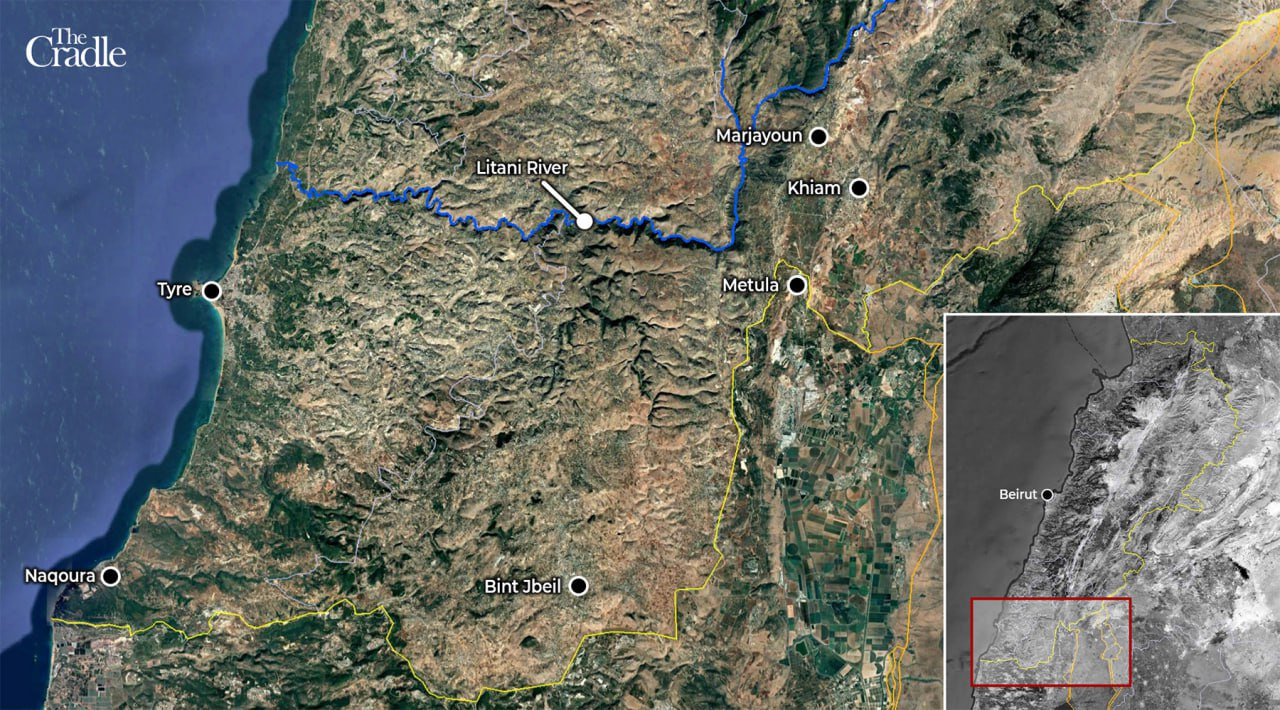
To understand why the occupation state keeps returning to Khiam, one should look at a topographic map. The town sits at 800 meters above sea level, roughly 5 kilometers from the Blue Line, with the Israeli settlement of Metula less than 1 kilometer away.
To the north, the road opens toward Marjayoun; to the east, the terrain descends toward the Bekaa Valley. Khiam has been described as a strategic gateway for a rapid ground incursion. Retired General Mounir Shehadeh confirmed that capturing Khiam opens two corridors: north to Marjayoun or east into the Bekaa.
Together with Bint Jbeil to the west and Shamaa on the coast, Khiam forms the eastern anchor of the line the occupation state needs for a continuous “buffer zone” from the border to the Mediterranean.
Yet the same geography also turns it into a trap. Narrow roads channel armored advances into predictable paths. Elevated terrain exposes attacking forces to anti‑tank fire. Dense urban structures provide concealment for defenders familiar with the landscape.
Over successive conflicts, resistance fighters have refined their ability to exploit these features, transforming Khiam into a recurring site of attritional warfare.
From torture complex to liberation symbol
In 1985, the SLA converted a French-built barracks on Khiam’s hilltop into a detention center. Over 15 years, some 5,000 prisoners passed through its cells. Amnesty International documented systematic torture, while declassified Shin Bet documents confirmed Israeli intelligence trained the SLA’s interrogators.
The Israeli Defense Ministry’s own affidavit admitted Shin Bet personnel held meetings “several times annually” with Khiam’s interrogators. The occupation state built Khiam’s torture infrastructure, staffed its methods, and profited from its intelligence product.
Throughout the 1990s, Hezbollah attacks inside the security zone escalated from 19 per year in 1990 to 344 by 1995. Between 1985 and 2000, 256 Israeli soldiers were killed in combat. In May 2000, as the SLA disintegrated, Hezbollah fighters – reinforced by 3,000 civilians – stormed the prison, freed 144 detainees, and the occupation’s proxy army collapsed entirely. The prison became a museum. Khiam became a symbol, further embedding itself in the collective memory of resistance.
Six years later, the occupation state bombed that symbol into rubble, widely interpreted as an attempt to erase the evidence of its crimes. On 25 July 2006, an Israeli bomb obliterated a UN observation post on the outskirts of Khiam, killing four unarmed military observers. Hezbollah fighters hit up to a dozen Israeli tanks outside the town; the 366th Division never completed its assigned missions.
In 2024, three brigades returned. Hezbollah attacked Israeli troops around the town more than 20 times in 48 hours.
The occupation army entered only after the ceasefire, occupied for six weeks, and withdrew. Now, in March 2026, it is back – and the resistance fighters waiting in the ruins are not the same ones it faced before.
The evolution of resistance warfare
The fighters now operating in Khiam include Hezbollah’s Radwan Force – a specialized formation shaped by years of combat experience in Syria. Originating as a rapid intervention unit under the command of Imad Mughniyeh, the force developed advanced urban warfare capabilities during battles in Al‑Qusayr, Al‑Qalamoun, and Aleppo.
Israeli researcher Dima Adamsky has concluded that this transformed the unit from advanced infantry into a commando force capable of strategic effects against a conventional military.
The unit’s structure reflects its doctrine. According to the Alma Research Center, Radwan squads of seven to 10 operatives deploy autonomously in specific geographic zones with pre-positioned supplies. Squad leaders act without central directives.
When an airstrike in September 2024 killed Ibrahim Aqil, the Radwan commander, along with 14 other officers, the unit absorbed the blow and continued fighting. On 5 March 2026, Reuters confirmed the Radwan Force had redeployed south of the Litani, with Khiam cited specifically as a deployment zone. Hezbollah Secretary-General Naim Qassem stated the resistance would confront a plan of “occupation and expansion.”
The Kornet and the Merkava: An asymmetric equation
The 9M133 Kornet is a Russian-made laser-guided anti-tank missile with a tandem HEAT warhead that penetrates over 1,000 millimeters of armor behind ERA, at an effective range of 5.5 kilometers. It is the weapon that has turned every Israeli armored advance into southern Lebanon into a graveyard for Merkava tanks.
In 2006, Kornets pierced the armor of 24 Merkava tanks and destroyed at least four outright. During “Operation Change of Direction 11,” a column of 24 tanks from the 401st Brigade drove into a prepared ambush at Wadi Saluki. Eleven tanks were hit. Eight tankers and four infantrymen were killed.
Israeli historian Uri Bar-Yosef called it “one of the most humiliating operations in the history of the Israel Defense Forces.” A former UNIFIL spokesman put it more plainly: anyone who sends a tank column through that terrain should not be a brigade commander but a cook.
Hezbollah’s doctrine goes beyond the Kornet itself. The Jamestown Foundation has documented a swarming method: fighters saturate a target with cheaper ATGMs to exhaust the Trophy active protection system, then the Kornet delivers the killing blow.
Fighters target the Merkava’s weakest points at close range; Haaretz reported that roughly one in four missiles pierced armor. The upgraded Kornet-EM extends the range to 8 kilometers and adds twin-launcher capability designed specifically to defeat Trophy through salvo fire.
Iran reverse-engineered the Kornet in 2015, breaking Hezbollah’s dependency on the Russian-Syrian pipeline, and has since added the Almas and Badr missiles to the arsenal. What the occupation army faces at Khiam is not a single weapons system, but a layered anti-armor doctrine operating on terrain purpose-built for ambush.
Rubble as a fortress
Destroyed urban terrain favors the defender. This paradox, documented by military analysts since 2006, is the core of Khiam’s lethality. The rubble the occupation army created has become the architecture of its defeat: channelized kill zones, unlimited concealment, and IEDs in every pile of concrete.
Clausewitz argued that irregular forces should remain “nebulous and elusive”; Mao compressed it to a single rhythm: the enemy advances, we retreat; the enemy tires, we attack. At Khiam, both principles converge on the same rubble.
Lebanese analysts suggest resistance units sometimes allow advancing forces to penetrate 2 to 3 kilometers into devastated neighborhoods before triggering coordinated attacks involving improvised explosive devices, missile teams, and drones. Rotational deployment ensures fresh fighters remain available while exhausted units regroup behind secondary defensive lines.
An Israeli minister admitted the resistance stripped the military of the element of surprise. Behind the front line, a second defensive line is already organized: when the Lebanese army withdrew from south of the Litani, Hezbollah fighters immediately pushed forward.
Arreguin-Toft demonstrated that when conventional force meets guerrilla tactics, the weaker party wins the majority of the time. The variable is adaptation. The occupation state has not adapted. The rubble it created has been reorganized into a fortress.
Comparable patterns – from US operations in Vietnam to Soviet campaigns in Afghanistan – highlight the limits of conventional superiority when facing adaptive guerrilla strategies embedded in local terrain.
The ‘buffer zone’ that buffers nothing
Despite repeated setbacks, Israeli leaders continue to frame incursions into Lebanon as necessary defensive measures. Yet prolonged evacuations of northern settlements and broad warning strikes against densely populated urban districts suggest persistent intelligence gaps and strategic uncertainty.
The “buffer zone” concept has reappeared under multiple names across decades – security zone, defensive perimeter, limited operation. Each iteration has produced similar outcomes: sustained casualties, strengthened resistance legitimacy, and an inability to secure the Litani frontier.
Doctrine persists even when battlefield realities contradict its assumptions.
One hill, many wars
Khiam has repeatedly shaped the trajectory of conflict between Israel and Lebanese resistance movements. Proxy forces collapsed there in 2000. Israeli units withdrew after heavy fighting in 2006. Recent operations have again underscored the difficulty of maintaining control over exposed high ground in the face of decentralized opposition.
Today, resistance fighters remain embedded in the ruins, supported by layered defensive networks and advanced anti‑armor capabilities. The terrain itself – reshaped by years of bombardment – has become an active participant in the conflict.
More than a century after early Zionist planners identified the Litani River as a strategic objective, it remains beyond Israeli control. Khiam continues to overlook a border that doctrine insists must move north, while history repeatedly demonstrates the limits of military force in achieving that ambition.
Jacob’s tents are long gone. The hill remains – a witness to wars fought, ambitions deferred, and lessons still unlearned.

No comments:
Post a Comment