
By Palestine Chronicle Editors
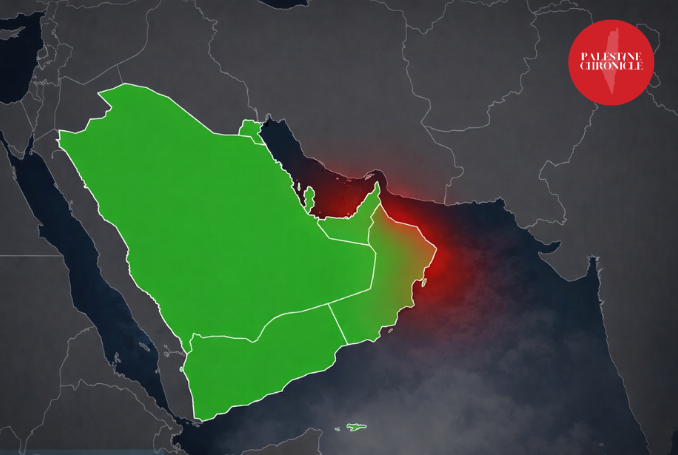 Arab Gulf states face mounting strategic pressure as the US-Israeli war on Iran threatens to expand across the region. (Design: Palestine Chronicle)
The US-Israeli aggression on Iran exposes Gulf states’ strategic dilemma between alliance commitments, regional stability, and economic survival.
Key Takeaways
- Gulf Arab states have long pursued a fragile balance between close US alliances and relatively stable relations with Iran.
- The US-Israeli war on Iran is collapsing that balance and dragging the Gulf into a confrontation it has tried to avoid.
- Israel appears keen to expand the war by drawing Arab states into direct confrontation with Iran.
- Direct involvement could devastate Gulf economies and destabilize the region’s main centers of economic growth.
- Arab governments face four difficult options, none of them without risks.
A Fragile Balance
For decades, Arab Gulf states attempted to maintain a delicate geopolitical balance between their security alliance with the United States and the need to coexist with Iran, their powerful regional neighbor.
Countries such as Saudi Arabia, Qatar, the United Arab Emirates, Bahrain, and Kuwait have historically depended on the United States as their primary security guarantor. US military bases across the region—particularly in Qatar, Bahrain, and the UAE—became central pillars of the Gulf’s defense architecture.
At the same time, these states understood that permanent hostility with Iran would carry serious risks. Iran sits across the Gulf from their territories, possesses significant military capabilities, and has deep regional influence.
For this reason, many Gulf governments tried to maintain relatively stable relations with Tehran, even when tensions escalated elsewhere in the region.
In recent years, some countries pursued cautious diplomatic engagement with Iran. Others moved in the opposite direction, deepening ties with Israel after the signing of the Abraham Accords.
The United Arab Emirates and Bahrain in particular developed strategic relations with Israel while remaining part of the US-led regional security framework.
Yet despite these shifts, Gulf states largely hoped to avoid becoming direct participants in a regional war involving Iran.
The current US-Israeli aggression on Iran is now testing that strategy.
War Reaches the Gulf
As the war has intensified, Iran has signaled that it views US military bases across the Gulf as legitimate targets, arguing that these installations are part of the military infrastructure supporting the attacks on Iranian territory.
Iranian strikes against US assets in the region have raised fears that Gulf states could become direct battlefields in the expanding conflict.
The legal implications of such strikes have already become part of the debate. In a recent analysis published by the Palestine Chronicle, legal experts examined whether Iran is violating international law by targeting US bases located in Gulf countries.
The analysis argued that if those bases are actively used in military operations against Iran, they may be considered legitimate military targets under international law.
This legal debate underscores the broader strategic dilemma now facing Arab governments.
Gulf states have urged Iran to refrain from targeting US installations on their territory. Yet at the same time, those same installations may be used by the United States to carry out strikes against Iran.
This position—asking Iran to avoid retaliation while allowing attacks on Iranian territory to continue—is increasingly difficult to sustain.
Israel’s Regional Calculus
Israel has strong incentives to widen the war.
From Israel’s strategic perspective, bringing Arab states into the confrontation with Iran would transform the conflict from a bilateral war into a broader regional alignment against Tehran.
Such a development would also reduce Israel’s military burden while legitimizing the war as a collective regional effort.
For this reason, Israeli policymakers have long advocated the creation of a regional security architecture involving Israel and several Arab states, particularly in the Gulf.
A wider war involving Arab states would also shift the geopolitical narrative away from the genocide in Gaza and toward a broader confrontation with Iran.
However, for Arab governments, direct involvement would carry severe consequences.
Economic Stakes
The Gulf has become one of the world’s most important centers of economic stability and growth.
Major global energy flows pass through the region. Financial hubs such as Dubai, Doha, and Riyadh have built reputations as centers of investment, tourism, and international trade.
A prolonged regional war would threaten this entire economic model.
Military escalation could disrupt shipping routes, energy exports, and financial markets. It would also undermine investor confidence and destabilize regional economies that depend heavily on stability and predictability.
Even limited attacks on infrastructure or shipping lanes could trigger serious economic consequences.
For this reason, Gulf governments have little incentive to become direct participants in a war that could devastate their own economic foundations.
Limited Options
Despite these risks, the options available to Arab states remain limited.
The first—and most constructive—option would be to launch a coordinated diplomatic campaign aimed at ending the war.
Arab governments could use their political and economic influence to press Washington to halt the escalation and pursue negotiations with Tehran. Such a strategy would require collective Arab engagement, possibly through regional institutions or coordinated diplomatic pressure. Yet diplomacy alone may not produce results unless it is accompanied by meaningful leverage over the parties involved.
A second option would involve seeking separate understandings with Iran aimed at insulating Gulf countries from the conflict.
Under such an arrangement, Gulf states could attempt to persuade the United States not to use their territories as launching platforms for attacks on Iran in exchange for Iranian guarantees not to target US bases located in those countries. However, this scenario assumes that Gulf governments possess sufficient influence over US military operations on their territory. It also assumes that Iran would accept such an arrangement during an active war.
A third option would be to tolerate Iran’s retaliatory strikes on US military installations while attempting to avoid direct confrontation.
This approach would effectively allow the conflict between Iran and the United States to unfold while Gulf governments seek to shield their own infrastructure and economies from its consequences. Yet such a strategy carries political and economic risks, particularly if Gulf territory becomes a battlefield or if instability begins to affect energy markets and regional trade.
The final—and most dangerous—option would be direct involvement in the war alongside the United States and Israel.
Such a move would likely prolong the conflict and could expose Gulf states to direct Iranian retaliation. More importantly, it could draw the region into a prolonged and devastating war whose economic and political consequences would be felt across the entire Gulf.
Strategic Reckoning
The war is exposing a deeper strategic problem for the Gulf.
For decades, many Arab governments relied heavily on the United States—and in some cases on emerging partnerships with Israel—as the cornerstone of their security strategy.
Yet the current war demonstrates the limits of that approach.
The United States appears primarily focused on defending Israel’s security interests, even if this risks destabilizing the Gulf itself.
At the same time, Gulf states now find themselves effectively co-belligerents in a conflict they did not initiate but cannot easily escape.
Once the war ends, Arab governments may face a difficult but necessary strategic reassessment.
Maintaining close relations with Washington may remain important. However, allowing their territory to serve as a platform for war against neighboring Iran is increasingly difficult to justify.
Ultimately, the stability of the Gulf is inseparable from the stability of Iran.
If the current conflict continues to escalate, the region’s long era of economic prosperity and relative stability could come to an abrupt end.
For many Gulf leaders, the war may ultimately serve as a wake-up call that their current strategy was a profound geopolitical miscalculation.
(The Palestine Chronicle)

No comments:
Post a Comment