
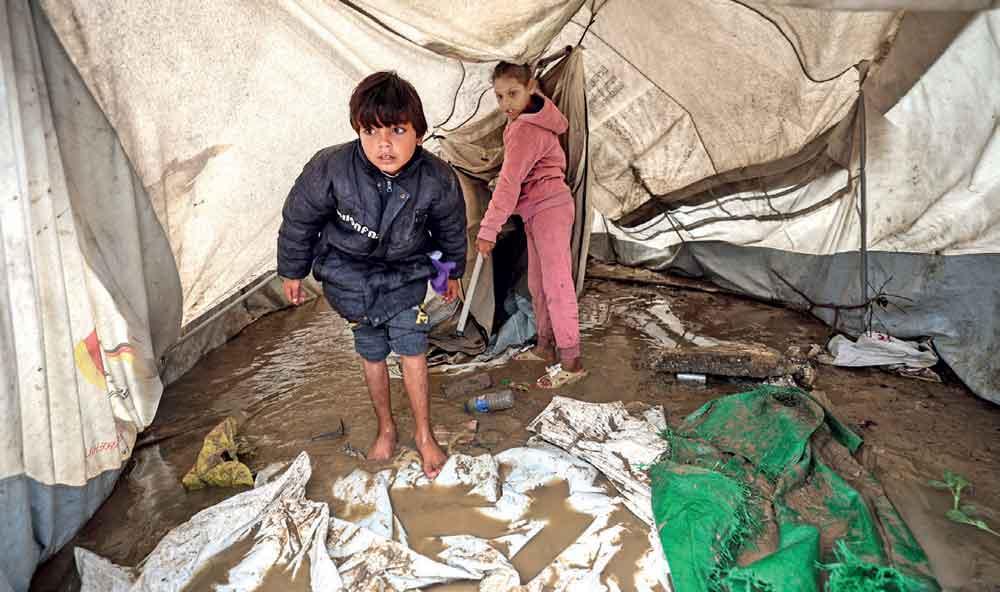
Displaced Palestinian children seen inside a tent flooded with rainwater in the central Gaza Strip as the besieged territory experiences cold winter conditions. AFP
But if past years are any indication, the New Year is more likely a continuation of 2025’s unfinished business. The world is far from the age when lamb and lion share the same abode. The idealists’ dream of a peaceful world order remains, for now, a pipe dream.
For the people in the Gaza Strip, January 1, 2026, was no different from December 31, 2025. The same sad story continues. They suffered in flooded tents, while barefoot children in drenched clothes were exposed to near‑freezing temperatures on December 31, 2025. January 1, 2026, did not bring them any hope. Instead, they heard that the genocide they are being subjected to by Israel—with the immoral backing of Washington, Berlin, and London in particular—would continue by other means amidst a charade euphemistically called a ceasefire.
For the battered people of Gaza, the New Year’s blow came from Israel’s Prime Minister Benjamin Netanyahu. The International Criminal Court’s war‑crime suspect, well protected by the United States and other Western allies, announced the cancellation of permits for humanitarian agencies to operate in Gaza. Can inhumanity be any nastier than the actions of Israel? Yet the Zionist state justifies genocide by invoking the Bible, little realising that its actions are nothing but blasphemy that deserves condemnation. Israel’s New Year move is likely to aggravate food insecurity in the besieged enclave and transform Gaza’s already fragile health sector into a graveyard for patients dying without medication.
The fragile ceasefire thrust on the parties by United States President Donald Trump—a vainglorious leader chasing a Nobel Peace Prize he hardly deserves—neither assures peace nor delivers justice. Rather, it is the perfect recipe for a second round of genocide, to be launched by Israel while finding an excuse to blame the Palestinian resistance group, Hamas. So, 2026 is likely to be yet another annus horribilis for Palestinians.
Elsewhere in the Middle East, too, the propensity for war and conflict looms larger than peace in the new year.
As 2025 drew to a close, a major tectonic geopolitical shift was witnessed in and around war‑ravaged Yemen. The first of the two earth‑shattering political events was Israel’s surprise recognition of Somaliland, a secessionist region within Somalia, close to the Houthi‑controlled parts of Yemen. During the two‑year Gaza war, the Houthis regularly launched missile and drone attacks on Israel and on ships connected to Israel as they passed through the Red Sea.
Analysts believe the quid pro quo in the recognition deal is permission for Israel to establish a military base in the strategically significant Horn of Africa.
Such a development will pose a security threat not only to the Houthis in Yemen but also to Saudi Arabia, which has launched an ambitious programme complete with socio‑economic reforms to make the country a powerful—if not the most powerful—state in the region. Saudi Arabia may be seen as inclined to sign the Abraham Accord with Israel under US pressure, but it is also not unaware that Zionism’s Greater Israel plan—endorsed and pursued by Netanyahu—includes a large part of Saudi territory.
Somalia strongly condemned Israel’s move. Somalia may even take military action against Somaliland, adding to the multiple wars the African continent is witnessing in Sudan, Ethiopia, Nigeria, Congo, Rwanda and the Sahel region.
The second big event was Saudi Arabia’s deadline for the United Arab Emirates to withdraw from Yemen after Riyadh on December 30 bombed two Emirati ships that allegedly brought military supplies to Yemen’s UAE‑backed Southern Transitional Council (STC) rebels, who have captured two governorates close to the Saudi border. Riyadh said the shipments posed an “imminent threat” to Saudi Arabia’s security.
Also causing concern to the Saudis is the Iran-backed Houthis’ claim that they rejected a UAE request—backed by a large monetary deal—to launch a missile attack on Saudi Arabia’s US$500 billion NEOM project that includes an AI‑led green linear city.
Although Saudi Arabia and the UAE are members of the Gulf Cooperation Council (GCC), and Saudi Crown Prince Muhammad bin Salman once considered UAE President Mohamed bin Zayed al-Nahyan his mentor, the two countries are now more divided by conflicting interests than united by a common purpose for the greater good of the GCC people. Saudi Arabia’s NEOM threatens to take the sheen off Dubai, which is on an ambitious march to emerge as the world’s biggest financial, entertainment, and educational hub.
After Saudi Arabia’s attacks on Emirati ships and a deadline issued by the Saudi‑backed Presidential Leadership Council in Yemen ordering UAE troops to withdraw within 24 hours, Abu Dhabi—seen as a close ally of Israel—complied. But the events unfolding in Yemen indicate more conflicts than compromise.
Meanwhile, a second war between Israel and Iran also cannot be ruled out in 2026.
Another area of concern is South America, where the US military build-up around Venezuela the country that holds the largest proven oil reserves in the world is threatening to trigger a land invasion reminiscent of the 2003 Iraq war, with Donald Trump, the pretender to the peace throne, publicly claiming that Venezuela s oil is US oil. The military threats the US has been directing at Nicolás Maduro’s socialist Venezuela are likely to continue or worsen in the newly dawned year.
The new year dawns on Ukraine not with fireworks but with Russian bombs lighting up the night skies. Trump is trying to thrust on Ukraine a warped peace deal and pressurise it to concede territory to Russia, much to the chagrin of the European powers, who are pumping billions of euros into the corrupt Ukrainian regime even at the cost of economically wounding themselves. If the war ends in 2026, it is going to end on Russia’s terms. There won’t be peace; instead, there will be rising tension between Russia and European powers amid a further economic decline in Europe.
Asia, however, continues to be the continent of growth despite Trump’s tariff wars with China and other nations. In the new year, too, China’s economic and military power will increase, giving Beijing more leverage to play an enhanced role in world affairs.
Continuing the trend of 2025, 2026 is set to see further environmental damage, which threatens the United Nations’ goal of limiting global warming to 1.5 degrees Celsius. Nature’s fury in the form of extreme weather disasters is likely to be as calamitous in the new year as it was in 2025. We hope it won’t be so.
But with the big powers and industrialised nations continuing the rape of the environment, ditching multilateralism, pursuing geopolitical and neocolonial games, and preferring war over peace out of greed for resources that do not belong to them, can the peace-loving people and global justice activists be optimistic in 2026? The world order in 2026 points to more war than peace.

No comments:
Post a Comment