
By Robert Inlakesh
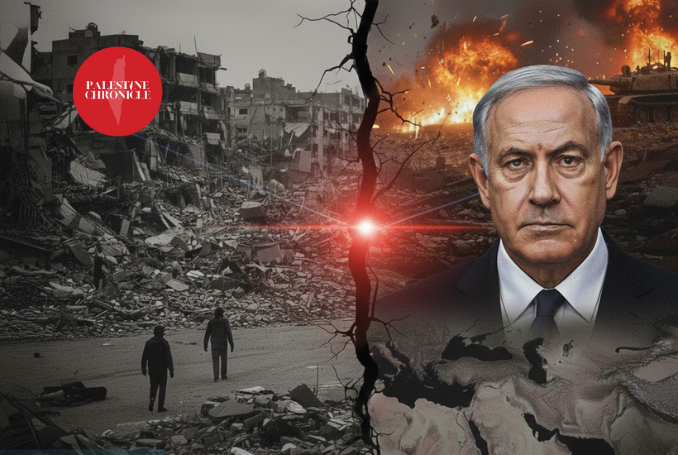 Israeli Prime Minister Benjamin Netanyahu repeatedly promised “total victory” in his seven-front war. (Design: Palestine Chronicle)
The only ones who acted were the Axis of Resistance. Lebanese Hezbollah and Yemen’s Ansarallah waged support fronts in solidarity with Gaza.
From the Gaza genocide to the assassination of Hezbollah’s senior leadership, Israel has carried out unprecedented destruction across the region. Yet, despite everything that has happened since October 7, 2023, has Israeli Prime Minister Benjamin Netanyahu truly delivered the “total victory” he promised over his regime’s adversaries?
The current state of play across West Asia has left many in despair. Undoubtedly, the genocide in the Gaza Strip has inflicted a generational psychological wound, not only on the people of the region, but concerned citizens throughout the world.
When the genocide began in October of 2023, many assumptions were made regarding who or what was going to come to the aid of the Palestinian people.
Some trusted in international institutions, others believed that the Arab masses would mobilize or assumed that the rulers of Muslim Majority countries would utilize their trade leverage, resources, and even militaries to rescue the people of Gaza. Then there were those who depended upon the Iranian-led Axis of Resistance.
On the question of the international institutions, the Israelis were brought before the UN’s top judicial organ, the International Court of Justice (ICJ), which found Tel Aviv plausibly guilty of committing genocide. However, when it issued its provisional measures, the court was simply ignored.
The United Nations Security Council (UNSC) even passed resolution 2728 on March 25, 2024, which called for a ceasefire until the end of the Muslim Holy Month of Ramadan, which was supposed to be binding and was again ignored by Israel.
Then came along the International Criminal Court (ICC)’s arrest warrants for Israeli Prime Minister Benjamin Netanyahu and former Defense Minister Yoav Gallant. Tel Aviv and Washington decided to go after the court and its prosecutor, undermining its authority.
The Arab Nations, with the exception of Yemen’s Ansarallah government in Sana’a, refused to lift a finger, as did the rulers of most Muslim Majority nations. The populations of Jordan and Egypt that were expected to act, didn’t even live up to the popular actions taken by European populations. The people in the major cities of the West Bank and in occupied Jerusalem didn’t even stage notable protests.
The only ones who acted were the Axis of Resistance. Lebanese Hezbollah and Yemen’s Ansarallah waged support fronts in solidarity with Gaza, while some Iraqi factions occasionally sent suicide drones and rocket fire from Syria would occur periodically.
Yet the way that the Axis of Resistance dealt with the genocide appeared to be the execution of a strategy to ultimately de-escalate hostilities and bring the assault on Gaza’s people to an end. The Israelis, however, were not interested in a cessation of hostilities and were instead hell bent on destroying the entire Iranian-led Axis once and for all.
Israel broke every tenet of international law and violated all diplomatic norms. They would go on to carry out countless assassinations eventually stretching across Lebanon, Syria, Iraq, Iran, Yemen, with a failed attempt on the lives of Hamas leaders in Doha, Qatar. The consular segment of Iran’s embassy in Syria was even bombed.
Israel carried out the pager terrorist attacks across Lebanon, which wounded thousands and killed dozens, including countless women and children. This not only shook Lebanese society to the core, but also proved a major security and communications blow to Hezbollah itself. The infiltration of Hezbollah allowed Israel to murder the majority of the organization’s senior leadership. Perhaps the biggest psychological blow was the assassination of Hezbollah’s Secretary General, Seyyed Hassan Nasrallah.
Shortly after thousands had been murdered by Israel’s onslaught on Lebanon between September and late November, the next major blow to the Axis of Resistance came in the form of regime change in Syria. Suddenly, a US-backed government had been ushered into power and instantly opened up lines of communication with Israel.
What occurred in Syria was significant for a number of reasons, the most important of which was the collapse of the Syrian military and occupation of vast portions of territory in southern Syria, including the strategic high-ground of Jabal Al-Sheikh (Mount Hermon). It also meant that weapons transfers to Lebanon, to supply Hezbollah and the Palestinian armed factions, were instantly made much more difficult.
The resistance in the West Bank that had been growing in the north of the occupied territory since 2021 was significantly cut down through aggressive Israeli and Palestinian Authority military campaigns. In the Gaza Strip, the resistance forces were also degraded and had no supply lines. Meanwhile, the only consistent front that never buckled and only accelerated their attacks was the Yemeni Armed Forces, but due to their geographical constraints were limited in what impact they could have.
For all of the above-noted reasons, the Israelis have appeared to have gained the upper hand, and this has left many fearing what they have in store next. It is assumed that further attacks on Lebanon and Iran will be aimed at achieving regime change in Tehran, which, if successful, would indeed declare Israel the undisputed ruler of the region.
A Reality Check
Despite the gains that the Israelis have made, they have also suffered enormous blows themselves, which are often left out of many analyses offered on the current situation the region finds itself in. Before delving into this, to avoid accusations of “cope”, it is important to make note of a few different points.
Many refutations offered to the pessimistic view commonly adopted of the region engage in exaggeration, speculation, and refuse to even acknowledge the obvious losses their side has suffered. This is often the practice of those who remain die-hard supporters of resistance against the Israelis and their regional project.
When such positive and romanticized depictions are used to describe the current situation and are heard by those who are convinced that their side has already lost, they often experience a visceral opposition to that sense of optimism. Supporters of the resistance to Israel’s tyranny attempt to rescue morale through slogans and dogmatic rhetoric, which falls on deaf ears, as such explanations lack logical consistency.
This all being said, things are not exactly as doom-and-gloom as the popularized pessimism that prevails across the region suggests.
At this current moment, Israel has not won on any front; the caveat is obviously that the Axis of Resistance has not won either. Every front is a de facto stalemate. This being said, the Israelis have undoubtedly inflicted much greater damage on their adversaries in the short run.
Yes, the Palestinian factions in Gaza have been weakened, and the human cost of the war has been enormous, beyond anyone’s imagination, but they have not been defeated. Instead, they have waged a guerrilla war against the occupying army that has targeted the civilian population as a means of attempting to defeat them by proxy. Are they capable of defeating the Israeli military? No, not by themselves, but this has always been the case.
In Lebanon, the Israelis certainly dealt a massive blow to Hezbollah; there can be no doubt about it. Although they were incapable of collapsing the group and it is clear that they still retained an abundance of arms, something demonstrated throughout the course of the war in late 2024. Today, Hezbollah is rapidly rebuilding its capabilities and preparing for the inevitability of the next round.
From UAE to Kazakhstan: Trump’s Normalization Strategy Shows Signs of Exhaustion
One key takeaway from the Israel-Lebanon war was that, beyond assassinations and intelligence operations, the Israelis proved incapable on the ground and were even deterred from conquering villages like Khiam along with the Lebanese border area. Their greatest tactical achievements came at the beginning of the war, while the remainder of the battle proved that Israel’s only edge came through its air force.
The reason why the Lebanon war was a loss for Hezbollah was down to the collapse of Hezbollah’s image. Previously, the propaganda of the organization and the trust commanded by its leader, Seyyed Hassan Nasrallah, had convinced the world that the group was powerful enough to destroy Israel by itself. In his last speech, before he was murdered alongside 300 civilians, Nasrallah had publicly admitted that there is, in fact, no parity between Hezbollah and Israel militarily.
In 2006, just as occurred in 2024, the result of the war was a stalemate. No side decisively beat the other. Instead, it was the combined fact that Hezbollah’s performance was militarily stunning, from a planning and execution point of view, in addition to the fact that nobody expected the group to even survive, let alone force the Israelis to abandon their war plans. If you look at the difference in Lebanese to Israeli casualties in 2006, there is no comparison; in fact, it was even a major achievement for Hezbollah to have hit Haifa with rockets back then.
The 2006 war proved that Hezbollah was a force to be reckoned with, that it would inflict serious blows on Israel if it sought to re-invade and re-occupy southern Lebanon, so Tel Aviv made the calculation that it was best to leave it alone. This is why there were 17 years of deterrence, where Israel would not dare bomb Lebanon.
Fast forward to 2023, Hezbollah was a group capable of striking any target across occupied Palestine, and in 2024 hit Tel Aviv for the very first time. Compared to a force of an estimated 14,000 men in 2006, Hezbollah’s current armed forces consist of over 100,000 men, making them a larger armed group than many of the militaries of various countries.
The difference is that Hezbollah is fighting Israel, which is equipped with an endless supply of the world’s most technologically advanced weapons and equipment that enables it to pinpoint target leaders.
It suffices to say, the two sides are not equal, but by no means is Hezbollah finished or weak; it is simply that the group must suffer immense sacrifices in order to prove victorious in any confrontation with Israel. This is because the equation has changed since October 7, 2023; it is no longer the case that the Israelis can be deterred. It is a long war that will lead to the total defeat of one side or the other. What happens from here is largely down to leadership and the willingness to commit to total war.
Syria is itself a totally different issue. First, we must keep in mind that the government of Bashar al-Assad was not actively engaged in the war against Israel; instead, it allowed for the Axis of Resistance to operate inside its territory and establish a defensive front in southern Syria.
Nick Fuentes and the Israel Question: Inside the MAGA ‘Civil War’
Again, being realistic, the new government in Syria has weakened the entire State and divided it even more than was already the case. Ahmed al-Shara’a is joint at the hip with his US allies and pursues policies that explicitly favor his backers in Western governments. All of the denialism in the world does not change this fact, nor does it change Damascus’s establishing direct communications and even coordination with the Israelis.
To avoid going through what is already well known and beating a dead bush, there are a number of key considerations to make when looking at the situation in Syria, which could lead in various different directions.
I will preface everything below by saying that it is plausible that for the foreseeable future, the Israelis are going to succeed at every turn in Syria, as they have done since the pro-US government took power.
Unfortunately, the Syrian conflict is the top cause of sectarian division in the region. These divisions work on two pillars: tribalism and propaganda. Round-the-clock propaganda is churned out to cause fitnah and you will still hear baseless claims, including totally fabricated statistics, spread to achieve this division. Some would blame these conflicts on religion, yet it is more about blood feuds, corruption, and tribalistic tendencies.
Putting this aside, the Syrian front is now open and various possibilities exist. There is a competition between Turkiye and Israel inside the country, meaning that a proxy conflict is not off the table. It is also very possible that Ahmed al-Shara’a, who has managed to create problems with even his once staunch allies, will be assassinated or ousted from power, creating a bloody power struggle that could pour into the streets of Damascus.
For now, the weapons flow into Lebanon to supply Hezbollah is ongoing and there are also indications that during the final days of the former regime, many advanced weapons fell into various hands. The US is now working alongside the government in Damascus to ensure that these weapons transfers are stopped or at least rendered much more difficult. In addition to this, in the event of a war between Hezbollah and Israel, it is safe to assume that weapons transfers will be put to a halt.
As Israel advances further into southern Syrian territory, more villages will likely choose to resist them, as occurred in Beit Jinn recently; this will happen independent of the government in Damascus. As Ahmed al-Shara’a does not enjoy full control over his country, this also provides opportunities for armed groups to pop up and begin resisting the occupying force, something that the Syrian President will not be able to control, especially if Israel makes mistakes and gets itself embroiled in a crisis.
A Mandate for Force: What the UNSC’s Gaza Resolution Means in Practice
This story is not over and Syria is a hostile environment for Israeli forces due to the rejection of the people there. Ultimately, just as occurred in southern Lebanon, when the government abandons its duties, the people end up taking matters into their own hands to resist occupation. Does this mean we can expect a robust fighting force there soon? Probably not for now, but various possibilities exist in the foreseeable future.
Then we look to Iran and Yemen, whose capabilities remain and only grow; neither has been defeated. Iraq’s Hashd al-Shaabi have not been mobilized until now, and it is unclear what role they could play in a broader regional war, but it is of note that they exist.
What has happened is that Israel has proven time and time again that it is willing to be daring with the one tactic that they can actually excel in, assassinations and intelligence operations. However, these operations do not win wars; they are undoubtedly blows, but they do not inflict a knockout punch.
When two sides engage in such a war, it is expected that losses will occur on both sides. The Israelis have suffered a battered economy, a divided society, their settlements in the north are still in ruins, they haven’t repaired the damage inflicted on their infrastructure, and they have lost public support across the world, including in the United States. They are a global pariah sustained only by their Western backers, incapable of defeating what was viewed as the weakest link of the Axis of Resistance in Gaza.
In their favor, they have eliminated most of Iran’s influence in Syria, committed one of the worst crimes in modern history against Gaza and weakened the armed resistance there as a result of it. They also took out Hezbollah’s senior leadership, while degrading it and its political standing. In addition to this, many leaders and generals in the Islamic Revolution Guard Corps (IRGC)’s chain of command were killed.
As Israel Hunts Leaders, Hezbollah Waits: What Will Another Israeli War on Lebanon Look Like?
In Iran’s case, the so-called 12 Day War, back in June, had resulted in failure for the Israelis. Instead of achieving regime change and/or the destruction of Iran’s nuclear program, it is clear now that it has only succeeded in driving out international monitors and even united the population in a way previously unimaginable. Tehran has leaned into the growing trend of Iranian nationalism among its people and is preparing for another round. That battle also ended with Iran landing the last real blows.
The Israeli military must be viewed for what it is; it has the military edge in the air, possesses the most advanced weapons in the world, enjoys full US support and is backed by one of the best intelligence agencies in the world. It also has something else on its side, which is that it does not care for morality or international law at all; it will break any rule to achieve an objective.
At the same time, its ground force is largely incapable, and it is also massively fatigued. The Israeli army was only really prepared to fight very brief battles and is an occupation force, which is why it now struggles to mobilize the soldiers necessary to carry out various offensive actions. It also needs to pay some of its soldiers’ danger money salaries. It has also recruited the private sector and civilians, paid as much as 800 dollars per day, to carry out their demolition missions in Gaza.
Beit Jinn Massacre: Syrians Begin Resisting Israeli Occupation Alone – Analysis
There is a reason why, on October 7, 2023, a few thousand Palestinian fighters armed with light weapons managed to collapse the Israeli southern command in a matter of hours and temporarily took control of the Israeli settlements surrounding Gaza. In other words, they are far from invincible.
Is this all to say that “Israel has lost”? No, clearly no side has won yet. There are various conspiracies in the works. In the Gaza Strip, the US is working alongside its allies to find a way to defeat the armed resistance groups. The Israelis clearly have their sights set on new wars against Lebanon and Iran; they will also likely strike Yemen hard again. However, they now find themselves in a much more vulnerable situation and could easily overextend themselves on one front, leading to significant losses.
So, can we say that Benjamin Netanyahu is closer to his “total victory”? The answer to this question is no. Is it possible that the “Greater Israel Project” will be implemented and that Iran will be toppled? This always has to be considered as a threat, because this is clearly Israel’s goal, but it is also just as likely that Tel Aviv will suffer a strategic defeat. It is especially the case because they are fighting an opposition that is more likely to commit to an all-out war, given what they have suffered up until this point.
(The Palestine Chronicle)

– Robert Inlakesh is a journalist, writer, and documentary filmmaker. He focuses on the Middle East, specializing in Palestine. He contributed this article to The Palestine Chronicle.

No comments:
Post a Comment