
By Iqbal Jassat
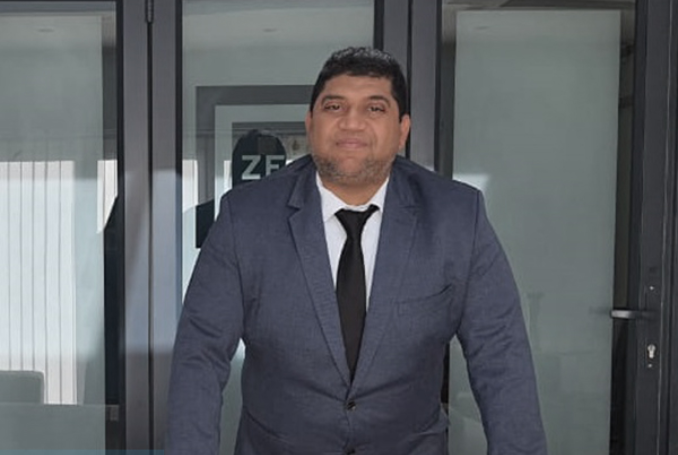 Attorney Ziyaad Patel correctly contends that military service in Israel is unlawful under South African law. (Photo: via Ziyaad Patel website)
By not charging South African mercenaries in the courts, along with their funders and recruiters, the criminal justice system will continue facing accusations of hypocrisy and double standards.
At the core of what promises to be a paradigm-changing legal case filed at Pretoria’s High Court is a body of evidence on illegal mercenary activities among occupation forces in Palestine, demanding accountability from the South African government.
A press release issued by the applicant’s attorney, Ziyaad Patel, confirmed that voluminous bundles of over 12,200 pages of law and evidence have been served on the presidency, respective government ministries, South African investigative and prosecutorial authorities, the National Director of Public Prosecutions (NDPP), the South African Police Services, and others. The core demand revolves around the nagging question: where are the prosecutions of South Africans fighting as members of the Israeli occupation forces?
Irrefutable evidence, much of which exists in the public domain via boastful posts by South African citizens engaged in illegal military services in the Israeli army, has been apparently ignored to date by South African authorities. But a D-day for accountability is approaching.
Investigations conducted so far have confirmed that not a single South African citizen has been authorized nor granted permission to bear arms against Palestinians in Gaza and the rest of occupied Palestine.
An executive summary of the case references several elements of the litigation. Pertinent to it is comprehensive evidence of unlawful recruitment, financing and participation in the settler colonial regime’s army of killers, in direct violation of South Africa’s security laws.
Apart from the fact that South African nationals are thus far unhindered in providing foreign military service in the occupation – and seemingly “condoned” by relevant state institutions due to their failure to criminalize and stamp it out – the impunity whereby apartheid Israel’s local Zionist lobbyists facilitate it is outrageous.
The context for this overdue and groundbreaking case stems from a series of criminal complaints filed against South African citizens, who are alleged to have joined and militarily served in the Israeli army.
Applicants Safoodien Bester and Attorney Ziyaad Patel correctly contend that such military service is unlawful under South African law and undermines both domestic security and South Africa’s credibility as a champion of international justice. As expected, the Regulation of Foreign Military Assistance Act (RFMAA), which strictly prohibits South African nationals and citizens from providing military assistance to foreign states without applying for explicit authorization, has been cited as a central plank in the case.
Both the record of evidence submitted through engagement with the specialized organs of the National Prosecuting Authority Service over the years and the National Conventional Arms Control Committee (NCACC) have confirmed that no such authorizations have been granted to South Africans serving in the Zionist occupation between the period of Israel’s 2006 war in Lebanon to its present wars and military operations in Gaza and beyond since 2023.
In addition, it is important to note that the latest findings against Israel under the Convention Against Torture treaty record severe violations of Palestinian political prisoners. Criminal conduct by the Zionist regime includes various forms of torture, including repeated severe beatings, dog attacks, electrocution, waterboarding, prolonged stress positions, rape and sexual violence, humiliation such as being forced to act like animals or being urinated on, denial of medical care, excessive restraints causing amputations, surgery without anesthetic, and exposure to extreme temperatures.
In the specific case of torture, it is important to establish how many of the South Africans among the occupation forces are directly complicit in these horrific acts. Military duty imposes many obligations on the recruits. Engaging in intelligence gathering operations is thus not excluded. But despite the strict regulations of the Convention Against Torture, assessments of Israeli state conduct have established widespread abuse. So, while active mercenary deployment in the Israeli army is prohibited in South Africa and punishable as a serious criminal offense, being complicit in the torture of Palestinians compounds the crime.
Nevertheless, the present High Court application raises serious questions about the apparent disconnect in the enforcement of South African law, the country’s constitutional obligations, and its international responsibilities. The Applicants contend that:
“Government silence and this disconnect by its national law enforcement authorities and organs of state is not merely an oversight but rather evinces an endemic and systemic problem, whereby these authorities and organs of state remain captured by pro Zionist influences.”
In direct contrast to South African mercenary activities in Palestine and the absence of any high-level intervention on it, President Cyril Ramaphosa has ordered an investigation into the circumstances that led to the recruitment into seemingly mercenary activities in the case of Russia and Ukraine. In sharp contrast to his silence on Israeli recruitment of South African mercenaries, Ramaphosa has ordered an investigation into the circumstances that led to the recruitment of 17 young men into suspected mercenary activities in the war-torn region of Donbas.
Such a disconnect does suggest that if South Africans are deployed as mercenaries in Ukraine, the highest office of state will intervene, but not in the case of Israel’s genocide in Gaza. This critique does not in any way take away the strides made on the question of Gaza by the Ramaphosa administration at the International Court of Justice and the International Criminal Court. However, by failing to discharge SA’s domestic legal obligations, it unwittingly provides Israel and its local agents with unprecedented impunity to breach the provisions of the RFMAA.
In October 2024, South Africa’s Department of International Relations and Cooperation concluded:
“Israel’s continued shredding of international law has imperilled the institutions of global governance that were established to hold all states accountable.”
By not charging South African mercenaries in the courts, along with their funders and recruiters, the criminal justice system will continue facing accusations of hypocrisy and double standards.
– Iqbal Jassat is an Executive Member of the South Africa-based Media Review Network. He contributed this article to The Palestine Chronicle. Visit: www.mediareviewnet.com

No comments:
Post a Comment