
By Robert Inlakesh
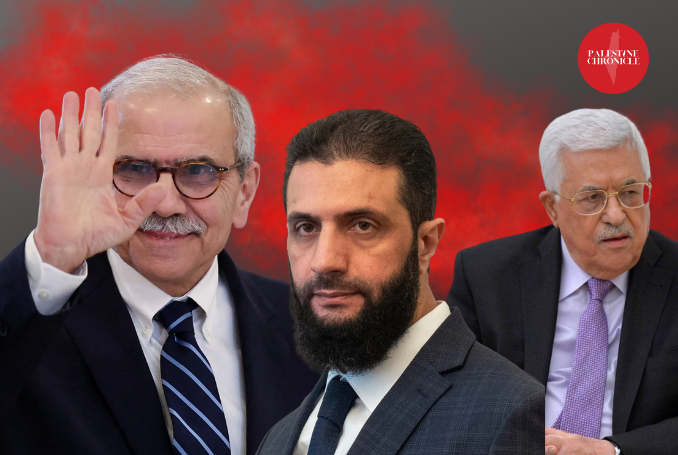 Lebanese Prime Minister Nawaz Salam, Syrian President Ahmed al-Sharaa, and Palestinian Authority President Mahmoud Abbas. (Design: Palestine Chronicle)
When you are being invaded by a force intent on domination, capitulation results in occupation, not prosperity—which is why the people resist.
Among Western populations, who have of late become far more well-versed in the plight of the Palestinians, there is often a blind spot on regional issues that very much concern this cause. As Israeli Prime Minister Benjamin Netanyahu puts it, Israel is fighting a “seven-front war,” and the genocide in Gaza is but one of them.
While it may be clear that the leaderships of the Arab and Muslim-majority nations have almost all failed the people of the Gaza Strip, there are various walls of propaganda that can often prove confusing to those who are seeking to understand that failure.
For the sake of this article, in the hope of better informing the public about the crisis of leadership in the Arab world, we will look at three of those leaderships that can be differentiated from the others because of the unique power imbalances that challenge them. These are the Palestinian Authority (PA), the Syrian government, and the Lebanese government.
Given that this piece centers around the cause of Palestine, which is, for all intents and purposes, the central cause of the entire region, it is only right that we begin with the Palestinian Authority (PA), which is based in the occupied West Bank city of Ramallah. As of late, there has been intense debate online surrounding the validity of the PA, triggering confusion on the issue among some who are new to Palestinian domestic politics. An example of such debates was a recent clash on X (formerly Twitter) between seasoned journalist Jeremy Scahill of Drop Site News and PA Ambassador to Côte d’Ivoire, Abdal Karim Ewaida, over an article Scahill wrote entitled “Trump, Gaza, and Oslo Déjà Vu.”
The Failure of the Palestinian Authority
As a start, the Palestinian Authority was the creation of what are known as the Oslo Accords (1993–1995). The Declaration of Principles, which really sealed the Oslo process deal, was signed by the then-leader of what is known as the Palestine Liberation Organization (PLO), Yasser Arafat.
Signing Oslo meant that the PLO, which had once been an umbrella organization under the fold of which were all the major Palestinian parties, officially recognized Israel as a state, while Israel only recognized the existence of the PLO and not the State of Palestine, leading to the fracturing of the Palestinian movement.
Nevertheless, this birthed what is often known as the “peace process,” which is what brought the ruling Fatah Party into a position of power over what was to be called the Palestinian Authority.
The PA was supposed to be the precursor organization to the future government of a State of Palestine, as a system was set up in both the West Bank and Gaza whereby this Palestinian Authority would assume partial control of the occupied Palestinian territories (oPt).
Under this new Oslo-invented system, the PA was supposed to maintain full civil and security control in Area A, civil administrative control in Area B, while Israel maintained its occupation of Area C. Under the agreements signed, the Israelis were supposed to initiate a withdrawal process and begin abandoning their occupation after five years, but instead accelerated illegal settlement expansion and entrenched their occupation even further.
From the get-go, all the signs were there that this Oslo scheme was set up to benefit Israel and not the Palestinians. The PLO had been based first in Jordan and then, after its violent expulsion, relocated to Beirut, Lebanon.
To cut a long story short, everything changed when Israel invaded Lebanon in 1982 after the PLO had already been in the process of entertaining a Two-State solution. The PLO’s 10-point plan and the Saudi-led Fez Initiative were indicators that the diplomatic course for achieving a negotiated settlement was in the organization’s plans.
Israel’s main issue with this was that the PLO enjoyed not only popular support across the region and had cemented itself as a formidable political actor, but also maintained significant leverage as an armed actor too. So, the Israelis devised a plan to provoke the PLO through raids on Lebanon to attack it, as a means of collapsing a ceasefire that was in place at the time, fearing what they called the PLO’s “peace offensive.”
The Israelis invaded Lebanese territory, killed up to 20,000 people, and besieged the PLO in Beirut, which led to its leadership agreeing to give up its weapons, abandon its tunnels, and relocate to Tunisia. Following this, the Palestinian refugee population of Lebanon was left defenseless, and the Israelis used their fascist militia allies to commit horrific massacres against them. Tel Aviv would also make the decision to occupy southern Lebanon.
Due to the surrender agreement, the PLO’s power faded in exile and it was no longer able to confront the Israelis militarily as it had done before. Fast forward to 1987 and the First Intifada was launched. The overwhelmingly non-violent uprising across the West Bank and Gaza, which began in Jabalia Refugee Camp, drained Israeli military resources, exhausted its soldiers, struck Israel’s economy, and damaged its international reputation. The PLO did not start off as the leader of the Intifada and it would begin struggling to take command of it.
In August of 1990, amidst the Intifada, Iraqi President Saddam Hussein decided to invade Kuwait. The PLO’s leadership was allied with Saddam Hussein and appeared to side with him in this endeavor, which led to Kuwait, one of the main donors to the Palestine Liberation Organization, withdrawing all its support for it.
It was in this weakened state that the PLO was dragged by Washington to sign onto the Oslo Accords. As a result of this agreement, the Israelis had managed to get the PLO to recognize Israel formally and end the costly Intifada.
Yet, the gains for Tel Aviv were even more tremendous. Through the creation of the PA and its security forces, Israel managed to secure a system whereby its occupation would become cost-free. The EU and US would foot the bill of funding the PA and its security forces, while Israel would still remain inside the majority of the occupied territories, but the major cities’ population would be controlled by PA security forces. Israel could rescue its international image while accelerating settlement expansion.
The Second Intifada then provided another opportunity to the Israelis, as they brutally slaughtered Palestinians and dismantled the resistance groups in the West Bank. PA President Yasser Arafat came under tremendous pressure from the United States to change the nature of the PA entirely. The US pressured Arafat to create a new position within the PA called Prime Minister, which Washington urged to be filled by Mahmoud Abbas, while also reinventing the Palestinian Security Forces entirely to ensure they worked as security contractors for the Israeli occupation army.
In 2004, Yasser Arafat died under siege, likely poisoned by the Israelis. The following year, Mahmoud Abbas was elected PA President for what was supposed to be a four-year term, yet there has never been another election since.
In 2006, as the Palestinian people witnessed the hopeless levels of corruption taking place within the PA, the national legislative elections took place. Prior to this, Hamas—whose armed wing had managed to survive Israeli military onslaughts against it in Gaza during the Second Intifada—was not engaged in any PA elections and had previously opposed it. However, the US Bush administration sought to pressure them to run in the elections.
Hamas ran its first-ever list in this democratic election process under the banner of “Reform and Change.” To everyone’s surprise, they won in a landslide, largely due to people voting for them in protest of the corruption witnessed by the Abbas-run administration. The US then would begin working on a conspiracy to fund and arm a coup against the democratically elected Hamas government, using former PA Preventative Security Forces leader Mohammed Dahlan.
This led to what is often called the Palestinian Civil War, after Hamas’s armed wing, the Qassam Brigades, crushed the coup plot, leading to the division of Gaza and the West Bank. The Gaza Strip, under the leadership of Hamas, would continue to resist Israel by force, under a brutal siege. Meanwhile, the PA would slowly become a mini-dictatorship under occupation, ruling segments of the West Bank.
No elections were ever allowed again by the PA. Mahmoud Abbas seized total control, the corruption issue continued to get worse and worse, all as the Palestinian Authority Security Forces worked as proxies for the Israeli military, suppressing all dissent. The PA is now opposed by the overwhelming majority of Palestinians. According to polling data, the percentage of those supporting the PA is roughly the same as the percentage of the population employed by it.
Throughout the genocide, the Palestinian Authority has repeatedly blamed Hamas and even used profanities at the resistance fighters in the Gaza Strip. What is even worse is that the PA, which grew out of the PLO, now controls the Palestine Liberation Organization and it is the Palestinian Authority that represents the State of Palestine at the United Nations. It only survives today due to Israel releasing its tax funds and foreign funding, primarily from the EU.
The PA has no political standing internationally and every time countries such as Algeria, Russia, China, and others try to bring its leadership to the table to establish unity with the rest of the Palestinian factions, it kills the unification process before it even starts.
The Palestinian Authority opposes armed resistance, yet uses its security forces to crack down on its own people and now even supports Donald Trump’s so-called “peace plan.” It hovers around to pick up scraps from foreign nations that don’t respect it and understand full well that it is a helplessly corrupt organization, with one of its latest initiatives being a campaign to grovel at the knees of Saudi Arabia.
The story of the PA is the story of a corrupt administration that has transformed the once respected and influential PLO into a laughingstock and beggar that stands in the way of its own people’s liberation. It could have used the last two years as an opportunity to revive the spirit of the old Arafat-led PLO’s former glory, unified its people, set forward serious plans and proposals for ending the conflict, but instead continued to perform the role that was always intended for it: to be a puppet regime.
This is the sad truth of the PA. It is the single biggest obstacle to the liberation of Palestine after Israel itself. While countless genuine and talented individuals have attempted to work through it, all have failed to change what is a fundamentally poisonous force. Its discourse about non-violently combating Israel is also hollow, as it refused even to back the Great March of Return in 2018, one of the largest non-violent protest movements in Palestinian history.
Sometimes the PA manages to deceive those who are genuinely concerned for the Palestinian people and support their cause, as it does possess some voices who can eloquently combat Israeli propaganda. It is also true that the Israelis bully the PA, crack down on their people, batter them into line, and that it still operates as an administration under occupation, yet none of these attacks on it can justify its own actions against the interests of the Palestinian people.
Lebanon and Syria’s Powerlessness
While the current governments of both Lebanon and Syria are newer than the PA, they also suffer from many of the same issues. Both are completely powerless. Both refuse to resist and oppose armed resistance, as their territory is occupied and their people are killed.
If we look at the government of Lebanese Prime Minister Nawaf Salam, he presides over an administration that has not secured reconstruction of the country and is being bullied by the United States at every turn. The only true interest that Washington has is to ensure that Hezbollah, the only force inside the country that is capable of resisting the Israelis, disarms and disbands.
Just as PA President Mahmoud Abbas endorses disarmament of the Palestinian resistance, Prime Minister Nawaf Salam seeks the same of Hezbollah. Neither has received guarantees of an Israeli withdrawal from their territory, nor that Israeli aggression against civilian targets will end, yet both are willing to hand over concession after concession with nothing in return.
A similar path is being pursued by Syrian President Ahmed al-Shara’a, who also makes concession after concession to no avail whatsoever. Despite Israel having wiped out its military arsenal, occupied over 400 square kilometers of land, killed hundreds of its citizens, bombed its Ministry of Defense, and ethnically cleansed villages, Damascus still negotiates with Tel Aviv directly. It also repeatedly uses the language of refusing to threaten its neighbors and claims that it doesn’t want war, but instead seeks “peace.”
As the Israelis also attempt to enter talks for economic cooperation with Lebanon, they are engaged in on-and-off rounds of negotiations to achieve a security agreement with Syria. The issue that both Nawaf Salam and Ahmed al-Shara’a have—assuming they are even concerned with the interests of their own people—is that without utilizing the threat of force, they have no leverage for achieving this non-existent peace they both speak about.
If you have reached this point in the article, it is important to understand that what is being said here will draw the ire of many who support Mahmoud Abbas, Nawaf Salam, and Ahmed al-Shara’a. To be clear, all three cases are not the same, although the parallels between their strategies—or lack thereof—to achieve the “peace” they advertise are striking.
The reason why I bunch these leaderships together is not only due to their proximity, but because they are in totally different predicaments than the likes of the rulers in Amman, Riyadh, Abu Dhabi, Cairo, and elsewhere. Syria, Lebanon, and Palestine are all under occupation.
Some of the supporters of these leaders will appeal to the need to secure economic development, to have “peace,” and to move past war. However, none of these leaders has a plan to achieve this at all. In fact, when you totally abandon your weapons, the historical record as well as Israel’s stated intentions all point toward more occupation and suffering. There is no promise for peace, no plan for defense, no desire to deter aggression, occupation, ethnic cleansing, or the theft of resources.
Yet, these vague notions of peace and speeches about fictional futures manage to capture the imaginations of some and even turn them against the forces seeking to resist the stated aims of the occupiers.
The Myth of Prosperity through Normalization
The easiest way to explain this is through a simple analogy: If you are seeking to strike a business deal, you need to exchange something in order to gain something; otherwise, you are simply giving stuff away for free and the opposing party is the only one benefiting.
The Lebanese government’s recent Naqoura meeting with the Israelis is an example of giving away ground for free. Lebanon’s President Joseph Aoun has indicated that these negotiations are ready to advance, while Prime Minister Nawaf Salam openly states his desire for an alleged “peace” agreement.
A skeptic may argue that because Lebanon is weaker than Israel, it must offer major concessions, yet it is gaining nothing material in return. The argument that you will often hear made by Lebanese—and Syrians, for that matter—who are supportive of normalization deals with Israel, usually center around the idea that they will gain economic prosperity and could end up looking like the UAE.
The problems with such arguments are that they are entirely emotional and not grounded in fact. To begin with, the United Arab Emirates (UAE) is a tiny nation with a base population of 1.44 million Emiratis. The wealth of this Gulf regime did not come about as a result of normalization, so you can rule that out of the picture; the same can be said of Bahrain.
Instead of fantasizing about a fictional future—which is just as serious a proposition as when Israel claims that Gaza could have become Dubai if it weren’t for its armed resistance—you need only look at the examples of the less wealthy nations that did normalize ties with Tel Aviv.
Take Egypt, which did actually have tremendous leverage when it negotiated the Camp David Accords in 1988. Cairo had just come out of a war in 1973, which it had ultimately lost, resulting in the re-occupation of the Sinai Peninsula. Yet, the Egyptians had managed to pull off enormous gains at the beginning of the October War and maintained a strong military capable of pulling off future offensives.
The Egyptians normalized ties with the Israelis and managed to take back the Sinai through diplomacy; they also received huge injections of billions in US foreign aid, making it the second-largest recipient of such aid after Israel. However, the Egypt of today has become a shell of itself. Cairo would later set up a gas sale agreement with Tel Aviv, whereby Egyptian and Israeli billionaires managed to reap huge profits through a corrupt scheme that sold the gas for a fraction of what it was worth and ripped off the Egyptian people.
Look at Egypt today: a country in total decline that struggles to keep its head above water. It would later transition from selling cheap natural resources to the Israelis to purchasing from Israel at full price. Similarly, the Hashemite Kingdom of Jordan has become reliant on Israel as its own economy declines. Although these nations haven’t completely collapsed, they did not end up prospering as a result of normalization, despite both regimes having entered normalization talks from much stronger positions than those of Syria and Lebanon.
A more recent example of normalization, which is not the same but has many more similarities to the Lebanese and Syrian predicaments, is the pledge by Sudan’s former transitional government to join US President Donald Trump’s “Abraham Accords.”
Similar to the case of Syria, Sudan was offered sanctions relief, the reversal of terrorist designations, IMF and World Bank loans, foreign aid, and a road to rebuilding their country. Israel allied itself with the Sudanese army’s leadership and Rapid Support Forces (RSF), even providing support to the RSF, which gave it military advantages. When the civil war broke out in Sudan—which would later transform into a genocidal campaign by the RSF—the Israelis were attempting to use their connections on both sides to act as mediators.
In the end, Israeli normalization and US aid did not help; in fact, it may have even accelerated the nation’s path toward its current destination. Why? Because Sudan was weak and offered nothing but concessions, while sacrificing the limited sovereignty it still maintained after the fall of its former dictator, Omar Bashir, back in 2019.
It could be argued that the cases of Lebanon and Syria are even worse than the predicament that was facing Sudan, because Israel has overt desires to occupy more of their territory under its so-called “Greater Israel” scheme. Unlike Egypt was, the Lebanese and Syrian governments are not leveraging military power against the Israelis; in fact, they offer the precise opposite.
Lebanon’s pro-US regime ignores the fact that Israel has committed over 7,000 violations of its ceasefire agreement, that its soldiers continue to expand their presence in the south, that they murder civilians on a consistent basis and pledge to continue doing as they are today. Instead of working to combat Israel’s actions, Beirut not only continues to pursue the implementation of the ceasefire agreement on their side by going after Hezbollah’s weapons south of the Litani River, but instantly bends to Washington’s demands that they totally disarm the Lebanese group.
If the Lebanese government were seriously acting in the best interests of its people, it would have at the very least used its leverage and secured guarantees as the basis of any disarmament or normalization talks, whether that is on the basis of economic or security agreements.
Similarly, the Syrian government instantly set up communications with the Israelis and insisted on a path toward “peace,” starting with a so-called security agreement. Ahmed al-Shara’a immediately bent the knee to begin carrying out operations to prevent weapons transfers to Lebanon, pushed for disarmament efforts in the south, refused to respond to Israeli massacres and air strikes, allowed for Israelis to enter the heart of Damascus, handed over the belongings of infamous spy Eli Cohen, and transferred the bodies of Israeli soldiers captured in 1982.
Both Lebanon and Syria refuse to endorse resistance movements; in fact, they oppose them as agents of Iran instead of working out deals to achieve deterrence or at the very least use these forces as a bargaining chip. Instead, they take straight to the negotiating table, offering concession after concession, which is why the Israelis continue to attack them and demand even more concessions.
No concessions are being imposed on the Israelis, even basic things such as Tel Aviv’s adherence to a ceasefire or the withdrawal from newly occupied territories. And why would Israel ever agree to withdraw? There is simply no incentive. Furthermore, US ambassador Tom Barrack even laughs at the prospect that either will receive anything—he openly admits that the US supplies the Lebanese Army in order to attack its own people, not to defend against Israel.
A Shared Strategy of Capitulation
Which brings us back to the Palestinian Authority. All three of these leaderships follow the exact same strategy.
They engage in dialogue with the Israelis, adhere to US demands for reform and crackdowns on national or regional resistance forces, while they appear more than willing to use the security forces they have to disarm and suppress their own people. They then stand before podiums to speak a US-approved message about prosperity, peace, and unity, without ever presenting any strategy to achieve this, and they speak under the direct threat of continued Israeli aggression.
Once you understand the nature of these regimes, reading regional politics becomes much simpler. There are many who do not want to accept these cold, hard realities because it is painful to do so. Nobody wants to hear that peace is currently an illusion and that the only ones benefiting from the moves that these leaders take are small, corrupt cliques, but it is the truth. When you are being invaded by a force intent on domination, capitulation results in occupation, not prosperity—which is why the people resist.
If the leadership would actually back their national resistance forces, they could in fact, achieve deterrence, or at least aid in using their leverage against the invaders. But instead, they side with the enemy who continues killing, occupying, and exploiting their people, hiding behind deceptive rhetoric and narratives about an imaginary peace that simply cannot exist.

– Robert Inlakesh is a journalist, writer, and documentary filmmaker. He focuses on the Middle East, specializing in Palestine. He contributed this article to The Palestine Chronicle.

No comments:
Post a Comment