
Pezeshkian leads a high-level delegation to Astana and Ashgabat to expand economic and political partnerships
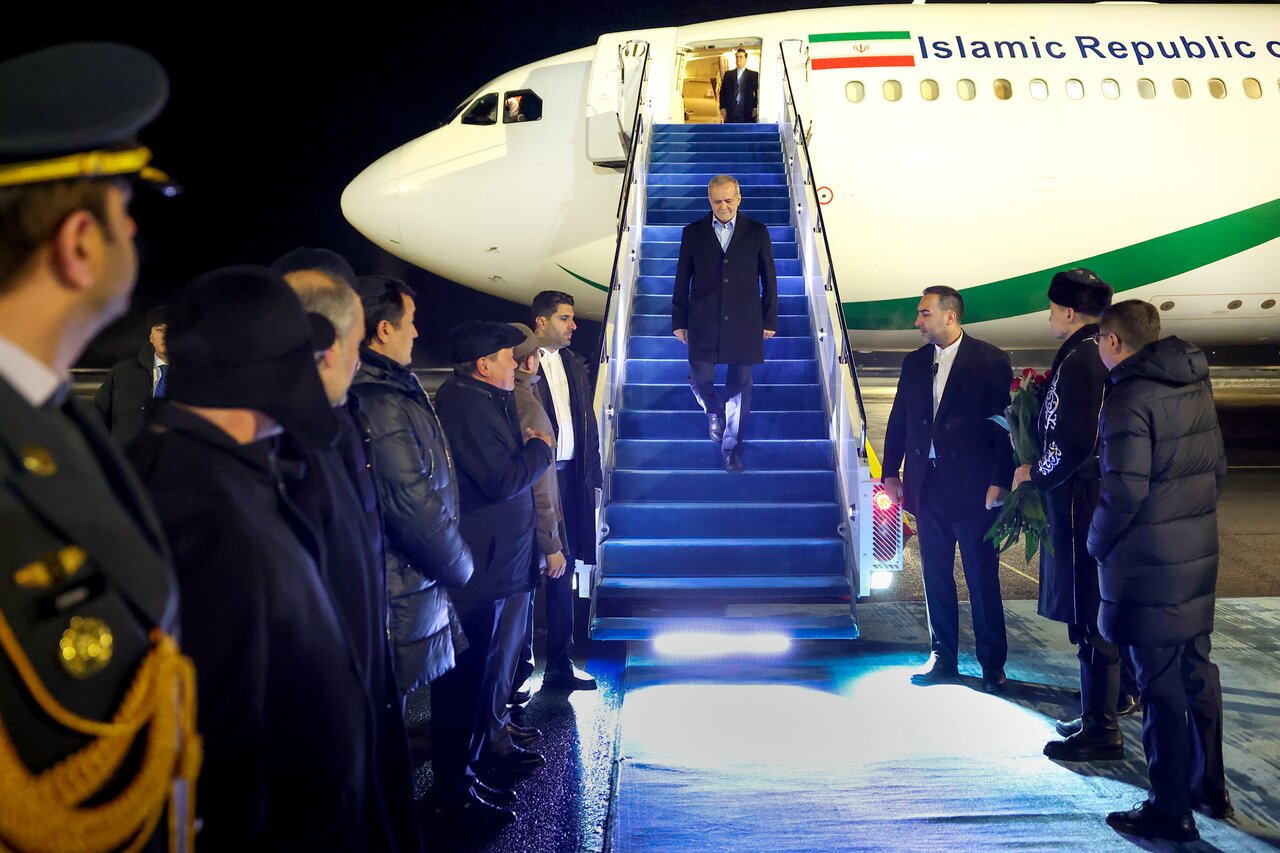
TEHRAN – President Masoud Pezeshkian departed Tehran on Wednesday for Kazakhstan and Turkmenistan, a two-day trip designed to advance economic agreements and participate in a regional conference on peace and trust-building.
Pezeshkian’s first stop is Astana, where he is meeting Kazakh President Kassym-Jomart Tokayev. Speaking at Mehrabad Airport, the president highlighted the opportunity to expand cooperation in economic, industrial, mineral, cultural, and transport sectors.
Accompanied by a high-level political and economic delegation, including Iranian business leaders, the president is expected to finalize over 20 bilateral agreements covering trade, agriculture, and cultural cooperation.
Amid shifting geopolitical dynamics in Central Asia—including increasing U.S. engagement, regional countries joining new treaties, and sanctions on Russia—Pezeshkian’s visit underscores Tehran’s pragmatic approach: strengthening ties with immediate neighbors while ensuring measurable outcomes in commerce and transit.
Following the Kazakhstan leg, the Iranian delegation will travel to Turkmenistan to attend the World Conference on Dialogue for Peace and Trust in Ashgabat at the invitation of President Serdar Berdimuhamedov. Pezeshkian will deliver an address and hold bilateral talks with participating heads of state and government. He described the summit as an opportunity to outline Iran’s views on regional stability and to respond to increasing militarization and humanitarian crises in the region.
The president’s itinerary builds on ongoing negotiations in trade, border markets, energy exchanges, and infrastructure projects such as electricity transmission lines and road links. These discussions are part of a broader Iranian strategy to increase integration with Central Asia — a region that functions as a strategic transit bridge for oil, gas, agriculture, and environmental cooperation.
Since recognizing Kazakhstan’s independence in 1991, Iran has maintained continuous diplomatic, cultural, and economic engagement with Astana. Over decades, this relationship has matured: from cultural affinities and early economic support, to cooperation in political and multilateral arenas.
Trade relations between Tehran and Astana have grown steadily, though unevenly. In 2024, bilateral trade reached approximately $340 million, a 12.3% increase compared to 2023. In the first nine months of 2025, trade totaled $249.1 million, nearly double the same period the previous year. During the first seven months of 1404 (March 2025-March 2026), non-oil trade between the two countries involved 277,000 tons of goods valued at $159 million. Both sides have publicly set targets of $1 billion in the near term and up to $3 billion over a longer horizon. These ambitions are supported by participation in the Eurasian Economic Union free trade agreement, under which Kazakhstan has removed tariffs on roughly 90% of goods, replacing the 2019 interim arrangement that increased trade by 38% and reached $521 million by 2022.
Transit and logistics remain central. Discussions in Astana include expansion of the eastern branch of the International North–South Transport Corridor (INSTC), which Kazakhstan has tied to throughput objectives of 15 million tons by 2027 and 20 million tons by 2030. Iranian officials see these corridors as strategic routes that can lower shipping times, support Eurasian supply chains, and reduce the economic impact of external constraints.
Kazakhstan’s interest in developing access to southern maritime routes, combined with Iran’s role as the primary Persian Gulf outlet for much of Central Asia, continues to create a structural incentive for cooperation. Proposals under review include Kazakh participation in Iranian port infrastructure, particularly facilities that can handle increased container and bulk freight volumes.
For Iran, expanding cooperation with Kazakhstan (and more broadly with Central Asia) serves as a tool to counter Western pressure. In periods when Tehran faces illegal US-led sanctions, establishing solid ties with countries like Kazakhstan offers alternative channels for trade, supply, and diplomatic outreach.
Through cooperation with Kazakhstan, Iran strengthens its access to Central Asian land routes, Caspian transit channels, and logistic networks that bypass traditional Westerncontrolled sea or air corridors. This diversification is not only about economics — it is also a political statement of independence and a bid for strategic resilience.
The composition of the delegation and the volume of draft agreements underscore that this trip is designed to produce measurable outcomes. Any assessment of its success will hinge on implementation: whether trade volumes move beyond the current sub-$400 million level, whether port and corridor projects receive funding, and whether freight flows on Kazakhstan–Turkmenistan–Iran routes increase in line with corridor capacity targets.
In this context, the visit functions not only as a diplomatic engagement but also as a test of Iran’s ability to convert political alignment and geographic advantages into durable economic gains.

No comments:
Post a Comment