Thursday, November 01, 2018

The Transformative Power of the Sirah

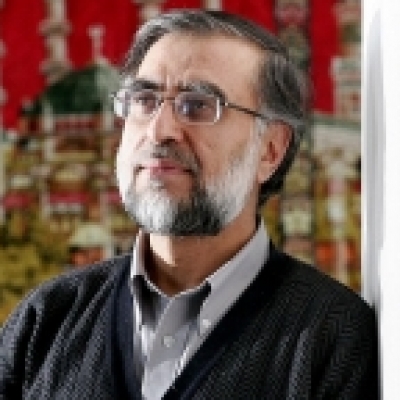
Zafar Bangash


The noble Messenger (pbuh) was sent not only to inform but also to transform errant humanity by bringing it out of darkness and into light (65:11). In the Qur’an, Allah (swt) says He ennobled the Messenger with a lofty character (68:04) and made him an example for all humanity to emulate (33:21).

The noble Messenger’s birthday occurs in the month of Rabi‘ al-Awwal. Muslims would do well to go beyond ritual celebrations and consider some of the transformational dimensions of the Sirah. There are two attitudes that dominate Muslim thinking about the Sirah of the noble Messenger (pbuh) today. One sees his example being relevant only in people’s personal lives — that is, in a narrow sense. Thus, there is emphasis on the Prophet’s attire, personal hygiene, and the manner of his eating, for instance, but the larger issues of state and politics are ignored. At the other end, some Muslims believe that the Prophet’s Sirah was nothing but an endless series of wars. They kill other Muslims because of minor fiqhi differences ignoring the fact that Allah (swt) sent the noble Messenger “as a mercy to all the worlds” (21:107). This was witnessed at the time of the liberation of Makkah in 8ah when the Prophet’s vanquished foes stood trembling before him. He forgave them all and sought no revenge against his decades-long enemies.
During that time Arabia was steeped in jahiliyah (ignocracy). Idol-worship shaped religious, social, and cultural behavior. Injustice, oppression, and tribal warfare borne of arrogance, female infanticide, and slavery were other practices prevalent in society. Today, Muslims are afflicted by many of the same problems even though idol worship has been replaced by the worship of nationalism, money, and class interests.
In Makkah, the noble Messenger (pbuh) emphasized the Oneness of Allah (swt). For this he and his small group of companions faced great hardships. They did not pose a physical challenge to the prevalent system of inequality and oppression. Even the Makkan mushriks knew this, so why then did they inflict so much harm on them? The mushriks realized that the kalimah — proclamation of the Oneness of Allah — was a direct challenge to their entrenched system of injustice and exploitation. Today, an estimated 2 billion Muslims proclaim the kalimah but no entrenched power feels threatened, much less has undergone a transformation.
Analyzing the prevalent system in Arabia, the Prophet (pbuh) found it unacceptable and emphatically rejected it. He then prepared a group of people and imbued them with steely determination to challenge the jahili system regardless of costs or hardships.
This was only possible because the committed Muslims were convinced of the veracity of the prophetic message. Further, certain corrective measures were instituted. These included abandoning such antisocial habits as stealing, lying, oppressing others, and mistreating women and slaves. This was a blow against the entrenched unjust system.
The institution of salah was meant to inculcate the spirit of equality and develop a sense of communal responsibility. Again, distinctions of tribe or clan, rich or poor, and mighty or weak were obliterated. Similarly, zakah as a system of wealth distribution was institutionalized so that those in need could be looked after. The Prophet (pbuh) led by example. He did not ask others to make sacrifices without first doing so himself.
The migration to Madinah, forced upon the Prophet (pbuh) and his companions, led to the establishment of the Islamic State. The principle of equality and fair dealings with all the constituent parts — Muslims, ummiyun (the unlettered), and Jews — was the cornerstone of this policy. In Madinah, the socio-political and economic principles of Islam were introduced.
Clear political principles were laid down. Leadership was on the basis of bay‘ah(willing consent of the people); no coercion was used, nor were decisions imposed from the top. Mutual consultation (shura) in all affairs became the norm and after due deliberation, the decision of the leader (the Prophet) was accepted as final.
At the economic level, the bayt al-mal (treasury) was established to address the circulation and distribution of wealth in a fair and equitable manner. Near the end of the prophetic mission, following many battles against the enemies of Islam, riba (usury), the source of much injustice, was abolished.
The prophetic Sirah offers a clear path for the Muslims to escape from the state ofjahiliyah into iman (faith-commitment, or light). The Sirah must be seen less as a set of rituals and ceremonial observances than as a practical guide for how life is to be lived on earth including dealing with state and politics.
Muslims must internalize this point to escape from the state of jahiliyah into which they have fallen today.

Zafar Bangash is Director of the Institute of Contemporary Islamic Thought (ICIT).

Planned Corridor to Link India to Europe via Iran

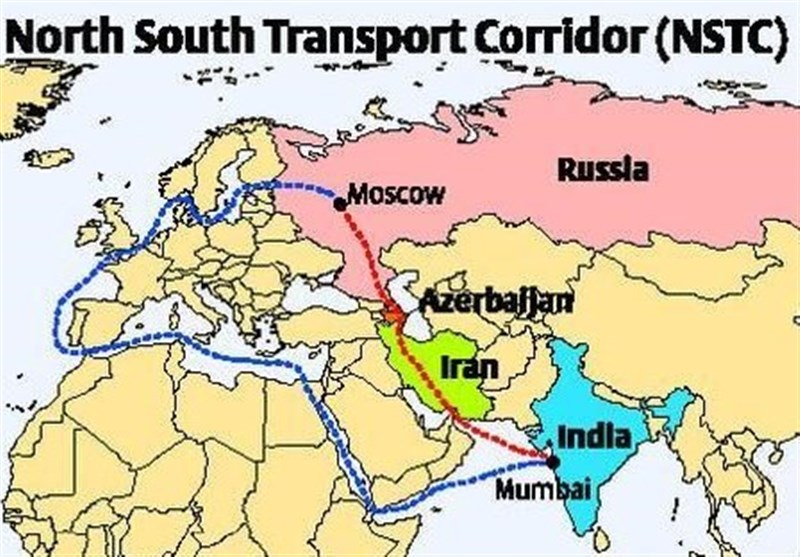
TEHRAN (Tasnim) – Officials from Iran, India, and Russia will meet next month to discuss the operation of a 7,200 km trade and transport corridor that would present a cheaper and shorter alternative to the traditional route through the Suez Canal.


Planned Corridor to Link India to Europe via Iran
The International North-South Transport Corridor (INSTC), a multimode network of sea and rail routes, will link the Indian Ocean and the Persian Gulf via Iran to Russia and Northern Europe.
The project comes in the backdrop of China’s multi-trillion-dollar One Belt One Road initiative. Within Iran, the two routes overlap in a potential boon to future businesses.
New Delhi has been actively courting Tehran, given the utmost importance it attaches to the route and Iran has been receptive.
According to Press TV, once operational, the corridor will allow India to send its goods to Bandar Abbas in Iran by sea, from where they will be transported to Iran’s Bandar Anzali on the Caspian Sea by road. Next, they will be shipped to Astrakhan in Russia and transported into Europe by rail.
The route will cut the time and cost of delivering goods by about 30 percent to more than 40 percent. Compared with the Suez Canal, the corridor will reduce the transport time between Mumbai and Moscow to about 20 days. The estimated capacity of the corridor is 20 to 30 million tons of goods per year.
India’s Union Commerce and Industry Minister Suresh Prabhu on Saturday met a Russian business delegation in New Delhi, where he said "all issues may be resolved in order to operationalize the (INSTC) route as early as possible."
An official statement said India, Russia and Iran will hold a trilateral meeting on November 23 to make the route operational soon, Indian media reported Tuesday.
"The INSTC is the shortest multimodal transportation route linking the Indian Ocean and Persian Gulf via Iran to Russia and North Europe," India’s Ministry of Commerce and Industry said in the statement.
To access resource-rich Central Asia, India has to route its goods either through China, Europe or Iran. The routes through China and Europe are long, expensive and time consuming, with Iran being the most viable one.
The first dry run of the INSTC was conducted in August 2014 and the second in April 2017.
India is seeking to leverage the strategic Chabahar port in southeast Iran to link with the INSTC.
The country has committed $500 million to Chabahar that it is building chiefly to crack open a trade and transport route to landlocked Afghanistan.
Last week, senior officials from the two countries met their counterpart in Tehran to discuss a full commissioning of the port that the three countries are jointly developing.
It was the first trilateral meeting of the Coordination Council of the Chabahar Agreement, coming in the face of fresh sanctions imposed by Washington on the Islamic Republic.
"All sides shared the view that a full operationalization of the trilateral Chabahar initiative will promote connectivity and economic development of Afghanistan and the region," India’s External Affairs Ministry said in a statement.
For landlocked Afghanistan, the corridor means opening the way to billions of dollars in trade and cutting the country’s dependence on foreigners for aid as well as stemming the illicit opium trade. 

Saudi dissident: Trump, Riyadh worked hand in glove in Khashoggi murder


Saudi dissident: Trump, Riyadh worked hand in glove in Khashoggi murder

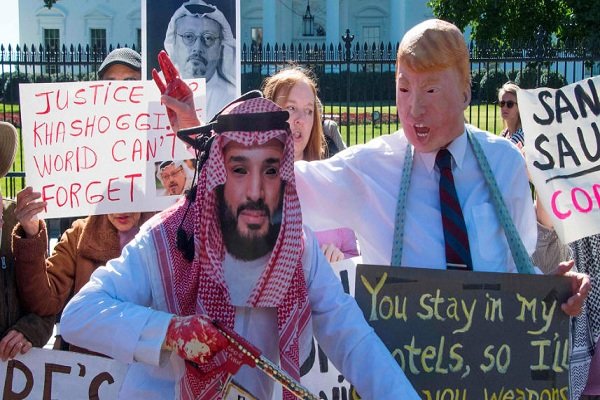
A protester dressed as Saudi Crown Prince Mohammed bin Salman and another dressed as US President Donald Trump stand outside the White House in the wake of the disappearance of the Saudi journalist Jamal Khashoggi on October 19, 2018. 

An exiled Saudi physicist and political dissident said US President Donald Trump had been informed by intelligence agencies of a plot to kill journalist Jamal Khashoggi and colluded with Riyadh in his murder.

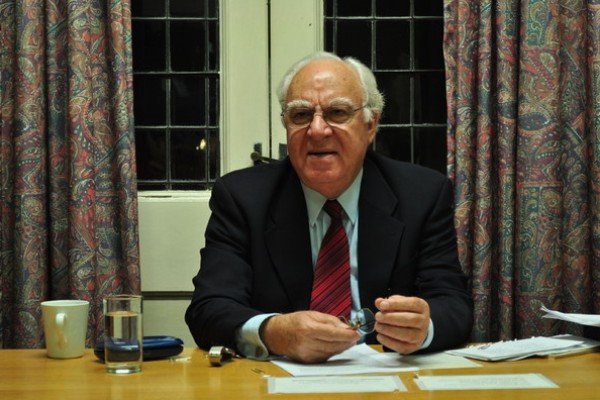
Mohammad al-Massari made the remarks in a program hosted by former British Labour MP George Galloway, footage of which was posted online, Press TV reported.
He revealed Trump’s involvement in Khashoggi’s murder, citing leaks from telephone conversations between Saudi Crown Prince Mohammed bin Salman, known as MBS, and exiled Palestinian politician, Mohammed Dahlan, obtained by a high-ranking Saudi official.
Massari said that Trump has been “lying” in whatever comment he has made regarding Khashoggi’s case as a copy of the Turkish-intercepted video was sent to him shortly after the critic was murdered.
Trump had been receiving daily intelligence briefings by the CIA and FBI since late 2017 about a plot to kill or abduct Khashoggi, but he never warned the journalist about what was to happen, he added.
“And there is also a story from high up in the Saudi ranks that MBS insists that his (Khashoggi’s) head should be cut and delivered to him so he can enjoy his revenge,” he said.
Massari also revealed backup plans, including one announced by the Saudi Interpol, in which Khashoggi’s body double would depart Turkey for Lebanon and get apprehended there as an international fraudster.
He, however, stressed that the scenario went wrong when Khashoggi’s fiancĂ©e, Hatice Cengiz, phoned her uncle, who is an adviser to Turkish President Recep Tayyip Erdogan, and took police to the scene.
The Western governments, which are at odds with Trump over several issues such as the taxes imposed by his administration, are all aware of the developments and they will “take out their swords” against the US president once the 2018 midterm elections on November 6 are over, he claimed.
Khashoggi vanished at the Saudi Consulate in Istanbul on October 2.
Riyadh initially claimed that the journalist had walked out of the mission.
Later, however, it said that Khashoggi had been accidentally killed in a “fistfight” with a Saudi hit squad. Most recently, the kingdom’s public prosecutor said that the murder had been “premeditated” by Saudi operatives.
Riyadh has denied any involvement by the crown prince in the killing, but it has been unveiled that some members of the Saudi hit squad were from bin Salman’s personal security staff.
Elsewhere in the TV program, Massari was asked about the motive behind the killing as Khashoggi was not in fact a member of the Saudi opposition, and only a critic who pushed for reforms inside the regime.
He said that Khashoggi, a media adviser to former Saudi intelligence chief Prince Turki bin Faisal, was actually a “chocolate opposition” and “critical of the regime in the sense like someone who wants to have reforms.”
Khashoggi, he added, was “a treasure of information, connections and contacts” and had “a memoir full of expositions, scandals and crimes.”
The memoir was not published during Khashoggi’s lifetime because it put him at risk, Massari said, alleging that he had got his hands on five pages of that memoir.

Iran UN envoy lashes out at US unilateral sanctions on Cuba


New York, Oct 31, IRNA – Permanent Representative of the Islamic Republic of Iran to the United Nations Gholamali Khoshroo on Wednesday slammed US unilateral sanctions against Cuba, saying that embargoes are a vivid example of the unilateral way in which the United States acts in the world.

Addressing a meeting themed “Necessity of ending the economic, commercial and financial embargo imposed by the United States of America against Cuba”, he added that the strengthening of the extraterritorial application of the blockade had profound adverse effect on Cuba’s international financial and loan relations.

Full text of his statements is as follows: 

“At the outset, I would like to express my gratitude for the recent report compiled by Secretary-General, demonstrating states and international organization’s strong stance on the necessity of ending the economic, commercial and financial embargo imposed by the United States of America against Cuba.

Warmly welcoming His Excellency Bruno Eduardo RodrĂ­guez, the Foreign Minister of Cuba and his delegation, I wish to seize this opportunity to reaffirm Iran’s full support for the people and Government of Cuba against this long lasting unilaterally imposed an unlawful and immoral embargo.

My delegation aligns itself with the statements made earlier by the representatives of the Movement of Non-Aligned Countries (NAM); the Group of 77 and China; and the States members of the Organization of Islamic Cooperation (OIC). However, allow me to add the following remarks in my national capacity.

Mr. President,

Undoubtedly, the economic, commercial and financial blockade against Cuba is the most unjust and longest-lasting unilateral sanctions imposed against a country in our modern world history. The blockade is a vivid example of the unilateral way in which the United States acts in the world. In fact, the way and one-track mindset of some of high ranking officials of the later State, increasingly keep them away from existing realities of today’s multilateral world. US long obstinacy and pathological tendencies on imposing unilateral sanctions, in particular, during recent administration, which pursue the Cold War obsolete policies, has inflicted enormous damage on all sectors of the Cuban economy and caused untold hardship for the Cuban people, preventing them from fully enjoying their human rights.

The strengthening of the extraterritorial application of the blockade and the intensification of this policy, had profound adverse effect on Cuba’s international financial and loan relations.

During 2018, dozens of banks all over the world decided to shut down their relations with Cuban or foreign companies in order to eliminate any ties with their activities with Cubans merely for the their nationality.
The blockade also constitutes a massive, flagrant and systematic violation of the human rights of all the Cuban people. It violates the United Nations Charter and international law and constitutes an obstacle for international cooperation.

Regretfully, in the 21st century, US officials still use and resort to inflammatory and hostile rhetoric in the spirit of the Cold War. Instead of learning lessons from their short-sighted and disastrous policy on Cuba as well as in our region, Middle East, they set a course of action and renewed the intensification of the blockade against the Island to increase political pressure on the Cuban leadership under far-fetched pretexts.

Mr. President,

The Islamic Republic of Iran, which has been more than 37 years subject to US unilateral coercive measures, including unprecedented economic and financial sanctions, fully shares the valid concern of the Government and people of Cuba, suffering from the recklessness and disregard of US for international values and institutions. Enjoying close companionship with Cuban people, the Iranian people have demonstrated their unwavering resilience during the past 37 years despite the difficulties and constraints caused by sanctions.

In this context, I deem it necessary to point out how US is addicted to imposition of sanction as an instrument to achieve its bilateral goals. The conclusion of the Joint Comprehensive Plan of Action in 2015 between Iran and the P5 + 1, which has been endorsed by Security Council resolution 2231, adopted under Chapter Seven of the UN Charter is a good example of the fact that the US is perfidious player in the international scene. The Security Council resolution 2231 was supposed to put an end to the imposed sanctions to Iran. It is so tragic that the US, a Permanent Member of the Security Council and one of the principal negotiator and parties to the agreement and drafting SC resolution, now punishing and threatening sovereign states, not because of violating, but for being abided by a Security Council Resolution.

The economic war that the United States has initiated under the rubric of new sanctions not only targets the Iranian people but also entails harmful repercussions for the people of other countries, and that war has caused a disruption in the state of global trade. 

The re-imposition of sanctions against Iran after the unilateral withdrawal indicated that US is not trustworthy at all and is a colossal mistake to count on its commitments. 

Mr. President,

The message of today’s meeting is the reaffirmation of the fact that the time of interventionist policy and interference in farthest reaches of the world has elapsed. The era of coups d’Ă©tat, invasions and destabilization, the policy of walls, sanctions and aggression that threatens the peace and security of the world is over.

The message of our today’s unanimous condemnation of unilateral coercive measures, in particular, ‘unilateral embargo and sanctions’ is that the preservation of interests and security in the world in the least costly manner is solely possible through the cooperation, solidarity and coordination among, countries in the framework of multilateralism. Although, it is unfortunate that we are witnessing rulers in the world who think they can secure their interests better—or at least in the short-term ride public sentiments and gain popular support—through the fomenting of extremist nationalism and racism, as well as through the trampling of global rules and undermining international institutions.

Confronting multilateralism by resorting to unilateral actions, including imposition of embargo and sanctions, is not a sign of strength; rather it is a symptom of the weakness of intellect—it betrays an inability in understanding a complex and interconnected world. 

Thank you Mr. President.”

Mousavian: Trump’s Iran sanctions will fail


Tehran, Nov 1, IRNA - Given recent developments in the region and EU's approach against US unilateralism, the next round of U.S. sanctions against Iran is unlikely to bring Washington closer to achieving its goals on Iran, according to a political analyst.

'The next round of economic sanctions on Iran, which will start going into effect on Nov.4, will mainly target the country’s oil and gas industries. These sanctions were eased after the 2015 signing of the Joint Comprehensive Plan of Action (JCPOA), commonly known as the Iran nuclear deal, but are being phased back in following President Donald Trump’s decision to withdraw from the accord six months ago,' Hossein Mousavian, a former member of Iran's nuclear negotiating team said in a commentary released by Reuters.

Trump’s goal in reinstituting the sanctions is to kill the nuclear deal, to bring Iran’s economy to the point of total collapse, to contain Iran’s regional involvement in Syria, Iraq and Yemen, and, in spite of Washington’s denials, presumably to celebrate the collapse of Iran’s ruling regime. The White House’s official position is that, by increasing economic and political pressure, it aims to bring Iran back to the negotiating table in order to replace the JCPOA with a new deal that bears Trump’s name, he said.

Mousavian said there are at least five reasons why Trump’s strategy will fail:

First, while the United States seeks to cut Iran’s oil exports to zero, it has become clear that this is impractical; there is no viable replacement for Iran’s 2.5 million barrels per day in oil exports. While Saudi Arabia previously claimed it had made up for any shortages, experts believe that Riyadh and its allies do not have the capacity to fully offset the loss of Iranian oil. Now that Iran’s oil exports have dropped to an estimated 1.5 million bpd – down from more than 2.5 million before the U.S. withdrawal from the JCPOA in May – the price of the OPEC reference basket has gone up to around $76. If forecasts indicating that it could jump to $100 per barrel are correct, the price hike will make up for Iran’s loss of revenue even if Tehran’s exports are cut further to 1 million barrels.


Second, Trump’s trade war with China and the U.S. imposition of economic sanctions against Russia make Beijing and Moscow less likely to work with Washington on Iran. Moreover, the White House cannot count on cooperation from the European Union, which initiated nuclear negotiations with Iran in 2003 and which sees the JCPOA as one of its signature foreign policy achievements. Further, the EU increasingly views extraterritorial sanctions as a threat to its own identity and independence. French Finance Minister Bruno Le Maire said recently that the “outcome of that crisis with Iran will be the chance for Europe to have its own independent financial institutions, so we can trade with whoever we want.” In the past, cooperation with all major powers was critical to creating an effective Iran policy.

Third, U.S. sanctions have laid the groundwork for a historic change in the global financial system. For many decades, the U.S. dollar has dominated the international financial markets. However, American withdrawal from the JCPOA has encouraged countries such as Russia, China, India and Turkey to use their local currencies to trade with Iran. If Europe succeeds in creating a financial system that is separate from the U.S. dollar, other states can use euros in trade with Iran, diminishing U.S. domination of global markets.

Fourth, the remaining signatories to the JCPOA view the nuclear deal as a means to counter American unilateralism. This is due to the fact that the JCPOA is a multilateral agreement backed by UN Security Council resolution 2231, which the Trump administration exited unilaterally and is now trying to punish other nations for implementing. Any capitulation to Washington on this issue would further buttress the current U.S. approach. To avoid this, both Iran and the international community will see preserving the JCPOA as a strategic necessity.

Fifth, powerful U.S. allies such as the EU and Japan continue to support the JCPOA. Only a handful of regional allies – namely Saudi Arabia, the UAE and Israel – supported Trump’s decision to withdraw from the deal while other major regional players such as Turkey, Oman and Iraq continue to support the accord. At the same time, developments in other regional crises do not favor the United States and its allies: Bashar al-Assad, backed by Russia and Iran, is winning Syria’s civil war; the U.S. campaign in Afghanistan has failed; Saudi Arabia has been unable to defeat the Tehran-backed Houthis in Yemen and Qatar has prevailed against the Saudi-led blockade. These developments will make it easier for Tehran to find workarounds to sanctions imposed by Washington.

For the past six decades, the United States has been the region’s hegemonic power. However, Trump’s unilateralist approach and the future of JCPOA may change the calculation by creating a rift among the transatlantic allies, and bringing the eastern bloc powers, Europe and regional powers such as Iran, Turkey and Iraq, closer together. Moreover, the JCPOA has paved the way for other world powers – specifically Europe, China, Russia and India ­– to preserve international agreements without the United States. This, coupled with American withdrawal from the international scene, has the potential to transform international power politics, shifting from an American-led system to a multi-polar world, with regional actors playing a more substantial role.

Against this backdrop, the next round of U.S. sanctions against Iran is likely to increase Middle East tensions – and unlikely to bring Washington closer to achieving its goals on Iran.

Seyed Hossein Mousavian is Middle East Security and Nuclear Policy Specialist at Princeton University and a former spokesman for Iran’s nuclear negotiators. His most recent book, “Iran and the United States: An Insider’s view on the Failed Past and the Road to Peace” was published in 2014.

World needs broader and more tolerant interpretation of religion: Jahanpour

By Javad Heirannia
TEHRAN - Professor Farhang Jahanpour, part-time tutor on Middle Eastern affairs in the Department of Continuing Education, University of Oxford, and a member of Kellogg College says that religion has always been associated with politics.
Former Senior Research Scholar at Harvard adds that “What the world needs at the present time is a broader and more tolerant interpretation of religion that would include the whole of humanity, not divide people into various religious sects and groups.”
Following is the full text of the interview:
Q: When did scholars first start to associate religion with politics?
A: In a way, religion has always been associated with politics. Even according to the earliest records of ancient Sumerian, Babylonian, Egyptian, Indian, Persian and Jewish histories, religions have always been closely tied up with politics. 
The earliest Sumerian Epic of Gilgamesh that dates from the Third Dynasty of Ur (2100-2000 BC) speaks of Gilgamesh as a historical king of Uruk in Babylonia. It portrays him as a divine being who was granted eternal life. Hammurabi (died c. 1750 BC), the first person to provide a detailed codification of 282 laws, was the sixth Amorite king of Babylon (the First Babylonian Dynasty). He talks of himself as the representative of Anu and Bel, the gods of the Babylonians. In the introduction to his famous Code of Laws, he writes: “Anu and Bel called by name me, Hammurabi, the exalted prince, who feared God, to bring about the rule of righteousness in the land, to destroy the wicked and the evil-doers.”
In ancient Egypt, the Pharaohs portrayed themselves as gods or the representatives of the Supreme Being. The famous Book of the Dead coming from the Middle Kingdom period (about 2050-1750 BC) speaks about divine kings. The mythic scene of the book describes the story of the life, death and resurrection of the god Osiris. 
Long before Biblical times, we have the Tale of Aqhat (written before 1365 BC when Ugarit where the book was written was destroyed as the result of a major earthquake) whose life story has many resemblances both with the stories about the life of Abraham, as well as of Jesus. The Hebrew kings, Saul, David and Solomon, and others also speak of their intimate relationship with God. 
In our own history, both Cyrus and Darius represent themselves as being chosen by Ahura-Mazda. In his famous Behistun Inscription (522 B.C.), Darius the Great, writes: “King Darius says: By the grace of Ahura Mazda am I king. Ahura Mazda has granted unto me this empire. Ahura Mazda brought me help, until I gained the empire; by the grace of Ahura Mazda do I hold this empire.” 
In the Hindu Bhagavad Gita (c. fifth century BC) Krishna reveals himself to Arjuna as a god. So, from the dawn of history, religion and politics have gone hand-in-hand and most rulers have tried to use religion in order to give themselves some element of divine rule and justify their legitimacy. 
Q: So, on the basis of what you say, is it always the case that religion and politics should go together?
A: It depends on what we mean by religion and politics. Some religions have been completely otherworldly, while others have involved themselves more in the affairs of the world. For instance, the teachings of Buddha in India or Lao-Tzu, the founder of Taoism in China (both of them from 6th century BC), have been more interested in spiritual and mystical issues, rather than material issues. For instance, Lao-Tzu argued that minimizing the role of government and letting individuals develop spontaneously would best achieve social and economic harmony. He was more interested in self-development, rather than in the role of the individual in society. Some have even called Lao-Tzu as one of the first anarchists. 
Some scholars argue that even Jesus was more concerned with the affairs of the soul, rather than with material issues, for instance when he said: “My kingdom is not of this world” or “render unto Caesar what is Caesar’s and unto God what is God’s.” In these verses, one can clearly see a complete separation of spiritual and material issues. 
Although ancient Iranian rulers used the name of Ahura Mazda to gain some legitimacy, or towards the end of the Sasanian period Zoroastrian clerics or the Magi achieved great power and interfered in political issues, there is nothing in Zoroaster’s teachings that justified that interpretation. His ethical teachings were summed up in “Good thoughts, good words and good deeds”.
One can even see similar verses in the Qur’an. The Qur’an insists on freedom of belief and condemns coercion of conscience, such as in 2: 256, where the Qur’an says, “There is no compulsion in religion. Certainly, right has become clearly distinct from wrong. Whoever rejects false idols and believes in God has taken hold of the unbreakable, firm handle. God is All-hearing and knowing.” 
The Qur’an urges turning the other cheek and wishing peace even on persecutors who orally harass the believers. The verse 43:89 says of the militant pagans who rejected the Prophet’s message, “yet pardon them, and say, ‘Peace!’ Soon they will know.” When the Qur’an speaks about righteousness, it is a general concept of faith that is not limited to Muslims alone. For instance, in 2:62, the Qur’an promises salvation to righteous Jews and Christians, or to whoever lives a good life: “Those who believed, and the Jews, and the Christians, and the Sabians, and whoever has believed in God and the Last Day and performed good works, they shall have their reward with their Lord.”
Q: Some scholars, such as Michael Allen Gillespie in his book “The Theological Origins of Modernity”, believe that modernity was not initially against religion, and in later years, as a result of social, cultural and political conditions, it has led to secularism. So, based on this conception, religion is not in conflict with modernity. Therefore, can it be said that religion is not in conflict with the international relations theory stemming from modernity?
A: There have been many scholars who have argued that religion has played a major role in creating the modern world. The late Professor Owen Chadwick’s important book, called “The Secularization of the European Mind in the Nineteenth Century” (1975), in fact argues that concepts of democracy and human rights emerged out of religious conflicts and disputes of the 16th and 17th centuries. 
I believe that he has a point, but of course he did not argue that because of the historical role that religion had played in ushering in modernism it means that religion should now interfere in politics. According to him, at a particular historical phase, religious disputes and conflicts led to the Renaissance and the Reformation, which paved the way for revolutionizing political and social ideas, and therefore played a role in shaping the modern world. 
Q: If religion can play a role in international relations, can it therefore be effective in resolving all the unresolved political issues and problems?
A: Again, it all depends on how one interprets religion. Various peaceful groups have used religion to advocate peaceful policies and coexistence, while others such as ISIS or some religious radicals and fundamentalists have used religion to justify their intolerant and hateful ideologies. I believe that if one goes to the essence of religions, which preach unity, tolerance, forgiveness, charity and justice, one can argue that religion can play a useful role in bringing peoples and nations closer together. At the same time, if one puts forward a narrow and fanatical interpretation of religion, one can justify disunity, hatred, divisions, violence and wars. After all, many wars have been fought in the course of history and even in our own time in the name of religion. 
What the world needs at the present time is a broader and more tolerant interpretation of religion that would include the whole of humanity, not divide people into various religious sects and groups. Religion is a very powerful force both for good or evil. If used correctly, it can be the source of unity and bringing various nations together, but if it is misused and misinterpreted it can be turned into a source of disunity, and even hostility and wars.

UK-based anti-Iran TV channel linked to MBS: Guardian

Channel supported MKO, al-Ahwaziya terrorists
A UK-based anti-Iran TV station is being funded through a secretive offshore entity and a company whose director is a Saudi Arabian businessman with close links to the Saudi crown prince Mohammed bin Salman, the Guardian said on Wednesday.
The disclosures are likely to raise concerns about the editorial independence of Iran International, and comes at a time of growing fears about a number of Saudi-linked stations operating across London.
A source has told the Guardian that Prince Mohammed, who many believe is responsible for the murder of the journalist Jamal Khashoggi, is the force behind Iran International. The station, which is operating out of Chiswick, has not denied claims that it receives its funding from the Saudi royal court.
Iran International TV emerged abruptly on the London media scene last year; many of the 100-strong staff network were offered generous salaries, often double what rivals paid, but was elusive about its source of funding.
London has become a hub of such exiled Iranian channels, which also include BBC’s Persian service and Manoto TV, which has broadcast Iranian versions of The X Factor and Come Dine With Me.
The source claimed Saud al-Qahtani, the crown prince’s information tsar, who was among two senior officials removed in connection with the Khashoggi affair, was involved in the funding behind Iran International TV.
“You could have a larger picture about how those kids [Saudi media moguls] with that money being thrown around [by Prince Mohammed] trying to change the world by buying media … It is money coming from the royal court,” the source said, when speaking about the crown prince.
While Saudi Arabia shows zero tolerance for criticism of its absolute monarchy, as underlined by Khashoggi’s murder, it is setting up media organizations in other languages promoting free speech, particularly about Iran.
Eskandar Sadeghi-Boroujerdi, a postdoctoral research fellow in modern Iranian history at the University of Oxford, said: “… it appears that Iran International is part and parcel of the Saudi crown prince’s decision to take a more aggressive posture against Iran, emboldened, no doubt, by the Trump administration.”
Earlier this summer, the station was criticized for airing extensive live coverage of a rally by the Mujahedin-e-Khalq (MKO), a terrorist organization that espouses regime change in Iran and has links to Saudi Arabia. Senior Trump administration officials, including John Bolton, are advocates of the group.
The TV channel’s support for terrorism most boldly manifested itself after it allowed the al-Ahwaziya terrorist group’s spokesman to go live on air to justify a terror attack in Iran’s Ahvaz back in September.
The al-Ahwaziya group, which receives backing mainly from Saudi Arabia, claimed responsibility for the September 22 gun attack in Ahvaz, Khuzestan province, which took the lives of 24 people, including a four-year old child, and injury of 69 others.
Following the airing of the interview, Iranian Ambassador to London Hamid Baidinejad said in a tweet that Iran had filed a lawsuit against the UK-based TV channel over its support for the terrorist group.
“The Iranian embassy in London has taken its official lawsuit to Ofcom to investigate the Iran International TV channel’s illegal move to broadcast an interview with the spokesman of the terrorist group,” the ambassador said.
 
Baidinejad added that the embassy had separately requested the UK government to identify members of the terrorist group, ban their activity, and expel them from the country.