Monday, June 01, 1998

50 years of zionist forgery and land grab

By Zafar Bangash


One of the biggest injustices of the twentieth century - the fiftieth anniversary of the establishment of the State of Israel - is being celebrated in a manner bordering on the scandalous. The implantation of the zionist entity in Palestine has been rightly described asal-Nakba (the catastrophe) by Palestinians.
The hoopla surrounding Israeli celebrations conveniently ignores the fact that Palestine was stolen by European Jews in connivance with the European powers, primarily Britain but also France (and later the US) to create a western beach-head in the heartland of Islam. This was only made possible by driving out the indigenous population - the Palestinians - from their ancestral lands, through terror and mass murder.
The zionists have peddled the mythology of turning 'deserts into orchards' with the active collaboration of the west. Their claim to Palestine is based on a complete perversion of historical facts sprinkled with Biblical references to geography. The zionists - most of them secular fanatics who have nothing to do with Judaism - have reduced the Bible to a real estate manual.
The zionist colonial settler enterprise was launched by shedding the blood of the Palestinians. It has been sustained through terror, the most common characteristic of the zionists, for 50 years. More than 475 Palestinian towns and villages were completely wiped out. There is no trace left of them anymore.
Soon after the June 1967 war, Moshe Dayan, the one-eyed Israeli general, had boasted to a group of visiting Jews from the US that the present generation had expanded the boundaries of the State of Israel this far. Now it was upto the next generation to take them further. He also candidly admitted that hundreds of Palestinian villages and towns had been wiped out.
Contrary to zionist propaganda, now admitted even by some Israeli historians, the Palestinian inhabitants of these once-thriving towns did not flee on orders from the Arab regimes. They fled in the face of the zionist terror machine. Deir Yasin (April 9, 1948) was but one example of numerous zionist atrocities perpetrated against innocent civilians. Palestinian women were parade naked in the streets. Many of them were bayoneted to death before their bodies were dumped in wells. At least 750,000 Palestinians were expelled from their homes in this campaign to settle European Jews in Palestine. This obscenity is being celebrated today as a great achievement.
Many leaders of the zionist terrorist gangs - Menachem Begin, Yitzhak Shamir et el - later became prime ministers of the 'only democracy in the Middle East'. The 'most powerful democracy' in the world - the US - has such a close relationship with the 'only democracy' that massive annual handouts are bestowed upon it even while American citizens are denied many of their basic needs.
The zionist State receives between US$4 to US$6 billion annually in aid (grants and loans) from the US. In the first 20 years of Israel's existence (1948-1968), it received only $348 million. But in the next 20 years, this shot up to $82 billion. The last 10 years have witnessed further burgeoning of these handouts.
As a colonial settler enterprise, Israel does not meet the standard test for such an entity. Traditionally, colonial possessions not only stand on their own feet but also remit large sums, in goods and money, to the mother country. The zionist entity, on the other hands, thrives as a parasite on the American body. Without American handouts, it cannot survive. Israel is America's biggest welfare recipient.
If the zionist State cannot survive without US handouts, American politicians cannot survive without Jewish support in the US. This symbiotic relation was alluded to by US vice president Al Gore on April 30 when he joined Israeli celebrations in Tel Aviv. 'We Americans feel our ties with Israel are eternal,' Gore said lyrically. He might as well have said 'without Jewish votes and money, I cannot win the presidency in the year 2000.'
There is another factor that binds the US and Israel. Two hundred years ago, European settlers in America pushed westward, expanding their frontiers at the expense of the Native peoples. Today, the indigenous population of America is found only on reservations. The zionists are pursuing exactly the same policy, only with much greater ruthlessness and efficiency. Many Americans see in the zionists the same 'enterprising' spirit that led to their own expansion.
Gore reflected this in his speech when he showered praise on Israel. 'As I lift up my eyes tonight and see the whole house of Israel, I recognize you.' Indeed. Gore could see his own forefathers in the crowd. 'And I remember the prophecy of Ezekiel - that God would raise you up... and restore your land.' Politicians are prone to hyperbole but Gore was telling blatant lies.
The land belongs to the Palestinians even if Gore was still in diapers when the zionists stole it. And as for God's fulfilling His promise to the zionists, surely God did not mean the gangsters, hustlers, mass murderers and torturers who rule the zionist State today.
Israel is the only country in the world where torture of political prisoners is not only legal but its supreme court actively endorses it. Palestinians are held without trial under what is euphemistically called 'administrative detention.' The maximum period is six months but it is routinely extended. There are Palestinians who have been held without charge or trial for four or five years.
While the western media routinely present Israel as a beleaguered State in a sea of hostile neighbours, it is the only nuclear power in the region with more than 200 nuclear weapons. Its army has grown to 600,000 and it can deploy more than 2,800 tanks and 700 combat planes, according to the Jaffee Centre for Strategic Studies at Tel Aviv University.
This gives it a formidable military muscle against the Arab armies which it has defeated in almost all the wars. But since 1982, Israel's military has found itself mired in less glorious adventures, including the costly 1982-1985 invasion of Lebanon and its attempts to crush the intifadah from 1987 to 1994.
In Lebanon it got a bloody nose at the hands of the Hizbullah, whose spirit of sacrifice put the fear of God into the pleasure-loving zionist thugs. Instead of confronting the Islamic fighters, the zionists bombard Lebanese villages using long-range artillery and planes.
Hostage-taking is also a favourite ploy of the zionists. Literally hundreds of Palestinians and Lebanese are incarcerated in the Khiam concentration camp where torture is rampant. Similarly, Palestinians held without trial are also tortured in prisons inside what is called Israel.
If young Palestinians are incarcerated, their leaders are expelled from their own land. It is ironic that alien occupiers from eastern Europe and America should expel people from their own homes and land where their forefathers have lived for millenia.
The zionists are also extremely sadistic. Young children are targeted for special wrath. Thousands of Palestinian children have been brutally beaten up by the gun-toting zionists. Young stone-throwing Palestinians have been buried alive; others have had their bones broken with rocks, on direct orders from Yitzhak Rabin, the Nobel peace prize winner!
During the intifadah, the zionist occupiers frequently used tear gas in confined spaces, resulting in hundreds of pregnant Palestinian women suffering miscarriages. Another of their favourite ploys is to mix flour and kerosene in Palestinian homes, making it unfit for consumption.
Despite such cruelties, the zionists have failed to break the spirit of the Palestinians. Every Israeli cruelty brings out an even greater determination to stand up to the occupiers.
As the Israeli military historian Martin Van Creveld of the Hebrew University in Jerusalem admitted, 'An army which fights against the weak, becomes weak itself.' He went on: 'In these instances, the army is the sure loser because its victories are without honour and its defeats are always humiliating.'
Israeli soldiers no longer wish to serve in Lebanon, Ghazzah or the West Bank. An army sergeant candidly admitted 'We have to hide from reservists the fact that they're going to serve in the Gaza Strip or they simply don't show up.' The time is not far off when Israeli soldiers would not wish to live in Palestine either.
Already, Israel is the least safe place for Jews anywhere in the world.
Sunday, November 16, 1997

Symbiotic relationship between illegitimate Arab rulers and their western masters

Zafar Bangash
A BRUTAL FRIENDSHIP: THE WEST AND THE ARAB ELITE By Said K Aburish. Published by Victor Gollancz, London, UK. 1997. pp. 414. Hbk: UK20.00.
Out of the ashes of the Ottoman empire emerged not an ‘Arab nation’, as envisioned by the champions of Arabism, but division of the Middle East into Arab nation-States. As if this were not bad enough, an additional blow was delivered by the creation of the Zionist State of Israel in Palestine. The misery of the people in the Middle East can be traced to these developments in the early part of this century.
The sordid role played by the colonial powers - Britain and France - since before the first world war, and by the US since the second - is carefully analyzed by Said Aburish in this highly readable book. Written in journalistic style, it is fast-paced and therefore, interesting.
His irreverant expose of Arab rulers stands in sharp contrast with their almost saintly image projected by court/official handouts and uncritically accepted by most of the mainstream media in the west. While he dismisses all regimes as illegitimate, Aburish identifies three types of rulers in particular in A brutal friendship: the west and the Arab elite: those viewed as friendly to the west, those opposed, and the ‘floaters.’
The west’s ‘friends’ are easy to identify: kings Fahd and Husain, president Husni Mubarak of Egypt, the Gulf shaikhs and even king Hasan of Morocco in the Maghreb. These rulers have always done the west’s bidding, some more than others.
Those on the enemy list - colonel Mu’ammar Qaddafi of Libya and Saddam Husain of Iraq - are not there because of their undemocratic credentials. They are considered enemies because they refuse to toe the western-prescribed path. The floaters include people like Hafez al-Asad of Syria and Yassir Arafat of the Palestinian Authority.
The wishes of the people in the Middle East do not matter; only the interests of the west are important. Besides, enmity is personalised to the rulers - Qaddafi and Saddam. ‘Questioning the lack of legitimacy of unfriendly regimes would inevitably extend such scrutiny to friendly ones’ (p.13), says Aburish.
The best example of this was witnessed on the eve of the Gulf War in 1990-1991 when US president George Bush personalised the entire campaign to Saddam by demonising him as ‘worse than Hitler.’ As Aburish points out, quite correctly, the west would be happy to have someone equally terrible in power in Iraq as long as he obeyed the west’s orders.
The author in fact goes on to provide ample evidence to show that Saddam - yes the ‘worse-than-Hitler Saddam’ - was the creation of the west itself because it suited their purpose at the time. Initially, Saddam had to be weaned away from the Soviet Union; later, he was needed to fight Iran after it had undergone an Islamic Revolution overthrowing the Shah, another western client.
Islamic Iran was viewed with alarm by the west’s client regimes in the Middle East and it had to be fought and contained. This task was assigned to Saddam who was provided money by fellow Arab rulers and weapons and chemical and biological plants to manufacture the most lethal weapons known to mankind, by the west. The only condition was that these were to be used against Muslims who dared challenge western interests.
Once the Iraqi-imposed war came to an inconclusive end and Saddam refused to demobilise his army, he had to be defanged. The oil weapon was used through Kuwait to undermine the Iraqi economy. Saddam reacted angrily but walked into a trap the west, especially the US, had set for him.
Numerous books have been written about the Middle East. Most deal with the emergence of the regimes, their relations with the west and, of course, the Palestinian-Israeli question. Some also delve into the rise of Arab nationalism. Few authors, however, have focused on the nature of the regimes the way Aburish does.
Of Paletinian origin, Aburish’s book is unique in that he takes a broad sweep of all the regimes including Yassir Arafat’s Palestinian Authority. He not only calls them illegitimate but also finds them unresponsive to the wishes of the people. It is a devastating critique of the subservient Arab rulers and how they have willingly played as tools of the west in order to advance their narrow personal interests at the expense of their peoples.
Any analysis of the contemporary Middle East scene must take into account the nature of the regimes that have come to occupy the various pieces of real estate, the background of the Arab ruling elites, their policies, alliances, preferences, oil policy, relations or lack thereof with Israel and of course, the Palestinians.
While the incompetence, greed and corruption of Arab rulers have been well-documented elsewhere, what is interesting about Aburish’s latest book is that it breaks considerable new ground. He augments historically documented facts with experiences of which he has personal knowledge, such as the sale of US weapons to Iraq in the early seventies.
Especially interesting is his revelation of the deep links between Saddam Husain of Iraq and the west’s eagerness - Britain, France and the US - to promote him. ‘It was an American company, Pfaulder Corporation of Rochester, New York, which in 1975 supplied the Iraqis with a blueprint which enabled them to build their first chemical warfare plant’ (p.99). Aburish says that he is in possession of a copy of Pfaulder’s design. Even earlier, in 1958, the American Central Intelligence Agency (CIA) had provided the list of Iraqi elite who had to be eliminated in the coup against the popularly-elected government of Abdul Karim Kassem!
The author reveals that in 1983, he had personally taken a proposal for a US$230 million deal to purchase US-manufactured Harpoon missiles to save Saddam’s regime which was under pressure from Iran’s forces. The offer to supply the missiles had come from an American arms dealer who told Aburish that the US government would be favourably disposed to such an arrangement (p. 100-101). One needs to remember that the US was officially ‘neutral’ in the Iraq-Iran war!
Given the west’s current hysterical campaign against Saddam, it is interesting to note how western regimes created the monster that he became, all because it served their interests at the time. This is the central thesis of Aburish’s book. The policies pursued by the Arab rulers as well as the west have nothing to do with principle or the interests of the peoples in the Middle East. Every policy is predicated on the need to serve the west’s interests.
The Arab rulers and elites who came to occupy important positions in their respective governments understood this well. They, therefore, served western - mainly British and French interests in the early part, and later on, US interests - to remain in their good books. The west in turn ensured their survival as rulers.
This is best illustrated by the Arab regimes’ oil policy. First discovered in Bahrain in 1908, it was western multinationals, and behind them their governments, which actually determined oil prices. Even when windfall profits accrued to oil producers because of sudden price increases, the money was funnelled back to the west.
This was done in several ways, the most common of which was arms purchases, totally unnecessary as far as the Arab regimes were concerned. The Saudi regime continues to be the biggest arms purchaser in the world but as the Gulf War showed, these weapons were of no use to defend the country. Aburish points out that ‘according to London’s International Institute of Strategic Studies, the cost to maintain a Saudi soldier is five times the cost of maintaining an American soldier’ (p.106). One need hardly compare their competence levels.
Arms, in fact, have been the west’s favourite tool in advancing its policies, as Aburish shows. In the early part of this century, Britain used the supply of weapons to Husain I (better known as Sharif Husain of Makkah) to promote the Arab revolt against Turkey. When Sharif Husain demanded that Britain honour its pledge to make him the king of all the Arabs, the British simply switched sides, supporting his arch-rival, Abdul-Aziz ibn Saud.
Husain I was ditched and humiliated, forcing him into exile as Ibn Saud’s tribal allies crushed his army. Later, the British would turn the tables even on the Ikhwan - Ibn Saud’s supporters - and facilitate their massacre so that Abdul Aziz would become the undisputed ruler of Saudi Arabia (as opposed to the ruler of all the Arabs).
The division of the Middle East into petty fiefdoms is described in detail by Aburish who makes a telling point about how on the eve of the creation of the zionist State of Israel, the British had yet again played a treacherous role. The Egyptian army, equipped with British weapons, was denied spare parts resulting in disaster for Egypt’s campaign against Israel in 1948.
In Jordan’s case, it was even more ludicrous. The Jordanian army had 21 British officers. They made sure that the West Bank of Jordan (which should have formed part of Palestine under the UN partition plan) was occupied by Jordanian forces but that no soldier was allowed to enter any part of Palestine allocated to Israel (p. 96).
Aburish reveals not only king Husain’s zionist connections which have come under close scrutiny lately, but also his long-standing liaison with the CIA. It was former US president Jimmy Carter who admitted in 1977 that Husain was on the CIA payroll. Aburish provides the details, which are both revealing and fascinating.
He also details Fahd’s indiscretions, whether his laziness, heavy drinking or womanizing. It is a disgrace that a man of his character should carry the title of Khadim al-Haramain. The author shows that it is Saudi Arabia, more than any other oil producing country, which has deliberately kept oil prices low in order to appease the US. This is at a heavy price to Saudi Arabia itself.
Quotaing from the world bank report of 1983, Aburish writes: ‘the per capita income of an average Saudi declined from $14,600 in 1982 to $6400 in 1992, without factoring in inflation,’ (p.253). Similarly, in 1982, Saudi Arabia had a surplus of $142 billion; ‘currently its debt is somewhere between $60 billion and $120 billion.’
It is a most interesting book, full of useful insights about the behaviour, policies and traits of the most important players in the Middle East. Aburish has a soft corner for Gamal Abdel Nasser of Egypt and shares his nationalistic inclinations but this has not blurred his vision of Nasser completely. He admits, for instance, that Nasser, too, was working with the CIA. It was only after he had been ditched completely that he turned to the Russians.
Those interested in the affairs of the Middle East and wish to understand the reasons for the failures of Arab rulers will find this book highly useful.


Zafar Bangash

Saturday, November 01, 1997

Muslim Parliament conference puts Europe’s record on Islam in the dock

Our Correspondent from London

Heralded as Europe’s first collective response to Islamophobia, the Muslim Parliament of Great Britain’s European conference, aptly entitled ‘Islamophobia - the oldest hatred’, brought together an impressive line up of speakers, activists and scholars from across Europe. Over 1200 participants packed the conference, held on 19 October, to hear speaker after speaker analyse Europe’s record on Islam.

The tone of the conference was set by Dr Ghayasuddin Siddiqui, Leader of the Muslim Parliament. In his keynote speech, he described how the hatred of Islam and Muslims had deep roots in European civilisation and psyche. He also contrasted the compassion and tolerance non-Muslims who lived in Dar al Islam enjoyed under Muslim rule, with the long history of intolerance and persecution of Muslims who have come to live in the west. His opening speech set forth how Europe’s relations with Islam were embedded in history and were determined by the changing power-balance between the two. “Western civilisation, in all its stages of evolution, has acted on the premise that Islam is incompatible with the West, and it is on this premise that the basis of Islamophobia lies”, Dr Siddiqui stated. “Any society that has no faith in Allah (swt) will always be a brutal civilisation at its core. Islam accepts that there will always be people in its society who will not accept this Divine faith. As such, their rights as a community are recognised and guaranteed. Other cultures and civilisations, on the other hand, merely tolerate diversity at best. In fact, those oppressed, if ever they found any abode of peace, found security in the lands of Islam. Let the West look at its own record before throwing stones at us.”

The key overseas guest speaker, Dr Mustafa Ceric, the Grand Mufti of Bosnia, sent his message to the conference. It was read out on his behalf by his special representative, Ifet Mustafic, a senior alim from the office of the Rais ul-Ulema in Sarajevo. In his speech, Dr Ceric said “I do not want to tell the people in the West whether to insist on perceiving Islam as a threat or otherwise. They have a right to their own perceptions or deceptions. But I do want to tell the Muslims that it would be a great mistake to perceive the whole of the West as an evil and to confront Islam with it. Of course it is easier to put Islam in front, than to be in the front of moral and intellectual demands. Muslims should be honest to recognise that they need Islam to defend them, rather than Islam needs their defense. Islam needs a genuine and sincere comprehension, not an apologetic cry”. His speech moved the audience.

Other speakers included Ahmad Huber from Switzerland who delivered a forceful condemnation of how the West has targeted Islam as its enemy number one. The overseas line-up also included Ahmad von Denffer from the Munich Islamic Centre, Germany, and Adil Mahdi, a senior scholar from France. All presented articulate and informative speeches reflecting concerns and issues from their countries.

Jahangir Mohammed, Deputy Leader of the Muslim Parliament, in a powerful speech on the historic roots of Islamophobia, described how Islamophobia was an age old problem. “To understand Islamophobia you need to go to its roots”, he said. “If European politicians and policy-makers genuinely wish to come to terms with Islamophobia, then they must first take a good look at their own civilisation and its long and bitter history of conflict with Islam, based on deliberate manipulation of Islam’s image for political and military purposes. They need to ask themselves why historically Europe has never been able to accept in its midst people of other faiths”.

Dr Yaqub Zaki, an historian from the Muslim Institute, explained how Islamophobia is endemic in Europe, but occasionally it becomes epidemic, citing the Rushdie affair and the Bosnian war. Rachid Messaoudi, an Algerian journalist spoke on how Islamophobia was at work in Algeria, and Dr Muhammad al Mass’ari from the CDLR, described how the Muslim client regimes promote Islamophobia by serving the west’s interests.

There were also presentations from researchers of Warwick and Manchester universities, who had studied the media coverage of Muslim issues during the past five years.

The conference once again showed the unity of the Muslims and the importance of an independent political platform on which all Muslims can discuss and pursue the common global goals of Islam. It was also an example of shura. Dr Ghayasuddin Siddiqui reminded the audience that Muslims are instructed by Allah (swt) to discuss amongst themselves the problems and issues of the day (Qur’an 3:159). “Shura must be used as a means of coming together to solve our collective problems, this creates a stronger and more confidence community of believers”, he said.

Muslimedia: November 1-15, 1997

Muslim Parliament of Great BritainDr M. Ghayasuddin SiddiquiBritainMuslims in BritainIslamophobia

Monday, April 01, 1996

Occupation of the Arabian Peninsula by the Al-e Saud


Zafar Bangash


How the House of Saud came to occupy the Arabian Peninsula makes fascinating reading. It is both a story of intrigue and great gall. That the House of Saud should occupy the entire Arabian Peninsula and then rename it, in complete violation of the Prophet’s sunnah, to Saudi Arabia, shows their brazenness.
The Prophet, upon whom be peace, had named this blessed land the Arabian Peninsula. He had also made the entire Peninsula sacred territory from which the non-Muslims are expressly excluded. The House of Saud has violated both these commands. The Arabian Peninsula is full of najs people as a result of the policies pursued by the House of Saud.
The Saudi tribe emerged from Dari’yyah in the eighteenth century (1744 Ce). Their first foray outside the town near present-day Riyadh was short-lived. After controlling Najd, the Saudi tribe moved towards the Hijaz in 1802. When the people of Taif, 40 miles from Taif, resisted the Saudi hordes, they slaughtered everyone. The terrified people of of Makkah and Medina opened their gates in hopes that they would be spared the fate of Taif.
Without meeting any resistance from the people, the Saudis turned their attention to pillage and sacking the sacred places. Pilgrims were prevented from performing Haij and were robbed of all their possessions. When news of the Saudi massacre in Taif and sacrilege in Makkah and Medina reached the Khalifah in Istanbul, he ordered his governor in Cairo, Muhammad Ali, to deal with the insurgents. After a number of unsuccessful attempts, Muhammad Ali’s son, Ibrahim Pasha defeated the Saudi hordes and drove them back in 1819. Dari’yyah was also razed to the ground as a lesson to the Saudis.
No more was heard of the Saudis until the end of the nineteenth century when the Saudis were driven by the Ibn Rasheeds. The Saudis sought refuge with shaikh Mubarak on the outskirts of Kuwait and sulked. Abdul Aziz ibn Saud was then a 19-year old youth but he had already established his reputation for ruthlessness. His favourite sport was robbing pilgrims’ caravan (the Saudis considered all those who did not share their narrow, literalist interpretations of Islam, as kafirs).
In 1902, two events occurred that were to change the destiny of the Arabian Peninsula in a profound way. One was Abdul Aziz’s attack on the Mismak fortress in Riyadh. Shaikh Ajlan, Ibn Rasheed’s governor, was slain and the fortress occupied by Ibn Saud.
At about the same time, the British consul in Jeddah, one Zohrab, noted the great importance of Makkah and Medina from which non-Muslims were excluded. He sent a memo to Britain pointing out that Muslims met at the time of Hajj and could discuss issues of which the British government would have no knowledge. He felt that this could threaten British interests because great plots could be hatched!
Zohrab suggested that Britain should have direct access to Makkah and Medina. If that were not possible, to have a trusted Muslim agent installed there. This led directly to British intrigue with the sharif Husain who was the wali (governor) of Makkah appointed by the Khalifah in Istanbul. British money and guns started to cultivate the sharif to incite him for a revolt against the Uthmaniyyah Khilafah. Sharif Husain was promised leadership over all the Arabs.
While the British were making these promises to sharif Husain, they were also promising Palestine to the Jews. British designs were not lost on the Turks who alluded to this in their paper The Hijaz (No 1896; 25 Safar 1433 [1914]).The paper correctly questioned the British intent to occupy the holy places.
British duplicity soon became apparent with the Balfour declaration of November 1917 promising a homeland to the Jews in Palestine. The British also had both Sharif Husain and Ibn Saud on their payroll. It is interesting to note that the Saudis considered Muslims who did not share their narrow interpretations as kafir yet they were quite happy to serve as agents of the British.
Abdul Aziz not only managed to defeat Sharif Husain, driving him out of the Hijaz but also fought off his Ikhwan allies who had supported him in his struggle against the sharif. British guns, money and planes were all used to facilitate his rise to power and pre-eminence in the Arabian Peninsula
In 1932, Abdul Aziz ibn Saud also occupied the Hijaz and declared that he would seek the advice of the Ummah about its proper administration. Yet without waiting for any advice, he proceeded to incorporate it into the kingdom of Saudi Arabia. He also changed the name of the Arabian Peninsula.
The plan envisioned by the British consul in 1902 was realized in a short span of 30 years. Since then, the House of Saud has become obedient servants of Uncle Sam.
Muslimedia - April 1996-August 1996


Zafar Bangash

Book exposes Saudi role in subverting Islam

By Rahhalah Haqq

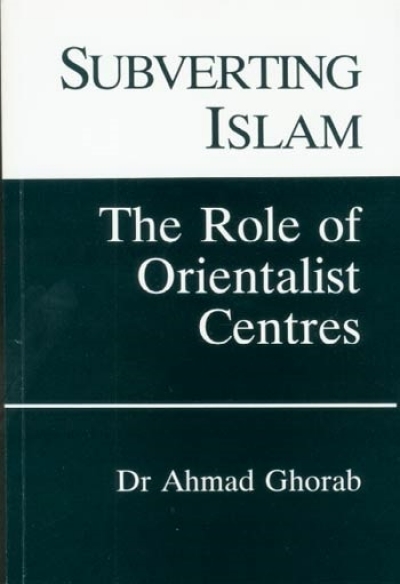
Subverting Islam: The Role of Orientalist Centres by Dr Ahmad Ghorab, (Minerva Press, London, 1995).
Dr Ahmad Ghorab is to be commended for his fine book, Subverting Islam: The Role of Orientalist Centres. His courage and forthright honesty is an inspiration for concerned Muslims in search of the truth. He has succeeded in identifying an important front in the current Euro-American crusade against the Islamic movement: the formation of an anti-Muslim network of institutions and scholars marching under the banner of `Islamic Studies'.
In his insider expose' of `Islamic Studies,' Dr Ghorab demonstrates how the new school of thought derives legitimacy by employing compliant Muslim scholars and professors, such as Ja'afar Sheikh Idris, Yusuf al-Qaradawi, Abdullah and Akbar Ahmed, to name just a few. Christian missionaries and professors, such as Bishop Kenneth Cragg, Rev. Montgomery Watt and John Esposito, are, as Dr Ghorab shows, always close at hand to guide verious `Islamic Studies' programmes . Dr Ghorab also exposes the Saudi role in funding such programmes, both in the Muslim world and in various European and American academic institutions.
Dr Ghorab provides a detailed discussion of the Oxford Centre for `Islamic Studies,' and also mentions other institutions with similar programmes, such as the Hartford Seminary, College of the Holy Cross, or Princeton University. By naming people and places subverting Islam, Dr Ghorab has done a great service for the Islamic movement. Muslims who are considering attending these institutions or consulting with these scholars should first study Dr Ghorab's book carefully. Many additional books can, and should, be written about the numerous `Islamic Studies' programmes proliferating in western academic institutions. This is especially urgent, since some Muslim-run schools, such as the Institute of Islamic Thought in Malaysia, hire their faculties almost exclusively from western universities.
Columbia University in New York City, fits Dr Ghorab's description of a centre for subverting Islam. While there is no department of Islamic Studies per se, Islam is the focus of various components within the Departments of Middle East Languages and Cultures (MELAC), Religion, Music, and, Anthropology, as well as the Middle East Institute. Though staffed primarily by Jews and Christians, there are also a few Muslim professors on hand for good measure. While the student body is one-third Jewish, some Muslim students take their degrees from Columbia, a few in MELAC. However, MELAC is especially popular with new or weak Muslims who hope to increase their faith or learn more about their religion and history by taking a few courses in the Department.
MELAC houses primarily language programmes, offering courses on Islam as they relate to the study of classic texts. The faculty includes Maan Madina, Hamid Dabashi, George Saliba, and Jeanette Wakin. A product of the American University in Beirut, Madina is an Arab secular-nationalist and uses his Arabic language courses to promote the works of Taha Husayn, Ali Abdul Raziq, and Michel Aflaq (The latter founded the Ba'ath party and was a mentor of Saddam. Madina is an avid collector of Islamic art, and occasionally offers courses in affiliation with the New York Metropolitan Museum of Art. To him, Islam is a vestige of the Arab past, to be revised by western scholars or curated in museums.
Waken offers courses on Islamic texts. Although teaching at Columbia for many years, she apparently has no Ph.D; her academic legitimacy comes from being a student of Joseph Schacht, the notorious orientalist who sought to discredit the shari'ah on the grounds that it was time-bound and irrevelant to modern society. Wakin ascribes to this belief, as well as to Schacht's other `great contribution' to Islamic Studies, his insistence that the hadith are all fabricated and therefore unrliable as sources! Wakin's courses, also disguised as language study, are carefully focused attacks on the foundation of Islamic civilization.
Many of the students who study languages at Columbia do so either to train for the Israeli Mossad or the American Central Intelligence Agency (CIA). American students with mediocre grades, but who desire such careers, get scholarships to continue studying in places like the American University in Cairo or Robert College in Turkey. MELAC students also include Muslims training to serve American officialdom; one Jordanian-American Muslim student admitted he was mastering Arabic so he could pass a US State department examination. Politically motivated language study disguised as `cultural' studies gives this department its legitimacy, and guarantees a continuous line of funding.
MELAC offers more than language courses. Saliba deals with Islamic sciences, ascribing to Hans Kung's school of thought and assigning books like John Burton's Collection of the Qur'an which attacks the validity of the Qur'an as the word of God. Dabashi is a disgruntled Iranian who harbors animosity toward Imam Khomeini and the Islamic Revolution. Like other professors, he teaches Islamic literature and philosophy through the prism of western tradition, as noted by Dr Ghorab: 1) denying the validity of revelation; 2) ignoring the reliability of Islamic sources; 3) refusing to promote Islam as anything other than an object of academic study; 4) avoiding any personal commitment to Islam.
At Columbia, political studies of Islam are the task of the Middle East Institute, a part of the University's school of International and Public Affairs, which is a recruiting front for the CIA. The Institute houses orientalist historians like Richard Bulliet, as well as a number of zionists. It has a siege mentality toward the Islamic movement and is obsessed with discrediting Imam Khomeini and the Islamic Revolution. Its past directors include Linda S Walbridge, an American Baha'i scholar specializing in Muslims of the US, and whose husband, also a scholar of `Islamic Studies,' is currently editing the encyclopedia of Baha'ism.
One expects to find this in departments whose stated goals are to study Islam and the Middle East. However, other departments at Columbia are also staffed with like-minded people. For example, the Division of Ethnomusicology in the Department of Music is headed by Dieter Christensen, who has a long and questionable history of studying the Islamic world, including work in Iran under the despised Shah. He now has a magic carpet to Oman, invited by Sultan Qaboos annually since 1985. Qaboos hires western scholars to advise him on Muslim cultural policy, and Christensen runs the Centre for Traditional Music in Muscat.
In his seminars at Columbia, Christensen - who doesn't know a word of Arabic - presents Islam as a hindrance for academic study, often complaining about `extremist' Omani Muslims who take too many breaks for prayers, or how Ramadhan disrupts his research schedule. At the same time, he gleefully boasts of swilling beer with `modern' Omanis. He also edits the Yearbook for Traditional Music, which zionist and anti-Muslim scholars use to attack Islam and curate Muslim cultures. Christensen probably has links to American, German and Israeli Intelligence agencies, and has a record of advising graduate students whose research in the Muslim workd and elsewhere is linked to missionary activities.
The Muslim Student Association (MSA) at Columbia reflects `Islamic Studies' in practice. During the early 1990s, its president was a Jewish convert to Islam (who has reportedly now changed his mind). A model `moderate' Muslim, he was a student in the Department of Religion, which projects Islam as a violent antithesis to Buddhism, the preferred religion for this department's faculty. During his reign as MSA chief, it seemed that the campus rabbi had more power in the MSA than Muslims. For example, when the regular room for Jum'ah was double-booked one Friday - despite advance requests by the MSA - some Muslims suggested praying on the sidewalk in protest, since this had occurred in the past as well whenever another group needed space. After consulting his rabbi, the MSA chief intervened and arranged for Muslims to pray in the dungeon-like basement of the campus church!
Like most other MSA chapters, the one at Columbia also answers to the Saudis. In 1992 when Saudi ambassador Bandar bin Sultan offered to join hands with a group of zionists to commemorate the expulsion of Jews and Muslims from Spain, MSA-central in Indiana quickly called for implementation of this plan on its satellite campuses. When some Muslim students at Columbia suggested inviting Dr T B Irving, a Muslim scholar of Islamic Spain, the Jewish student protested, claiming that he was an `extremist' and an `anti-Semite,' the latter a zionist euphemism for anyone who questions Israeli supremacy. The programme was subsequently cancelled, after the Saudis and the zionists could not secure a `moderate' speaker.
These and other stories need to be heard and often. Dr Ghorab has correctly identified many of the allegiances and dynamics found within `Islamic Studies' programmes. In fact, similar `Islamic Studies' agendas can be found in many different organizations outside academia. Given all this, it seems incumbent upon concerned Muslims who are affiliated with any of these institutions or organizations to take Dr Ghorab's initiative and help expose the programmes in their own areas.
Much work along these lines needs to be done in the US, the base of what Syed Qutb called `American Islam.' In the US, people like Esposito are revered as Islamic scholars by several Muslim organizations. As Dr Ghorab points out, Esposito was invited by the Saudis as far back as 1983, when he suggested establishing an institute for `Islamic Studies' in the US. Since then, Shaykh Esposito has had stints on the advisory boards of American Muslim organizations, most recently the American Muslim Council, sharing the latter distinction with other `Islamic Studies' mainstays, including Hassan Hathout and Ali Mazrui. The ubiquitous Ja'afar Sheikh Idris also appears at AMC functions.
The American Muslim Council (AMC) needs to be investigated for ties to the Saudis and official Islam in places like Egypt, as well as for its connections wiht US government agencies and corporations. Its debut was in June 1990, only two months after board member Hathout attended a Saudi-sponsored conference in Riyadh, according to Dr Ghorab. The first AMC newsletter came out in the fall of 1990, at a time when the Saudis were building Muslim support for the murderous American oil war against Iraq.
One of the stated policy goals of the AMC is to entangle Muslims with American party politics, which is also a US government policy goal recommended by CIA analysts and the RAND Corporation in a special report prepared for the US department of Defence in 1990. Founding AMC member Robert Crane, whose long history of US government service includes an appointment as ambassador to the United Arab Emirates by US president Reagan, is one of the AMC ideologues. He fits Dr Ghorab's description to someone who is seeking to "revise" expediency. The AMC also appears to be playing a role in dividing Muslims between `moderates' and `extremists', fulfilling another agenda item for `Islamic Studies', as is evidenced by public statements on Steve Emerson's zionist `jihad' against Muslims or on the rigged `trial' of Shaikh Omar Abdel Rahman and other Muslims in New York.
Dr Ghorab lays the methodological foundation for systematically identifying and exposing `Islamic Studies' programmes in western and Muslim institutions. He has linked them to the ongoing western crusade against the Islamic movement, showing that such programmes operate in the service of taghoot. Concerned Muslims can and should find ways to continue his efforts and help prevent `American Islam' from gaining any further ground.

Dr Kalim Siddiqui 1933-1996 Obituary

Obituary

Crescent International

Dr Kalim Siddiqui was a leading intellectual of the Islamic movement during the final decades of the 20th century. He is best known as the Director of the Muslim Institute, London, which he founded in the early 1970s, and founder and Leader of the Muslim Parliament of Great Britain in the early 1990s, in the wake of the Rushdie controversy.

Well known for his unreserved support for the Islamic Revolution of Iran and its chief exponent to the outside world, Dr. Kalim Siddiqui, the late founder-leader of The Muslim Parliament in Britain, believed that the Muslim world needed a series of revolutions. His last book Stages of Islamic Revolution, which in his own words has the “flavour of his last testament”, was launched only two weeks ago during the Crescent International conference in South Africa.

A leading exponent of the global Islamic movement, his strong defence of Imam Khomeini’s fatwa against Salman Rushdie endeared him to the Muslim masses throughout the world.

One of his most important articles of faith was that jihad - which can mean anything from holy war to ‘holy struggle’ - is still a basic requirement of Islam. Another is that Islam requires an Islamic theocracy in order to flourish. “At the root of all our problems,” he said in a recent speech, “is the fact that Muslims have little experience of living as a minority in a country where we exercise virtually no political power.”

A third axiom is that the political and moral problems of today cannot be divorced from history. The colonies may have gone, but most Islamic countries are still ruled by Westernised elites who allow their people to be exploited by the West in return for support for their unrepresentative regimes. The only Islamic country ruled by and for its people - not for the West - is Iran.

“The present crop of regimes in Islamic countries, from Morocco to Indonesia, is unacceptable,” he said. “They have to be overthrown. Islamic revolutions are needed all over the Muslim world. Muslims have an overriding duty to overthrow those governments which currently rule Muslim countries.”

Dr Siddiqui’s first brush with the authorities came in 1942, when, as an 11 year-old schoolboy, he was shot at by a British soldier during nationalist agitations in Azamgarh in north-east India. The bullet killed the boy behind him. Most of his teens were spent in the very unpleasant atmosphere of the years leading up to partition, and he fled to Pakistan at the earliest opportunity, aged 17. He spent six dissatisfied years in Pakistan before arriving in Britain in 1954 with plans to become a journalist.

For the next 10 years he worked as a reporter on various local papers. Then, from 1964 until 1972, he was a sub-editor at The Guardian, London. He also married, in 1960, and, at around the same time, began to address what he perceived to be gaps in his education. He spent most of the Sixties as a part-time student, doing his journalism by night and studying by day, starting with O-levels and culminating in a Ph.D from University College, London. He also wrote a book, about Pakistan, which was banned in that country. And he became prominent among Britain’s earliest Islamic activists. Suez saw him demonstrating in Hyde Park; the Algerian war saw him driving friends to Paris to demonstrate in the Champs-Elysees.

In 1972 he abandoned journalism and with some friends founded The Muslim Institute, in Bloomsbury, funded by subscriptions from members and donations from Muslims around the world. “We started from the idea that Muslim political thought needed to be rewritten. We felt that Western political thought had penetrated Islamic political thought and that we needed an institute to disengage from the West at the intellectual level.” He himself became director of the Muslim Institute.

The Iranian revolution in 1979 was a turning-point, establishing for the first time in Dr Siddiqui’s lifetime the sort of Islamic state that his theories advocated. He became a regular visitor to Iran and was a friend of Imam Khomeini. Both men promoted a newly self-confident version of Islam, contemptuous of everything Western. His ideas earned him respect among Islamic activists around the world - including South Africa, Sudan and Malaysia where he last visited in April 1994.

His affection for Imam Khomeini was palpable in his voice whenever he had occasion to speak about the Imam. He saw Imam Khomeini as a role model. Dr Siddiqui used to speak warmly of his hero. “The Imam was a very great man. I think his greatness was not in the sense that people like Churchill or Hitler were great. He was a simple man. He simply believed in certain basic values and rallied people to them. He lived a simple life. He slept on the floor, his food was simple. He took nothing for himself. He was an example to men.”

Some British Muslims prefer not to be associated with Dr Siddiqui’s Muslim manifesto establishing the Muslim Parliament of Great Britain, questioned his right to do so and criticised him. Dr Siddiqui was equally keen not to be associated with them. “These so-called moderates who are always being wheeled out to criticise me are not Muslims at all,” he said. Yet in the manifesto he calls for all Muslims to unite in mutual self-defence. They are urged, for example, “to develop the Muslim community as an island of peace, harmony and moral excellence” and to achieve “the greatest possible degree of taqwa” (moral excellence acceptable to Allah). There are also worthy proposals to take practical steps to strengthen Britain’s network of mosques and protect Muslim interests in public life.

The manifesto’s starting point is that “in Britain today, Muslims are being asked to accept subservience and the total disintegration of their identity, culture and religion, as the only real options open to them.” Its finishing point, to quote from the speech with which Dr Siddiqui launched it, is that, “Inside 10 years we can pack a greater punch than the Jews.”

How much influence his vision will have on Britain’s Muslim community remains to be seen. It is possible that its effects will be quite far-reaching. But it is also interesting because of the way it resembles Dr Siddiqui himself: intelligent, eloquent, perceptive and civilised.

Muslimedia - April 1996-August 1996