Showing posts with label afghanistan war. Show all posts

Friday, December 13, 2019

The U.S. Government Lied about the Afghanistan War, They Couldn’t Have Done It Without Media Lapdogs

 
Photograph Source: Jayel Aheram – CC BY 2.0
“In ten years or so, we’ll leak the truth,” the Dead Kennedys sang. “But by then it’s only so much paper.”
But it might just score you a Pulitzer Prize.
Award bait and bragging rights are no doubt the principal goals of The Washington Post’s self-congratulatory data dump, “The Afghanistan Papers.” As the headline implies, the 2000 pages that a court-ordered the Office of the Special Inspector General for Afghanistan Reconstruction to release to Jeff Bezos’ newspaper paints a Robert McNamara-esque portrait of not-so-best-or-bright Bush and Obama Administration bozos privately admitting what they knew all along—that the U.S. invasion and occupation of Afghanistan was always an unwinnable, counterproductive mistake—at the same time they were telling the American people that victory in the post-9/11 “good war” was right around the corner. All we had to win was win Afghan hearts and minds.
“The [I.G.] documents also contradict a long chorus of public statements from U.S. presidents, military commanders and diplomats who assured Americans year after year that they were making progress in Afghanistan and the war was worth fighting,” the Post reported. “Several of those interviewed described explicit and sustained efforts by the U.S. government to deliberately mislead the public. They said it was common at military headquarters in Kabul—and at the White House—to distort statistics to make it appear the United States was winning the war when that was not the case.”
“The Afghanistan Papers” is a bright, shining lie by omission. Yes, our military and civilian leaders lied to us about Afghanistan. But they could never have spread their murderous BS—thousands of U.S. soldiers and tens of thousands of Afghans killed, trillions of dollars wasted—without media organizations like the Washington Post, which served as unquestioning government stenographers.
Press outlets like the Post and New York Times weren’t merely idiots used to disseminate pro-war propaganda. They actively censored people who knew we never should have gone into Afghanistan and tried to tell American voters the truth.
People like me.
I was among the tiny minority of journalists and commentators who opposed the Afghanistan war from the very beginning. Nine days after 9/11, I published the first of my cartoons pointing out that Al Qaeda was in Pakistan, not Afghanistan, so there was no moral or legal justification for invading. As the war dragged on I pointed out that the men and women in charge of the war didn’t have a clue about Afghanistan or the Afghan people. According to “The Afghanistan Papers,” those men and women knew they were screwing up, wouldn’t admit their ignorance and refused to bring in experts.
I went to Afghanistan to check things out for myself. It was obvious the U.S. didn’t stand a chance there. “The principal goal of this adventure in imperialistic vengeance, it seems obvious, should be to install a friendly government in Kabul. But we’re winning neither hearts nor minds among either the commoners or the leadership of the current regime apparent,” I wrote from Afghanistan on December 11, 2001. “And so we’ve lost this war, not because they’re good or we’re not, but because of who we are. The American Empire can’t spend the bodies or the time or the cash to fix this crazyass place, because in the final analysis, election-year W. was right—we’re not nation builders…we ought to tally our dead, write up our losses, and count ourselves lucky to still be called a superpower.” My piece, for The Village Voice, was titled “How We Lost Afghanistan.”
It was published eighteen years ago. But not in the Post. They didn’t want to hear what lefties like me had to say.
They still don’t.
Afghanistan was not a passing fancy for me. I wrote hundreds of essays and drew hundreds of cartoons urging an end to the madness. It was lonely. Even Democrats liked the Afghan war; they called it the right war while Iraq was the dumb one.
I went back to the country, traveling independently as an unembedded reporter, several times. I wrote the first book about the U.S. invasion of Afghanistan, the only book about oil pipeline politics in that country, a book placing Afghanistan in the context of Central Asia, and yet another book comparing the state of Afghanistan when Obama said we were pulling out—another lie—with how it was at the start of the war.
What was my reward for being right while everyone else was wrong? Hundreds of death threats. Getting fired by my client newspapers and magazines. It’s hard to believe now but back in 2004 George W. Bush was popular and being compared to Winston Churchill; that was the year that the “liberal” New York Times and Washington Post stopped running my work.
Major news outlets and book reviewers ignored my books. Editors refused to hire me. Producers wouldn’t book me. Anyone opposed to the Afghanistan war was censored from U.S. corporate media.
Not that Afghanistan was ignored. It was the subject of countless analysis pieces and opinion articles in American newspapers—all of it pro-war propaganda. There were thousands of television and radio stories about the Afghan war on radio and television. Corporate media repeatedly trotted out the same retired generals, former CIA officers, and random right-wing warmongers for quotes and analysis. Never, ever did they invite critics or opponents of U.S. interventionism in Afghanistan to share their thoughts with readers, listeners and viewers.
Nothing has changed. Whenever there is a foreign policy “crisis,” you will never read or hear or see someone completely opposed to U.S. involvement given a voice in the media. Certainly not in the Post.
So, 18 years and tens of thousands of lives and trillions of dollars too late, it’s nice to see the media finally shame these scumbags and their government handlers. But they ought to save a big portion of the blame for themselves.

Wednesday, October 02, 2019

Americans Enable Unspeakable Atrocities Every Day

Not so long ago, in November 2010, I took command of B Troop, 4th Squadron, 4th US Cavalry in a ceremony at Fort Riley, Kansas. It was, for me, a proud day. Army officers are taught to revel in their unit’s history, and the 4th Cavalry Regiment had a long, storied past indeed. On that cool, late fall day, the squadron’s colors – a flag with battle streamers – fluttered. One read: Bud Dajo, Philippine Islands – a reference to one of the regiment’s past battles. The unit crest pictured on the flag and pinned on our uniforms included a volcano and a kris – the traditional wavy-edged sword of the regiment’s Moro opponents in the Philippines – but hardly a trooper in the formation knew a thing about that war, battle, or the 4th Cavalry’s sordid past in the islands.
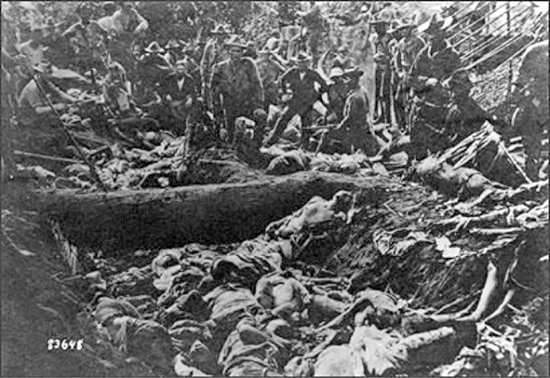
Bud Dajo was hardly a battle at all. It was a massacre. Some 1,000 Moro separatists, including their families, who opposed the US military occupation of Jolo Island, had fled to the crest of a volcano to avoid American conquest and retribution. Then, from 5-8 March 1906, the 4th Cavalry, along with other army formations, bombarded the overmatched Moros – few had firearms at all – then rushed the summit. The Moro men fought desperately and managed to inflict some 20 deaths on the charging American troopers, but they’d never stood a chance. Reaching the volcanic top, the cavalrymen fired down into the crater until all but six defenders and occupants were dead, a 99% casualty rate. The victorious troopers then proudly posed for a photograph, standing above the dead – which included hundreds of women and children – as though they were naught but big game trophies on a safari hunt.
Few Americans remember the US invasion, occupation, and pacification – a neat euphemism, that – of the Philippine Islands, but Filipinos will never forget. Perhaps half a million locals died (one-sixth of the total population) at the hands of superior US military technology, induced disease and starvation. The war also reflected and affected the US Army culture of the day. Most of the generals were veterans of the vicious Indian Wars of extermination in the previous decades. Racially pejorative terms for the Filipinos entered the military vernacular. Some, such as “nigger,” were reappropriated; others, like gugu – thought to be the etymological precursor to the Vietnam-era epithet gook – were new. The war also informed the army’s leadership for many years. The first twelve of the US Army’s chiefs of staff, including General John Pershing of World War I fame, had all served in the Philippines. The legacy was quite long. Even General George Marshall, architect of World War II victory and a future Secretary of State, had served in the islands as a fresh lieutenant.
The war bloodied and frustrated the US Army, too. Some 4,000 soldiers died, many more were wounded, and the conventional conflict and counterinsurgency raged from 1898-1913, making the Philippine War the second longest in American history, after Afghanistan, that is. The war did, in a peculiar moment during the 2016 presidential campaign, briefly earn a shout out from Donald Trump. In order to bolster his own calls for war crimes against terrorists and their families, he told an apocryphal – and debunked – story about how Pershing had once ordered bullets dipped in pig’s blood (considered unclean in Muslim culture), had 49 prisoners executed with them, and then set the one survivor free to inform his comrades of what awaited them should they continue to resist. The result, said Trump, “for 25 years there wasn’t a problem, okay?”
U.S. soldiers pose with Filipino Moro dead after the First Battle of Bud Dajo, March 7, 1906, in Jolo, Philippines.
It made for great rhetoric, but awful history. Not only had the incident never occurred but the war had dragged on for years after even the army’s worst atrocities, including the 1906 Bud Dajo massacre. A cool seven further years, in fact. Besides, Pershing – though himself flawed and later architect of his own volcanic Moro massacre of 200-300 souls in 1913 – had been largely sympathetic to the locals. He learned their language, ate their food, traveled unarmed to meet their leaders, and became the honorary father to a local sultan’s wife. When his superior, General Leonard Wood – who today has a prominent active fort named after him in Missouri – ordered the assault on Bud Dajo, Pershing had surveyed the results and declared “I would not want to have that on my conscience for the fame of Napoleon.”
Back home in the states, many prominent consciences were indeed shocked by the massacre, and, in particular, the trophy photo taken by the victorious troopers. The image flooded the papers, the 1906 version of going viral. At that time, unlike today, there was a substantial (if not majority) anti-imperialist movement brewing. It’s lead literary spokesman, Mark Twain, said of the Bud Dajo “battle,” “We abolished them utterly, leaving not even a baby alive to cry for its dead mother.” These words were hardly trifling, and the rhetoric and activism of anti-imperialists succeeding in getting opposition to empire and the Philippine occupation into the platform of even the highly racist, Jim Crow-era, Democratic Party.
The photograph also galvanized African-American civil rights activists. W.E.B. Du Bois declared the crater image to be “the most illuminating I’ve ever seen,” and considered displaying it on his classroom wall “to impress upon the students what wars and especially wars of conquest really means.”
Nothing even approaching that level of intellectual outrage exists now, as the American Empire spreads its tentacles the world over. Few public intellectuals – to the extent that endangered species even exists these days – even notice the extent of their nation’s ongoing war crimes in the Greater Middle East. Take Afghanistan, for example, the only war longer than the American debacle in the Philippines. After 18 indecisive and bloody years of combat, the US military and its Afghan allies now kill more civilians annually than the vicious Taliban. That ought to be cause for pause, reflection, concern. Only it isn’t, not in Washington, not even in most universities. We’re a long way from Du Bois posting the Bud Dajo picture on his classroom wall.
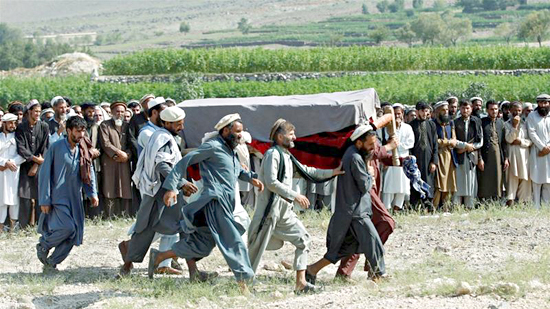
Men carry the coffin of one of the victims after a drone strike that killed 30 pine nut farmers in Nangarhar province, Afghanistan, on Sept. 19, 2019.
Not that there haven’t been plenty of shocking photos of the civilian victims of US bombing these past weeks. Over the course of just several days in late September, the military (“accidentally,” it claimed) struck two weddings, and a group of thirty innocent pine nut farmers. Total civilian deaths approached 100, with many of the victims (in the weddings) women and children. Their crimes, apparently: gathering while Afghan! That’s right, in militarized Afghanistan, merely forming sizable groups – for ceremonies, funerals, farming – appears, to drone operators and bomber pilots, apparently criminal and threatening.
Far too often, way more routinely than Americans are apt to remember, US aircraft have subsequently slaughtered civilians – thereby bolstering Taliban narratives and recruitment, and sowing distrust of the U.S.-backed Kabul regime. Nevertheless, you’d never know it back here in the safety of the homeland. These war crimes hardly crack mainstream media and the macabre photo evidence barely raises an American eyebrow. That’s apathy manifested as tragedy.
So consider this modest piece of mine, this brief history lesson and connection to contemporary US empire, a plea of sorts to the teachers of America. Want to be a true patriot, a forceful educator, and decent human being? Well, do your students a favor: post the photos of recent US military airstrikes upon civilians in Afghanistan – the war crimes of the 21st century – on your classroom walls. Du Bois, and Twain, would be proud…and that’s hardly bad intellectual company to keep…


Maj. Danny Sjursen
Maj. Danny Sjursen is a retired U.S. Army officer and former history instructor at West Point. He served tours with reconnaissance units in Iraq and Afghanistan...