
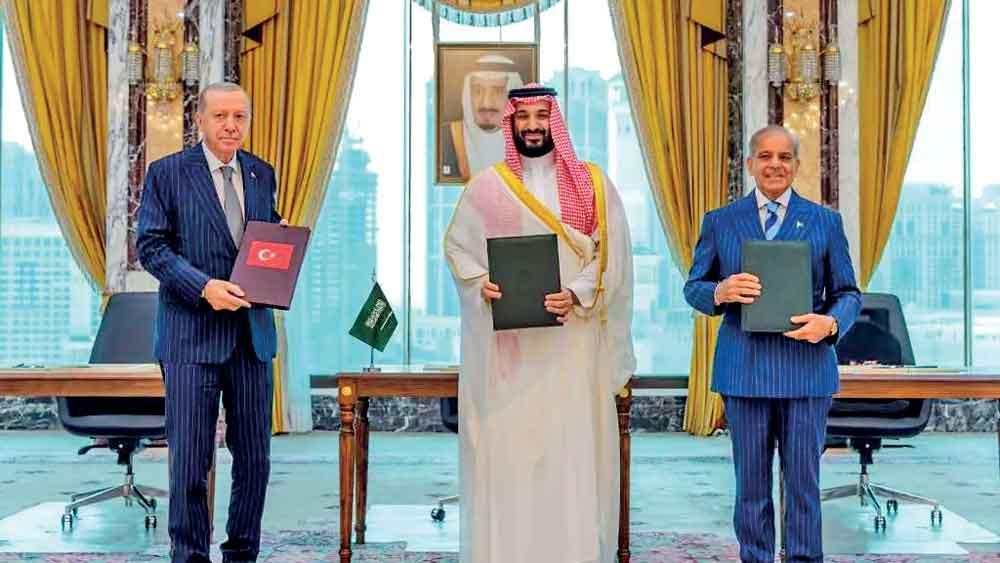
From left: Turkish President Recep Tayyip Erdogan, Saudi Crown Prince Mohammed bin Salman and Pakistani Prime Minister Shehbaz Sharif holding copies of the Mecca Pact after they signed the joint defence agreement in Mecca and August 7. Credit: Facebook/Shehbaz Sharif

The choice of Mecca as the venue for the leaders of Turkey, Saudi Arabia, and Pakistan was both significant and deliberate, for the holy city symbolises the Qur’anic call for Muslim unity — a call that has remained elusive since the passing of the Prophet Muhammad 1,437 Hijri years ago.
If Muslim unity is what the ‘Mecca Joint Defence Agreement’ represents, does the accord between the three Sunni‑majority countries portray Sunni solidarity while excluding Shiites, who comprise 15 per cent of the world’s two billion Muslims? The three countries, however, have rejected attempts to frame the deal in sectarian terms.
Now rewind history to the early 20th century, when World War I broke out. There was no Saudi Arabia then. Ottoman Sultan Mehmed V declared jihad, or holy war, calling on the world’s Muslims to join his empire’s fight against the Allies, led by Britain. Instead of responding to the call, many Arabs rebelled. Wahhabi imams such as Sulaiman ibn Sahman from the Najd province in present‑day Saudi Arabia issued fatwas to justify the rebellion in religious terms. Ibn Sahman’s fatwa declared the Muslim Ottomans kafirs (infidels) and hailed the British as Ahl al‑Kitab (People of the Scriptures), urging Muslims to join the Britain‑led Allies.
In another blow to the Ottomans, (Turks), Wahhabi forces from Najd attacked northern Arabia’s Rashidi tribes, whose support the Ottomans relied on to prevent the British forces from capturing Palestine, including Jerusalem. The end result was that the Ottomans lost Jerusalem, and the Arab Middle East was carved into nation‑states, weakening Arab unity and enabling the Zionists to establish Israel — the root cause of many of the region’s problems, including the current war of aggression against Iran.
From the post–World War I division of the Middle East to August 7, 2026, much blood has flowed under the bridge. In the interim, Saudi Arabia’s King Abdulaziz Ibn Saud met President Roosevelt in 1945 to establish a defence partnership; the secular Turkish Republic joined the North Atlantic Treaty Organisation in 1952; and Pakistan threw its weight behind the Western bloc during the Cold War, later siding with a rising China, and now seeks to balance between China and Donald Trump’s United States.
An attempt at unity after a century of division is indeed a welcome move.
Some have called the August 7 deal a ‘Muslim NATO’ because it contains an Article 5‑like clause warning any aggressor that an attack on one will be regarded as an attack on all. This raises serious security concerns with global implications, since all three nations face unresolved disputes ‘ Pakistan with India and Afghanistan; Saudi Arabia with Iran, the Houthis in Yemen, and other regional rivals; and Türkiye with Greece.
Aside from the comparison to NATO’s Article 5, the deal does not resemble NATO in its structure or function. It does not include provisions for a NATO‑style organisational structure with a headquarters, a secretary general, and a supreme commander. Cynics also view it as an alliance of Sunni Muslim nations that have not fought Israel, directed against a nation — Iran — that has. The three signatories, however, insist the agreement is defensive in nature and intended to strengthen collective security and promote regional stability, not to target any specific country.
Iran has welcomed the agreement.
Signed by Türkiye’s President Recep Tayyip Erdoğan, Saudi Crown Prince Mohammed bin Salman, and Pakistan’s Prime Minister Shehbaz Sharif, the Mecca agreement underscores the emerging security realities of the Middle East after Iran demonstrated its ability to withstand both the United States and Israel.
The Mecca pact also exposed the unreliability of the United States as a security partner. Saudi Arabia has bitter experience with Washington, which failed to respond to drone and cruise‑missile attacks on Saudi oil facilities in September, allegedly carried out by Iran. Saudi Arabia was shocked when Israel struck a residential facility housing a Hamas peace delegation in Qatar last year, with the US maintaining strategic ignorance, thus abandoning Qatar despite close defence ties. Moreover, when the Iran war broke out, Washington was unable to provide security cover to regional countries, even as it relied on bases and radar facilities in those countries to attack Iran.
Amid these concerns, Saudi Arabia saw its security liabilities rise. They include Iran’s emergence as a regional superpower; the ability of the pro‑Iranian Houthi militia in war‑ravaged Yemen to hit Saudi targets; the United Arab Emirates’ rogue behaviour destabilising the Red Sea region; and Israeli politicians — including Prime Minister Benjamin Netanyahu — publicly flaunting the ‘Greater Israel’ map that incorporates one‑third of Saudi Arabia. Another growing concern is Israel’s attempt to establish a base in Somaliland after recognising Somalia’s breakaway region overlooking Saudi Arabia’s strategic Red Sea coast.
The Mecca agreement follows a failed Saudi attempt between 2015 and 2017 to form a pan‑Islamic military coalition against the backdrop of Yemen’s civil war. The August 7 deal emerged after a top‑secret initiative by Ankara, which has not taken lightly Israel’s recent comments describing Türkiye as a security threat.
The Mecca security alliance is reinforced by Saudi Arabia’s financial strength and strategic geography, stretching east to west from the Strait of Hormuz to the Red Sea; Türkiye’s military weight as an advanced arms manufacturer; and Pakistan’s ability to provide the much‑needed nuclear umbrella.
The deal signals the formalisation of the close security relations that Türkiye and Saudi Arabia already had with Pakistan. It also expands on the agreement Islamabad and Riyadh signed in September last year.
As expected, the Mecca agreement has unsettled Israel and India. Israeli analysts view their country as the alliance’s main target, while India says it is committed to safeguarding its national interests and assessing the development. Both India and Israel are nevertheless expected to strengthen their already close security partnership — a partnership that prompted Amnesty International to accuse India of complicity in the Gaza genocide. Both countries are members of the Middle Eastern Quad, also known as I2U2 — comprising Israel, India, the United States and the UAE.
Regarded as the mother country of Sunni Islam, Saudi Arabia sits atop a military power mine it does not know how to harness or strategise. If Ray Klein’s formula is applied to measure Saudi Arabia’s power, what it lacks is strategic population strength and the political will to resist — elements that can come only through the Islamisation of security, as Iran has done. Iran’s security solutions are home‑grown and faith‑driven, whereas Saudi Arabia depends on Western solutions, particularly from the United States, which is certain to side with Israel should war erupt between Israel and Saudi Arabia.
Islamisation of security offers Saudi Arabia a two‑billion‑strong global military force. Meanwhile, the Mecca security deal could emerge as a greater deterrent against Israel and ensure regional stability if it can bring Iran into the fold or establish a separate regional security pact with Tehran.

No comments:
Post a Comment