Showing posts with label Vank Cathedral. Show all posts

Monday, December 09, 2019

350th Anniversary of Vank Cathedral

Compiled By: Firouzeh Mirrazavi

Deputy Editor of Iran Review

A ceremony was held in Isfahan capital city on Monday (20th October, 2014) to mark the 350th anniversary of construction of the Holy Savior Cathedral also known as Vank Cathedral. Vank Cathedral, also known as the Church of the Saintly Sisters, is the most visited cathedral in Isfahan. Vank means "cathedral" in the Armenian language. The ceremony was attended by Armenian Church Leader His Holiness Aram I, Archbishop of Isfahan province and southern parts of Iran Babken Charian and a group of Isfahan's Armenian residents and officials. During the service, Archbishop Charian recited Prayers of Lament and holy bread was distributed among worshipers.

Following the Ottoman war of 1603-1605, Armenians began to arrive in Iran in search of a new life under the Safavid King Shah Abbas I. Shah Abbas I, who settled tens of thousands of them in the Iranian provinces south of Aras River, also relocated Armenians, who had fled from the Ottoman massacre in Nakhchivan to Iran.


Nakhchivan suffered a lot during the 14th to 18th century wars between Persia and the Ottoman Empire. The city fell under Safavid rule in the 16th century. In 1604, when Shah Abbas I realized that the lands of Nakhchivan and its surrounding areas might fall into Ottoman hands, he decided to force the entire Muslim, Jewish and Armenian population of the city to leave their homes and move to Iran. The Armenian immigrants settled in Isfahan, the capital of the Safavid Dynasty, and populated the city's New Jolfa district, which was named after their original homeland in today's Azerbaijan Republic.


Upon entering Iran, Armenian refugees started building churches and monasteries to continue their religious activities in their new home. The first monastery in Jolfa was built in 1606 and included a little church called Amna Perkich, which means 'All Healing.' The little church was later expanded and turned into the magnificently designed Vank Cathedral, which was built 50 years later under the supervision of Archbishop David. One of the largest and most beautiful churches of Iran, the cathedral was completed in 1664. It includes a bell-tower, built in 1702, a printing press, founded by Bishop Khachatoor, a library established in 1884, and a museum opened in 1905.


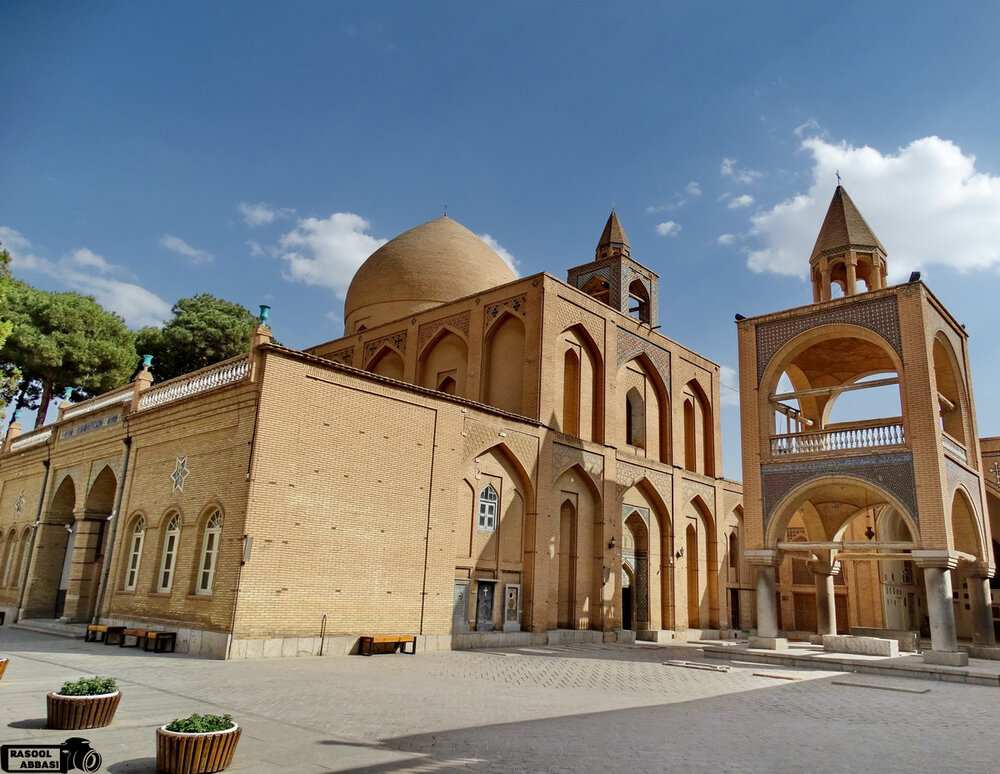
The architecture of the building is a mixture of the 17th-century Safavid style with high arches and an Islamic-style dome. The cathedral has greatly influenced the architecture and decorative treatment of many churches in Iran and the Mesopotamian region. The main entrance of the cathedral is a large wooden door through which visitors enter the courtyard of the building. Upon entering the courtyard, one encounters two rooms that were once used as administrative offices, which helped Armenians process their paperwork. A large freestanding belfry stands in the cathedral courtyard and towers over the graves of Orthodox and Protestant Christians who have been buried along the wall before the entrance. Built 38 years after the main structure, the belfry leads into the nave.


On the right side of the belfry there is a large blue inscription surrounded by crucifix stones. The stones have been collected from the ruined churches of the Jolfa quarter. On a raised area to the left, a memorial has been set up in memory of the victims of the Ottoman massacre. Every year on April 23 Armenians gather by the memorial to light candles in honor of their martyrs. At a corner of the cathedral's courtyard, rooms and halls have been built to accommodate guests, the Isfahan archbishop and his retinue, as well as other Armenian religious authorities in Iran. Across the courtyard and facing the cathedral is a building, which houses the Vank library and museum.


The library contains more than 700 manuscripts and hard-to-find sources on Armenian and medieval European languages and arts. The Vank museum houses unique and priceless collections of various types of items gathered from across the Armenian world. Built in 1871, the museum contains numerous objects related to the history of the cathedral and the Armenian community of Isfahan, including the 1606 edict of Shah Abbas I establishing New Jolfa and prohibiting interference with, or the persecution of, Armenians and their property and affairs in the district. Exquisite Bibles are also part of the museum's dazzling collection. A seven-gram bible displayed at the museum is believed by some to be the world's smallest written text in seven languages.


Safavid costumes, tapestries, European paintings brought back by Armenian merchants, embroideries and other valuable items from the Iranian-Armenian trading heritage are also part of the museum's unique archive. The Vank museum also houses an extensive collection of photographs, maps, and Turkish documents related to the 1915 massacre of Armenians by Ottoman kings. Vestments, monstrances, chalices and other sacramental objects have also been displayed at the museum.


The Vank printing house is known as the first of its kind in Iran and the Middle East. The first book published at Vank was about the lives of Armenian priests and monks, a few prints of which are now kept at the Vank museum. The early printing machine, which was built by Bishop Khachatoor, was replaced by a new one brought from Amsterdam in 1647. Later in 1844, an Armenian resident of Jolfa brought a printing machine from Europe, which is also housed at Vank Museum. The first book printed by the machine was the Psalms of David, which is now kept at Oxford's Bodleian Library.


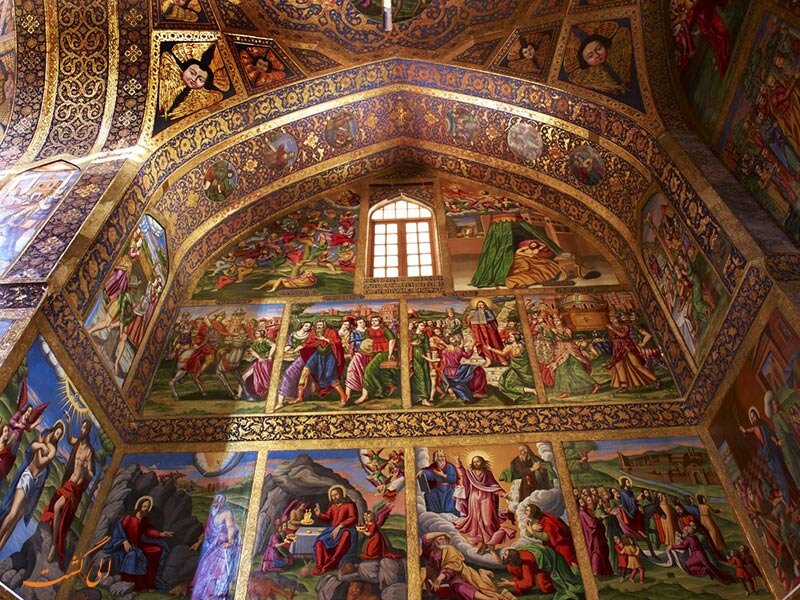
The dun-colored brick exterior of the cathedral gives way to a stunning combination of Persian tiles, Byzantine gold and European-style frescos inside. The modern and plain exterior has a striking contrast with its gloriously decorated interior. The entrance ceiling is adorned with floral motifs and the top of the walls are covered with murals depicting events from the life of Jesus. The interior is adorned with paintings, gilded carvings and eye-catching tilework and the pendentives bear painted images of a cherub's head surrounded by folded wings. On the northern wall of the cathedral paintings of Judgment Day can be seen with heaven depicted above and hell below. The bottom parts of the interior walls are covered with paintings depicting Armenians being tortured by the Ottoman Turks. The double-layer brick dome is beautifully gilded and adorned with paintings and floral patters in its azure interior.


The paintings depict the Biblical story of the creation of the universe and man's expulsion from Eden. Eight windows surround the dome with biblical scenes painted between them. The creation of Adam and Eve, eating the forbidden fruit and the death of Able are among the stories painted between the windows. The narthex is also adorned with four paintings, which are surrounded with floral patterns and show tortures inflicted upon holy figures. The birth of Jesus, the Last Supper, the crucifixion of Jesus and the Ascension of Jesus are also among the biblical stories depicted in the paintings inside the cathedral. The paintings have been inspired by both old and new testaments and have been painted by Armenian masters and three monks, namely; Havans, Stepanus and Minas.


After the death of Shah Abbas I, his successor Shah Abbas II also paid close attention to Armenians and New Jolfa, which is located on the banks of the Zayandeh River and still houses a large part of the Iranian-Armenian community.


Iran's Armenian community grew in number as until 1933 immigrants and refugees continued to flock to Iran from the Soviet Union. They built churches, schools and various cultural, artistic and sports centers across the country and eventually became Iran's largest Christian community. Today, Iranian-Armenians have two seats in the Iranian Parliament (Majlis) and are the only minority with official observing status in the country's Guardian and Expediency Councils. Armenians also publish books, journals, periodicals, and newspapers, including the daily Alik. Many Armenians served in the Iranian army, and many died in action during the Iran–Iraq War. Due to Iran-Iraq War the number of Iran's 250,000 Armenians further decreased to its current 150,000. Today in Iran there are about 120,000 - 150,000 Armenians left. Half of which live in the Tehran area. A quarter live in Isfahan, and the other quarter is concentrated in Northwestern Iran or Iranian Azarbaijan. In addition to having their own churches and clubs, Armenians of Iran are one of the few linguistic minorities in Iran with their own schools.

*Photo Credit: Mehr NewsFars NewsISNATasnim

Isfahan Half of the World


French poet Renier visited Isfahan for the first time, he was amazed and called it “Half of the World”.
Isfahan flourished under the Safavid Dynasty and is renowned for its outstanding Islamic and Iranian architecture. In those times, it had a population of one million and boasted of many parks, libraries, public baths, shops and mosques that amazed domestic and foreign visitors alike.
One of the great works of Shah Abbas in that period was Naqsh-e Jahan (“Pattern of the world”) Square which is a jewel in Isfahan’s crown. This majestic complex comprises commercial, worship and aristocratic buildings designed with a view to aesthetics and visual harmony.
Tourist Spots
To the west of Imam Square, a beautiful tree-lined boulevard offers delightful hours of walking under its cool green shades. Chahar Bagh is the main street of Isfahan and traverses Zayandeh Rud. Some of the world’s most picturesque bridges have been built on this river.
Another place worth spending hours is the city’s four-mile labyrinthine bazaar, with its majestic Qeysarieh Portal in Imam Square.
Andre Malraux, the famous French author and adventurer, says, “Who can claim to have seen the most beautiful city of the world without having seen Isfahan?”
Therefore, do not hesitate to visit the Florence of Iran whose well-proportioned mosques and their turquoise blue domes and minarets rival the color of the sky.
Ali-Qapu Palace
The name Aali-Qapu, meaning “Magnificent Gate“, was given to this place as it was right at the entrance of the Safavid palaces that stretched from Naqsh-e Jahan Square to Chahar Bagh Boulevard. Built at the end of 16th century, the royal palace was used to entertain visitors and foreign ambassadors.
Aali-Qapu is 48 meters high and has five floors, with a wide terrace whose ceiling is inlaid and supported by wooden columns. It offers a wonderful panoramic view of the square and the best view of Imam Mosque. The interior of the building is decorated with paintings by Reza Abbasi, the renowned Persian miniaturist. On the upper floor, the music room is also decorated with plasterwork representing pots and vessels.
Imam Mosque
Imam Mosque, formerly called Shah Mosque, is one of the greatest architectural achievements of Shah Abbas I who built it to complete the magnificent central square of Isfahan. Work started on its outstanding entrance in 1611 and it was not until 1629, the last year of Shah Abbas’s reign when the mosque was completed, although minor decorations were added during the reign of his descendants.
The height of the entrance’s minarets is 48 meters, southern minarets 42 meters and central dome 52 meters. Due to double-layering the interior, its ceiling is 36.3 meters high, and the hollow space in between is responsible for the loud echoes heard when you stamp your foot below the dome.
The entrance faces the square as a counterpoint to the Qeysarieh portal, but the mosque is designed to point in the direction of Mecca. A short corridor leads into the inner courtyard, which has a pool and is surrounded by four corridors, each of which leads into a vaulted sanctuary. There are also two theological schools, a marble prayer niche and a pulpit at the head of stairs on which the speaker sits, which are beautifully crafted.
The mosque is completely covered, both inside and outside, with dazzling tiles. An estimated 18 million bricks and 472,500 tiles have been used in the building. The richness of its blue-tiled mosaic designs, the unity of the overall structure and its perfectly proportioned Safavid-era architecture form a visually stunning monument.
Chehel Sotoun
This building, now a veritable museum of Persian painting and ceramics, was a pleasure pavilion used for the king’s entertainments and receptions. It stands inside a vast royal park, but near the enclosure, and was built by Shah Abbas II around an earlier building erected by Shah Abbas I.
An inscription states that the decoration and frescoes were completed in 1647. Only two large historical frescoes date from the later period of the Zand dynasty.
Unfortunately, the Chehel Sotoun has been badly damaged since then, especially when the Afghans occupied the town and covered the paintings with a thick coat of whitewash. It is now being extensively restored under the aegis of the Institute Italiano Per il Medio Orient.
The pavilion opens onto the gardens through an elegant terrace, only a few steps high and supported by slender, delicate wooden pillars. In reality, there were never more than 20 columns, but their reflections can be seen in the park’s pool and, hence, Iranians call the building “pavilion with forty columns” (besides, the number 40 has a symbolic meaning in Persia and expresses respect and admiration).
Two rows of water-spouts and fountains in the shape of stone lions at the four corners carried water to the huge, elegant rectangular basin. The terrace is a marvel of elegance. The slender pillars support a light wooden ceiling with wide fretwork louvers. This clearly shows the influence of East Asian architecture. Part of the sumptuous decoration has disappeared.
Picture the back wall covered with mirrors, doors made of rare carved wood and the pillars, each cut from a single plane tree, with their fine veneer, their brightly colored paintings and studs of colored glass. The remarkable ceiling is till intact with its beams, its covering, its painted wood louvers and its carefully designed rosettes, suns, stars, stylized fruit and foliage.
The great wooden ceilings--a rare luxury in a country so lacking in treesÑare guarded by four lions that support the central columns.
Shahrestan  Bridge
It is one of the oldest bridges of Isfahan on Zayandeh Rud.
Most of the 11-arched stone and brick structure is believed to date from Sassanid period prior to Islam and have been repaired and completed under the Dailamites and the Seljukids. The name Shahrestan comes from the village located to the east of Isfahan, which is now a part of the city.
Vank Cathedral
Vank Cathedral, built between 1606 and 1655 with the encouragement of Shah Abbas, is the historical focal point of Armenian Church in Iran. It is located in Jolfa, the Armenian quarter south of Si-o-Seh Pol. The church’s interior unlike its exterior is richly decorated with beautiful paintings and miniatures that represent biblical traditions and images of angels and apostles.
It shows the curious mixture of styles, Islamic tiles and designs alongside Christian imagery. The attached Vank Cathedral’s museum displays historical records and relics, and the edicts of Iranian kings dating back to the time of Shah Abbas I. It also contains an interesting collection of artworks.
Grand Bazaar
The Grand Bazaar of Isfahan, the heritage of the Seljuk and Safavid eras is one of the oldest and largest bazaars of the Middle East. It stretches from Imam Square to Jame’ Mosque several kilometers away.
The bazaar can be entered at dozens of points along its winding route, but the main entrance is via the Qeysarieh Portal at the northern end of Imam Square. The high gateway is decorated with tiles and, higher up, frescoes by Reza Abbasi depicting Shah Abbas’s war with the Uzbeks.
Like most Iranian bazaars, Grand Bazaar is loosely divided into several interconnected corridors, each specializing in a particular trade or product, with carpet dealers, goldsmiths, samovar-makers, shoemakers and dyers, all having their own quarters.
You can also find several mosques, tea shops, bathhouses and even gardens. Small apertures in the vaulted roof let in sufficient light yet kept out the intense heat of summer and retained warmth in winter.
Hash Behesht Palace
Hasht Behesht, a two-story palace, is located in the middle of Bagh-e Bolbol.
Built about 1669 by Shah Sulieman’s commission, it was once surrounded by a vast garden and similar buildings, of which nothing remains except this interesting and beautiful palace. It consists of an octagonal base on which four corridors and four smaller sets of chambers are raised, while the center is surmounted by a spectacular ceiling.
The domed ceiling of the main reception room is painted in purple on a glittering gold base. Painted tile designs of birds, animals and hunting scenes, found on the spandrels of the outer blind arches, enliven the facades of Hasht Behesht. The palace owes its fame, apart from its architectural and decorative merits, to the lavish use of marble slabs, vault decorations and excellent tilework dotted with scenes of animals (birds, beasts of prey and reptiles) covering the building on the outside.
Si-o-se Pol
Allahverdi Khan Bridge, built on a section of Zayandeh Rud, is a continuation of Chahar Bagh, the principal street in Isfahan.
Built at the beginning of 17th century on the order of Shah Abbas, it is named after a famous general. It is also called Si-o-Se Pol (Bridge of 33 Arches). It is said that the bridge originally comprised 40 arches, but this number gradually reduced to 33. It is the longest bridge in the city and is 45 feet wide and 175 yards long. Although it looks impressive, it does not have the same archeological or aesthetic interest as the two other bridges farther downstream.
Hammam-e Sheikh Bahai
The bath of Sheikh Bahai is located in a small street named after him in the southern section of the old bazaar close to Masjed-e-Jam’e. It derives its fame mainly from the story that it was warmed by a single candle placed in a closed space, which never needed a replacement.
The candle was larger than the ones normally placed on tables and the clay pipes, which supplied the water, became unusable many years ago. According to his own instructions, the candle would not work once it is dismantled. Unfortunately, this happened during the repair of the building and no one could make the system work again.
Monar Jonban (Shaking Minaret)
It is a mausoleum built over the grave of Abu Abdollah and dates back to Safavid period. Minarets on both sides of the mausoleum and its porch are the main attractions of this place. Because of the ratio between the height and width of the minarets, any movement produced in one of the minarets is automatically replicated by the other minaret.
The corridor of the mausoleum has been decorated with polygonal azure tiles, and the inscription on the tombstone reads as follows:
“This is the tomb of the virtuous, god-fearing Sheikh Abu Abdullah ibn Muhammad ibn Mahmud Saqla, my God bless his soul. Dated (17th Zil-Hijja, 716 AH).”
As Iran’s artistic and historical center, Isfahan offers a wide range of charming choices to tourists keen on visiting monuments and picturesque landscapes. They can also purchase Isfahan’s fine carpets, handicrafts, souvenirs and sweets.
Source: Iran Daily

Sunday, December 01, 2019

Cultural Importance of Vank Cathedral as Symbol of Coexistence of Religions

Fatemeh Safavi
Central Asia Analyst
In the early days of October, the Armenian Prelacy of Isfahan, held a conference dubbed “Vank Cathedral, Symbol of Interaction and Coexistence of Divine Religions,” which had special speakers and guests on the list of its invitees. The prelacy had been for a long time making extensive plans to hold a celebration to mark the 350th anniversary of the construction of the Vank Cathedral(1)
The conference aimed to introduce the activities as well as cultural and social reflections and other positive aspects of this cathedral in terms of promoting interaction among followers of monotheistic religions of Christianity and Islam both at national and international levels. During the conference, various issues related to the church, including murals of Vank Cathedral; architecture of Vank Cathedral; the art of writing manuscripts in New Jolfa; role of Armenians living in Isfahan’s New Jolfa neighborhood in shaping civilization of this city; role of Vank Cathedral as a spiritual center; social status and administrative system of New Jolfa Armenians during the 19th century; New Jolfa and international trade in the 17th century; potential opportunities and capacities of Isfahan Armenians for the improvement of relations between Iran and Armenia; role of Isfahan as the sister city of the Armenian capital, Yerevan, in promoting relations between Iran and Armenia; as well as the present situation of historical monuments such as statues and cross stones of Old and New Jolfa neighborhoods were presented in papers and posters. The conference was attended by a great number of scholars and researchers from such countries as the United States, Armenia, Italy and Lebanon.
Bishop Papken Tcharian, the religious leader of Armenians in Isfahan and south Iran, played the host to a group of clerics and Armenians from such Iranian cities as Isfahan, Shahin Shahr, Tehran and Tabriz, who had participated in of the event. One of the most respected invitees of the conference was Catholicos Aram I, the head of the Catholicosate of the Great House of Cilicia. The ceremony was held in cooperation with the Governor’s Office, the City Hall, General Department of Culture and Islamic Guidance of Isfahan, and other concerned provincial authorities.
After arriving in Iran, Catholicos Aram I attended Saint Sarkis Church (2) to address Armenians living in Tehran. While wishing health and increasing success for the Iranian nation, he said, “I give my special thanks to all the officials of the Islamic Republic.” In his remarks on the founder of the Islamic Republic, he noted, “The measures taken by Imam Khomeini were great and laudable and if the world has just come to appreciate the importance of peaceful coexistence of religions, Iran had reached that point 400 years ago.”
The religious leader of Armenians of the Great House of Cilicia, which is headquartered in Lebanon, added that the revolution which was led by Imam Khomeini in Iran proved to the world that no government can survive without reliance on religious values because the Islamic Revolution in Iran was a spiritual, religious and social revolution. As a result, he added, the Islamic Revolution highlighted the role of divine religions in the society and this is why being loyal to the Islamic Republic is a cause of honor for Armenians.
Catholicos Aram I then put emphasis on religious teachings that stipulate faith as the main impetus for family and social life. Touching on the social lifestyle, he added, “Faith is a source of inspiration in human life,” noting that despite all the difficulties in life, faith will help human beings to remain upright and break considerable grounds.
Papken Tcharian, the bishop of the Armenians in Isfahan and south Iran, then took to the podium noting that one of the greatest honors for the Iranian society is that religious minorities live freely alongside Muslims. He reiterated the remarks of Catholicos Aram I on the necessity of protecting the values of Armenians, noting that the ceremony was not just a simple gathering, but was held to mark the necessity for the protection of Armenians’ values. “For this reason, I am obliged to thank all the country’s officials, especially the Supreme Leader for their unparalleled cooperation with the Armenians to protect their historical monuments and carry out their religious rituals and I have to add that the model introduced by the Islamic Republic of Iran for peaceful coexistence of religions is the best model in the world, which should be followed by other countries as well,” he said.
In addition to touching on domestic issues, which were of interest to Armenian religious leaders, the speakers then turned to important regional and transregional developments. In doing so, they talked about such issues as bilateral relations and interactions between Iran and Armenia and gave their opinions about the activities of terrorist groups, especially the ISIS Takfiri terrorists as one of the main problems in contemporary world.
Catholicos Aram I then explained about the powerful role of Armenians in the political structure of the United States and talked about very important developments that have taken place in international arena. He said due to the very important role and status of Iran in the region and the world, diplomatic activities of the Islamic Republic of Iran can help to solve many regional problems, including the current problems faced in Syria and Lebanon.
He opined that the ISIS is a global scourge and underlined the undeniable role that Iran plays in fighting this group. He added, “Today, we are facing a major evil in the Middle East in the name of the ISIS and we are honored that the Lebanese Hezbollah movement is engaged in a serious and true war with this terrorist group.”
Reflecting on this issue, the bishop of Armenians in Isfahan and south Iran also pointed out that the ideas promoted by the ISIS are absolutely terroristic and have nothing to do with any of the monotheistic religions. He added that the measures taken by this terrorist group (the ISIS) have nothing to do with either Islam, or any other divine religions. As put by Papken Tcharian, the activities of this group can be summed up as animosity to religion and humanity and massacre of innocents and defenseless people. This religious leader asked international organizations not to allow the repetition of human catastrophes in countries that are in war with terrorist groups.
In conclusion, it should be noted that as put by Catholicos Aram I in his remarks, such gatherings serve to remind everybody that dialogue and coexistence among divine religions are major requisites for the establishment of peace and justice across the world. It is also noteworthy that the initiative taken for marking the 350th anniversary of Vank Cathedral in Isfahan provided an opportunity to discuss the existing issues related to the society, religions and the religious establishment. It can also pave the way for better recognition of the existing capacities and help find important and effective solutions to current problems and, as such, serve as a first step toward doing more in this regard. Armenians in all parts of the world can be considered as cultural emissaries of Iran, especially due to the very effective role that they can play in bolstering relations and contacts between the two neighboring countries of Iran and Armenia.
Notes:
(1) It is noteworthy that the historical and religious complex that is now known all around the world as the Vank Cathedral is located in Jolfa neighborhood of the central Iranian city of Isfahan. It is locally known as the center of monotheistic religions, which contains the secretariat of monotheistic religions and is now working as an institution affiliated with the Islamic Propagation Office of Isfahan.
(2) Located along Karim Khan Ave. in the Iranian capital city of Tehran

Tuesday, June 25, 2019

Vank Cathedral: A gorgeous fusion of Islamic, Armenian architecture

TEHRAN – The centuries-old Vank Cathedral (locally called Kelisa-ye Vank) is widely referred to as an everlasting masterpiece of architecture.
Located in New Jolfa district of Isfahan, central Iran, the Cathedral harmoniously blends Islamic motifs and elements with those of Armenians.  Vank means “monastery” or “convent” in the Armenian language.
Built in the first half of the 17th century, with the encouragement of the Safavid rulers, Kelisa-ye Vank is a historic focal point of the Armenian Church in Iran.
The cathedral consists of a domed sanctuary, much like an Iranian mosque, but with the significant addition of a semi-octagonal apse and raised chancel usually seen in western churches.
Its sumptuous interior is richly ornamented with restored wall paintings full of life and color, including gruesome martyrdoms and pantomime demons. The ceiling above the entrance is painted with delicate floral motifs in the style of Persian miniature.
The cathedral’s exteriors are in relatively modern brickwork and are exceptionally plain compared to its elaborately decorated interior.
There is also a museum exhibiting a fabulous collection of illustrated gospels and Bibles, some dating back as far as the 10th century.
Hundreds of Armenians, who migrated to Isfahan during Ottoman–Safavid War (1603–18), contributed to the cathedral being completed.
Some say that the varying fortunes and independence of this suburb across the Zayande River and its eclectic mix of European missionaries, mercenaries and travelers can be traced almost chronologically in the cathedral’s combination of building styles and contrasts in its external and internal architectural treatment.
The construction is said to begin in 1606 by the first arrivals being completed with major alterations to design between 1655 and 1664 under the supervision of Archbishop David.
The Armenian quarter of Isfahan dates from the time of Shah Abbas I, who transported a colony of Christians from the town of Jolfa (now on Iran’s northern border) en masse, and named the village ‘New Jolfa’. Shah Abbas sought their skills as merchants, entrepreneurs and artists and he ensured that their religious freedom was respected – albeit at a distance from the city’s Islamic center. At one time over 42,000 Armenian Christians reportedly lived here.
Many visitors visit the cathedral in the afternoon and stay on in New Jolfa to enjoy dinner in the relatively liberal village atmosphere.
Isfahan is Iran’s top tourist destination for good reasons. Its profusion of tree-lined boulevards, Persian gardens and important Islamic buildings gives it a visual appeal unmatched by any other Iranian city, and the many artisans working here underpin its reputation as a living museum of traditional culture.
Here is a select of comments that visitors to the cathedral have posted to TripAdvisor, one of the most popular travel websites in the world:
"Beautiful piece of history"
A not-to-be-missed visit in Isfahan. A beautiful piece of art and a nice museum. Useful to understand the construction of the city and yet another part of Armenian history in the world. (Sibtravelling form Brussels, Belgium; reviewed April 2019)
“Change from the mosques”
This cathedral is in the Armenian quarter of the city next door to the Armenian museum. It’s small for a cathedral but has some interesting art work and visiting the museum afterwards rounds out the backstory of Armenian migration to Iran. (Casa62 from Brisbane, Australia; reviewed April 2019)
“Worth your time”
Fabulous settings and artworks, museum not really inspiring. Though there are great funky coffee shops in the area. Suggest you take a stroll along the river. (Casanovawinner19 from London; reviewed April 2019)
“I expected more”
Armenian cathedral in Isfahan. I didn’t expect there is payment for visiting this holy place. Entrance fee is 50 000 toman. (Edin Krnic from Podgorica, Montenegro; reviewed May 2019)
"The awesome Armenian Cathedral of Isfahan!"
From its simple brick walls, one cannot imagine the beauty of its interior: a domed ceiling, several frescoes, gilded carvings and rich tileworks. On its courtyard, a bell tower, several graves, a stone cross, a library, a museum and a memorial to the 1915 Armenian Genocide. Combine your visit with lunch or snacks at any of the several cafés and restaurant of nearby “Jolfa Square”. Enjoy! (LuizDutraNeto from Rio de Janeiro, Brazil; reviewed February 19, 2019)