Showing posts with label Sudanese Janjaweed militia. Show all posts

Sunday, July 07, 2019

Backing the bad guys: US helping to sabotage new Arab uprising

Major Danny Sjursen
In the wake of the public uprisings in certain Arab countries, Washington instead of respecting people’s will for change of government, has decided to back the new military rulers who have taken power.
Stay with us for an article in this regard that appeared on the ‘Antiwar’ site, titled: “Backing the Bad Guys: US Helping To Sabotage New Arab Uprising”.  
The writer is retired US Major Danny Sjursen, who served combat tours with reconnaissance units in Iraq and Afghanistan and later taught history at his alma mater, West Point, before authoring a memoir and critical analysis of the Iraq War, titled: “Ghost Riders of Baghdad: Soldiers, Civilians, and the Myth of the Surge.”
Months back when protests rocked Algeria and Sudan, observers almost immediately dubbed it a “New Arab Spring.” This, of course, was a reference to the popular demonstrations that rocked several Arab states in 2011, ranging from Tunisia to Egypt, Libya and Bahrain to Yemen. The results 1.0 were ultimately disappointing – Egypt’s elected president was ousted in a military coup, Libya remains in a state of near civil war, Yemen is a war-ravaged humanitarian disaster area, and the Saudi Army invaded and quashed unrest in nearby Bahrain. Only in Tunisia was there a semblance of (fragile) success and relatively limited violence.
Perhaps, then, it should come as little surprise that matters are shaking out in a similarly disappointing fashion in Algeria, and, especially, Sudan. Military juntas (they call themselves "transitional" governments) hold power in both states and, in the case of Sudan, soldiers and militiamen have taken to slaughtering their own people. It seems there shall be no democracies in North Africa any time soon. Pessimism aside, it’s still a tragic and rather disturbing state of affairs. Nevertheless, I’m no proponent of US intervention in these complex affairs in distant lands. Indeed, I’ve previously asserted that Uncle Sam ought to "keep his hands off" the New Arab Spring this time around.
Solutions, such as they are, must be Algerian and Sudanese solutions. Recent regional history firmly demonstrates that foreign meddling tends only to stoke already chaotic fires and make matters far worse. Here’s the problem: the US may not be directly engaged, but, rather than staying out completely, continues to back Arab autocracies – Saudi Arabia, Egypt, and the UAE – that are actively destroying any hope for democracy in Sudan. It’s unconscionable. And, coming from a country that’s a self-proclaimed "beacon of democracy," it is also embarrassingly hypocritical.
What’s unfolding in Sudan, and America’s tacit role in these events, is far worse than it seems, and nearly ignored in US mainstream media.
Want to get actual news on North Africa? Better tune into Al Jazeera, because you’ll get minimal coverage and zero context from CNN. Here’s the rub: a mass uprising in April in Sudan toppled the thirty year incumbent, indicted war criminal President Omar al-Bashir.
Not a bad turn of events. Problem is the military – in tenuous alliance with government supported militias – took power and failed to hold democratic elections or transition to civilian rule. When the brave protesters refused to go home, a paramilitary group calling itself the Rapid Support Forces (RSF) began slaughtering peaceful demonstrators, gunning down at least 100 on June 3rd alone.
Since then matters have turned from bad to gruesome. The RSF, which, incidentally, grew out of the infamous Janjaweed militia responsible for the genocide in Darfur a decade ago, has gone on a murderous rampage in the capital, Khartoum. Protesters have been thrown off bridges, shops looted, men and women raped. Just when it seemed matters could hardly get worse, well, that’s when America’s best buddies in the region stepped in. That’s right, our chums the Egyptians, Emiratis, and Saudis – all dictatorships themselves – actively back the Sudanese junta. They’ve offered a combined $3 billion in cash to the military regime. The Saudis go one step further, loading the notorious genocidal militiaman (and number 2 leader in the junta) Hamdan Dagalo up with bundles of money and guns with which to slaughter the innocent.
So what, you might ask, does the US, does President Trump, have to say about all this? Crickets, that’s what.
Washington has released paltry platitudes at best and done absolutely nothing to restrain – pay attention now – its brutally dictatorial "friends" from empowering a genocidal maniac and military junta whose foot soldiers toss peaceful activists screaming from bridges to their deaths.
Trump has nothing but praise for the Egyptians and Saudis. He proudly pronounced that Egypt’s strongman, Abel Fattah as-Sisi is “doing a great job.” His Jewish son-in-law, Jared Kushner – nepotism incarnate – carries on a bromance with his literal pen pal, Saudi Heir Apparent and de facto ruler Mohamed bin Salman (MBS). Trump even declared a national emergency so as to defy Congress and push through a hasty $8 billion arms deal to the Saudis.
I’ve got a sneaking suspicion that some of those guns and bombs are going to make their way into the clutches of the murderous RSF. That puts Sudanese civilian blood on Americans’ collective hands.
It gets just a bit worse. Why, one might ask, does MBS back the war-criminal-in-chief of Sudan? Well, beyond MBS’ general affinity for fellow Arab dictators, he’s especially fond of Dagalo. That’s because Dagalo’s militias reportedly supply thousands of mercenary Sudanese foot soldiers – including child soldiers – as cannon fodder for the Saudi terror campaign in Yemen. It is truly a twisted state of affairs when two states – Yemen and Sudan – that are already the world’s worst humanitarian disaster areas, are manipulated even further by the Saudis to add to the bloodshed and preclude any hope for democracy. And still we’re told the Saudis are our "friends."
Let us review, then: the United States unconditionally backs a Saudi absolute monarchy that is terror bombing Yemeni civilians, and then trading guns to a genocidal Sudanese dictator in exchange for child soldiers that add to the fighting in Yemen. As such, any hope for democracy, or even basic human rights, dies in both locales. You can hardly make this up!
One last thing, our friends the Saudis, well, they recently had a teenager on death row for a crime – simply protesting the government – that he allegedly committed when just ten years of age. What friends Uncle Sam makes these days; talk about running with a bad crowd.
Not that many Americans notice. Media silence, ample profits for the arms dealer corporations that own many congressmen, and public apathy about foreign affairs, combine to keep the despicable, twisted Saudi-Sudanese nexus off the American grid. Still, what we ignore, the global community – especially in the West Asia-North Africa region – does not forget. The United States has widely come to be associated with imperialism and militarism. It’s certainly no friend of regional democracy. As such Washington acts as the terrorist recruiting sergeant’s best friend.
The US will one day reap the whirlwind for these sins. When it does, the American government, and the American people, will have no one to blame but themselves.

Friday, April 19, 2019

Sudan’s Revolution Risks Being Stolen From Under Our Noses

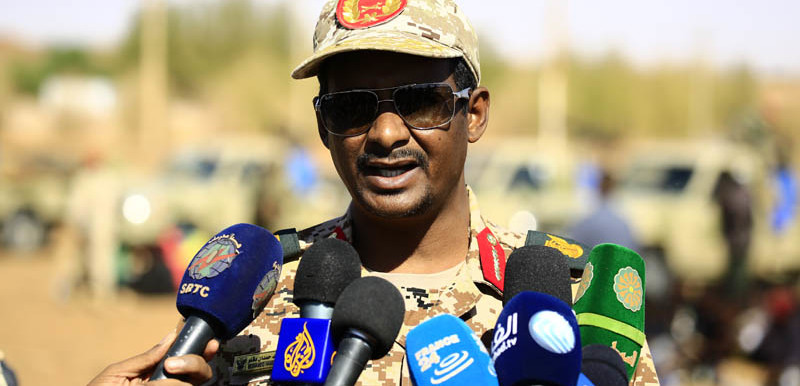
Gen. Mohamed Hmadan (Hemeti)
On April 11, there were jubilant scenes on the streets across Sudan when Omar al-Bashir was ousted after almost three decades in power.
When the protests started last December, an unprecedented number of Sudanese took part or supported the peaceful protests, including solidarity protests by the diaspora, in London, Cairo, Washington, DC to name a few.
The protests showed the many facets of Sudanese creativity, generosity, humour and most importantly, the tenacity and courage that had enabled them to endure the Islamist government and their policies thorough 30 years of undemocratic rule.
Long-time leader Bashir was ousted and replaced by a military-led transitional council, headed by Awad Ibn Auf, the Minister of Defense.
But this did not quell the protests, and within 24 hours, Ibn Auf resigned and was replaced by Abdel-Fattah al-Burhan, general inspector of the armed forces. The transitional council has promised dialogue with the opposition and to hand over power to a civilian government within two years.
However, a very unique revolution is in danger of being stolen from under people’s noses. Many people were quick to realise that the current transitional council is looking to continue business as usual. The state of emergency declared by Bashir remains in place and no sight of a civilian government is emerging.
The sit-in outside the military headquarters continues, and all eyes are now on how the transitional council deals with those determined to maintain the sit-in until their demands are met.
One particularly troubling issue in the new government is the rise of the Rapid Response Forces (RSF) Lt. Gen. Mohamed Hamdan (aka Hemeti), who is now the second in command of the newly established transitional military council.
The RSF, formally known as the Janjaweed, have been responsible for serious human rights violations in the Darfur, including the use of rape as a weapon of war with more than 300,000 people killed and over two million displaced from their homes.
In haste and jostling for some power, most of the opposition appears to have embarked on a compromise strategy in its dialogue with the transitional council, indicating they have perhaps grown used to lowering the bar when it comes to how Sudan should be governed, and thereby jeopardizing the very essence of the revolution.
In part, their reaction is a symptom of the years of systematic destruction of any political opposition in Sudan, as well as the civil society spaces. However these efforts failed to placate those who have protested over the last couple of months, and the sit-in at the military headquarters continues.
This is the time to be bold, and to address Sudan’s numerous challenges, including reforming the economy, and rebuilding the state’s infrastructure including health, education and justice sectors, especially for the peripheries in Darfur, Nuba Mountains and Blue Niles which have endured years of conflict.
Why Is Protest on this Scale Happening Now in Sudan?
With a history of revolutions against dictatorship in Sudan, in 1964 and 1985, it was not a question of if, but when protesters would come out against the government.
December 2018 was the perfect storm – Sudan’s economy was in free fall, with every household affected by the spiralling cost of living. The protests began in the periphery, starting in El-Damazin on December 13, quickly spreading to other towns and cities across the country, with a critical demonstration in Atbara, Nile State, on December 19.
Government forces were not able to quell the protests as quickly if they had started in Khartoum. Additionally, the leadership of an unaffiliated non-ideological body was critical in galvanizing the masses, notably the Sudanese Professionals Association (SPA), an umbrella organization of doctors, lawyers, journalist, teachers and other professional groups.
Despite continued references to “the second Arab Spring” – and there are numerous similarities – these comparisons deny the country its multiple identities.
Sudan lies across unique cultural, linguistic, religious and ethnic fault lines, which cross both Africa and the Arab world. This was not a second Arab Spring, rather a unique Sudanese revolution.
The Role of Women and Youth in the Protests
The protests were driven by young people – those born or raised under Bashir’s almost 30-year rule. Women, young Sudanese women, in particular, have played a crucial role in the protests at all levels, and have been labelled “kandakat”, the title for queens of ancient Nubia.
Despite restrictive rules to govern dress and behavior which predominantly affected poor communities, Sudanese girls and women showed their strength and tenacity during the protests.
This should come as no surprise; Sudanese women have played significant social and political roles throughout Sudan’s modern history, but it will be essential that they also form part of the political dialogue and future government.
What Can the Wider World do for the Sudanese People?
There was a deafening silence by governments and international media when the protests began, and the coverage of events only came to the fore when Bashir was ousted.
But Sudan is the midst of competing interests and powers, providing the foot soldiers for the Yemen conflict, for example. Its allies, Saudi Arabia, United Arab Emirates and Egypt, all came out to support the transitional council (al-Burhan is the General overseeing Sudanese forces in Yemen), while the European Union talks about democracy, but is blinded with its drive to stem migration to its shores.
The African Union was one of the few voices that rejected the military-led transitional council, urging the installation of a civilian-led government.
A lot is a play at the moment, and in truth, no one knows where Sudan will go in the coming days and weeks, as negotiations and deal-making take place behind closed doors.
While the Sudanese people now face many challenges, the hope is that their aspirations for a better life can be realized.
Bashair Ahmed is the executive director of Shabaka and a doctoral researcher at the University of Sussex. 

Wednesday, January 02, 2019

The U.S. Is on the Side of Terrorists and War Criminals in Yemen

By Daniel Larison


The Washington Post reminds us how the Saudi coalition war on Yemen helps Al Qaeda:
Last year, the Trump administration imposed sanctions on a powerful Yemeni Islamist warlord, accusing him of being a “prominent military instructor” and fundraiser for al-Qaeda who had also at one point “served with” the Islamic State and financed its forces.
But Abu al-Abbas is not on the run. He is not even in hiding.
By his own admission, Abbas continues to receive millions of dollars in weapons and financial support for his fighters from one of Washington’s closest Middle East allies, the United Arab Emirates, undermining U.S. counterterrorism goals in Yemen.
The Saudi coalition’s cooperation with and support for members of Al Qaeda in the Arabian Peninsula (AQAP) has been an open secret for many years. Back in August, the Associated Press published one of the most detailed reports on the coalition’s practice of buying off and recruiting AQAP members as part of their war against the Houthis. Members of the coalition have been working with and supporting known terrorists for years, and they continue to do so even now. Meanwhile, U.S. officials keep justifying U.S. support for the coalition’s war on Yemen by claiming that Saudi and Emirati cooperation on counterterrorism is so very important. The war on Yemen has strengthened jihadist groups both directly and indirectly, and this is just one more example of that. The U.S. continues to support a war that not only benefits jihadists by sowing chaos, but it also backs the governments that directly finance and arm those same terrorists.
As if that weren’t bad enough, the Saudi coalition also includes the war criminals of Sudan. This is also not news, but it is good that it is getting more attention. Mark Perry previously reported on the coalition’s use of Sudanese Janjaweed militia in Yemen in a story for TAC earlier this year. Here is a New York Times report saying much the same thing over the weekend:
Almost all the Sudanese fighters appear to come from the battle-scarred and impoverished region of Darfur, where some 300,000 people were killed and 1.2 million displaced during a dozen years of conflict over diminishing arable land and other scarce resources.
Most belong to the paramilitary Rapid Support Forces, a tribal militia previously known as the Janjaweed. They were blamed for the systematic rape of women and girls, indiscriminate killing and other war crimes during Darfur’s conflict, and veterans involved in those horrors are now leading their deployment to Yemen — albeit in a more formal and structured campaign.
The Saudi coalition uses the foot soldiers of Sudanese genocide to aid in the commission of war crimes and crimes against humanity in Yemen, and they have been doing so for years. The U.S. continues to assist a coalition of governments that includes one that has already committed genocide and also includes several more that are in the process of committing the crime of mass starvation against the people of Yemen. There are many ugly chapters in the history of U.S. foreign policy, but our government’s ongoing support for this war is one of the most reprehensible and despicable.