Showing posts with label Popular uprising in Sudan. Show all posts

Friday, April 19, 2019

Sudan’s Revolution Risks Being Stolen From Under Our Noses

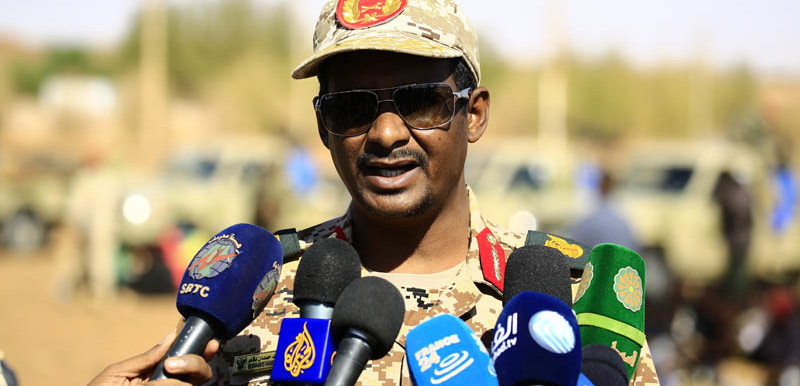
Gen. Mohamed Hmadan (Hemeti)
On April 11, there were jubilant scenes on the streets across Sudan when Omar al-Bashir was ousted after almost three decades in power.
When the protests started last December, an unprecedented number of Sudanese took part or supported the peaceful protests, including solidarity protests by the diaspora, in London, Cairo, Washington, DC to name a few.
The protests showed the many facets of Sudanese creativity, generosity, humour and most importantly, the tenacity and courage that had enabled them to endure the Islamist government and their policies thorough 30 years of undemocratic rule.
Long-time leader Bashir was ousted and replaced by a military-led transitional council, headed by Awad Ibn Auf, the Minister of Defense.
But this did not quell the protests, and within 24 hours, Ibn Auf resigned and was replaced by Abdel-Fattah al-Burhan, general inspector of the armed forces. The transitional council has promised dialogue with the opposition and to hand over power to a civilian government within two years.
However, a very unique revolution is in danger of being stolen from under people’s noses. Many people were quick to realise that the current transitional council is looking to continue business as usual. The state of emergency declared by Bashir remains in place and no sight of a civilian government is emerging.
The sit-in outside the military headquarters continues, and all eyes are now on how the transitional council deals with those determined to maintain the sit-in until their demands are met.
One particularly troubling issue in the new government is the rise of the Rapid Response Forces (RSF) Lt. Gen. Mohamed Hamdan (aka Hemeti), who is now the second in command of the newly established transitional military council.
The RSF, formally known as the Janjaweed, have been responsible for serious human rights violations in the Darfur, including the use of rape as a weapon of war with more than 300,000 people killed and over two million displaced from their homes.
In haste and jostling for some power, most of the opposition appears to have embarked on a compromise strategy in its dialogue with the transitional council, indicating they have perhaps grown used to lowering the bar when it comes to how Sudan should be governed, and thereby jeopardizing the very essence of the revolution.
In part, their reaction is a symptom of the years of systematic destruction of any political opposition in Sudan, as well as the civil society spaces. However these efforts failed to placate those who have protested over the last couple of months, and the sit-in at the military headquarters continues.
This is the time to be bold, and to address Sudan’s numerous challenges, including reforming the economy, and rebuilding the state’s infrastructure including health, education and justice sectors, especially for the peripheries in Darfur, Nuba Mountains and Blue Niles which have endured years of conflict.
Why Is Protest on this Scale Happening Now in Sudan?
With a history of revolutions against dictatorship in Sudan, in 1964 and 1985, it was not a question of if, but when protesters would come out against the government.
December 2018 was the perfect storm – Sudan’s economy was in free fall, with every household affected by the spiralling cost of living. The protests began in the periphery, starting in El-Damazin on December 13, quickly spreading to other towns and cities across the country, with a critical demonstration in Atbara, Nile State, on December 19.
Government forces were not able to quell the protests as quickly if they had started in Khartoum. Additionally, the leadership of an unaffiliated non-ideological body was critical in galvanizing the masses, notably the Sudanese Professionals Association (SPA), an umbrella organization of doctors, lawyers, journalist, teachers and other professional groups.
Despite continued references to “the second Arab Spring” – and there are numerous similarities – these comparisons deny the country its multiple identities.
Sudan lies across unique cultural, linguistic, religious and ethnic fault lines, which cross both Africa and the Arab world. This was not a second Arab Spring, rather a unique Sudanese revolution.
The Role of Women and Youth in the Protests
The protests were driven by young people – those born or raised under Bashir’s almost 30-year rule. Women, young Sudanese women, in particular, have played a crucial role in the protests at all levels, and have been labelled “kandakat”, the title for queens of ancient Nubia.
Despite restrictive rules to govern dress and behavior which predominantly affected poor communities, Sudanese girls and women showed their strength and tenacity during the protests.
This should come as no surprise; Sudanese women have played significant social and political roles throughout Sudan’s modern history, but it will be essential that they also form part of the political dialogue and future government.
What Can the Wider World do for the Sudanese People?
There was a deafening silence by governments and international media when the protests began, and the coverage of events only came to the fore when Bashir was ousted.
But Sudan is the midst of competing interests and powers, providing the foot soldiers for the Yemen conflict, for example. Its allies, Saudi Arabia, United Arab Emirates and Egypt, all came out to support the transitional council (al-Burhan is the General overseeing Sudanese forces in Yemen), while the European Union talks about democracy, but is blinded with its drive to stem migration to its shores.
The African Union was one of the few voices that rejected the military-led transitional council, urging the installation of a civilian-led government.
A lot is a play at the moment, and in truth, no one knows where Sudan will go in the coming days and weeks, as negotiations and deal-making take place behind closed doors.
While the Sudanese people now face many challenges, the hope is that their aspirations for a better life can be realized.
Bashair Ahmed is the executive director of Shabaka and a doctoral researcher at the University of Sussex. 

Monday, April 15, 2019

Coup Replaces Coup to Crush Aspirations of Sudanese Muslims


By: Kayhan Int’l 

The events rocking Sudan are certainly no revolution, nor is the fall of General Omar al-Bashir and his 30-year long dictatorial rule a relief for the Muslim masses of that country. 
It is a mere ceremonial changing of the guards at the presidential palace in Khartoum, as the replacement is also a military general. In other words, it is a coup to replace the coup of 1989, with the long suppressed aspirations of the Sudanese people taking a back seat yet again.
General Abdel-Fattah al-Burhan Abdur-Rahman, like all other coup leaders anywhere in the world, has formed a so-called transitional council of men-in-uniforms with a vague ‘promise’ to hand over rule to a civilian government in future – which is unlikely to come. 
No one takes him seriously, especially the group that has been leading the protests, the Sudanese Professionals Association (SPA), which rejecting the coup declaration, has called on people to press on with demonstrations and to stage a sit-in outside military headquarters.
SPA, an umbrella organization of doctors, lawyers and journalists, said in its statement: "The regime has conducted a military coup to reproduce the same faces and entities that our great people have revolted against.”
It added that protests would continue until power is handed over to a civilian transitional government.
This means the people should brace for more bullets and greater number of the dead and the wounded, to prove they possess the indomitable spirit of sacrifice to change the status quo. 
It will be a gargantuan task for the Sudanese people, and only time will tell how determined the masses are in the face of the current economic crisis.
At the moment, however, the new military leadership, which includes old faces like Defence Minister Awad Mohamed Ahmed Ibn Auf, has won the backing of reactionary Arab regimes of the Persian Gulf with whom General al-Burhan was clandestinely working, even as they pretended to play poker with al-Bashir – a replica of their game-plan to deceive and topple Egypt’s only elected president, Mohammad al-Morsi in 2013, while grooming General Abdel-Fattah as-Sisi behind the scenes. 
Saudi Arabia, the UAE, and Egypt, have thus hailed the fall of Bashir, the same Bashir, whom they had recently feted in their capitals and greased his palms with a fistful of dollars to cut diplomatic ties with the Islamic Republic of Iran and to establish relations with the illegal Zionist regime, in addition to providing them dirt cheap soldiers for their suicidal war in Yemen – all on the false promise that the UN and the US would drop charges against him as a wanted war criminal.
Al-Burhan may or may not hand al-Bashir to the International Criminal Court for war crimes in Darfur a decade ago, but one thing is certain, he will cozy up to the godfather of terrorism, the US, and provide bases to the Americans, so that he could be permitted to rule unhindered for some years at the expense of the Islamic and democratic aspirations of the people of Sudan.
This is all indicative of an intricate plot to spread the tentacles of Israel in Northeast Africa and the Red Sea region to compensate for the setbacks suffered by the unholy American/Zionist/Arab Reactionary trinity in Iraq, Syria, and Lebanon at the hands of the Resistance Front inspired by the Islamic Republic of Iran.
Yemen has become the Vietnam of the Saudis, and there are growing fears in the Arab and Western capitals that the trend of events might positively impact the protesting people of Sudan. Hence the sudden change of mask in Khartoum in order to abort in the embryonic stage a likely Islamic uprising having the potential to reignite the Muslim mass demonstrations against Sisi’s Zionist-backed misrule in Cairo, with dangerous consequences for Riyadh, Amman and the Persian Gulf sheikhdoms.

Thursday, April 11, 2019

Sudan Ruler Omar Al-Bashir Removed as President: Reports

TEHRAN (Tasnim) – Sudan’s longtime ruler Omar al-Bashir appeared to have been removed as president on Thursday following months of on-and-off popular protests that culminated in clashes between his loyalist security branches and the uniformed armed forces, reports said.

During a tense dramatic morning that saw the country’s state broadcaster seized by the military and protesters mass in front of the armed forces headquarters, Bashir’s position remained unclear. The army alerted the public in a 5 a.m. statement that warned of an impending announcement.
Reports emerged that the airport in Khartoum had been seized, Bashir and other senior officials had been arrested, and that a transitional council headed by the defense minister, Ahmed Awad Ibn Auf had been formed, according to sources cited by Dubai-based Al-Arabiya.
Doha-based Al Jazeera reported that armed forces informed Bashir “he was no longer president”
None of the reports could be confirmed. For hours state television played  patriotic and martial music as the nation of 41 million people waited and thousands amassed at the main protest site outside the military headquarters in Khartoum. 
Reports of Bashir's alleged ouster come amid a popular uprising against his rule that has seen thousands take the streets across the country. The largely peaceful protests have escalated in recent days, as different armed government forces engaged in deadly clashes.
As news of the statement spread, people flooded the streets in Khartoum in celebration, according to social media reports and witnesses on the ground.
Bashir took control after a coup in 1989 and became President in 1993. He stands accused of conducting an campaign of ethnic cleansing in the country's Darfur region, and was nearly arrested in 2015 while visiting South Africa.
The protesters started as a demonstration against the rising costs of living but escalated into a push for the Bashir's removal from office, with mass rallies and sit-ins outside the presidential compound and army headquarters. In February, Bashir declared a year-long state of emergency in response to the protests.
This week's sit-in had grown into one of the biggest rallies since the uprising began, with crowds braving temperatures of more than 110 degrees Fahrenheit (43 degrees Celsius) to camp out in the streets of the capital.
On Tuesday, members of the Sudanese army moved in to protect protesters in Khartoum, after national security forces attempted to break up the third day of a mass sit-ins.
Earlier in the week, the mood among protesters outside the compound had verged on victorious, with people chanting "thawra" (revolution) and waving the national flag aloft as soldiers looked on, footage from the scene showed.
Photos captured protesters sitting atop military vehicles and handing out water bottles, as others posed for selfies with members of the armed forces, flashing V-for-victory gestures.
Sudan's government has reported some 32 fatalities since the protests began earlier this year, including three security personnel, but doctors and opposition activists suggest the toll is 78, excluding the military.
More than 3,000 people have been arrested since protests began in December, based on testimony gathered from activists, lawyers and victims. Many have been taken to secret detention sites known as "ghost houses," which the government says don't exist, and where detainees say they face physical and psychological torture.
Sudan has sought to censor news coverage of protests, and journalists found reporting on the demonstrations risk life imprisonment and the death penalty.