Showing posts with label Protecting Sacred Sites. Show all posts

Wednesday, April 03, 2019

The Duty to Protect Sacred Sites – Part IV

Sacredness of all heritage sites is protected

John Andrew Morrow

If anyone questions the Islamic obligation to preserve religious heritage sites, the clearest and most definitive answer comes from the Covenant of the Prophet Muhammad with the Armenian Christians of Jerusalem, which reads,

From Muhammad ibn ‘Abdillah, the Prophet and Messenger of Allah, to Abraham, the Patriarch of Jerusalem, and to the Armenian Bishops of Damascus, and those who are found in other Muslim territory, and to those who depend upon them, namely, the Ethiopians, the Copts, and the Syrians, who inhabit Jerusalem: I have granted them their convents, churches, schools, residences, and fields.
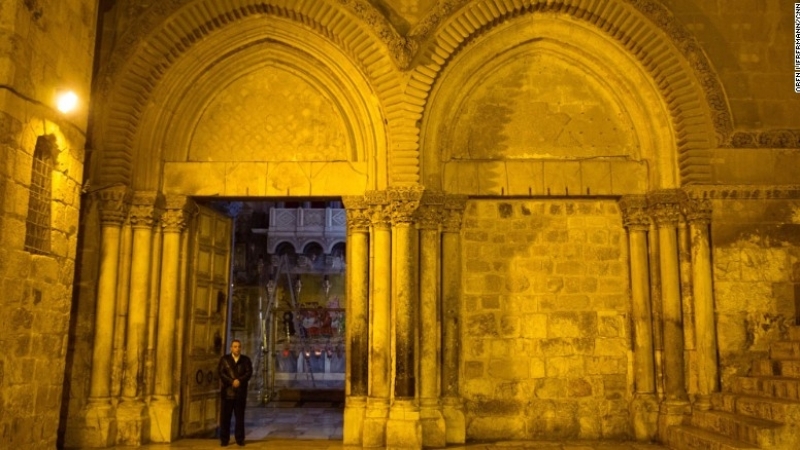
I, the Messenger of Allah, with Allah as my Witness, and with the conscious witness of all people, men and women, who are found here, have promised and granted [them] the churches located in Jerusalem, the Church of the Holy Resurrection, and the Cathedral of St. James in the southern part of the Holy City, which is located next to the Monastery of Zion.
I have also given them the Mount of Olives Monastery, the Chapel of the Prison of Christ, the Church of Bethlehem, and the chapels of St. John of Samaria [Nablus], the oratories located behind the sanctuary of the Holy Resurrection, and the totality of the upper and inner levels of the Golgotha and the Tomb of Christ where the eternal light shines, all the places of religious pilgrimage, as well as the mountains, the valleys, the residences, and their acquisitions; I have granted them with the witness of Allah, the Messenger of Allah, and all believing Muslims (Morrow, vol. 1, pp. 452–53).
If I repeat the protections provided by the Prophet (pbuh) over and over again, I do so for the same purpose that he did: for emphasis, and to demonstrate that the protections in question were not limited to a single community, were not limited to a certain geography, and were not limited to a certain period of time. They are universal laws, principles, and rights. They apply, not only to Christians, but to Samaritans, Jews, and Zoroastrians as well.
In the Covenant of the Prophet Muhammad with the Samaritans, the original of which was preserved by the followers of Moses until the 20th century, the Messenger of Allah (pbuh), states concisely and definitely that, “I, Muhammad ibn ‘Abdillah ibn ‘Abd al-Muttalib, have commanded that a covenant of protection and security be written for the Samaritan community for their persons, their children, their property, their wealth, their places of worship, their financial endowments, and to be binding in all the provinces and places in which they reside. We also pledge to behave with them and the people of Palestine in the best possible manner” (Morrow, vol. 2, p. 527).
And what about the Jews? It is exactly the same. As the Messenger of Allah (pbuh), says in the Covenant of the Prophet Muhammad with the Children of Israel, known also as the Treaty of Maqna, “Yours is the safeguard of Allah and that of His Messenger with regard to your persons, belief, and property…” (Morrow, vol. 2, p. 288).
But what about the Zoroastrians? Some Persians might ask. In the Covenant of the Prophet Muhammad with the House of Salman, which is found in Abu al-Shaykh’s Tabaqat al-Muhaddithin and Abu Nu‘aym’s Akhbar Isfahan, the Messenger of Allah (pbuh) states that “This is a writing for the people of the House of Salman. They have God’s protection and my protection of their blood and property” (Morrow, vol. 2, p. 405). Property is property. It includes all kinds of property. It includes personal property. It includes historical sites. It includes Persepolis and other such places. Such world heritage sites must be protected.
And consider what the Messenger of Allah (pbuh) has to say in the Covenant of the Prophet Muhammad with the Parsis, “Their hands shall be free in building fire temples, administering them, and spending their wealth… They shall be granted exclusive privileges from among the various sects protected” (Morrow, vol. 1, p. 527).
The question begs to be answered. If the Messenger of Allah (pbuh) was so adamant about protecting the places of worship of Christians, Samaritans, Jews, and Zoroastrians, why on earth would he command Muslims to destroy Islamic heritage, masjids, graveyards, tombs, mausoleums, and shrines? Why would he want Muslims to destroy their own religious, historical, cultural, and archeological sites? He would not. It makes no sense. If the lives and property of non-Muslims are so sacred, so are the lives and property of Muslims.
As we have seen, the Qur’an, the Sunnah, the Sirah, and the letters, treaties, and covenants of the Prophet Muhammad (pbuh) are testimonies to the tolerance of Islam and its commitment to protect the lives and property of both Muslims and non-Muslims. Time and again, we see that the protection of people and their property is inseparable. They always go hand in hand.
Is this the life, liberty, and property presented by John Locke, the Founding Fathers, the Declaration of Independence, the Bill of Rights, and the Universal Declaration of Human Rights? No. No. No. That’s the life, liberty, and property presented by the Prophet Muhammad (pbuh). In other words, all of that is from Allah (swt). Respecting, maintaining, preserving, and protecting sacred and world heritage sites is a sacred duty. May the peace and blessings of Almighty Allah be upon the Prophet Muhammad and his family.

Friday, March 01, 2019

THE DUTY TO PROTECT SACRED SITES — PART III

The Prophet’s Covenants establish the Sunnah of historical preservation

By John Andrew Morrow
In light of the war crimes and cultural genocide committed by takfiri terrorists in Libya, Syria, Iraq, and elsewhere, in which masjids, graves, shrines, mausoleums, and churches have been destroyed, what do the letters, treaties, and covenants of the Prophet Muhammad (pbuh), have to say about the preservation of heritage sites — religious, cultural, and historical? This is something truly significant.
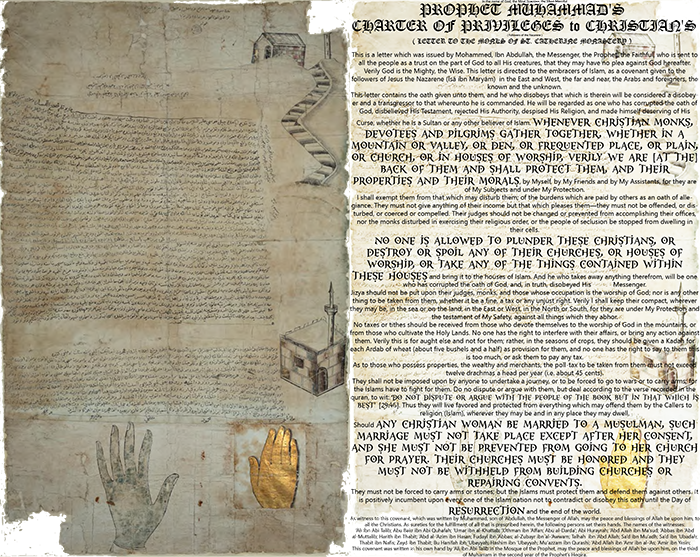
In the Covenant of the Prophet Muhammad with the Monks of Mt. Sinai, the famous Ashtiname of Muhammad, ‘ahd nabawi or ‘ahd al-nabi, the Messenger of Allah (pbuh), promises the Christians from the Monastery of St. Catherine in the Sinai Peninsula, that “no building from among their churches shall be destroyed” and warns that “whoever does such a thing violates God’s covenant and dissents from the Messenger of God” (Morrow, vol. 3:2). Not only are Muslims prohibited from demolishing churches, they are exhorted to maintain them, “These people shall be assisted in the maintenance of their religious buildings and their dwellings; thus, they will be aided in their faith and kept true to their allegiance” (Morrow, vol. 3:3).
In the Covenant of the Prophet Muhammad with the Christians of Persia, which was provided to the Armenian Christians of Persia, and was preserved in the Cathedral of New Julfa, in Isfahan, Iran, the Messenger of Allah (pbuh), states that “All pious believers shall deem it their bounden duty to defend believers and to aid them wherever they may be, whether far or near, and throughout Christendom” (Morrow, vol. 3:5).
But what exactly does it mean to protect Christian believers? The Prophet (pbuh), provides the definition. It consists in protecting “the places where they conduct worship, and those where their monks and priests dwell” (Morrow, vol. 3:5–6). He decreed that “their building enterprises shall not be interfered with… neither shall their churches be dismantled or destroyed, or their homes and mansions confiscated by Muslims, for mosques or residences, without their consent” (Morrow, vol. 3:6). What is more, he encouraged Muslims to help Christians repair their churches, chapels, and monasteries.
But for what reason, you may ask. As the Prophet (pbuh) most logically explains, for “the interest of the benevolent Muslim public and of their faith… as an expression of friendship and goodwill” (Morrow, vol. 3:7–8). The relationship is reciprocal. It can help seal a fraternal understanding. That is how you build bonds of brotherhood and sisterhood. That is how you promote social cohesion, tolerance, and coexistence. That is how you unite a diverse community. That is how you honor the signs of God.
Is there any territorial limitation to such obligations of protection of both persons and property? Absolutely not. As the Messenger of Allah (pbuh) explains, it applies
…everywhere, in mountains, on the plains, in towns and in waste places, in deserts, and wherever they may be, that people shall be protected, both in their faith and in their property, both in the West and in the East, both on sea and land (3:5–6).
The Messenger of Allah (pbuh) was not establishing municipal law, state law, or federal rights: he was establishing universal human rights. In fact, he was the very first to do so in the history of humanity. The rights he gave, he gave to all the world. He also warned that “Whosoever shall not do as is here prescribed, but shall do contrary to my behests; the same shall be held a despiser of this Compact, and a gainsayer of the word of God and of his Prophet” (Morrow, vol. 3:6).
In the Covenant of the Prophet Muhammad with the Christians of Najran, which was found by Habib the Monk in the Bayt al-Hikmah of Baghdad in the 9th century CE, the Messenger of Allah (pbuh) states,
I commit myself to support them, to place their persons under my protection, as well as their churches, chapels, oratories, the monasteries of their monks, the residences of their anchorites, wherever they are found, be they in the mountains or the valleys, caves or inhabited regions, in the plains or in the desert” (Morrow, vol. 3:15).
He also stresses, “it is not permitted to destroy any part of their churches, to take parts of their buildings to construct mosques or the homes of Muslims” and warns, “whoever does such a thing will have violated the pact of God, disobeyed his Messenger, and become estranged from the Divine Alliance” (Morrow, vol. 3:16).
In the Covenant of the Prophet Muhammad with the Christians of the World, which was rediscovered in a monastery in the Levant in the 17th century by Father Pacifique de Provins, and published in Paris by Gabriel Sionita, the Messenger of Allah (pbuh) declares,
I grant security to their churches, their places of pilgrimage wherever they are and wherever they may be found, be they in the mountains or the valleys, in the caves or inhabited regions, in the plains or the desert, or in buildings; and that I protect their religion and their property wherever they are and wherever they may be found in land or at sea, in the East or West, in the same way that I protect myself, my successors, and the People of My Community among the Believers and the Muslims (Morrow, vol. 3:21).
The Messenger of Allah (pbuh) asserts that “it is not permitted to destroy any part of their churches, to take parts of their buildings to construct mosques or the homes of Muslims” (Morrow, vol. 3:21). He states that “if the Christians seek the help and assistance of the Muslims in order to repair their churches and their convents… they must help and support them” (Morrow, vol. 3:23). However, he stresses, “they must not do so with the aim of receiving any reward” but rather “they should aim to restore that religion, out of faithfulness to the pact of the Messenger of God, by pure donation, and as a meritorious act before God and His Messenger” (Morrow, vol. 3:23). Once again, he warns, “whoever does such a thing will have violated the Pact of God, disobeyed his Messenger, and betrayed the Divine Alliance” (Morrow vol. 3:21).
In the Covenant of the Prophet Muhammad with the Christians of the World, which was copied in Egypt in 1538 from an ancient manuscript, the Messenger of Allah (pbuh) states,
I grant security to them, their churches, their businesses, their houses of worship, the places of their monks, the places of their pilgrims, wherever they may be found, be they in the mountains or the valleys, caves or inhabited regions, the plains or the desert (Morrow, vol. 3: 26).
He also states that Muslims must help and support Christians if they seek their assistance to repair their churches and convents (Morrow, vol. 3:28). He stresses that they should only do so to restore that religion, out of faithfulness to the Covenant of the Prophet, as a pure good deed, and as a blessed act before God and His Messenger (Morrow, vol. 3:28).
In the Covenant of the Prophet Muhammad with the Assyrian Christians, which was housed in the Cathedral of Jilu until the 19th century, the Messenger of Allah (pbuh) proclaims, “Leave their places of worship in peace” (Morrow, vol. 3:31); “Leave all their possessions alone, be it house or other property, do not destroy anything of their belongings” (Morrow, vol. 3:31). In the words of the Prophet, “their church buildings shall be left as they are, they shall not be altered” (Morrow, vol. 3:31); “None of their churches shall be torn down, or altered into a mosque, except by the consent and free will of the Christians” (Morrow, vol. 3:31). And, once again, he warns, “If anyone disobeys this command, the anger of God and His Prophet shall be upon him” (Morrow, vol. 3:31).
In the Covenant of the Prophet Muhammad with the Coptic Christians, the Messenger of Allah (pbuh) professes,
I will defend their dwellings and their houses of prayer and their churches, their monasteries and their gathering places, the gathering places of their monks and priests and hermits, the places of their hermits, and their monks’ cells and grottos (Morrow, vol. 2:236).
He iterates, “nothing shall be removed from their places of prayer or from their churches which they have” (Morrow, vol. 2:237). He also assures, “every building of their places of prayer and churches that was destroyed shall be rebuilt as it was at first” (Morrow, vol. 2:237). In other words, not only are Muslims required to respect, protect, and preserve religious institutions of other faiths, they are obliged to rebuild any of them that were destroyed.
In the Covenant of the Prophet Muhammad with the Syriac Orthodox Christians, the Messenger of Allah (pbuh) offers the same promise of protection,
I grant security and safety to their churches, their homes, their places of worship, their monasteries, their sites of pilgrimage, wherever they are and wherever they may be, be they in mountains or valleys, in caves or inhabited regions, in plains or in the desert and buildings (Morrow, vol. 2:342).
We see the very same thing in the Covenant of the Prophet Muhammad with the Armenian Christians, in which he says,
I safeguard them and remove all harm from them and from their churches, cloisters, convents, and places of worship, wherever they may be found, by they in mountains, valleys, caves, inhabited regions or in the plains (Morrow, vol. 2:477),
and in which he asserts, “It is not permitted to destroy or take parts of their ancient churches to construct mosques or homes for the Muslims” (Morrow, vol. 2:477).
This version is particularly interesting since it speaks not only of existing structures, but to ancient churches. Protection, therefore, is not limited to modern, contemporary, buildings, but also applies to those of historical importance.