
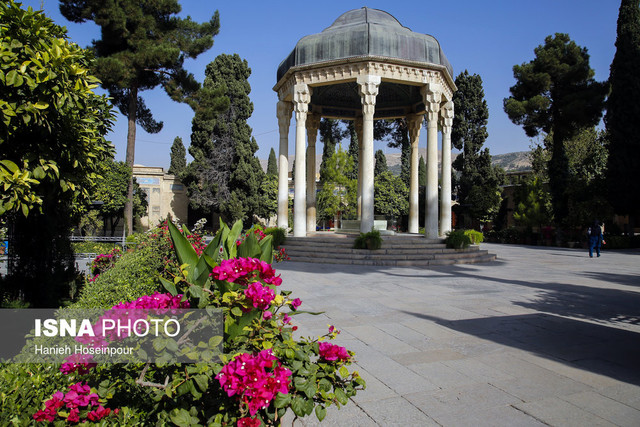
Tehran (ISNA) – Khwajeh Shams al-Din Muhammad Hafez Shirazi was a Persian mystic and poet who was born in the city of Shiraz in 1310.
Most of his poems are Ghazal (which the subject includes both love and religious beliefs or mysticism) and his elocution is similar to Khajawi Kermani.
He was one of the most influential poets of his time. In the eighteenth and nineteenth centuries, his poems were translated into European languages, and his name somehow reached Western literary circles. Hafez national commemoration day is October 21.
Professor of Comparative Literature in Imam Reza University of Mashhad, Dr. Maryam Kouhestani in an interview with ISNA talked about, the poetic style of Hafez which is concentrated on three issues of love, mysticism and panegyric. The most important characteristic of the Hafez’s style is the dispersion of the subject and the independence of the verses which is still discussed by the Hafez scholars.
There is no doubt about the influence of the Qur'anon Hafez thought and belief. In the field of form and structure, the most important feature of Hafez's poems, the independence of the verses, are most influenced by the Qur'anic Āyahs (verses). This is the characteristic of the Hafez revolution in the verses. The realm of meaning, Hafez; is in the position of a thoughtful poet whose poetry represents his worldview, merged the ancient and Islamic culture of Iran with religion, theology, philosophy, and mysticism.
Johann Wolfgang von Goethe (1749-1832), the most renowned poet of German literature was deeply interested in Eastern literature and above all, Hafez poems which increasingly awakened his interest in Persian literature. The first impulse of Goethe in imitating Hafez was a framework to compose romantic poems but later the mystical aspects of Hafez poems attracted him. The influence of Hafez Ghazaliat (the collection of his poems/ghazals) on Goethe was so profound that he composed his collection of poems in order to imitate Hafez and named it the -“West-Eastern Divan”-. By imitation of Hafez, Goethe called his collection of poems -“the Divan”- and named this collection, which consists of twelve sections, with Persian names. He titled the sections of his book in the following order: the Singer (Moganni Nameh), Hafiz (Hafis Nameh), Love (Uschk Nameh), Reflection (Tefkir Nameh), Ill Humour (Rendsch Nameh), Maxims (Hikmet Nameh), Timur (Timur Nameh), Zuleika (Suleika Nameh), Cupbearer (Saki Nameh), Parables (Mathal Nameh), Parsees (Parsi Nameh), and Paradise (Chuld Nameh. Goethe also tried to rhythme, meter and rhyme of the Hafez’s poetic style. He praises Hafez for his broad-mindedness and intellectuality.
The remarkable point that impresses the reader of the West-Eastern Divan is that Hafez is not a Persian-speaking poet for Goethe; he represents great human beings throughout the ages. The important feature of his work is combination of Eastern culture with Western structure and the cohesion of them in his book.
Ralph Waldo Emerson (1803-1882), a great American philosopher and poet was also fascinated by Saadi and Hafiz among Iranian poets. Emerson started to know Hafez thought reading Goethe's West-Eastern Divan. For Emerson, Hafez became a perfect poet whom he called a “poet for poets”. He spent fourteen years reading Hafez poems. To recognize the spirit of Hafez's poetry in English literture, Emerson first translated "Sagittarius" into English and called it "From Hafiz's Persian Poetry". He was the founder of Transcendentalism, a philosophical movement which was based on spirituality and intellectualism at the time. He was vastly under the auspices of the Hafez‘s notions. Emerson was the primary practitioner of the movement, which existed loosely in Massachusetts in the early 1800s before becoming an organized group in the 1830s.
France and Hafez
William Jones was the first Englishman who translated some of Hafez's gazals into English. He also translated thirteen gazals of Hafez into French.
The inspiration of Eastern culture was so strong that many French poets were impressed by Eastern literature. Among them Victor Hugo (1802-1885) was profoundly affected by Persian poets especially Saadi, Hafez and Ferdowsi. Hugo was much inspired by Hafez poems through reading the West-Eastern Divan by Goethe. He composed his “Les Orientales” by inspiration of Saadi and Hafez’s notions. In the preface of this book, Hugo highly colored several poems of Hafez and Saadi.
Jean Lahore (1840-1909) was one of the French symbolist poets who knew Hafez through translations and was inspired by Hafez in his collection of poems entitled "Pandar".
Andre Gide (1869-1951 was acquainted with Hafez through Goethe. In the preface to of his famous book, “The Fruits of the Earth”, he brought a line of Hafez poem.
Armand Renaud (1836-1895) was very inspired by Hafez. He composed a set of twelve poems under the name of “Les Nuits persanes”. In the preface to his collection, Renaud noted his interest in Eastern culture and literature and entitled one of the twelve sets as “Iranian Night”.
Theophile Gauthier (1811-1872), the founder of the Parnassianism was also fascinated by Hafez, He began the preface of his famous Divan, "Enamels and Engravings" with a fascinating poem about Hafez that shows his enchantment of Hafez’s poems.
The French poet, painter and musician, Tristan Klingsor (1874-1966) was fascinated by Hafez and sang a love song to him.
England and Hafez
William Jones (1746-1794), the English Orientalist was the first translator of some of Hafez's gazals into English. Although Jones's translation of Hafez's poems were very eloquent and praised by many literary critics; he had deviated from the principle ideas of the poems in his translation, which has the taste and the style of English poetry.
John Richardson (1740-1795), was the editor of the first Persian-Arabic-English dictionary. He was a member of the East India Company, who was fascinated by Eastern literature and worked as a periodical writer and editor. In 1774, he translated a number of Hafez's gazals. Like Jones, he was not faithful in the the rhetorical figures of the poems and transferred Hafez's the notions through his own understanding of the poems and mingled them with the taste and style of English poetry.
Henry Wilberforce Clarke in 1891 translated the Divan of Hafez into English prose. The translation was accompanied by extensive notes, a clear biography of the Hafez, and detailed notes explaining practically some lines of the poems. His translation was hard to understand and had with many ambiguous figures.
One of Hafez's best translations was made by a lady named Gertrade Lowthian Bell in 1898. In her translation, she focused on the mystical and social aspects of Hafez's poems; therefore, it is a known as one of the best translation which seems to be close to the original version of Hafez Divan.
John Payne (1842-1916), an English poet and translator. He was best known for his translation of “Diwan Hafez” and ‘The Arabian Nights”. He translated the entire Divan of Hafez into verse in 1901. He also translated the quatrains of Omar Khayyam. Payne once said that Hafez, Dante and Shakespeare were the three greatest poets of the world.

