Showing posts with label Madawi al-Rasheed. Show all posts

Thursday, October 03, 2019

Nobody Buys MbS’s Whitewashing of Murder

By: Madawi al-Rasheed*

The brutal murder of journalist Jamal Khashoggi at the Saudi consulate in Istanbul on October 2, 2018 shattered the myth of the benevolent monarchy and set Riyadh on a charm offensive.

While the murderers are yet to be convicted in Saudi courts, Crown Prince Muhammad bin Salman (MbS) has come close to admitting responsibility. His recent PBS interview included a statement that should have been made a year ago, as the prince admitted the crime happened under his watch - but he went on to say that there are three million Saudis working in the public sector, and officials among them were responsible for the crime.

A year after the murder, neither the perpetrators nor the boss who gave the orders have been convicted. A secretive trial of 11 operatives has yet to issue its verdict. And bin Salman’s key aide, Saud al-Qahtani, named as one of the suspects, has disappeared from the public eye, while the crown prince enjoys applause at carefully staged populist events, including the September 23 celebration of Saudi Arabia’s national day.

Yet, while the veneer of "life as normal” continues in the kingdom, the crime of the century changed many things. It was a catalyst that reminded the world of the treacherous nature of a regime long endeared to its Western allies. The U.S., UK and other partners were not going to change their intimate relations with Saudi Arabia simply for the sake of a slain journalist.

After all, thousands of Yemeni men, women and children have been bombed over the past five years, without shaking the conscience of those who arm Saudi Arabia and support its air strikes on the ground.

Realpolitik prevails against the uproar of global civil society and UN agencies who have conducted their own investigations of the Khashoggi murder and the war on Yemen. The Khashoggi case was not going to change the basic rules of the game.

But domestically, the trust between the Saudi leadership and the people has been permanently shattered. The murder exposed the deep state that Muhammad bin Salman inherited from his deposed cousin, Muhammad bin Nayef, who wired Saudi Arabia to control its citizens and widened the net to catch critics, dissidents and civil society founders, under the guise of fighting terrorism.
'Maybe He Did'

Unfortunately for bin Nayef, he became persona non grata despite him being the CIA’s preferred candidate to succeed King Salman. Bin Nayef was sacked as U.S. President Donald Trump clashed with his intelligence agencies and offered the crown prince cart blanche to rise to the top posts in the kingdom, amassing a half-dozen senior jobs.

Trump even refused to accept the verdict of his own intelligence services on the Khashoggi murder, shrugging off the evidence and the intercepted phone calls, and concluding that "maybe he did” have knowledge of the event "and maybe he didn’t”.

The Khashoggi murder was merely a symbol of the erratic, daring and brutal thinking of the crown prince, who proved capable of humiliating his own kin under the guise of anti-corruption.

His bullying of the wealthy elite to save the initial public offering of five percent of the state-owned Aramco oil company promised to safeguard his Vision 2030 and raise much-needed cash. The princes and business elite detained in the Ritz Carlton two years ago are terrified at the prospect of losing their own excessive wealth, but also their heads, should they attempt resistance. 

A Clear Message

Murdering Khashoggi sent a clear message to all citizens, including royalty. This regime is drawing the curtain on previous episodes of royal politics, namely the deployment of carrots and sticks, which to a certain extent succeeded in containing dissenting voices and earned the regime the title of benevolent dictatorship. But alas, the carrots have vanished, and the sticks have been replaced by sharp knives.

The rentier redistributive economy that ensured acquiescence is giving way to a new strategy of ultimatums. You either pay and keep silent, possibly while under a travel ban, or face a return to the Ritz or somewhere even worse. This is the new face of the kingdom, under the full control of the boy king.

Bin Salman’s treacherous nature is reminiscent of an earlier historical episode. It reminds us of that moment when his grandfather, Abdulaziz bin Saud, eliminated the very people who consolidated his kingdom, a consortium of zealot tribal leaders, as he killed them one after another when the job was finished. He sacked towns, killed people in mosques, and precipitated massacres in places such as Riyadh, Taif, Hayil and others.

While this history has yet to be written properly, the boy king promises to continue that tradition with impunity. The murder of Khashoggi, described by his Turkish fiancee Hatice Cengiz as a man "from the palace”, was perhaps just the beginning. Saudi jails are bulging with prisoners of conscience, and executions are on the rise.
Dishonoring the Dead

Bin Salman will not even honor the dead. Khashoggi’s corpse disappeared, and there are no signs that parts of it will be found or returned to his family to be buried properly.

According to Ali al-Dubaisi, director of European Saudi Organisation for Human Rights in Berlin, the regime is still holding 83 corpses of slain detainees, mostly Shia prisoners who were executed behind closed doors.

Khashoggi's murder alerted the world to how the boy king is determined to rule with an iron fist

The future of the kingdom under the crown prince looks bleak, despite all the hype about tourism, entertainment and other new opportunities on the horizon. Repression will continue hand-in-hand with so-called reform. Khashoggi’s murder alerted the world to how the boy king is determined to rule with an iron fist.

 *Madawi al-Rasheed is visiting professor at the Middle East Institute of the London School of Economics.
-Courtesy: Middle East Eye

Tuesday, September 03, 2019

Saudi Arabia's Mr Hashtag: Where is Saud al-Qahtani?

Madawi al-Rasheed
If Mohammed bin Salman's former aide was poisoned to death, what does it say about the crown prince and Jamal Khashoggi?
Saudi Arabia's Crown Prince Mohammed bin Salman attends an event on women's empowerment during the G20 Summit in Osaka on 29 June (AFP)
The disappearance of Saud al-Qahtani, an important aide of Saudi Crown Prince Mohammed bin Salman and a man reportedly involved in the murder of Saudi journalist Jamal Khashoggi in Istanbul 11 months ago, is still a mystery.

Since Qahtani was sacked following the murder, he is yet to appear in public or post on social media, as he once always did. 
On 28 August, Oslo-based Palestinian exile and critic of the Saudi regime, Iyad al-Baghdadi, tweeted that he "received news that Saud Al Qahtani (SQ) had been poisoned to death by Mohammed bin Salman. The source is well placed and has been consistently reliable for nearly a year. I cannot publicly reveal anything else about this source".

Dead or alive?

A couple of months ago, Norwegian intelligence services put Baghdadi himself under protection after the CIA sent warnings that his life might be in danger, as he may be targeted by agents of the Saudi regime.
While dictators are notorious for killing their critics and dissidents, they are equally known to have eliminated those closest to them
Baghdadi’s Twitter thread on Qahtani's poisoning is yet to be officially backed up by a third party, but neither Qahtani nor the Saudi regime has issued a statement confirming his continued existence or acknowledging his death.
While dictators are notorious for killing their critics and dissidents, they are equally fond of killing those closest to them, especially when they might have helped rid them of a persistant critic. It is only natural for unaccountable regimes to murder their aides, who might reveal their intrigues and thuggery. They become scapegoats to save bigger heads from greater scrutiny and responsibility. 

No hard evidence

In the absence of hard evidence that Qahtani is still alive or in hiding, we cannot assume that Baghdadi’s statement is fabrication beyond the realm of the possible.
MBS has a number of reasons to make Qahtani vanish from the face of the Earth, as his name has been closely associated not only with Khashoggi's scandalous murder but other equally abhorrent intrigues.
Qahtani was sacked from his multiple jobs in the regime bureaucracy and, since Khashoggi's murder, he has failed to make an appearance on social media, the space where he was most active.
Qahtani was named as one of the masterminds of the Istanbul murder by several reports, amongst them the UN investigation led by human rights expert Agnes Callamard in June 2019. He was one of the first named persons to be banned from entry to the US, Britain and other European countries. 

Saud al-Qahtani, Mohammed bin Salman's former top aide (twitter)

Saud al-Qahtani, Mohammed bin Salman's former top aide (Twitter)

The hawkish crown prince is still determined to silence all critics, encourage ultra-nationalistic rhetoric and create death squads whose role has become prominent in spreading fear inside Saudi Arabia. His death squad plotted and carried out murder, hacking and intimidation of critics inside and outside the country in the name of protecting and defending the nation.  
Like Mohammed bin Salman, Qahtani was a graduate of King Saud University, where he studied law. After a short career as a law lecturer at a Saudi Arabian security college, Qahtani was brought into government by Khalid al-Tuwaijri, a senior aide of King Abdullah. He was then sidelined, and became resentful.Qahtani was one of the officers named in the murder case but remained in Riyadh after the scandal and remained in contact with MBS.

Young, ambitious and aggressive

In autumn 2017, Qahtani's name was associated with the Ritz Carlton incident, when Mohammed bin Salman detained several senior princes and elite businessmen under an alleged anti-corruption campaign. Several sons of King Abdullah, for example Miteib and others, were humiliated and detained for several months. Perhaps Qahtani was waiting to strike back and take revenge for his own humiliation during King Abdullah’s reign.  
But since 2012 it was reported that he contacted the Italian spyware vendor Hacking Team to enlist its services for the regime. Since he was brought back by the Saudi crown prince, he was reported to have initiated contact with the Israeli cyber intelligence company NSO, which manufactures spyware.
Qahtani became royal court advisor before Mohammed bin Salman made him media consultant and general supervisor for the Centre for Studies and Media Affairs at the Saudi royal court. Like Mohammed bin Salman, Qahtani is young, ambitious and aggressive on social media, especially Twitter.  
In 2017, Qahtani's name was also mentioned in the context of holding Lebanese Prime Minister Saad Hariri in Riyadh and coercing him to read a prepared resignation letter, hoping to precipitate a political crisis in Lebanon and undermine Iranian-backed Hezbollah’s control over the country. 

Mr Hashtag

Qahtani’s thuggery was symptomatic of the character of the regime as a whole under Mohammed bin Salman. In 2018, relatives of Lujain al-Huthloul reported him as responsible for sexual and physical violence inflicted on the women's rights activist, who has been detained since May 2018.
But the climax of his criminality was fully exposed only after Khashoggi's murder.
Qahtani’s thuggery was a symptomatic of the regime's character as a whole since Mohammed bin Salman became crown prince
Qahtani’s aggressive statements on social media prompted many dissidents and critics of the regime to name him Mr Hashtag. He was dubbed the founder of the "army of electronic flies", a team of cyber attackers and intimidators.
Khashoggi wanted to counter the "army of electronic flies" with an "army of electronic bees", exposing injustices, supporting prisoners of conscience and promoting freedom of speech, the right he had been denied by the crown prince and his aide.    
Qahtani always claimed that he wanted to rid the country of traitors and enemies of the state. On one occasion, deploying populist language for authoritarian ends, he tweeted that the "people should assist the government in drawing a black list of those traitors who criticise it and tarnish its reputation". Khashoggi was obviously on that list.
Eventually, he promised to eliminate those whose names appear on this black list. He was the promoter of the "citizen informer" and "citizen policeman", as he demanded that all Saudis should be enlisted in defending the nation in multiple ways.
Adding names of critics and dissidents abroad to the black list was one of them. Qahtani was building a data bank in which names of random people and critics of the regime are listed, with possible plans to eliminate them. 

Serving the master

Qahtani was responsible for controlling the image of Saudi Arabia under the new leadership as a progressive, liberal and prosperous country. For this purpose, he sought the expertise of several Western public relations companies. He was named by US intelligence services as the ring leader of the death squad that eliminated Khashoggi at the consulate.  

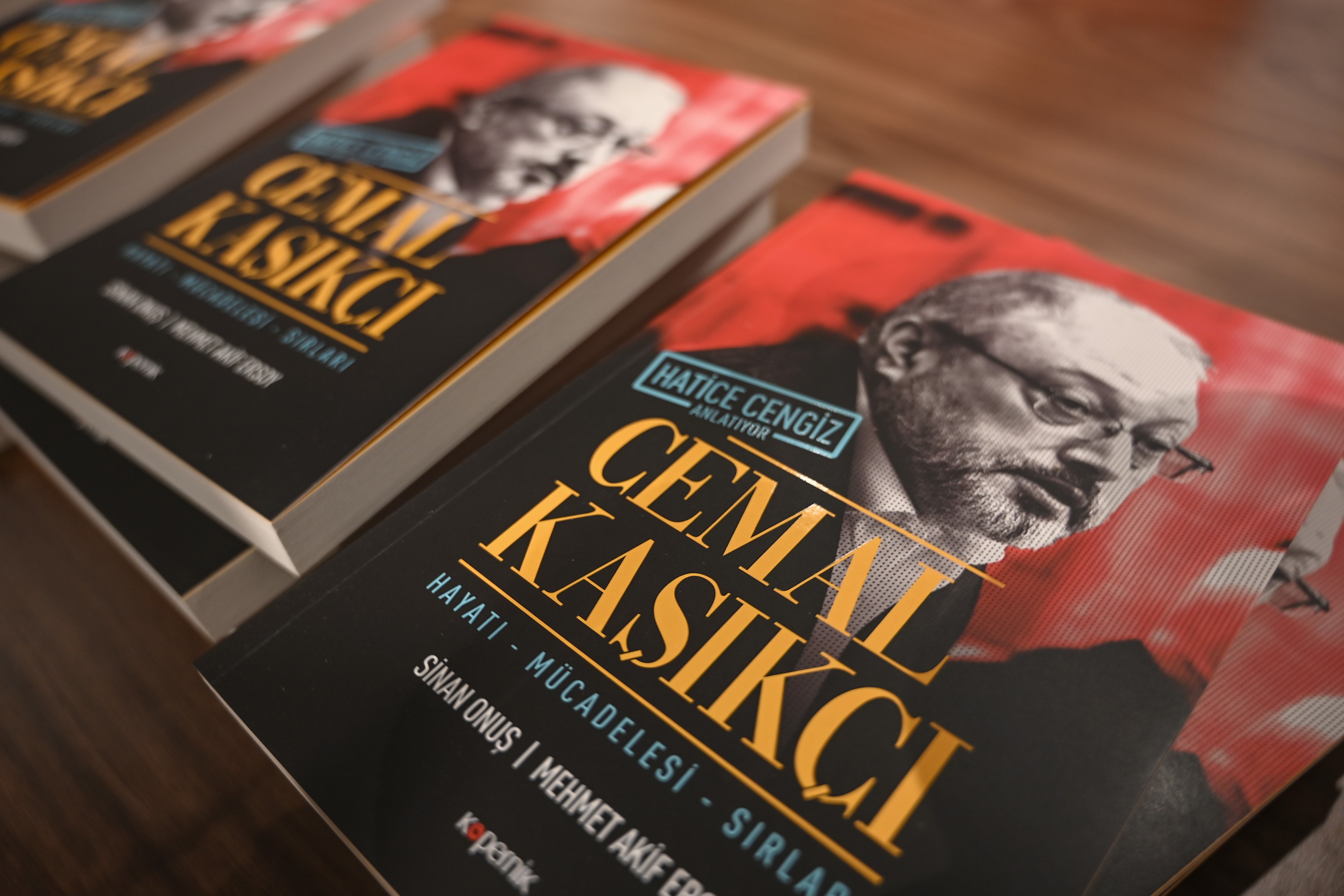
Books dedicated to the murdered the Saudi journalist Jamal Khashoggi, written by his partner Hatice Cengiz, are displayed during a presentation in Istanbul on 8 February (AFP)

Books dedicated to the murdered the Saudi journalist Jamal Khashoggi, written by his partner Hatice Cengiz, are displayed during a presentation in Istanbul on 8 February (AFP)

Qahtani’s aggressive nationalist rhetoric was closely linked to security. He accused the kingdom's critics of being treasonous and used ultra-nationalist rhetoric to intimidate and silence them. Khashoggi was only one of these critics.
But Qahtani always reiterated that he was merely serving his masters, the Custodian of the Two Holy Mosques, King Salman and his royal highness the crown prince. He also always thanked them for the trust they invested in him, signing his statement as their loyal servant. He regularly reminded his Twitter followers that he always received his orders from the crown prince. 

False nationalism

Under the new thuggery that poses as sincere nationalism, the charge that a detained person has maintained contacts or communication with foreign agents or governments is now common in Saudi Arabia. Dissidents criticising the kingdom from abroad are accused of treason or of undermining the bright new nation. 
If it is proven that Qahtani was poisoned, more questions will be asked about Mohammed bin Salman's role in Jamal Khashoggi's murder. The poisoning of a close aide is simply like the disappearance of Khashoggi’s body after the murder.Talking to foreign media without authorisation is a crime that can lead to prison. Qahtani and his team of cyber trolls always contrast the khains (traitors), with the real watanis (nationalists like themselves). Detained women activists were also dubbed traitors who undermine the nation. 
The intrigues of Mohammed bin Salman may be endless but there remains one important fact. The man at the top of the Saudi hierarchy, who is destined to become the future king and who has blood on his hands, remains accused of heinous crimes and may never prove his innocence. 
Madawi al-Rasheed
Madawi al-Rasheed is visiting professor at the Middle East Institute of the London School of Economics. She has written extensively on the Arabian Peninsula, Arab migration, globalisation, religious transnationalism and gender issues.