Showing posts with label Israeli-Palestinian conflict. Show all posts

Wednesday, June 26, 2019

Most Democratic Candidates Still Afraid to Criticize Israel’s Violations of Palestinian Rights

Because of the pervasive presence and power of pro-Israel forces, elected officials have long taken a “hands off” approach to dealing with this issue

by
ames Zogby
It was disturbing how few of the candidates appear to have given the matter any serious thought. (Photo: Gage Skidmore via Flickr)
The attitudes of Democratic voters toward the Israeli-Palestinian conflict have become decidedly more balanced in the past two decades. Favorable attitudes toward Palestinians are up while attitudes toward Israel appear to be in decline. While, overall views of Israel remain positive, substantial numbers of Democrats are opposed to Israeli policies – namely settlement construction and violations of Palestinian rights. Israel’s leader, Benjamin Netanyahu, is also viewed negatively by most Democrats.
These shifts in opinion have placed many Democratic presidential candidates in a bind – especially those who have served in Congress or as Governors. As conscious as they may be of their base’s changing mood, they have also been schooled not to alienate pro-Israel donors or cross Israel’s lobbyists, who can, if aroused, distract their campaigns with a barrage of protests. 

It was against this backdrop that I watched the results of a months-long New York Times’ project in which they interviewed 21 of the Democrats running for president on a range of foreign and domestic policy issues that will confront the next president. There were questions on Afghanistan, handguns, health care, immigration, and the death penalty.

Most intriguing to me was question #4: “Do you think that Israel meets international standards of human rights?” because it was deeply revealing about each of candidates’ principles, their understanding of, and readiness to deal with the Israeli-Palestinian conflict.

It was disturbing how few of the candidates appear to have given the matter any serious thought. With the notable exceptions of Senator Bernie Sanders, Mayor Pete Buttigieg, and Congressmen Eric Swalwell and Seth Moulton, most of the elected officials stumbled about like frightened high schoolers being asked a test question for which they hadn’t prepared.

Only a handful found the inner strength to suggest that Israel, in fact, was violating human rights.
Only a handful found the inner strength to suggest that Israel, in fact, was violating human rights. Most respondents hedged their replies noting the challenges Israel faces or “Israel attempts meet human rights standards…but could do a better job. A few, Senators Kamala Harris and Michael Bennet, Mayor Bill de Blasio, and Congressman John Delaney, actually indicated that they believed that Israel was upholding human rights. Some, instead of addressing the question, shifted to a more comfortable critique of the failings of President Trump or Prime Minister Netanyahu – as if to suggest that problems began with these two leaders.

Additionally, those who hedged their answers implying that Israel’s record was less than perfect offered, as their way out of appearing to be critical of Israel, something like – “Israel’s trying to do the right thing, but sometimes they fail and need our help.” Finally, other than the few that mentioned settlement expansion, most failed to consider other human rights violations that occur in the Occupied Territories. The only Democrat who did was Seth Moulton, who cited his earlier support for legislation calling for “not supplying Israel with weapons and goods if they do not uphold standards for the treatment of Palestinian kids in prison.”

As they awkwardly struggled to get out of the challenge foisted upon them, you could almost see the wheels spinning inside their heads weighing their need to assert their pro-Israel bona fides with the newly felt need to be relevant to the changing mood of the Democratic electorate. It was for many “a damned if they do, damned if they don’t” situation.

What became painfully clear was the extent to which most of the candidates, either because they were loath to offer any criticism of Israel or because they simply had no idea how to answer this question, found themselves forced to recall comfortable, though irrelevant, talking points.

The top of mind reply of a majority of the respondents was a variation of “Israel is our most important ally” or “Israel is a liberal democracy” – completely dodging the question asked. Equally off-topic was the support a majority of the candidates expressed for a “two state solution.”

You can read the transcripts of their comments, but far more interesting was watching their faces as they struggled to answer this simple question. First, there was the obvious discomfort at being called upon to talk about a topic they would rather avoid. Then, you could see them fumbling about trying to remember talking points and looking for a safety net. At one point, you can see the lights go on when they recalled the magical “two state solution” formula. It was as if at the end of a long and grueling half-baked answer to an unwanted question, they remembered “Ah ha! Two states – that’s the way out of this mess.” then without any connection to the question or anything they had said up until that point, they would shift into their comfort zone and say “we should be doing more to press the parties to negotiate a two-state solution” – end of answer and smile – as if they were saying “Phew! Did I get out of that one?”
What’s especially troubling about this “fall back” two-state solution answer, in addition to the fact that it had nothing to do with the question that was asked, is that most seemed to act as if just saying they supported two states absolved them of needing to say or do more – for this reason, I’ve come to refer to it as “the two state absolution.” The notable exception here was Congressman Julian Castro who acknowledged that settlement expansion made the goal of two states “harder.”

Most disappointing was the non-response of the usually thoughtful Senator Elizabeth Warren, who said that she would urge the Israelis and Palestinians to “come to the table and negotiate” and then “stay out of the way to let them negotiate,” as if that had never been tried before and as if the ascendancy of far-right in Israel isn’t hell-bent on doing everything they can to avoid an independent Palestinian state.

The bottom line is that most of the Democrats running for president have a long way to go to in dealing with Israel/Palestine. The reason is simple. Because of the pervasive presence and power of pro-Israel forces, elected officials have long taken a “hands off” approach to dealing with this issue. Many have learned that stepping “out of line” brings painful results – calls that tie up their office phones and angry emails that fill up their inboxes, leading them to avoid this issue like a disease. The result is what I called “willed ignorance.” They focus on “their issues” – the ones that got them elected and ignore those that can only bring trouble.  Therefore, they don’t receive or even request briefings on this critical question.

But the situation is changing. The evolving attitudes of the electorate – especially key blocs of Democratic voters and the disgust of many Democrats with Netanyahu’s policies and the Trump/Netanyahu “love-fest” – all point to the fact that this will not be the last time uncomfortable questions about Israel-Palestine will be asked. It’s time for those who hope to lead us to take the time to learn about this issue that has vexed every American president for 70 years.

Thursday, June 13, 2019

Tim Anderson: Trump’s Golan Move Part of US Inimical Role in Palestine

TEHRAN (FNA)- Tim Anderson, Australian academic and activist, says Washington has shown no signs of any currents to play a constructive role in Israeli-Palestinian conflict, as neither Trump nor his predecessors’ administrations minded Israeli land grabbing nor “ethnic cleansing” in the West Bank or Gaza.
In an exclusive interview with FNA, Dr. Anderson also made comments on Arab League’s condemnation of the US Golan move, saying while its members seek to establish ties with Israel, the bloc cannot call for action against Washington’s move.

Tim Anderson, Ph.D., is an Australian academic and activist. He was a senior lecturer at the University of Sydney and the author of several books on independent development and anti-imperialism.
Below is the full text of the interview:

Q: The Arab League, for many years, has failed to take any meaningful move with regard to the Israeli-Palestinian conflict. How do you view the bloc’s condemnation of Washington’s move to recognize Israeli “sovereignty” over the Golan Heights?

A: The Arab League disgraced itself some years back by supporting attacks on two members, Libya and Syria. I doubt if they can regain credibility, especially due to the increased role of the [P]GCC in the League. They did formally reject Tel Aviv’s attempt to annex the Golan, and called “invalid and illegitimate” Trump’s move to recognize that annexation. They also, once again, rejected the Zionist occupation of the West Bank and called for a Palestinian state. Yet in neither case was there any call for action. In diplomatic terms they did no more than the European Union, which also unanimously rejected the Golan annexation. Hezbollah praised the statement of Lebanon President Michel Aoun but said that the Arab League position “failed to match the seriousness” of the situation. The Resistance group also noted the movement of some League and [P]GCC members towards closer relations with Israel.

Q: The US claims its “Deal of the Century” brings the Israeli-Palestinian conflict to an end. Does Washington’s recent move dispute its own claim?

A: The Palestinian Authority has engaged with the US, but it has failed to show any real leadership or advance on the question of ‘negotiations’. That is why there is much disillusionment with the PA within Palestine. The most recent Jerusalem Media and Communications Centre polls in August and October of 2018 show that 82% of Palestinians saw “widespread corruption in the Palestinian Authority institutions and services”, while the percentage of those who trust President Mahmoud Abbas ranged between 10 and 11% in 2018. On the US-led ‘negotiations’ more than 80% saw no acceptable benefit for Palestinians in President Trump’s much hyped ‘Deal of the Century’. More broadly, only 12% said the Oslo accords of 1993 had “served Palestinian national interests”. So public opinion on both the PA and the US is very dim. Neither the Obama nor the Trump administration has been able to place the slightest constraint on the steady land theft and ethnic cleansing in the West Bank, nor have they stopped the murderous attacks on Gaza. It is principally local Palestinian resistance, in all its forms, which has slowed Zionist expansion. The Israeli entity has been blocked in the north by the Lebanese resistance and in the south by the resistance from Gaza. Now the north east expansion is in play. The West Bank has been flooded with colonies, destroying any possibility of making it the potential core of an Arab state. That in turn has led to an apartheid state – a crime against humanity. While there is a popular international movement in favor of this, there are no signs of any currents in Washington which could play a constructive role. For these reasons, even before President Trump, the US role in Palestine must be viewed as inimical and dangerous.

Q: How is the US’s global role viewed after Trump’s proclamation of Israeli “sovereignty” over the Golan Heights?

A: Washington, under President Trump, has acted in an increasingly unilateral manner and has therefore become more isolated. That is the contribution of the crude ‘realism’ of the Trump regime. Tearing up the JCPOA agreement with Iran, then penalizing third parties who wished to do business with Iran, has alienated Europe. Combined with the trade war on China and sanctions on Russia, Trump’s unilateral aggression has forced former allies to look for more independent financial and trade channels. Trump’s regressive role on climate agreements and withdrawal from a strategic arms limitation agreement with Russia further undermines any presence at a leading US role in the world. All this is before we come to the hybrid wars practiced against at least nine Middle Eastern states and peoples (Palestine, Lebanon, Afghanistan, Iran, Iraq, Libya, Syria, Yemen and Bahrain), and several more underway in Latin America (against Venezuela, Nicaragua, Cuba and Bolivia). The US has its special military forces in all regions, including Europe and Africa. Under the pretext of ‘fighting terrorism’ they have become the greatest sponsors of terrorism. They pose a great threat to the world.

Wednesday, June 12, 2019

Trump’s Middle East Policy In Tatters

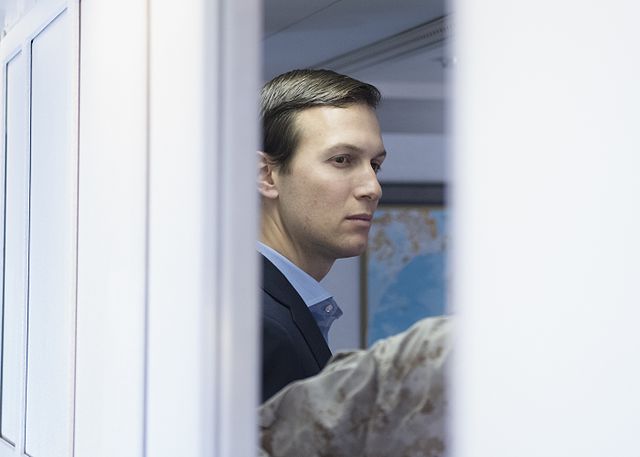
Jared Kushner (Wikimedia Commons)
The confluence of the Israeli snap elections, the Arab, Muslim, and Gulf Cooperation Council summits in Mecca this past weekend, and the upcoming “Bahrain Workshop” underscores the amateur nature of President Trump’s Middle East policy. The conundrum in which Washington finds itself illustrates the absence of any comprehensive thinking on the part of this administration toward Iran, the Arab world, and the Palestinian-Israeli conflict. In light of the recent Arab, Muslim, and GCC statements on the future of Palestinian-Israeli rapprochement and the need to have such a settlement grounded in the “two-state” and “land for peace” paradigm, whatever “Deal of the Century,” or parts of it, that Jared Kushner plans to reveal at the so-called Bahrain Workshop at the end of June will be dead on arrival. Arab, Muslim, and Palestinian leaders have already signaled their disapproval of the American approach, stating that economic support is welcome but statehood rights cannot be overlooked.
Even on Iran, although the Saudis were able to engineer a strong Arab, Gulf, and Muslim statement at the three summits against Iran, regional leaders are no longer sure or clear of the Trump administration’s real stand. The Saudi and Emirati leaders, together with Israeli Prime Minister Benjamin Netanyahu, have been clamoring for a war, presumably lead by the Americans. According to recent statements, however, the administration is backtracking on the rush to war. “Regime change,” according to Trump, is off the table, and the draconian and untenable conditions that Secretary of State Mike Pompeo had established earlier as a requirement for talks with Iran have been jettisoned. “We are prepared to engage in a conversation with no pre-conditions,” Pompeo said in a recent press interview. “We are ready to sit down.”
Netanyahu’s political future is the other wobbly pillar in Trump’s Middle East political edifice. Jared Kushner and Jason Greenblatt, the president’s special envoys dealing with the Israeli-Palestinian conflict, had banked on the Israeli prime minister’s solid standing in Israel and the Gulf region to help sell the plan through economic largesse. Netanyahu’s failure to form a government, resulting in snap elections to be held in the fall, and his legal troubles, with a looming indictment on corruption, have weakened his position, throwing the whole process in doubt.
Miscalculating on Iran
President Trump’s visceral animus toward Iran and his determination to bring the clerical regime to heel are based on three pillars: pulling out of the nuclear deal; imposing severe economic sanctions on Iran, especially the oil sector; and forming an Arab-Islamic-Israeli alliance with an eye toward containing Iran’s regional posture and activities. Trump’s hostility proved ephemeral.
The Iranian regime has not caved in. Other signatories of the deal—the four UN Security Council permanent members plus Germany—have opposed undermining the nuclear agreement and urged the Trump administration to settle America’s differences with Iran peacefully. To its credit, Iran for the most part continues to abide by the key requirements of the nuclear deal.
Although the harsh economic sanctions have dealt a blow to the Iranian economy, other nations have continued to trade with Iran, including buying its oil. The Iranian people’s perceived threat of regime change by the United States, the two Gulf Sunni Arab autocracies of Saudi Arabia and the United Arab Emirates, and the right-wing Israeli government has unified the Iranian people in defense of their national, sovereign Persian state.
Iranians who abhor the clerical regime are never sanguine about a foreign power declaring war on their country in order to remove their regime by force. Iran and the region still retain a vivid memory of the 2003 American invasion of Iraq. As the Bush administration discovered then, Iraqis dislike for their brutal regime did not translate into their liking a foreign invader. Iran is not any different.
By selling unprecedented amounts of sophisticated arms to Saudi Arabia and the UAE despite some congressional opposition, the Trump administration has hoped that these heavily armed regimes would force Iran to end its support for the Houthis in Yemen and capitulate. The war continues unabated, and the U.S.-supplied weapons to Riyadh and Abu Dhabi have been killing more civilians in Yemen. Without overtly admitting the failure of its gunboat diplomacy against Iran, the Trump administration seems to be searching for another course of action that does not threaten regime change but involves negotiations without preconditions.
Miscalculating on Israel-Palestine
The Israeli prime minister boasted recently that Trump has been the most supportive U.S. president of the state of Israel. What Netanyahu really meant to say was that Trump has been the biggest supporter of the ultraconservative, pro-occupation, and anti-Palestinian policies pushed by the current prime minister. President Trump, despite the opposition of most regional experts and former diplomats—for example, the two former U.S. ambassadors to Israel Daniel Kurtzer and Martin Indyk—and contrary to UN Security Council resolutions, declared Jerusalem the capital of Israel, moved the American embassy from Tel Aviv to Jerusalem, and accepted the “legality” of Israel’s control of the Golan Heights. The Trump-Pompeo State Department no longer uses “Occupied Territories” to describe the Israeli-occupied Palestinian lands in the West Bank.
Furthermore, the Trump administration has closed the Palestine Liberation Organization office in Washington and severely reduced its contributions to the United Nations Relief and Works Agency, which provides for Palestinian refugees’ relief and human development. President Trump has acquiesced in Israel’s continued economic tight grip on Gaza and the withholding of most taxes it collects on behalf of the Palestinian Authority in Ramallah.
The president has appointed his trusted adviser and son-in-law Jared Kushner to resolve the Israeli-Palestinian conflict. The envisioned plan—the so-called Deal of the Century—is reportedly grounded in economic aid to the Palestinians while dismissing their right to self-determination as a political community. Unfortunately, Jared Kushner is the least qualified “honest broker” interlocutor with the Palestinians. He has supported Israeli settlements in the West Bank and does not believe in the Palestinians’ right or ability to govern themselves in their own state alongside Israel. Kushner erroneously perceives the road to peace with the Palestinians going through Mohammed bin Salman (MbS) of Saudi Arabia and Mohammed bin Zayed (MbZ) of Abu Dhabi. He is also convinced that the expected billions of dollars from the Gulf states would buy off the Palestinians’ aspirations for statehood through some sort of a quisling leadership that would remain subservient to Israel for decades to come.
As Kushner discovered following the recent Arab-Muslim summits in Mecca, most participants reiterated their support for a two-state solution based on UN Security Council Resolutions 242 and 338, which were adopted following the 1967 and 1973 wars. Participants, including Gulf leaders, also support East Jerusalem as the capital of a future Palestinian state. Neither he nor his two key partners in the Gulf—MbS and MbZ—will be able to kill the idea of Palestinian statehood in the Arab psyche.
This is not to say that the two-state paradigm is at all achievable. In fact, more and more experts believe that this paradigm has faded and is being replaced by one area between the Jordan River and the Mediterranean Sea comprising two peoples—Israelis and Palestinians,  roughly six million each. Kushner will soon find out, whether at the Bahrain Workshop or in other forums, that unless he recognizes the political peoplehood of the Palestinians, no deal will succeed. Perhaps a Palestinian state is unachievable, but unless the Palestinians are involved in charting their future, together with other “honest brokers,” Kushner’s deal will fail. No plan for Israel and the Palestinians cooked up in Washington, Riyadh, and Abu Dhabi under the guise of fighting Iran will work.
Recapturing America’s indispensable role in the Middle East must conceptualize groundbreaking negotiations with Iran and a resolution of the Israeli-Palestinian conflict based on the right of the two peoples to live together in peace, dignity, and security. This effort can best be accomplished through international and regional collaboration. Its military and economic might notwithstanding, America cannot accomplish such a monumental task alone. Will Washington rise to the challenge or leave the region to others to fill the ensuing vacuum?