Showing posts with label Islamic revolution of Iran and the Islamic resistance. Show all posts

Monday, November 05, 2018

How Jamal Khashoggi's murder could reshape the Middle East order

The journalist's brutal killing could threaten the US-Saudi relations and Saudi crown prince's grip on power, and dramatically affecting the calculations of Israel and the US


Marco Carnelos's picture
Marco Carnelos


The shifting power balance in the Middle East over the last 15 years recalls the European experience in the 16th and 17th centuries, between the 1517 Protestant Reformation and the 1648 Peace of Westphalia. What took more than a century in Europe is happening in just a fraction of that time in the Middle East.
It is difficult to determine whether we are already in the more acute phase of the conflict, like the Thirty Years' War (1618-48) that destroyed Europe four centuries ago, or whether the worst has already passed.
President Recep Tayyip Erdogan is carrying out a slow and calculated leaking strategy to pressure Saudi Arabia and burn Riyadh’s clumsy narrative on Khashoggi’s killing
The Thirty Years' War led an exhausted and devastated Europe to the Peace of Westphalia, which finally ended the continent's religious wars and laid down rules of the international system. It is time now for a Westphalian peace in the Middle East, hopefully without another major war.
The Middle East today resembles the TV series Game of Thrones, with a wide-ranging power struggle among kingdoms, states, militias, religious groups and external actors - all entangled in conspiracies, plots, dynastic rivalries, sudden changes of alliances, competing interests, contradictory behaviour, assassinations and a widespread zero-sum mentality.

'Arab NATO' vs 'Axis of Resistance'

Oversimplifying to the extreme, there are two fronts: the so-called "Arab Nato" and the "Axis of Resistance".
Arab Nato is an array of Western states, Arab kingdoms and autocracies committed to protecting the old Arab order in the region. It is anchored to the leadership of the United States, and its core group comprises the US, Saudi Arabia, Egypt and the UAE, with Israel leading from behind the scenes. Its main purpose is to paint Iran and its regional allies and proxies as the main threat to regional stability.
Iran and its partners are confident that certain Arab kingdoms and autocracies are doomed - because they are unpopular, ruthless, illegitimate and, apparently, self-destructive
This group aims to reach a renewed Pax Americana that is sensitive to the interests of Israeli and Arab rulers, including a US-brokered deal, the deal of the century, between Israel and Palestine as a step towards a comprehensive Israeli-Arab peace; increased economic sanctions on Iran to prompt regime change; and reshaping political Islam in a way that does not threaten the old Arab order.
These achievements would usher in a new era of political harmony, economic cooperation and development as envisaged by Saudi Crown Prince Mohammed bin Salman’s Vision 2030.
Currently, the main threat to this project involves the global reaction to the murder of Jamal Khashoggi, which could threaten the US-Saudi relationship and the crown prince's grip on power.
Mohammed Bin Salman was supposed to be the cornerstone of the Arab NATO strategy; now, he appears to be its main weakness. The consequences of Khashoggi’s brutal killing could, once again, reshape the regional power balance, relegating Vision 2030 to a mirage and dramatically affecting the calculations of Israel and the US.

Competing agendas

The "Axis of Resistance" has a different agenda. What Arab NATO calls US "leadership", the axis defines as US hegemony. Iran, alongside Shia Iraqi political forces, "useful Syria", Hezbollah and other militias are its main shareholders.
As the “Axis of Resistance”, this group rejects the perceived US-Israel hegemony and their respective plans for the region. It also rejects Western values and the liberal order, considered as a form of cultural, political and economic imperialism.
To an extent, this axis represents what Martin Luther’s thesis represented in 16th-century Europe; their irregular militias are a sort of reissue of the French Revolution's Ragamuffins of Valmy. They are poorer and far less equipped than Arab NATO but animated by a much stronger resilience and revolutionary zeal.
Saudi women stand next to a Saudi Vision 2030 pavilion in Dubai on 16 October 2018 (AFP)
The Axis of Resistance members believe that the US-brokered peace deal between Israelis and Palestinians will be an imposition and a humiliation for the latter. It considers US sanctions against Iran a punishment for the country's refusal to bow to US hegemony, and it is convinced that it is impossible to suppress or harness political Islam in a way that would be functional to Arab kingdoms' interests.
Iran and its partners are confident that certain Arab kingdoms and autocracies are doomed - not as a result of the axis' destabilising actions, but because they are unpopular, ruthless, illegitimate and, apparently, self-destructive. At the moment, the main threat to the axis is the effect that renewed US sanctions on Iran will have on Tehran and its partners’ resilience.

Russia, China and Turkey

The political agendas of both Arab NATO and Axis of Resistance are chimeras. The first will never have the stamina, cohesion, patience and intellect necessary to implement its agenda. The second has all the qualities that Arab NATO is missing, plus enough critical mass to disrupt the other’s agenda - although, most probably, not enough to impose its own.
Russia, China and Turkey are watching from the sidelines. Russia is more active in supporting the axis, while China is more cautious; nonetheless, both Moscow and Beijing underwrite the axis's refusal to accept the Western political, economic and financial order.

Inside the Arab NATO-Axis of Resistance confrontation is a major battle for the leadership of the Arab-Islamic world.Turkey, so far, has played its cards smartly, especially on Khashoggi’s murder. President Recep Tayyip Erdogan is carrying out a slow and calculated leaking strategy to pressure Saudi Arabia and burn Riyadh’s clumsy narrative on Khashoggi’s killing. The Turkish leader appears to be using this event to further promote his own leadership of the Arab world, as an alternative to the Saudis.
There are enough elements for another major geopolitical earthquake in the region. The sooner the main local actors, and their external partners and sponsors, put aside their respective agendas and zero-sum approaches, the better.
A broader mechanism to settle their respective disputes and grievances should be found. The experience of Westphalia could be enlightening.
Marco Carnelos is a former Italian diplomat. He has been assigned to Somalia, Australia and the United Nations. He has served in the foreign policy staff of three Italian prime ministers between 1995 and 2011. More recently he has been Middle East Peace Process Coordinator Special Envoy for Syria for the Italian government and, until November 2017, ambassador of Italy to Iraq.

Saturday, September 15, 2018

The legacy of Ashura: resistance and victory


The legacy of Ashura: resistance and victory

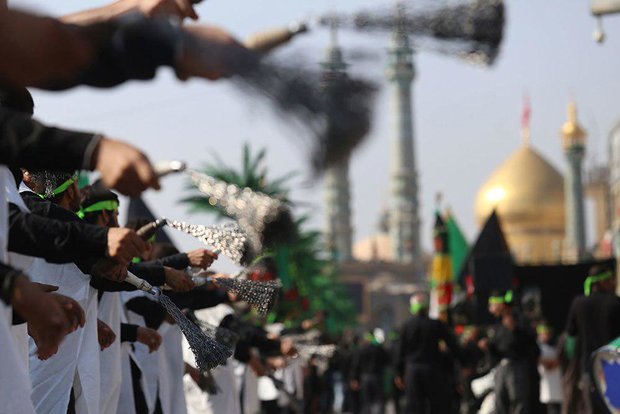
TEHRAN, Sep. 15 (MNA) – Muslims around the world mark the holiest lunar months of Muharram and Safar to mourn the martyrdom anniversary of Imam Hussein Ibn Ali.
Imam Hussein is the grandson of the Prophet Muhammad (PBU’em), born in 620 A.D. to a family famed for their values of love, honour and peace. His martyrdom anniversary which is, beyond a doubt, considered a defining event in the ideological and resistance movements of Muslims against corruption and oppression at all times, in all things, and in all places.
During The Battle of Karbala, Yazid; the corrupt, tyrant and illegitimate ruler killed Imam Hussein, the 7th-century revolutionary leader, who has recorded a phenomenal valiant stand for social and political justice. Definitely, the resistance’s current victories over the imperialist arrogance illustrate one of Ashura’s core issues: the triumphs of the oppressed over the oppressors.
After more than 1400 years, Imam Hussein still has the capability to awaken the oppressed people to heroically resist and to never approve any hegemonic power. Hezbollah Secretary General Sayyed Hasan Nasrallah says, “And that what happened during the Islamic revolution of Iran and the Islamic resistance [Hezbollah], as well as fighting all Takfiri groups. Ashura’s logic, spirit and determination are still active and present.”
To commemorate Ashura means to acquire knowledge on how to confront despotism and autocracy and how to disable the fundamental goals of the Zionists and the Imperialists. It indoctrinates us that only Resistance manages to prevent those foes from achieving their colonialist goals.
Thomas Carlyle, a Scottish historian and essayist say, “The best lesson which we get from the tragedy of Karbala is that Hussein and his companions were rigid believers in God. They illustrated that the numerical superiority does not count when it comes to the truth and the falsehood. The victory of Hussein, despite his minority, marvels me!”
While most of the Western media’s focus is on the very bloody ritual of self-flagellation; known as Tatbir, the main aim of Ashura is to refuse humiliation and to fight for every universal righteous causes. Indeed, Tatbir is a wrongful, unlawful and also a fabricated irrational and superstitious tradition. “Become an ornament for us, do not be a disgrace for us,” Imam al-Sadiq; the fifth Imam of the Ahlul Bayt, states.
Besides, the highest ranking and most widely respected Muslim scholars stress that any ritual which ridicule the religion is impermissible and that this suspicious ritual has not been mentioned anywhere in the religious teachings.
Islam survived, spread and expanded because of sacrifices of this great Imam; buried today in in Iraq’s holy city of Karbala, where some 22 million of Muslims gather to pay homage to Imam Hussein, in the world’s biggest annual pilgrimage.
During the ten days of Ashura, Muslims partake in large congregations where they recite elegies, lament and beat their chest as a cultural tradition. They do not only display their grievance but they distribute food and organise charitable and blood-donation campaigns.
Not long after the death of Prophet Muhammad (PBUH), the Muslims had slid into political turmoil and corruption as the Umayyad dynasty usurped power and slowly began destroying the moral fabric of society.
Just like his father and brother, Imam Hussein was a leader widely known for his compassion, wisdom and integrity. He rejected to pay Yazid an oath of allegiance in order to gain credibility for his illegal rule.
Out of his moral obligation and principles of social and political justice, Imam Hussein refused to pledge allegiance and legalise Yazid’s corruption and repression, despite it being a risk to his life. He chose to make a phenomenal stand, and launched his mighty uprising, alongside with his family and 72 sincere companions.
Knowing that what was ahead of them was a certain martyrdom; yet they all remained steadfast, loyal to their principles and fought valiantly against the army of Yazid.
Charles Dickens; an English novelist, maintains, “If Husain had fought to quench his worldly desires…then I do not understand why his sister, wife, and children accompanied him. It stands to reason, therefore, that he sacrificed purely for Islam.”
Out of fear, that Imam Hussein would gain momentum, Yazid dispatched an army of 30,000 to halt him and his companions in their track from Medina. Yazid had ordered his army to block, deny access to water, attack and kill them in the desert land of Karbala (in Iraq), on the 10th day of Muharram, the first month of the Islamic calendar; known as The Day of Ashura.
Certainly, Imam Hussein headed to Iraq not to seek power but to reform and reorganise the Islamic Muhammadan state and its universal humanitarian ethics. He fought bravely against the enemy and was attacked from all sides with swords, spears and arrows.
Eventually, a man by the name of Shimr ruthlessly beheaded him on the burning plains of Karbala, fatigued, thirsty and heavily wounded but victorious through his legacy and distinct goals.
The Battle of Karbala, absolutely, has triggered a series of uprisings against tyrannical regimes and imperialist forces through history. Furthermore, the Ashuraian resistances have obviously proven that each hegemonic power would have an eventual demise.
Today, pilgrims, from all across the world, pay tribute to Imam Hussein’s courageous stand and regard him as a symbol of resistance who stood for humanitarian values of sacrifice, freedom and dignity.
In the aftermath of The Battle of Karbala, Yazid’s army held the Imam’s women and children captive and marched them from Iraq to Syria. His sister was the one who safeguarded the uprising’s principles to reflect the essential role Islam set for women in any revolutionary movement.
Sayedah Zainab defied Yazid in his own courtyard in her famous sermons, which unnerved even his closest allies, and imposed his heinous massacre and violations.
Undeniably, Hezbollah – the Lebanese resistance –  and various other revolutionary movements have been greatly inspired by the outstanding figure of Imam Hussein (PBUH). Along with the axis of resistance, it defeated the U.S.-backed regional powers, who invaded and imposed an unconditional global war on Syria.
Hezbollah’s armed strength has grown in the wider region to contend the hostile U.S. administration. It has become a draining movement to vanquish and provoke the imperialist hostility, not only standing up to the Zionist conspiracies but has also morphed into a powerful regional force.
In fact, escalating Hezbollah resistance’s involvement in Syria has elevated the movement into an indispensable partner in a high-stakes confrontation, whose principal exponents are the extremist radical Saudis.