Showing posts with label Ayatollah Khomeini. Show all posts

Tuesday, November 26, 2019

The future of Islam and Muslims

By Quayyum Raja

KASHMIR - Islam is a universal faith. Anyone from anywhere at any time can embrace Islam and has been doing so ever since the dawn of Islam. Therefore, the future of Islam is bright, but the future of the current Muslim states looks very bleak.
Therefore, the future of Islam is bright, but the future of the current Muslim states looks very bleak.
Why?  Because most of the Muslim states are either fighting their own people or against each other. There is no independent foreign policy due to external interference.
  Any Muslim state which tries to have its own foreign and economic policy is targeted by the imperialists and the other fellow Muslims watch it idle by. Iran is a prime example, which has been facing unjustified economic sanctions for decades.
 How Iran has managed to survive is a miracle. Iran’s ability to survive in the face of harsh economic sanctions provides a source of strength and hope. It raises the question as to what is the power behind the survival of Iran, whose living standard and infrastructure is still better than most of the well-off Muslim states.
I have recently spent three months in Iran during which I have very closely observed the social, cultural, political and economic conditions of Iran.  The Iranians are a dignified people with a remarkable history and civilization.  They have supported their government, because they know the external powers see their civilization as a competing force.
America wants a political hegemony and Iran is seen as a power but why? Iran was certainly not seen as a threat for America during the Shah era. So, what is the difference?  The main difference is that Shah had allowed America to change its culture and control resources and foreign policy.
 In comparison, the post-revolution Iran has maintained its independence in the face of all difficulties and proved clear difference between “Oral Islam” that existed during the Shah era and practicing Islam brought about by Ayatollah Khomeini.  The practicing Islam emerged out of firm belief in Allah (SWT) and life after death. 
Over a century ago, Dr. Allama Iqbal, the poet and philosopher, who is a Kashmiri by background, but known in Iran as Iqbal Lahori, wrote extensively in Farsi despite, not being in Persia. His poetry showed to what extent he adored the Persian language and culture.
 Iqbal lamented the “Oral Islam”, where Muslims had reduced Islam to rituals and customs and lacked belief. It is unfortunately still the case today, where most of the Muslim rulers are happy with “Oral Islam.”  People follow Islam out of a habit rather than an understanding of the concept of Islam. 
 Pakistan was formed in the name of Islam, but it has become more un-Islamic than it was before its formation in 1947. The educational curriculum of Pakistan comes from Britain and the language of instruction right from the primary school is now English in Pakistan. 
 This is how the Pakistani children are being brainwashed, losing the knowledge of their own history, culture and heritage. The Arab countries have Arabic as their language of instruction but the level of research is very limited and creativity hardly encouraged. This is why the Arab world has not been able to contribute to the world for centuries in terms of scientific knowledge despite large resources.
Up until the 12th century, the Islamic world produced scientists, scholars, and poets like Omer Khayyam, Abu Sinna, Ibn Khaldun, Abu al Qasim Ferdowsi, Sheikh Saddi Shirazi and Syed Ali Shah Hamdani and many others within a short span of time, but not half the figure in the last ten centuries. So, what is the reason? It is simply because the most Muslim countries do not have their own curriculum in their own languages.  
The imperialistic world has discovered a new weapon to defeat and rule the people through a remote control. This is the imposition of their education system in their own language. 
The solution lies in the re-introduction of our own curriculum in our own language. Iran is a good precedent for the Muslim world.  Iran does not only have a good education system, but also “Public Diplomacy” through which the Persian Language and culture is promoted as well as the public to public relations.
 The Muslim countries must follow the example of Iran’s Public Diplomacy to bring about mutual understanding between the Muslims necessary for harmony and peace between them. Otherwise, the Muslims will remain a community in competition with itself rather than other competing forces, who have already reduced it into a subordinate exploited world. 
Dr. Iqbal has envisioned “the Mard-e-Momin”, a true Islamic character by following Allah and the Prophet through self-discipline and patience for removal of all the ills in the Muslim society. Let us try to create and develop such a character in each of us. Iqbal’s “Mard-e-Momin” is not confined to a particular territory or belong to a particular race. It is a human being who has followed the sunnah of the Prophet to gain complete independence from the evil forces and has acquired inner satisfaction rather than material success in the eyes of the materialistic world. 
The Western Union has removed visa restrictions for economic benefits, while we Muslims believe in one God and one Prophet, but have hardest visa conditions. This is why, the Muslims know more about non-Muslim countries and little about each other. Let us start here and today to bring the Muslims closer and stronger.

Thursday, March 07, 2019

Iranian revolutionary experience had effective leadership: Falk

By Javad Heirannia
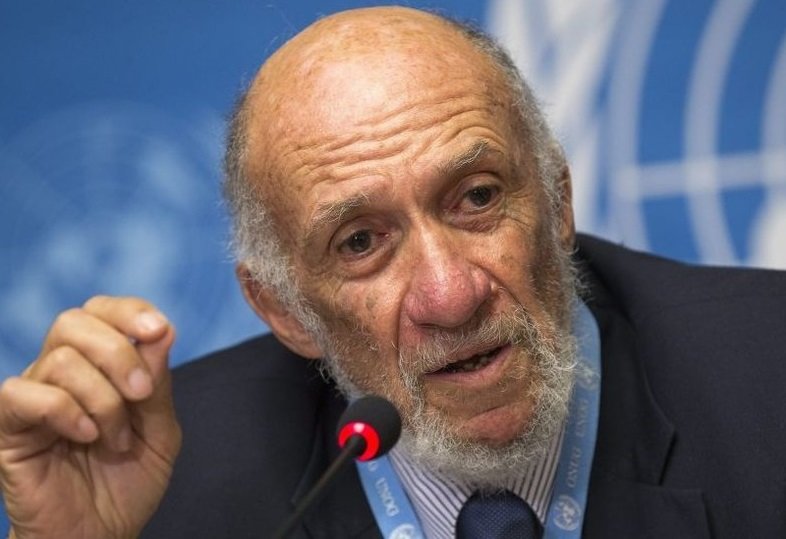
TEHRAN - Richard Anderson Falk, professor emeritus of international law at Princeton University, says “Iranian revolutionary experience had effective leadership and a clear vision of what it was for and against.”
Former United Nations High Commissioner for Human Rights says “I became rather uncomfortable after the first hour or so. I was very impressed by Ayatollah Khomeini’s demeanor, his dark bright eyes, his softly spoken confident words, and his probing questions raising serious issues.”
Following is the full text of the interview:
Q: You met with Ayatollah Khomeini shortly before the victory of the Islamic Revolution of Iran. What memory do you have of the visit?  What did you think about Ayatollah Khomeini at that meeting?
A: It was a vivid climax of our visit to Iran early. Prior to the meeting we had been in Iran for two weeks. During that time, the Shah had left the country, and it became clear to the world that revolutionary movement of the Iranian people had been successful. 
I remember sitting on the rug covering the ground in the tent outside his house at Neuf de Chateau. This was where Ayatollah Khomeini received foreign visitors. As I was not used to sitting on the ground for such a long time, I became rather uncomfortable after the first hour or so. I was very impressed by AK’s demeanor, his dark bright eyes, his softly spoken confident words, and his probing questions raising serious issues. In addition to myself our group consisted of Ramsey Clark, the former American Attorney General who still in close contact with many top decisionmakers in Washington and Philip Luce, a religious leader and a political activist who became known around the world when he showed some U.S. Congressmen visiting Saigon during the Vietnam War the notorious ‘tiger cages’ where political prisoners of the government were cruelly confined.
We had been invited to Iran by Mehdi Bazargan for the purpose of understanding the revolution as it really was, and not as it was being presented in distorted cartoon fashion by the mainstream Western media. While in Iran we were given the opportunity to meet a wide variety of religious leaders and societal figures who had been active in the movement against the Shah. 
Q: When met with Ayatollah Khomeini, what did he think about America's relationship with Iran?
A: Ayatollah Khomeini was deeply concerned about the prospect of an American intervention. We found this concern natural and prudent. He was explicitly worried about a repeat of the experience of 1953 when Mossadegh, the democratically elected head of state in Iran, became a victim of a coup supported and encouraged by the CIA, and designed to restore imperial dynasty of Reza Shah Pahlevi. Ayatollah Khomeini sought our opinion as to whether the U.S. Government would organize some kind of counterrevolutionary response designed to restore the power and authority of the Shah’s regime. We responded that such a risk existed, but we were not in a position to assess its seriousness. 
If no coup or counterrevolutionary moves was attempted, it was our impression that Ayatollah Khomeini seemed open to normal relations with the West. If there was American interference in internal Iranian affairs relations would be strained. The new leadership in Iran would use all means at its disposal to resist any attempt to intervene. If Washington was prepared to accept the reality of the new Islamic Republic of Iran, Ayatollah was ready to endorse normal diplomatic relations, and even spoke of a willingness to maintain earlier commitments to purchase American military equipment.  
Q: You were accompanied by an American delegation to travel to Iran. That American delegation opposed U.S. involvement in Iran's internal affairs, and that meeting was initiated by the Prime Minister's invitation of Bazargan. During that trip, you talked with the last prime minister of the shah, Shapur Bakhtiar and the last American ambassador to Iran, William H. Sullivan. At that time, what did they comment on the Events and Developments in Iran? Did they think that revolution would occur in Iran?
A: As your question suggests, we were more clearly opposed to past and any future U.S. intervention in Iran than we were supporters of the revolution. We came to Iran hoping to learn about what was happening, and what to expect from the new leadership. We tried our best to meet a wide range of relevant personalities who were in one way or another involved with these dramatic developments. We did not receive clear or consistent answers to our questions about what to expect in post-Shah Iran, and were told on more than one occasion that ‘the revolution happened too quickly,’ in the sense that there was no time to prepare for the future.
Our meeting with Prime Minister Shapur Bakhtiar occurred on the evening that the Shah left Iran. Bakhtiar seemed nervous and somewhat agitated. He was surrounded in his office by a group of men whom we assumed were associated with Iranian intelligence, and likely not sympathetic with this remnant of the former government. Bakhtiar acted as if he was almost a prisoner despite the fact that he was still holding the highest office in the government. When we asked to visit the political and ordinary prisoners on the following day, Bakhtiar turned to these minders in the room before responding. He told us we had permission to visit the political prisoners, who were soon to be released, but not the common criminals, presumably because the conditions of their confinement was far below international standards.
Overall, Bakhtiar gave an impression of being an unhappy casualty of history, not questioning the revolutionary results directly, yet not being able to reconcile his secular outlook with the prospect of a religious oriented political leadership, and undoubtedly very worried about his own fate. In some senses, Bakhtiar conveyed an impression of a European style of worldliness, including an obvious affection for French culture.
Our meeting with the American ambassador, William Sullivan, was problematic for a number of reasons. Clark had little respect for the kind of diplomacy that Sullivan practiced while serving as ambassador in Laos, which included authorizing the use of the embassy to coordinate military attacks on the Laotian countryside as an extension of the then ongoing war in Vietnam. Sullivan had the reputation of being a counterinsurgency diplomat. Clark was initially opposed even to our seeking a meeting with Sullivan, but I persuaded him that the credibility of our impressions of Iran would be increased if we heard what he had to say. Meeting with Sullivan was also problematic for me as I had testified a year or so earlier in the U.S. Senate against his appointment as ambassador to Iran, alleging that he was guilty of war crimes in Laos.
When we entered Sullivan’s spacious office, I was greeted with these words, “I know Professor Falk thinks I am a war criminal.” I didn’t nothing to alter this perception, remaining silent. Sullivan didn’t express any hostile feeling toward Ramsey Clark. After this initial tense moment, Sullivan gave us a clear briefing about what was happening in Iran, emphasizing his difficulties with respect to persuading the White House to accept the outcome of the revolution. Sullivan made clear to us that he was very unhappy with the role being played by Zbigniew Brzezinski, the National Security Advisor to President Jimmy Carter, who refused to accept the unfolding realities, and remained intent on reversing the revolutionary outcome, and tried in various ways to promote a result that Sullivan opposed as unwise, and likely counterproductive. I later wrote and spoke about this meeting in ways that reported these views, and turned out to be damaging to Sullivan’s career after it was determined via Clark that our meeting was on the record, that is, it was thus permissible to repeat to the media what we had been told in Tehran. In fact, we had the impression that Sullivan was so upset by Brzezinski’s behavior that he wished that his efforts to turn the clock back in Iran be made public. 
I recall an incident during ‘the hostage crisis’ that occurred some months later when I had been asked to act as an intermediary between Iran and the U.S. because there was no direct contact between the two countries. It was at a time fairly early in the crisis when Ayatollah Khomeini let it be known that he would look with favor if an African American diplomat had been sent to negotiate the release of the hostages. Andrew Young, who satisfied the ethnic criterion set by the Iranian leader had been suggested as the appropriate person to carry out such a mission, and I had agreed to accompany him as a kind of resource person. Young was ready and willing, but he didn’t want to burn his bridges in the U.S., and insisted as a precondition on a green light from the White House. When this was refused, and Young declined, the furious head of the Iran Desk in the State Department who was eager to defuse the crisis, told me “Brzezinski would rather see the hostages dead that see Young get credit for their release.” 
Among the other valuable aspects of this meeting with Sullivan was his acknowledgement that before the revolution the American Embassy had prepared 26 scenarios of what could go wrong in Iran from the perspective of the stability of the Shah’s governance, and not one of them had perceived a threat from Islamic sources. The Cold War mentality had focused on various threats from Marxist and Soviet sources, but the Islamic dimension was assumed to have been either subordinated, or at least neutralized, by the exile of Ayatollah Khomeini or aligned with the anti-Marxism of the Shah.
Q: When you were in Iran, the Shah left Iran. What is your memories of those days and those events?
A: I remember that day very clearly. We had gone to the city of Gazvin to meet at the home of some doctors who had treated Iranians wounded in anti-Shah demonstrations. They had told us about the Iranian armed forces entering the hospitals, and removing some of those wounded and generally interfering with humane and effective medical attention given to these nonviolent participants in political activities hostile to the government.
While having lunch, the radio reported the Shah’s departure but some of the Iranians present were stunned, and wondered whether the reports were even true. I remember a doctor worrying that this might be a trap designed to lure anti-Shah militants to engage in victory demonstrations that would be crushed by a military crackdown. As the news sank in, and was accepted as accurate, concerns gave way to a celebratory mood. On the drive back to Tehran to keep our appointment with Bakhtiar, the road became more crowded with cars blowing their horns and displaying flags and posters of Ayatollah Khomeini. It was a scene of intense political excitement.
On the following day we walked in a huge demonstration affirming the Shah’s departure and the prospect of transformative change in Iran, the nature of which was not yet clear. It was a moment of popular excitement and hopefulness, and an impressive celebration of the unity that joined many elements in the extraordinary struggle against the Shah that had been viewed skeptically until this moment when its success could no longer be doubted. 
It was sad to witness during the days that followed the beginnings of disunity among these forces that had so recently joined together against the Shah. The main early tension involved women who were fearful that their progress in secular Iran would not be sustained if the governing process took a religious turn. Also, it became evident to me that the left component of the anti-Shah movement would not accept the dominant religious tendency, and vice versa.
Q: Previously, you said that when you referred to the revolution of Iran in a meeting with Ayatollah Khomeini, Ayatollah Khomeini corrected your remarks and he said the “Islamic” Revolution of Iran. Is it possible to explain more about this? Why did Ayatollah Khomeini emphasize Iran's Islamic Revolution rather than the Iranian revolution?
A: It was only somewhat later that I began to understand why Ayatollah Khomeini gave such importance to this matter of naming of the revolution. By calling the post-Shah Iran the ‘Islamic Republic of Iran’ there were several ideas present. First of all, was the point that Iran was an Islamic society, and to say this was to express the basic character of the political community of the country. To be ‘Islamic’ was also to be part of a larger religious and civilizational community than could encompassed be a territorial sovereign state, and could be interpreted as the basis of an Islamically oriented political challenge to the secular governments in Islamic majority countries. During our meeting, Ayatollah Khomeini also expressed his strong belief that ‘peace diplomacy’ after World War I had wrongly imposed the European concept of territorial state on the region with its emphasis on ‘national’ identity that displaced religious and cultural identities alone capable of establishing a voluntary community.
Further the idea of an ‘Islamic Republic’ drew a sharp contrast with the idea of a secular, dictatorial monarchy, with dynastic claims to exercise leadership, that had characterized the imperial governance of the Pahlavi Dynasty. Present also was the notion of ‘republic’ that seemed to signal an intention to establish limits on governmental authority and to protect the citizenry against abuses of state power, preferably under the guardianship of religiously respected figures.
Ayatollah Khomeini also made clear his view that monarchy and dynastic rule lacked political legitimacy. He referred explicitly to Saudi Arabia, insisting that it was no more legitimate than had been the Shah’s governance structure. 
Q: You talked to a lot of American officials on that days (Days before Iran revolution). In your opinion, why did American officials never support the Iranian revolution and government?
A: The U.S. relationship with Iran was dominated by ideological and geopolitical considerations ever since the Shah was returned to power, with Washington’s help in 1953. The Shah was a compliant partner with the United States during the Cold War, serving as the anchor of the containment policy directed at the Soviet Union, an important customer of the American arms industry, and a willing participant in the liberal world order serving private corporate and financial interests. Beyond this Iran was willing to be an oil supplier to both Israel and South Africa at a time when the U.S. was eager not to be seen as defying world public opposition by befriending these two governments. Against this background, it is not surprising that Henry Kissinger called Iran ‘the rarest of things, an unconditional ally’ in his political memoir.
At the same time, there was a suspicion about what the revolution portended, even the fear that it would push Iran into the arms of the Soviet Union, and represent a major setback for the U.S. in the ongoing Cold War rivalry. The populist character of the revolution was also perceived as a threat to Israel, especially given the outreach of Ayatollah Khomeini to the entire Islamic community and his clear rejection of Zionist claims to govern Palestine, including Jerusalem. In our meeting Ayatollah Khomeini made a clear distinction between the Jewish religion that he called ‘an authentic religion’ and Zionism that he regarded as a political project hostile to the Palestinian people and to Islmaic interests and values. He also distinguished between Jews, whom had historic roots in Iran and he hoped would remain after the revolution, and Bahais, whom he categorized as ‘a sect’ that had no legitimate place in the Islamic Republic he envisioned.  
Q: Previously you described Ayatollah Khomeini as a true and genuine revolutionary. In your opinion, what was the difference between the Iranian revolution and the developments of the Arab Spring in 2011? Was the Egyptian Revolution in 2011 a genuine and real revolution?
A: I think this is a really important question. The main difference is that the Iranian revolutionary experience had effective leadership and a clear vision of what it was for and against. It also understood in ways that were not present during the Arab Spring, especially as developments unfolded in Egypt, that the Iranian revolutionary process was threatened from without and within. Perhaps, Ayatollah Khomeini and others in the leadership were taking prudent account of their memories of the 1953 coup, and their realization that this could happen again in Iran if serious precautions were not taken. Arguably, such a learning of the ‘Lessons of 1953’ produced some repressive over-reactions, using the fears of counterrevolution to justify actions taken against internal liberal adversaries and other perceived ‘enemies.’ Such an assessment remains to be made, requiring some inside knowledge that I do not possess.
The Arab Spring political movements were unstructured, seeking to challenge the established order, but without any clear agreement on ‘what next.’ This fluidity created ample opportunities for external and internal elements opposed to transformation to reassert themselves after the dramatic moment had passed when the hated leader had been overthrown. Perhaps, also, the political inexperience of the Muslim Brotherhood also accentuated the vulnerability of these movements to reversals in the public spaces of several Arabic countries after displaced elites had regrouped to stage a comeback.

Wednesday, February 20, 2019

It was a revolution of faith

By Sebastián Salgado
CARACAS - There are very few reports on the Islamic Revolution in Iran in the Western media and what springs to mind is the movie Argo on the Iran hostage crisis in 1979.
The movie, directed and starred in by Ben Afleck, portrays hundreds of Iranian revolutionary students climbing over the wall of the U.S. embassy in Tehran with photos of Ayatollah Khomeini in hand. They seized the “US Den of Espionage”, as it was dubbed, where Shah Pahlavi received instructions from the U.S., puppet that he literally was. Just like any other Hollywood production, the movie mostly demonizes the people’s movement that stood against Washington. 
Getting the full picture of what happened in Iran in 1979 is quite difficult. Our imaginative view of a Latin American revolution in which protesters are dressed in military uniforms fades away quickly. It was a fight against a dictator in this region of the world and not guerrilla warfare. 
The Islamic Revolution offered a new element: Faith. Words had more value than guns.
The duty of Muslims was to rise up against oppression. The exile of Imam Khomeini only spread his peace message across the entire world. He urged the revolutionaries not to confront the soldiers of the Shah as he considered them part of the people, even though they were in control of the regime. At the rally, people handed soldiers flowers.
Imagine a photo portraying a military guy receiving a flower as a loving gesture. As they say, a picture is worth a thousand words. There is no way to confront people who are willing to sacrifice for their faith and demand changes in the political system.
The torture method in Shah’s time was like the Videla in Argentina. (Waterboarding, the picana electrica, and other methods). I visited the Towhid Prison (Iran Ebrat Museum), putting abuses under the Shah on display, in Tehran, and felt that I was in the former ESMA, (the School of Mechanics of the Navy's Clandestine Detention Center.) Pictures of missing people hang on the walls and many survivors of that time are part of the Iranian government now.
Over the course of eight years, U.S. ally Saddam Hussein attacked Iran, but he did not realize that these peace-loving people, at the same time, were proud to become martyrs and would sacrifice their lives for the revolution. In the Sacred Defense (the Iran-Iraq war), there were more volunteers than weapons. Over a million people died in the war.
Iran is celebrating the 40th anniversary of the Islamic Revolution, a living movement that is reinforced in spite of foreign attacks and financial sanctions, and the revolution has transferred Iranians to world leaders in a variety of technological and scientific fields, such as nano-technology and peaceful nuclear industry.

Saturday, January 26, 2019

In U.S. one new NYT columnist just made a serious impact

By Martin Love
NORTH CAROLINA - The Power of the Press, provided it’s the right particular medium, packs at least an incipient punch. Take for example the so-called “newspaper of record” in the United States, the New York Times, which despite decades of obfuscations and bias in certain arenas such as the Middle East remains the one newspaper which, if the mainstream media were to be absolutely shunned, would probably be the last to meet that fate.
Too many smart readers who more or less try to keep up with politics and international affairs and have some grasp of things at least have continued to “trust” the NYT, and when it is clearly pointed out or revealed that the paper has erred time after time and misled readers in the past, it’s like dropping a stink bomb on the morning commute train into the Big Apple with potential reverberations all across the country and particularly in Washington.
One column last Sunday in the paper by one Michelle Alexander, a recently hired writer, has heartened seekers of truth like few others in years. Alexander, a respected professor now at Union Theological Seminary in Manhattan and a longstanding and respected civil rights advocate, wrote such a lucid piece about Palestine that it has flummoxed the entrenched “Israel can do no wrong” masses and left them in the dust, gasping unsuccessfully to counter her arguments (especially on Martin Luther King Day) that it is high time the wrongs against the Palestinians are addressed and Likud Israel is at last challenged for its various and obvious crimes. Iran, of all countries, well knows what those crimes have been for seven decades or more against the natives of the Holy Land.
Ayatollah Khomeini, who led the revolution in Iran, was speaking out against the Zionist program way back in the 1960s, if not earlier, even when he was exiled from Iran by the Shah for over a decade, and it’s one of several big reason the Israelis and the U.S. have long sought the end of the Islamic Republic since 1979.
What Alexander, a Baha’i by the way, especially did in her column was write – eloquently -- what few have dared utter: that there are many “progressives” in the U.S. who, knowing right from wrong, have not dared challenge Israel because they feared they would be smeared so harshly that they would be unable to carry on their work in other worthy causes, having been declared “anti-Semitic” if not worse.
 There are so many cases in the U.S. of smart people being marginalized and slandered for decades by Zionists and their supporters, people often losing their jobs, that it is almost unbelievable how deeply and powerfully this has played out – maybe, just maybe, until now when other thinkers like Alexander may be emboldened finally to speak truth to power about Israel, as Iran’s leaders have long done and as Alexander has now just done. Yes, she is being smeared by the usual culprits, but it appears to no affect. Maybe the NYT will fire her as a columnist, but one must doubt it: it would be so transparent if they did. At any rate, her column has been deemed a “strategic threat” by Zionists.
It seems a corner has been turned in the push for justice at last, and justice in Palestine is the key to winding down the awful terror of the so-called War on Terror instituted by George W. Bush and the Neocons, many of whom remain in powerful roles in Washington under Trump. And one reason the NYT allowed the publication of her column, it has been suggested, is that last year the newspaper elevated a new, young publisher of the same Jewish family that has long been at the helm of the paper -- a young Jew and no doubt Zionist who sees the future better than his predecessors did.
Presuming a new page is beginning to open up in the U.S. whereby those who have been hurt for challenging Israel’s cruelty find some vindication. I happen to be one minor victim of real hostility for trying to write as a journalist about Palestine on several occasions in the past, going all the way back to the mid-1970s after I spent a month at Jabalia Refugee Camp in Gaza.
We few Americans who have at least attempted to shine a light on Israel’s misdeeds and human rights abuses must now also wonder what this possible change of atmosphere might mean for the campaign long underway by Israel, the U.S and some Arabs against the Islamic Republic. Might this odious campaign against a sovereign Iran be somehow abbreviated and neutered to some extent, if not absolutely halted? It is difficult to know, but one thing is certain: the dialogue in the U.S about the depredations of Zionism seems about to expand, and there may be some spillover with regard to dampening Washington’s warmongering in the Middle East.
 (The criticisms and demands for a reckoning with Muhammad bin Salman over the Jamal Khashoggi murder last October, for example, continue with one of the most fervent Zionist supporters, GOP Senator Lindsay Graham. If Graham manages to push moves to throttle and punish MBS, might his next realization be, at the margin, a change of heart regarding his carte blanche support for the far right-wing Zionists?)
Some Iranians, anyway, are saying just the right things, and one must quote one unnamed Iranian: 
“The U.S. and its allies can sanction Iran, threaten her, demonize her, raise false flags to spread lies, BUT they will never break her. Why, because she stands on the right side of history, on the side of the oppressed. As an Iranian, I have the right to question my government, to hold it to account and even change it. Iran is not a perfect country and we need a lot of work to make it better for everyone, BUT no other country has the right to tell us what is best for us. Anyone looking to the U.S. as an ally or a country that brings “democracy” or “human rights” to anywhere be deluded or a traitor. The notion that we in Iran need help from outsiders is a false and dangerous idea that will only lead to harm and destruction. Never again.”

Monday, August 27, 2018

PALESTINIANS ARE BEING OPPRESSED: WHAT ARE YOU DOING?

BY MAHDI GARBA


Whether you are keen on foreign news or not, one can never run away from the despicable stories of the oppressed people of Palestine or argue that the news has never crossed their news bars, newspaper headlines, or now the emerging conventional social media timelines. The news ranges from detention, torture, cold-blooded murder, to unprovoked attacks by the Israeli security operatives on unarmed civilians, majorly the vulnerable — women and children.

On March 30th, the Palestinians launched a protest tagged ‘March of Return’, which was a move among series of efforts to press for the demand of their usurped land to end the inhumane treatment by the Israeli regime against them. The protests which culminated on May 15th that coincided with America’s Donald Trump ill-informed decision to move the US embassy to Jerusalem. A decision that, pundits maintain, would be rejected even in a world gone mad.

Out of sheer and vicious cruelty, Israeli snipers shot about 110 Palestinians including children, journalists, and medical personnel. The number of injured persons skyrocketed from 2,771 to about 12,000 between March 30th to May 15th.

While American diplomats, evangelists, and cronies were celebrating the embassy shift, the oppressed people of Palestine were burying their dead ones and attending to the injured ones. Surgeries were even carried on without anesthesia, courtesy of dwindling medical supplies. Just imagine a bullet being removed from one’s body without any anesthesia!

This has been the norm in occupied Palestine because, in May, the Palestinians still commemorated the 70th Nakbah anniversary – which means the day of catastrophe. The Nakbah was set aside to remember the ethnic cleansing perpetrated against the Palestinians exactly seven decades ago.

This remains the lone reason why the pioneer of the Iranian Islamic revolution, late Ayatollah Khomeini in 1980, a year after the 1979 revolution, set aside the last Friday of every Ramadan to mark the International Quds day to denounce Israel’s barbarism and show solidarity with the oppressed Palestinians. The late revolutionary said,

“The issue of Quds is not a private or personal issue. It is neither the exclusive problem of one country nor a present-day problem of all Muslims. Rather, it is a phenomenon concerning the monotheists and faithful people of all ages — past, present, and future.”

In 1988, the Organization of Islamic Countries endorsed the idea of Ayatollah Khomeini. Since then, the International Quds day has been recording massive turnouts with people of conscience devoid of their religious and ethnic affiliation participating annually. Turnouts in countries like Malaysia, Austria, Nigeria, South Africa, Pakistan, Britain, Canada, and the US have been captivating. In 2014 alone, the International Quds day was marked in 22 Nigerian cities, which is increasing yearly.

Another indication that myriad is heeding Imam Khomeini’s call to liberate the first Muslim qiblah, Masjid al-Aqsa (one of the three revered Mosques in Islam) and the locus of Prophet Muhammad’s ascension to the heavens in the Night Journey, popularly known as al-Isra wa al-Mi’iraj among Muslims.

This call has echoed on the ears of Muslims, Christians, and Jews who understand that Israel is ostensibly a Zionist state with no religious underpinnings. This is the reason why even Jewish Rabbis join the pro-Palestinian rallies around the world and have gone the extra mile to launch a campaign tagged “Not In My Name”, although, this is being drowned by the propaganda of Israel. Just last month, Jewish Rabbi Dovid Weiss delivered a paper on the illegal occupation of al-Quds at the New Horizon Conference in Mashhad, Iran.

Present at the conference were Russian Philosopher Alexander Dugin, Allison Weir of IfAmericansKnew.org, ex-CIA officer Phillip Giraldi, Israeli-born anti-Zionist Miko Peled, French researcher and writer Maria Poumier, and British Journalist, sister-in-law to Tony Blair, Lauren Booth who converted to Islam in 2010 after visiting the Holy city of Qom.

It is important to deconstruct the idea of complacency. There is no room for neutrality. One must be supporting the oppressed or their oppressors. Moreover, nobody should be fooled by mainstream media headlines using words like crisis or conflict or speaking about a ‘Two-State Solution’. It’s offensive against the downtrodden people of Palestine, and should leave every person with a conscience agitated.

Sequel to Imam Khomeini’s declaration, it is pertinent to understand that protesting for the people of Palestine doubles as an avenue to stand in solidarity with the oppressed Palestinians and all the oppressed people around the globe. The plight of the people of Yemen, Syria, Myanmar, Bahrain, Kashmir, etc. should be identified with. It is also important to demand the release of the champion of the Palestinian cause in Nigeria, Sheikh Ibrahim Zakzaky who has been under illegal detention since December 2015 and every person illegally detained.