Showing posts with label Archaeology. Show all posts

Tuesday, September 24, 2019

Ancient Iran: a glimpse of Persian art and architecture under Sassanids

TEHRAN – The Sassanid era (224 CE–651) is of very high importance in the history of Iran. Under Sassanids, Persian art and architecture experienced a general renaissance.
Architecture often took grandiose proportions such as palaces at Ctesiphon, Firuzabad, and Sarvestan that are amongst highlights of the ensemble.
Crafts such as metalwork and gem-engraving grew highly sophisticated, yet scholarship was encouraged by the state. In those years, works from both the East and West were translated into Pahlavi, the language of the Sassanians.
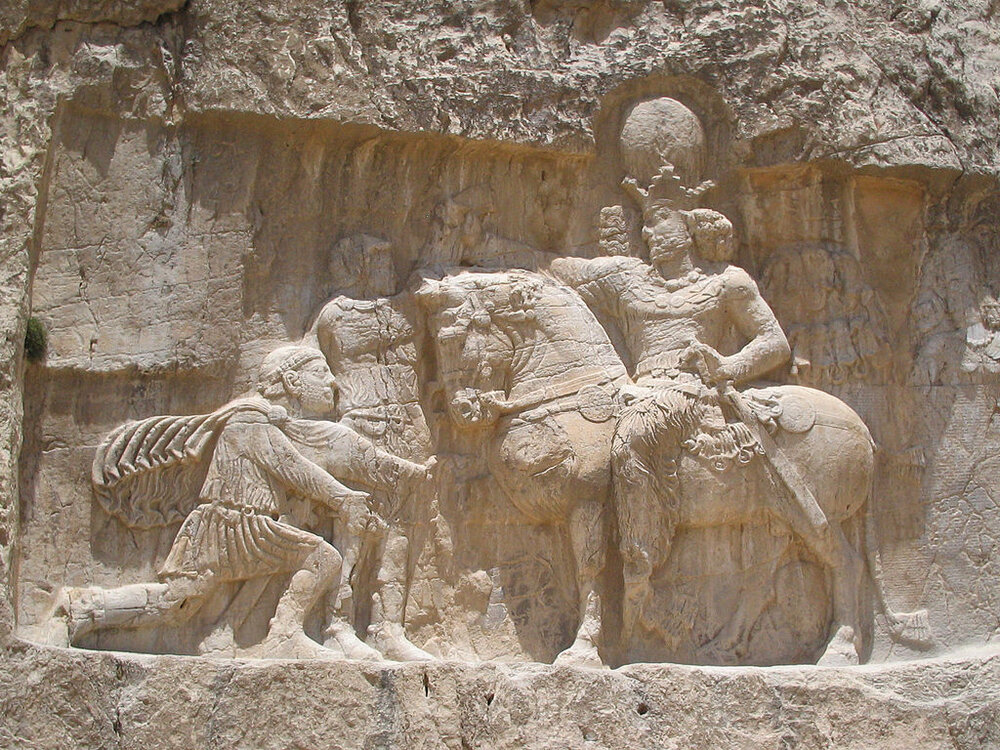
Rock-carved sculptures and bas-reliefs on abrupt limestone cliffs are widely deemed as characteristics and striking relics of the Sassanian art, top examples of which can be traced at Bishapur, Naqsh-e Rostam and Naqsh-e Rajab in southern Iran.
In 2018, UNESCO added an ensemble of Sassanian historical cities in southern Iran -- titled “Sassanid Archaeological Landscape of Fars Region”-- to its World Heritage list.
The ensemble is comprised of eight archaeological sites situated in three geographical parts of Firuzabad, Bishapur and Sarvestan. It reflects the optimized utilization of natural topography and bears witness to the influence of Achaemenid and Parthian cultural traditions and of Roman art, which later had a significant impact on the architecture and artistic styles of the Islamic era.
Efforts made by the Sassanids also yield a revival of Iranian nationalism took place, for example, Zoroastrianism was declared as the state religion.
The dynasty evolved by Ardashir I and was destroyed by the Arabs during a period of 637 to 651. The dynasty was named after Sasan, an ancestor of Ardashir I.
Under his leadership who reigned from 224 to 241, the Sassanians overthrew the Parthians and created an empire that was constantly changing in size as it reacted to Rome and Byzantium to the west and to the Kushans and Hephthalites to the east, according to Britannica Encyclopedia.
At the time of Shapur I (reigned 241 CE–272), the empire stretched from Sogdiana and Iberia (Georgia) in the north to the Mazun region of Arabia in the south; in the east it extended to the Indus River and in the west to the upper Tigris and Euphrates river valleys.
Bust of a Sasanian king, most likely Shapur II
According to UNESCO, the ancient cities of Ardashir Khurreh and Bishapur include the most significant remaining testimonies of the earliest moments of the Sassanid Empire, the commencement under Ardashir I and the establishment of power under both Ardashir I and his successor Shapur I.
“The architecture of the Sassanid monuments in the property further illustrates early examples of construction of domes with squinches on square spaces, such as in the chahar-taq buildings, where the four sides of the square room show arched openings: this architectural form turned into the most typical form of Sassanid religious architecture, relating closely to the expansion and stabilization of Zoroastrianism under Sassanid reign and continuing during the Islamic era thanks to its usage in religious and holy buildings such as mosques and tombs,” the UN cultural body say in its website.
The Sassanid archaeological landscape also represents a highly efficient system of land use and strategic utilization of natural topography in the creation of the earliest cultural centers of the Sassanid civilization.

Monday, September 23, 2019

Uni. of Tehran honors Prof. Barbara Kaim for archaeological achievements

TEHRAN, Sep. 23 (MAN) – The University of Tehran, in collaboration with the Polish embassy, organized a program on Sunday in honor of Professor Barbara Kaim, who has made valuable achievements while conducting extensive research and excavations in Iran.
Professor Barbara Kaim is a renowned scholar and scientist from the Warsaw University, Poland, specializing in the archaeology of Iran and Central Asia.
Her archaeological excavations in Turkmenistan and Persia, particularly the Sassanian era, shed more light on the culture and heritage of Iran. Her focus has been directed to fire temples in Central Asia for the most part. Since 1997, Prof. Kaim has been conducting excavations in the Serakhs region in Turkmenistan, in the remnants of one of the best preserved Partho-Sasanian temples. This experience enabled her to compare the Central Asian temples with the Iranian ones and then share her knowledge with Iranian scientists. She is also an author of many publications on the Zarathustrian fire temples, as well as ancient Iranian art and culture.
Her mission in Iran started back in 2004, upon receiving an invitation from former director of the Iranian Center for Archaeological Research, to study important archaeological remains of a fire temple in the Razavi Khorasan province.
Later on, she came back with a Polish team of archaeologists to participate in a rescue excavation program in Tang-e Bolaghi, situated at a short distance from the important Achaemenid site of Pasargadae, which was feared to be submerged by the creation of an artificial lake in the vicinity of the area.
Her extensive excavations have led to unearthing important evidence of rural settlements in the area.
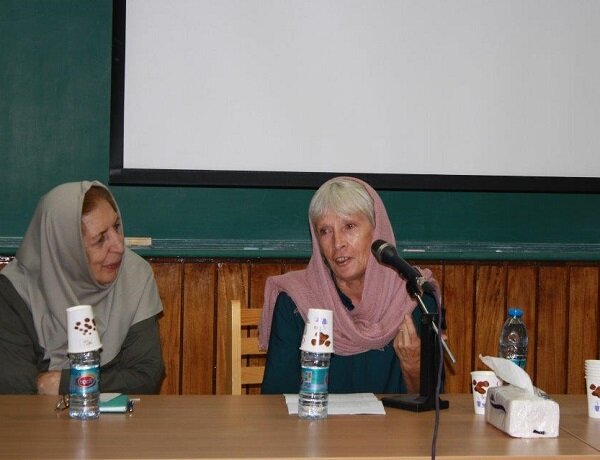
The program, held at the Faculty of Humanities and Literature at the University of Tehran, was attended by a group of enthusiastic archaeology students, as well as the Polish Ambassador to Tehran Maciej Fałkowski, Iranian professor and chairman of the department of Ancient Iranian Culture and Languages Jaleh Amouzgar, Post-Doc researcher in Archaeology at the Faculty of Literature and Human Science of the University of Tehran, Dr. David Meier, and a number of other notable figures in the field of archaeology, and of course Prof. Barbara Kaim herself, who gave a short introduction of her work in Iran, and answered some questions posed by the press and students present at the event.
Speaking at beginning of the program, Polish Ambassador Maciej Fałkowski praised Prof. Kaim’s extensive contribution to the research on the Iranian history, also by bringing here the results of her archaeological studies on fire temples in Turkmenistan.
Polish Ambassador Maciej Fałkowski speaking at the program in honor of Prof. Barbara Kaim
He made note that Poland’s interest in the Persian culture began in Safavid period when Poland pursued diplomatic and economic relations with Persia. The first academic studies on Iran, however, he said were undertaken at universities only by the end of the 19th century. They were further continued and extended after Poland regained independence in 1918.
The ambassador also maintained that many of the Polish refugees arriving in Iran from Soviet Russia in 1942, were Polish intelligentsia and professors, who, despite the hard conditions and everyday fight for survival, established the Iranian Studies Association in Tehran.
He added that their legacy is today continued by the young generation of scholars and supported by exchange programs for students and researchers. “There are about 150 Iranian students in Poland now,” he said.
The ambassador further voiced hope to see new astonishing results of this academic cooperation between Iran and Poland.