
By Mohammed Abu Qamar – Gaza
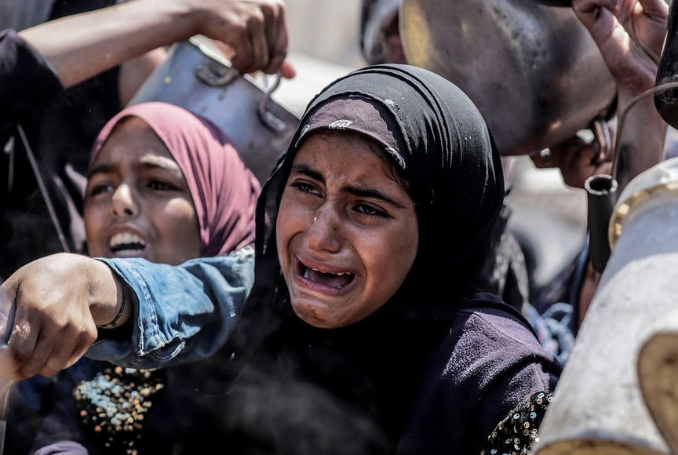 Israel has continued to use starvation of civilians as a weapon of war against Palestinians in Gaza. (Photo: via QNN)
Israeli policies of “trickle-down” aid and a full siege have created a famine in Gaza, with current aid levels meeting only a fraction of the population’s needs.
While the Israeli government has claimed to be easing the delivery of food aid to the Gaza Strip, the number of trucks entering through crossings reveals a “trickle-down” policy. This strategy controls the flow of a limited amount of supplies, meeting just 14% of the daily needs for over two million Palestinians, following a complete blockade of all food items for five months.
Over the past two weeks, only 1,210 aid trucks entered Gaza, despite an estimated need for 8,400 trucks during that same period. A comparison with pre-war food shipments shows an urgent need for a daily flow of at least 600 trucks for more than three months to avert the famine gripping the besieged population.
Since early March, Israeli occupation forces have prevented more than 90,000 trucks from entering Gaza by tightly sealing the crossings, which is part of a systematic plan to starve the population.
Systematic Starvation
A source in Gaza’s Ministry of Economy stated that before the war began in October 2023, an average of 122,000 trucks entered Gaza annually. These included aid from international organizations like the UN Relief and Works Agency for Palestine Refugees (UNRWA) and private commercial shipments.
The government source explained that 30,000 trucks (28% of total imports) came annually from Egypt via the Salah al-Din commercial route, with the rest coming from the Israeli side. The source also noted that 60% of all pre-war trucks were for food supplies, with half of those being aid distributed by UNRWA and other international organizations. Gaza’s monthly flour requirement is estimated at 15,000 tons, with 8,000 tons designated for UNRWA.
According to the Ministry of Economy source, the monthly needs for basic goods for Gaza’s population are estimated at: 3,700 tons of sugar, 3,300 tons of rice, 2,100 tons of oils, and 330 tons of lentils. However, lentil consumption has surged to 2,000 tons per month during the current famine as most residents now rely on it.
To deepen the famine crisis in the Gaza Strip, Israel has reportedly:
Restricted the work of international organizations and banned UNRWA from operating within its territories since late January.
Suspended the humanitarian protocol agreed upon on January 18, which coincided with the start of a ceasefire’s first phase.
Tightened the siege and completely closed crossings since early March.
Prevented the secure passage of aid to international organization warehouses for fair distribution to all residents.
Relied on opening American aid centers that provide minimal food supplies without a clear distribution mechanism, which puts residents at risk. (Over 1,500 Palestinians have been killed by soldiers while waiting to receive aid-PC)
The government source believes that Gaza’s recovery would be faster if the private commercial sector were allowed to import food and goods without restrictions. This would facilitate access for citizens and lower inflated prices.
The economic situation in Gaza was described as “very difficult” due to the prolonged war, the prevention of food entry, a lack of income for most workers, a cash liquidity crisis, and widespread malnutrition. The source pointed out that Gaza needs an unrestricted daily flow of goods for three months to recover its food sector.
Continued Israeli Restrictions
Economic researcher Ahmed Abu Qamar believes the real problem behind the food shortage in Gaza is Israel’s “trickle-down” policy. At best, the quantities Israel allows in do not exceed 15% of Gazans’ needs, and in previous months, only 2-3% of the population’s needs were met.
Abu Qamar said that Israeli restrictions on the passage of goods have created economic distortion and led to illogical, soaring prices. This explains the “marathon” price increases and the market’s inability to function naturally.
He added that even during the truce in late January and February, Israel implemented a “flooding” policy with certain items, like flour, while depriving the Strip of others. He emphasized that the market needs diversity to function, not just quantity. The researcher explained that the “flooding policy” is no less dangerous than the “trickle-down” policy, as both harm the economy and prices. He noted that allowing commercial trucks in is crucial for market diversity and partially solves the liquidity problem.
He pointed out that “Israel is deliberately keeping the state of famine and high prices in place because it insists on allowing a certain number of trucks to enter through only a few merchants, while preventing broader importation.”
Abu Qamar also noted that while commercial trucks are important, 95% of Gaza’s population now relies on aid. This means that famine will persist as long as Israel refuses to secure aid entry and work according to the agreed-upon humanitarian protocol from last January.
Prices remain extremely high compared to normal rates, a reflection of the small quantities entering relative to the market’s severe need for supplies.
The economic researcher also mentioned that Israel is preventing market diversity by only allowing certain food items to enter.
The market needs several strategic goods that are no less important than food, such as fuel, a primary driver of inflation and high prices. The months-long ban on fuel has led to record price increases of over 1,600% compared to pre-war costs.
Gaza also needs alternative energy tools after two years of a complete power outage, as well as essential shelter items like mobile homes and tents, which Israel has refused to allow in.
(Originally published in Al-Jazeera Arabic – Translated and Prepared by the Palestine Chronicle)

No comments:
Post a Comment