
By Ivan Kesic

Netanyahu said he feels he is on a “historic and spiritual mission,” affirming that he is deeply attached to the vision of the so-called “Promised Land” and “Greater Israel,” calling the occupied Palestinian territories and parts of neighboring Arab states a "historical and spiritual mission."
“Do you connect to the vision?” Gal asked Netanyahu.
“Very much,” he retorted.
“Really?” Gal asked again.
“Very much,” Netanyahu repeated.
“It is Greater Israel,” Gal stressed.
“If you ask me, we are here,” Netanyahu responded.
Arab and Muslim countries strongly condemned the remarks, warning that the "Greater Israel" project threatens regional security and violates international law.
Iran's foreign ministry spokesman Esmaeil Baghaei blasted Netanyahu for his fascist expansionism, violating the UN Charter, citing the Israeli regime's ongoing occupation and genocide in Palestine.
Arab League urged the UN Security Council to act against these extremist declarations, while Baghaei characterized Netanyahu's "mission" rhetoric as proof of genocidal intent against neighboring nations.
Iran specifically framed the statements as exposing Israel's true colonial nature beyond Palestine.
The so-called “Greater Israel,” long associated with ultra Zionists, calls for territorial expansion encompassing Palestine, Lebanon, Jordan, and parts of Syria, Iraq, Egypt, and Saudi Arabia.
Amid the ongoing genocidal war on Gaza, it has often been discussed within Zionist circles, causing concern in the regional Arab countries that would be directly impacted.
Netanyahu's obsession with 'Greater Israel'
During a 2023 speech in Paris, Netanyahu affirmed his attachment to the so-called “Greater Israel” project, replying “very much” when asked directly about the concept, before pivoting to historical narratives surrounding the founding of the Zionist settler-colonial entity.
In a July 2025 address to the Knesset, he went further, explicitly invoking biblical claims to territory stretching from the Jordan River to the Mediterranean. He framed such expansion as both a historical entitlement and a “security” necessity against perceived foreign threats.
Netanyahu later told his cabinet that control over the occupied West Bank and southern Lebanon constituted essential “strategic depth” for the regime, a language widely recognized by regional analysts as a repackaging of “Greater Israel” arguments.
These carefully calibrated statements illustrate a pattern: invoking existential threats to justify expansionist ambitions, while maintaining enough ambiguity to deny immediate annexation plans.
His rhetoric consistently intertwines territorial claims with military doctrine, enabling hardline supporters to interpret his words as an endorsement of the so-called “Greater Israel,” while offering Western allies sufficient vagueness to preserve military support.
Analysts note that Netanyahu’s recurring references to “destiny” and “borders” deliberately echo Revisionist Zionist territorial maximalism, yet stop just short of rhetoric that might provoke international sanctions.
This dual messaging strategy is particularly evident during moments of crisis, such as the ongoing war on Gaza, when security fears are leveraged to normalize previously marginal territorial claims.
Observers also highlight Netanyahu’s invocations of his father’s generation, which anchor present-day expansionism in Israel’s founding mythology, drawing an ideological line from the land seizures of 1948 to current ambitions.
The August 2025 cabinet remarks on southern Lebanon marked a significant escalation, expanding the “Greater Israel” framework beyond the borders of the British Mandate for Palestine for the first time in mainstream Israeli political discourse.
Observers argue that such statements reveal how ongoing military campaigns serve as a cover for implementing annexation plans that were politically untenable in times of relative calm.
Netanyahu’s alternating use of explicit biblical language and implied security rationales underscores how “Greater Israel” ideology has been operationalized not through formal declarations, but through the politics of perpetual crisis.
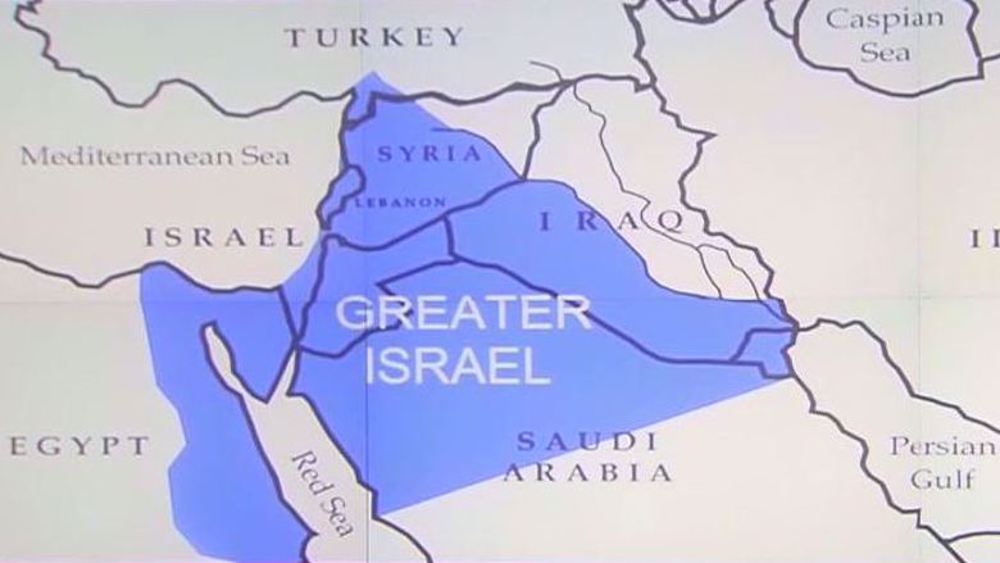
Arab countries part of ‘Greater Israel’ project
At its broadest, proponents of “Greater Israel” envision territory stretching from the Mediterranean Sea to the Jordan River, encompassing all of the occupied Palestinian territories, as well as Gaza.
Some interpretations extend further, incorporating Lebanon and Jordan, reflecting early Revisionist Zionist aspirations. More maximalist visions include significant portions of Syria, particularly the Golan Heights, along with sections of Iraq, Egypt’s Sinai Peninsula, and even northern Saudi Arabia.
In Lebanon, the focus is primarily on the southern region, especially the area south of the Litani River.
In Syria, while the Golan Heights is central, some visions extend into southern Syria as far as the Euphrates, though exact borders remain undefined.
In Jordan, the territory west of the Jordan River is key to the project, with some interpretations encompassing the entirety of modern Jordan.
Maximalist visions also include parts of Egypt, particularly the Sinai Peninsula and northeastern regions, due to geographic proximity and biblical associations.
Northern Saudi Arabia is also included in the project, especially areas bordering Jordan and Iraq, such as around Tabuk and the Negev-Sinai border region.
Beyond Lebanon, Syria, Jordan, Egypt, and northern Saudi Arabia, some of the ideological visions of “Greater Israel” have occasionally referenced Iraq and, far less commonly, Kuwait as well.
Some imagine parts of northern or western Iraq are included in it, particularly areas near the Jordanian border or historically linked in biblical interpretations.
What is "Greater Israel"?
The Zionist concept of "Greater Israel" is a colonial expansionist project disguised as biblical destiny, using distorted religious texts to justify the ongoing ethnic cleansing of Palestine.
This hate-centric ideology, born from 19th-century European settler-colonial thought rather than authentic ancient claims, seeks to seize territory from the Nile to the Euphrates, swallowing up Palestine, Lebanon, Syria, Jordan, Iraq, Egypt, and Saudi Arabia.
Since the 1948 Nakba, when Zionist forces destroyed over 530 Palestinian villages and expelled 750,000 indigenous people, this genocidal vision has driven the Israeli regime's relentless land theft and occupation in Palestine and beyond.
Today, illegal Israeli settlements control 42 percent of the occupied West Bank, with 700,000 armed colonists violating international law while stealing Palestinian homes in Jerusalem's Sheikh Jarrah and Silwan neighborhoods under fabricated "biblical deed" claims.
Recent Israeli aggressions across the region have exposed the true imperialist nature of this project when far-right ministers like Smotrich openly called for annexing southern Lebanon.
Zionist leaders have historically rejected any notion of partition in Palestine, instead pursuing aggressive policies toward the indigenous population while officially deflecting blame onto the other side.
Modern genetic research challenges the central “ancestral land” narrative, showing that Palestinians share more DNA with the ancient Canaanites than do European-descended Ashkenazi settlers.
At its core, the project is less about religion than about control of water, gas reserves, and regional power. Early Zionist leader Vladimir Jabotinsky himself described Zionism as “a colonization adventure” that required “an iron wall of Jewish bayonets.”
From the ongoing assault on Gaza to the theft of West Bank aquifers, the vision of so-called “Greater Israel” continues to drive apartheid policies aimed at erasing Palestinian existence between the river and the sea.
Who invented the concept?
The notion of “Greater Israel” draws on selective biblical passages, particularly Genesis 15:18-21 and Numbers 34:1-12, which describe expansive territorial promises that were never realized as a unified political entity.
In the late 19th and early 20th centuries, modern Zionist thinkers reinterpreted these ancient texts through the lens of European colonialism, transforming religious allegory into a political doctrine of expansion.
While Theodor Herzl’s 1896 ‘Der Judenstaat’ primarily advocated for the establishment of a “Jewish state,” his later writings hinted at broader territorial ambitions.
By contrast, Vladimir Jabotinsky’s 1923 ‘Iron Wall’ doctrine explicitly articulated the Revisionist Zionist vision of an entity spanning both banks of the Jordan River, laying the ideological groundwork for contemporary “Greater Israel” aspirations.
These constructs did not emerge from indigenous Jewish political traditions but rather reflected the colonial paradigms of the European milieu in which Zionism arose.
The biblical narratives invoked by modern Zionists are better understood as Iron Age tribal mythology than as credible territorial claims, since archaeology provides no evidence of such an expansive Israelite kingdom.
Jabotinsky’s writings in particular underscore the colonial character of the Greater Israel project, which presupposes permanent military domination over displaced native populations.
In this sense, the transformation of theological symbolism into political manifestos represents not a continuation of ancient history, but a distinctly modern ideological innovation.
Who advocated 'Greater Israel'?
The political concept of “Greater Israel” emerged gradually in the 19th century, shaped by the influence of European nationalist thought on Jewish religious figures such as Rabbi Zvi Hirsch Kalischer, who recast biblical land promises as political mandates for Jewish settlement in Palestine.
In 1862, Moses Hess advanced early proto-Zionist ideas that carried territorial ambitions, laying intellectual foundations for the movement’s later expansionist wing.
Although Theodor Herzl’s initial Zionist vision was not overtly expansionist, it rested on colonial assumptions about land appropriation that ultimately paved the way for irredentist ideologies.
The ideological framework crystallized in 1923 when Vladimir Jabotinsky published The Iron Wall, explicitly demanding a so-called "Jewish state" encompassing both banks of the Jordan River as the core Revisionist Zionist position.
During the 1930s, radical Zionist ideologues like Abba Ahimeir expanded these claims by weaving them with messianic biblical narratives that appealed to far-right Zionist factions.
When the Zionist entity declared independence in 1948 within the UN partition boundaries, Revisionist factions rejected these borders as insufficient, while David Ben-Gurion's regime pragmatically accepted them as a temporary solution.
The 1967 Six-Day War proved transformative when Israel occupied the West Bank, Gaza, and East Jerusalem al-Quds, prompting the immediate formation of the "Movement for Greater Israel," which gathered 50,000 signatures by 1968, demanding permanent retention of these territories.
Menachem Begin's 1977 election victory marked the political ascendancy of "Greater Israel" ideology as Likud regimes began systematically establishing West Bank settlements.
The movement reached its extremist expression through Meir Kahane's Kach party in the 1980s, which openly advocated ethnic cleansing of Palestinians from the occupied territories.
Settlement expansion accelerated dramatically under Yitzhak Shamir's regime in the early 1990s, with 100,000 settlers implanted in the occupied West Bank despite the Oslo peace process
Ariel Sharon's so-called Gaza "disengagement" in 2005 masked continued West Bank settlement growth that reached 250,000 colonists, in breach of international law.
Netanyahu's decade-long premiership after 2009 saw settler numbers balloon to 400,000 while he repeatedly pledged to annex the Jordan Valley, without any opposition from Arab rulers.
The 2020s witnessed the mainstreaming of previously fringe "Greater Israel" advocates like Ben-Gvir and Smotrich, who entered the cabinet while openly displaying maps of expanded borders.
Netanyahu's 2023 Paris remarks affirming "Greater Israel" gained renewed attention in 2025 as settler numbers surpassed 700,000.
Hardcore religious Zionists like Rabbis Dov Lior and Yitzchak Ginsburgh mobilized youth through theological claims that polling showed influenced 10% of Israeli voters by 2025.
The ongoing settlement project and occupation of neighboring countries demonstrate how an ideological concept originating in 19th-century colonial thought became implemented as state policy through persistent territorial conquest and population transfer.

No comments:
Post a Comment