
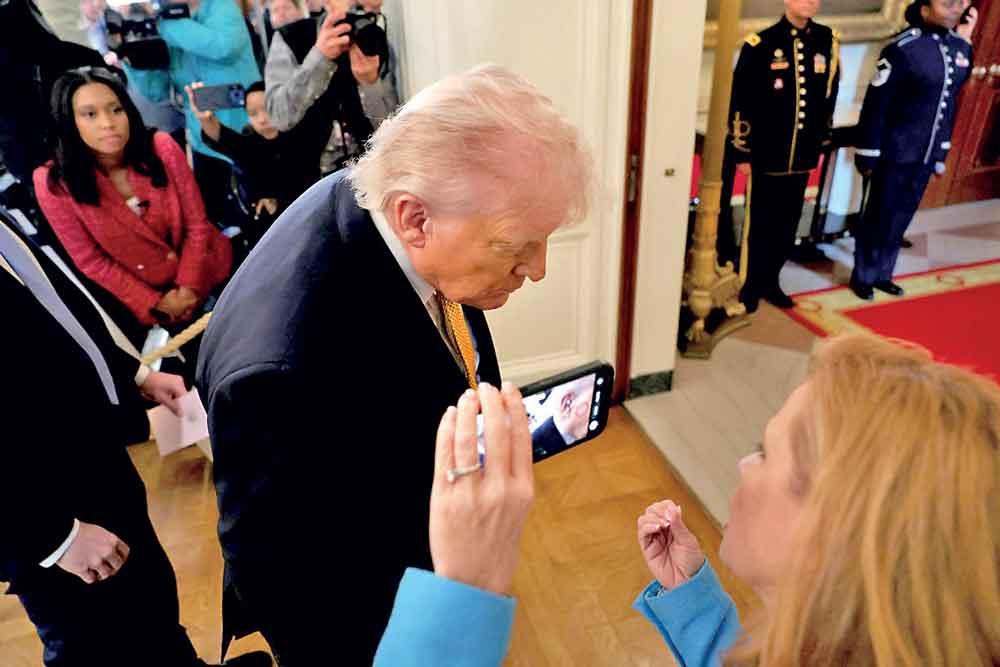
A journalist asks President Donald Trump about Iran as he departs following a military mothers celebration in the East Room of the White House on Wednesday. AFP
Since the April 8 ceasefire agreement, US President Donald Trump has stirred hopes of an end to the Iran war, only to shatter them—often within hours—with warnings, deadlines, and military escalation. This pattern has led critics to wonder whether Trump’s announcements were part of insider dealings to help his Wall Street allies, as peace-promoting words drive stock prices up.
Will his latest announcement of a peace deal—said to be a one-page document—end up in the dustbin of history like the previous ones, despite the optimism it is generating in US media and among Pakistani facilitators? Iran has said it is positively reviewing the 14-point US proposals sent through Pakistan, but maintains that the US is not acting in good faith, underscoring the deep trust gap between the two sides. Iran’s response to Trump’s latest peace proposal was expected yesterday.
For any peace deal to succeed, if Trump is serious about peace, it must be win-win. Yet Trump’s record suggests otherwise. He offers peace, only to sabotage the process and then blame Iran for it. Neither his peace strategy nor his military pressure reflects foresight. This was evident in his decision to attack Iran on February 28, even as talks on Iran’s nuclear programme were progressing with Oman’s facilitation.
Ignoring Pentagon and State Department veterans’ warnings, Trump embraced Israel’s hawkish Prime Minister Benjamin Netanyahu’s plan—essentially a trap—for attack. If Trump is eager to remove another world leader after Venezuela’s Nicolás Maduro and Iran’s Ayatollah Ali Khamenei, he should set his sights on Netanyahu, for it was he who pushed Trump into an abyss from which he struggles to emerge unscathed.
Though, for his presidential race, Trump campaigned on an anti-war platform, Netanyahu convinced him that the war could be over within days. The butcher of Gaza misled him into believing Iran was merely a paper tiger. Yet Iran proved its mettle by confronting two nuclear powers at once.
The roar of the Persian lion now echoes far beyond the region. Iran controls the Strait of Hormuz, through which more than 20 percent of the world’s oil flows. The one who controls the Strait of Hormuz controls the oil trade. And the one who controls the oil trade controls the world.
With the US military response and pressure tactics failing to challenge Iran’s dominance in the Hormuz Strait, Trump is now desperate for an off-ramp. As the oil prices rise, political pressure on him, especially from the Republicans, mount. He seems to be bargaining for one that he can present to his MAGA (Make America Great Again) base as a resounding victory. Iran is not going to grant him that if such a deal undermines its national security or its newfound role as the dominant power in the Hormuz Strait.
The US first imposed a blockade on April 13, two days after talks in Islamabad ended in a stalemate. Washington claimed its blockade was meant to prevent ships from entering or leaving Iranian ports, hoping the pressure would force Iran to lift its own blockade of the strait. Operating at a relatively safe distance in the Gulf of Oman, US forces managed to seize only two Iran-linked ships. Most vessels, especially those carrying Iranian oil to China, continued without incident, while ships from other Gulf ports remained stranded for fear of Iranian attack.
When pressure failed to work, the US announced Operation Project Freedom on Monday, describing it as a defensive measure aimed at ensuring the passage of more than 2,000 commercial vessels stranded in the Strait of Hormuz. Perhaps, Trump does not want to be accused of resuming a war that does not serve the US interests.
The Project Freedom initiative was preceded by—and also linked to—the United Arab Emirates’ decision to quit the Organisation of Petroleum Exporting Countries (OPEC)—a move intended to allow the UAE to produce and release as much oil as possible to the market, thereby driving down prices and undermining Iran’s leverage over the Hormuz Strait.
Iran then drew two red lines across the strait, like the opposite sides of a trapezium, declaring that no ships could enter or leave without its permission. The zone included the UAE’s Fujairah port, from which much of Emirati oil was to flow to the market. The UAE’s OPEC departure was good news for Trump, but not for Saudi Arabia. Amid these circumstances, Saudi Arabia hosted the Gulf Cooperation Council summit on April 28. Confirming the growing rift between Saudi Arabia and the UAE, the UAE president did not attend the summit, sending the foreign minister instead.
Saudi Arabia has been alarmed by many of the UAE’s policies—whether in Yemen, Sudan, Somaliland, or now in its decision to undermine Saudi Arabia’s OPEC strategy of maintaining high prices through production cuts.
The UAE’s strained relations with Pakistan are also making major ripples in regional politics. Suddenly, the UAE demanded that Pakistan immediately repay its US$3.5 billion loan. Moreover, UAE authorities rounded up tens of thousands of Shiite Pakistanis, froze their assets, and deported them—for being Shiites and a threat to UAE security. Yet the loan repayment demand and mass deportations are a serious blow to Pakistan’s struggling economy, which has vowed to defend the kingdom against external threats.
Trump’s Operation Project Freedom ended almost as soon as it began, but not without high drama in the Strait of Hormuz, where Iran fired shots at US naval vessels that tried to defy Iran’s no-go zone while the UAE—including the Fujairah port—came under attack on Monday and Tuesday. Interestingly, Iran has denied responsibility for the attacks on the UAE.
The emerging scenario underscores a new security architecture in the Gulf region, with Iran asserting dominance. These developments have sparked discussion of a possible security arrangement between Iran and Gulf nations, as indicated by the subtext of Iran’s Foreign Minister Abbas Araghchi’s meeting with his Chinese counterparts Wang Yi in Beijing on Wednesday.
China is expected to play a key peacemaking role in any security framework between Iran and Gulf nations, especially Saudi Arabia, though likely excluding the UAE, which has drawn criticism across the Muslim world for its close alliance with Israel. Israel has sent advanced air defence systems to the UAE—the first country to receive them—along with military personnel and technicians to operate them. This effectively places Israeli boots on the ground in the war zone.
The presence of Israelis in the Emirates poses a security threat not only to Iran but also to Saudi Arabia, which maintains that its consent for the Abraham Accords with Israel is conditional upon the establishment of a free and independent Palestinian state.
Israel’s strategy is, meanwhile, aimed at weakening Arab and Islamic states. Its war against Iran is largely part of that effort. Once Iran is subdued, Israel could target Turkey or even Saudi Arabia—states it views as major impediments to its Greater Israel expansion project. This is all the more reason why Saudi Arabia, Turkey, and Iran need to reach a common security arrangement to keep Israel where it should be—confined within the 1967 borders.

No comments:
Post a Comment