
By Robert Inlakesh
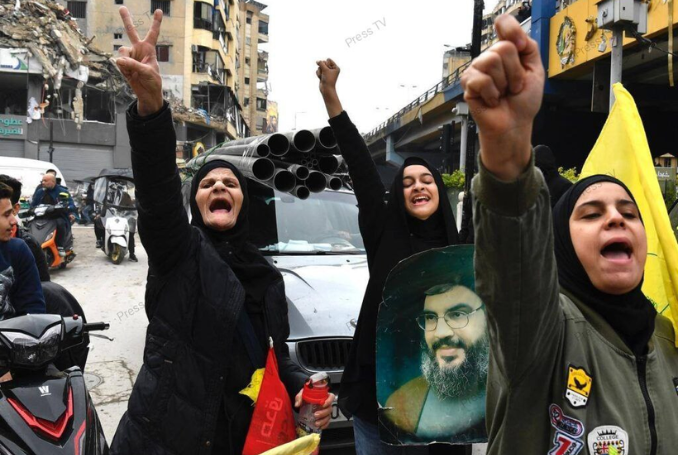 Residents of southern Lebanon celebrate their return to their towns and villages after the war between the Lebanese resistance and Israel. (Photo: via PressTV)
All of these groups enjoy massive popular support. In the cases of Hamas and Hezbollah, they are inseparable from their people in terms of their values and national missions.
After Israel failed to defeat any of Iran’s allied groups in the region, an anxious United States moves in to try and achieve what Tel Aviv couldn’t through force. The ultimate goal is to leave the people of the region defenseless and in chaos, before pursuing regime change in Tehran.
On November 27, 2024, the Lebanese government agreed to sign a ceasefire deal to end the war with Israel. While the Lebanese Armed Forces were targeted by Israeli airstrikes, they didn’t fight to defend their country, instead the task was given to Hezbollah.
In response to the ceasefire announcement, Hezbollah decided to adhere to the agreement, halting its fire and deciding to allow the dismantlement of military infrastructure in the south of the country. However, from the very first day of the truce, the Israelis committed airstrikes and refused to withdraw from southern Lebanese lands, occupying territory in contravention of international law.
To date, Israel has committed around 4,000 violations of the ceasefire agreement and the Lebanese Army, under the command of its new President Joseph Aoun and Prime Minister Nawaf Salam, has refused to respond and defend their nation. Instead, under US pressure, the Lebanese government has pushed instead for the disarmament of Hezbollah, the only force capable of protecting Lebanon.
Former US Envoy, Morgan Ortagus, had stated back in February that the political Party Hezbollah had been “defeated” by Israel and should no longer be allowed involvement in the Lebanese government. She also claimed at the time that the US Trump administration was “very committed” to the February 18 deadline for Israeli withdrawal from southern Lebanon.
Despite Israel’s refusal to withdraw from five points across southern Lebanon, near the border, the US and Lebanese government refused to do anything about it, instead attempting to pave the way to Hezbollah’s full disarmament instead.
Initially, President Joseph Aoun, who would not be in power without the Hezbollah-Amal vote to break the previous political deadlock, had declared that he wasn’t seeking a forceful strategy to disarm Hezbollah, but instead could pursue dialogue and the integration of its forces into the Lebanese Army.
Yet, the idea of integrating Hezbollah into the Lebanese Armed Forces peacefully was forcefully opposed by the US government. In fact, the Israel Lobby aligned ‘Washington Institute for Near East Policy’ (WINEP) think-tank, published a piece back in April called “There Is No Better Time to Disarm Hezbollah”. In this piece, it clearly spells out that it is expected, from the US government’s perspective, that violent clashes ensue during disarmament.
The WINEP analysis also points towards avoiding a scenario such as was sought after by the authorities in Baghdad, whereby the Hashd al-Shaabi, were being integrated into the Iraqi security forces, while also maintaining their own autonomy.
Already in March, the Pentagon had been demanding of the Iraqi State that it dismantle the country’s resistance factions. US Secretary of State, Pete Hegseth, had reportedly issued a direct demand to Iraqi PM Mohammed al-Sudani get rid of a collective group calling itself the Islamic Resistance in Iraq (IRI), which had played a support role for Gaza and Lebanon.
Then, last month, US Secretary of State, Marco Rubio, called Iraqi Premier al-Sudani urging him to kill the Popular Mobilization Commission (PMC) bill, which is part of a broader reform process in the country that seeks to codify the integration of the Popular Mobilisation Units (PMU) into the Iraqi security forces.
The US even threatened Baghdad with sanctions and other measures to stunt economic growth, delaying the 2016 PMC bill from passing through the Council of Representatives in Iraq.
The PMU, or Hashd al-Shaabi in Arabi, are currently said to maintain 238,000 personnel and were formed back in 2014 in order to crush the Daesh insurgency and liberate the country from the Takfiri groups radical rule. However, the US seeks to see the group ostracised and ultimately discarded, especially due to many of the PMU factions maintaining working relations with Iran’s IRGC that helped the groups dismantle Daesh.
The US has currently applied pressure on the Iraqi government to adhere to its demands, while it has just proven successful at using the pro-American leadership in Beirut to officially call for disarming Hezbollah. In addition to this, the Trump administration is calling upon Hamas in Gaza to disarm, without any guarantees for the security of the Palestinian people, while attempting to dangle aid and reconstruction above the heads of the starving population of the Gaza Strip.
Another American Miscalculation
What the White House hopes to do is achieve across the region, what it attempted and failed to do through force. It is clear that Washington is anxious about the capabilities of the Iraqi PMU, especially if another round of hostilities with Iran occurs. It also believes it can starve and bomb the Palestinians into submission, while triggering civil war that will lead to disarmament in Lebanon.
The common theme here is that in each of these cases – Palestine, Iraq and Lebanon – the US has demonstrated to the Arab Public why resistance forces are absolutely integral to national security.
In the case of Lebanon, Hezbollah was formed in 1985 and was born out of the 1982 invasion of Lebanon. When Israel invaded, it mass murdered around 20,000 people – most of whom were civilians – eventually managing to reach an agreement with the Palestine Liberation Organization (PLO), in which the Palestinian resistance agreed to disarmament and its leadership to flee to Tunisia.
Immediately after disarmament, Israel not only presided over massacres that killed thousands of Palestinian civilians and murdered Lebanese Shia, but they illegally occupied the south of Lebanon. Hezbollah was then the only reason Israel was forced to leave the country in 2000.
Then, the defeat of the Israeli military’s attempted re-invasion of southern Lebanon in 2006 led to a period of around 17 years, during which the Israelis didn’t dare to attack Lebanon. In October of 2022, simply by way of threatening war, Hezbollah managed to pressure the US and Israel to grant the Lebanese State access to its maritime boundaries, unlocking the potential to exploit a potential treasure trove of natural gas.
The Lebanese Army is for all intents and purposes under US jurisdiction and barred from possessing strategic weapons, meaning that it is incapable of defending the country on its own, even in the event of a major insurgency from neighbouring Syria. Hezbollah is a much superior fighting force and would crush it, yet has always stood on its side and never expressed interest in damaging the Lebanese State.
If Hezbollah is disarmed, which isn’t possible even in the event of civil war and would require a US-Israeli invasion to even attempt to achieve this, then Lebanon will become like Syria. It will be ruled by a regime that has no stability, no security, and will be subjected to similar waves of sectarian bloodshed that we have seen in Syria’s Sweida province and along the Coast with the Alawite massacres.
Israel, like it did in Syria, will move to occupy more territory in southern Lebanon and ethnically cleanse countless villages, while having free reign to strike whatever it likes at will. If Hezbollah disarms, Lebanon will be dead as a country and this could cause a massive refugee crisis, especially combined with the situation in Syria.
Similarly, Hamas in Gaza has the PLO’s Lebanon experience to draw from, but more recently the Palestinian Authority (PA)’s position in the occupied West Bank. The PA not only abandoned armed resistance and denounced it as “terrorism”, it actively worked alongside the Israeli occupiers to do their dirty work in ensuring the safety of the ever expanding illegal settlements that steal their land.
Yet the capitulation of the PA, or the new Syrian authorities for that matter, is never enough, the Israelis and US are still working to squeeze them, bomb their people, occupy their lands and cause endless instability.
Especially following the Gaza genocide, Arab public opinion has shifted even further towards the notion that Israel must be eliminated as the primary obstacle to peace in the region. Therefore, any attempts, especially by force, to disarm the Iranian-led Axis of Resistance will likely achieve the opposite of the desired effect. Instead of defeating these groups, they may actually receive even greater popular support and be pushed to pursue even more aggressive policies.
All of these groups enjoy massive popular support. In the cases of Hamas and Hezbollah, they are inseparable from their people in terms of their values and national missions. There is also no coherent strategy that has been developed that would achieve disarmament, on every level this push is set up for failure. Despite this, the US is seeking to risk deadly civil war in the hopes of pursuing their mission. This suggests that the true strategy is either to create internecine conflicts, or alternatively it indicates that they are out of options.
(The Palestine Chronicle)
– Robert Inlakesh is a journalist, writer, and documentary filmmaker. He focuses on the Middle East, specializing in Palestine. He contributed this article to The Palestine Chronicle.

No comments:
Post a Comment