Sunday, October 25, 2026

Are the United States and Israel in Decline-and-Fall Mode?

The horrors deliverable by Israel that might come next

Speculation is growing over the sustainability of the United States’ model of global dominance which emerged as Washington ended the Second World War as plausibly the sole superpower. That role was first tested in the Korean War, which produced something of a stalemate in a confrontation that included China, and led to a Ceasefire Agreement which is still in place to this day. More recently the collapse of the Soviet Union in 1991, even given the disastrous and pointless war in Vietnam, confirmed the US’s superior military, political and financial status, leading to an affirmation of American dominance as an essential element in global political stability in several initiated and mandated policy documents including in the statement of principles spelled out in 1990’s which was later published in September 2000 as the Rebuilding America’s Defenses: Strategy, Forces, and Resources for a New Century: a Project for the New American Century (PNAC). The final elaboration of the policy was derived from the so-called “Wolfowitz Doctrine” which was the common referral to national defense guidance developed when Paul Wolfowitz, working for Vice President Dick Cheney, was Associate Secretary of Defense. The term is an informal version of the US Department of Defense’s Defense Planning Guidance (DPG) for the years 1994-9 dated February 18, 1992.

As the first DPG after the Cold War and first Gulf Wars ended and the draft described the United States as the world’s only superpower it made preventing the emergence (or re-emergence) of a global or regional competitor a top priority. This objective included preventing any hostile power’s dominance of strategically or resource rich important regions that could produce alternative sources of global power. It argued that that the US Military must remain sufficiently strong enough to deter possible competitors, retaining the ability to act unilaterally if necessary. The PNAC declaration called for a continuing global leadership role for the United States which implied the resort to preemptive war against adversaries when needed.

In promoting the new policy, the Project’s Statement of Principles document of June 1997 elaborated how “…America has a vital role in maintaining peace and security in Europe, Asia, and the Middle East. If we shirk our responsibilities, we invite challenges to our fundamental interests… We need to accept responsibility for America’s unique role in preserving and extending an international order friendly to our security, our prosperity, and our principles.”

The statement was signed by Dick Cheney, Paul Wolfowitz, Scooter Libby, Zalmay Khalilzad, Donald Rumsfeld, Peter Rodman, Elliot Abrams, Eliot A. Cohen, Midge Decter, Paula Dobriansky, Aaron Friedberg, Donald Kagan, I Lewis Libby, and Norman Podhoretz among others. It was considered to be very “Israel friendly” subsequently and it, combined with the awesome and growing political and institutional power of the US Israeli Lobby, was used to justify US interventions in the Middle East during the following decades. Indeed, one might argue that Israel’s form of interaction with its neighbors and even with much of the world today was shaped by the numerous Jews and Israel firsters who participated in the drafting of the critical documents asserting Washington’s need to behave aggressively, to include its participation in conflicts that it would otherwise been able to avoid such as those occurring in the Middle East which were instigated by Israel’s promotion of its own interests just like is currently taking place with Iran.

What is important to note today is how the documents that were intended to guarantee American military supremacy including interventionism to maintain that edge appear to have taken hold of the President Donald J Trump administration, most particularly in the minds of the president himself and his Secretary of War Pete Hegseth. So, what went wrong as the United States now appears to be losing on all fronts where it has opted for confrontation instead of negotiation? It is perhaps important to note that the geopolitical missteps are likely the result of a doctrine coming from a different world than 1991 with different means of assessing strength or weakness. Trump and Hegseth might well be perceived as dinosaurs heading for extinction during their own version of the Triassic Period and the country that they have so much abused might be heading for decline and fall. The question becomes “After the US falls, who will be there to pick up the pieces?”

And one might presume that America’s most protected client Israel, which would certainly be joined to the US as the world’s most hated nation, might also be heading in the same direction. The only difference being that Israel has declared that it will use its nuclear arsenal to take much of the world with it if it goes down, the so-called Samson Option. Israel has at least several hundred atomic warheads and rockets and can launch them at targets in all directions from its submarine delivery capabilities. Most European capitals would certainly be targets for Israeli missiles and warplanes. Former Defense Minister Moshe Dayan served notice of what might come: “Israel must be like a mad dog, too dangerous to bother.” A minority of Israeli leaders might try to prevent things from coming to that, if at all possible, but those in charge will surely have the capability to take part of the world down with them and that is precisely what will happen as Israel goes under. But before that happens a wave of millions of Jewish “refugees” will roll over the US and Europe primarily. They will insist on creating new nations just like they did to the Palestinians and likely will have their nuclear weapons with them as “insurance.”

Interestingly, Israel is also reported to be developing a biological weapon arsenal which is “ethnically targeting” selective meaning that it will kill only holders of certain DNA or ethnic characteristics, presumably killing those with majority Arab biology while sparing anyone with Jewish traits or characteristics. Interesting. I might be the easy way to “mow the lawn” of objectional foreigners as Israel’s leaders have frequently carried out in places like Gaza and Lebanon.

But it occurs to me that Israel will follow a slightly different pattern, namely disorienting the playing field by the use of false flag incidents that will encourage Americans and Europeans to support pro-Israel policies that are clearly not in their interest, and applying “Palestinian option” alternatives to reduce and then completely eliminate resistance to its own form of “global dominance.” That means stealing other people’s land while also systematically exterminating them, possibly with the biological “bombs. The process of emigrating is already underway among many mostly better educated Israelis who are already rapidly leaving an Israel under threat to recreate their exclusively Jewish ghettos and settlements in places like Crete, Greece and in South America. The local residents frequently complain about the abuse they receive from the newcomers but their governments suffer from the typical Zionist disease, i.e. local governments that are bought or pressured to give way.

America already has discovered the phenomenon in the communities in New York and New Jersey states and elsewhere in the country where often Orthodox Jewish religious ritual restrictions control behavior of all citizens and even visitors who dare to defile the enclaves. If Israel in what was once Palestine goes under will that mean that millions of new immigrants, certainly given free entry with no conditions on their behavior by a US Congress which displays Israeli flags in its office spaces on Capitol Hill. The clowns in Congress and the White House may not be bothered by the Israeli Jewish tendency to despise the other 90% of any country’s inhabitants as subhuman, as they do with the Palestinians currently. Florida (of course!) Congressman Brian Mast, who wears his Israeli army uniform when working in his Congressional office, said : “there is no such thing as innocent Palestinians”! And he is not the only congressman or staffer who embraces that view, which is reiterated by 90 of Israeli Jews who support extermination of all Muslims and Christians!

So what comes next? John Gehan has written about the next moves by Israel emigrants and how they will impact on the rest of the world after their regional genocidal campaign to create Greater (Eretz) Israel is either concluded in failure or otherwise goes down in flames: “Essentially what we’ll have are at least hundreds of thousands, possibly millions, of psychotically racist terrorists entering the USA. These are ethnically obsessed monsters who don’t consider anyone outside of their pernicious tribe to be human. They’ll have weapons at their disposal and a cemented nationwide network to commit mass murder. Maybe some of these crazies will seek shelter in Europe or Canada or Argentina, etc. But many will choose the USA as a redoubt. At best, murders and acts of terror will spike dramatically in this country. Israeli Zionists are genocidal psychopaths. As we have all seen.”

For those who need further elucidation of what is going on and what drives it, the head of one of Israel’s most prominent think tanks, Major General Tamir Hayman has described in an article further examined by Trita Parsi the Quincy Institute, the harsh reality of Israel’s current and ongoing new national security doctrine: Hayman describes how “The United States is a ‘declining power’ and, given its ongoing social and political shifts, will soon abandon Israel in any event. This is compelling Israel to move toward greater self-reliance in order to avoid ‘excessive dependence’ on the US since it ‘exposes Israel to the influence of a progressive American value system that is incompatible with Israel’s Jewish character.’ He concludes: ‘Severing ties with the United States is therefore not only inevitable, but essential to Israel’s independence and the resilience of its Jewish national identity.’” Why is that? “Because of the Primacy of Jewish Identity over Democracy: The state’s Jewish identity takes precedence over its democratic system of government.” And it takes precedence over the constitutional rights of any nation that Jews should wind up settling in!

So, we Americans and presumably lots of other people have something to look forward to from an Israel whose leaders including Benjamin Netanyahu and Ariel Sharon have often bragged about how they control “America,” and now it it boasting how it has taken its pound of flesh and then will discards the US donor after it is bled white! It presumes the end of nations as we know them that try to function decently to be replaced by an ethno-religious state armed with nukes and bio weapons that will begin its process of extermination just as it is already carrying out in the Middle East! Mazel Tov to y’all!

Philip M. Giraldi, Ph.D., is Executive Director of the Council for the National Interest, a 501(c)3 tax deductible educational foundation (Federal ID Number #52-1739023) that seeks a more interests-based U.S. foreign policy in the Middle East. Website is https://councilforthenationalinterest.org address is P.O. Box 2157, Purcellville VA 20134 and its email is inform@cnionline.org.

Iran slams US-Israeli attacks on peaceful nuclear facilities, condemns double standards

TEHRAN– Iran’s ambassador to the United Nations has condemned US and Israeli attacks on Iran’s peaceful nuclear facilities, accusing Western countries and international nuclear authorities of applying double standards and politicizing global non-proliferation efforts.

Addressing the 81st session of the UN General Assembly in New York on Friday, Gholamhossein Darzi, Iran’s ambassador and deputy permanent representative to the United Nations, reaffirmed Iran’s inalienable right under the Nuclear Non-Proliferation Treaty (NPT) to develop nuclear energy for peaceful purposes, including uranium enrichment.

Darzi said the United States was challenging the rights of NPT member states by questioning their entitlement to pursue the full nuclear fuel cycle. He argued that denying countries access to uranium enrichment technology while claiming to support peaceful nuclear energy was incompatible with Article IV of the treaty.

“No State can unilaterally rewrite the Treaty or impose its own political veto on the legitimate rights of other States Parties,” he said, warning against the use of non-proliferation concerns as a means of exerting political pressure on sovereign nations.

The Iranian envoy said the United States and Israel had launched two wars of aggression against Iran in 2025 and 2026, targeting its peaceful nuclear facilities under International Atomic Energy Agency (IAEA) safeguards. He described the attacks as violations of international law, the UN Charter, the IAEA Statute, relevant IAEA General Conference resolutions and UN Security Council Resolution 487 (1981).

According to Darzi, the attacks caused extensive destruction and claimed thousands of lives, including that of Iran’s Leader, whose religious decree, or fatwa, rejects nuclear weapons and other weapons of mass destruction.

Iran criticizes international response

Darzi strongly criticized the IAEA’s governing bodies, its director general and the UN Security Council for failing to condemn the attacks on safeguarded nuclear facilities. He said the absence of a clear response had exposed the selective application of international non-proliferation standards.

“Instead, pressure is directed against the victim while the aggressors escape accountability,” he said.

The envoy contrasted the treatment of Iran, an NPT member since 1970, with that of Israel, which he described as the only nuclear-armed state in the region and whose nuclear facilities are not subject to comprehensive IAEA safeguards.

He argued that continued political and military pressure on Iran, alongside 'impunity for Israel,' undermined the credibility of the international non-proliferation regime. He also criticized the withholding of technical cooperation that, in his view, deprived Iran of the benefits of peaceful nuclear development that the IAEA is mandated to promote.

Safety conditions remain central to inspections

Addressing calls for the resumption of inspections, Darzi said Iran had neither abandoned nor formally suspended its safeguards obligations. However, he stressed that the military attacks had fundamentally changed the physical and security conditions under which verification activities could take place.

He noted that the IAEA’s own reports acknowledged that verification activities had ceased and inspectors had been withdrawn for safety reasons. Such concerns, he said, could not be disregarded when demands were made for their return.

“No country can reasonably be expected to provide access amid military operations and persistent threats without adequate safety guarantees,” Darzi said, adding that responsibility for creating these conditions rested with the countries that carried out the attacks.

He concluded that Iran remained prepared to cooperate with the IAEA to the extent permitted by prevailing circumstances, but emphasized that such cooperation must not compromise the safety of the Iranian people, nuclear facilities or agency inspectors.

Darzi also insisted that the IAEA’s reporting must remain professional, objective and free from political influence, arguing that the agency’s credibility depended on technical integrity and impartiality.

Why Saudi Arabia Cannot Defend Against Yemeni Missiles and What It Means

By Robert Inlakesh
What should serve as a frightening lesson for all the US-allied nations across the region is that what Yemen is doing now, Iran can do on a much broader scale and with even more advanced munitions.

Yemeni missiles and drones have shocked the public – easily bypassing Saudi Arabia’s US-made air defense systems, striking their targets with devastating accuracy. How this was achieved is no mystery, and their allies deploying more anti-air capabilities will have little impact.

Much of the shock over the failure of the Kingdom of Saudi Arabia to protect its energy and military infrastructure from retaliatory attacks originating from Yemen has been over the fact that modern American-made anti-air capabilities are having little to no impact.

Analysts, in an attempt to explain this, have worked on the assumption that the failure of Riyadh is down to a general depletion of overall air defense munitions during the highest intensity phase of the war on Iran. While it is true that US Patriot Missile and THAAD interceptor missile stockpiles are dwindling, this is not the primary reason for the Saudi failure.

If we take a look at the initial 40-day war period, most of the Iranian missile and drone strikes were carried out against targets in the other Gulf Cooperation Council (GCC) States, while American operating systems were used to combat the strikes inside Saudi territory. Out of all the Gulf States that experienced attacks on targets located inside their territory, the Saudis endured the least. Therefore, hypothetically, they should have retained one of the largest stockpiles of interceptors that they had previously purchased. Even if not, it is simple to explain why it isn’t the main cause of the predicament they are in today.

The primary reference points for the effectiveness of US-made air defense systems come from the data collected during the 40-day war of missile and drone attacks that impacted “Israel”, the UAE, Kuwait, Bahrain, and Qatar. In addition to this, there are examples of Iran’s strikes against Israeli targets during the entirety of its Operation True Promise series of counter-attacks.

Keep in mind that the interception effectiveness that was claimed by the Israelis, the UAE, Kuwait, and others has been proven repeatedly to be false. They often allege anywhere between an 80-90% effective shootdown percentage, which video footage alone often debunks. However, there can be no doubt that there are interceptions that take place and succeed in diminishing the devastation that occurs during missile waves fired at various targets.

Leaving the Arab states aside, when we look at the Israeli example, a number of different factors come into play that make their air defense strategy far superior to anyone else’s in the region, including the strategy for protecting American bases and personnel.

The Israelis not only have US THAAD systems operated by US personnel and historically have used Patriot batteries, but they also have their own air defenses like the David’s Sling, as well as Arrow systems and the Iron Dome that confronts rockets. In addition to this, the Israelis have an entire Western coalition that puts modern fighter jets in the skies in order to help shoot down incoming munitions, in addition to the use of naval assets at sea.

All of this adds different advantages, but there are two more elements that have also worked to their benefit which the Saudis do not have working in their favour: the Israelis have a much smaller territory to cover and are much further away from major missile powers who fire upon them.


In the case of Saudi Arabia, they have an enormous country that is incredibly difficult to cover. Their most important oil fields are in the country’s east, which would lead many to believe that this would require the greatest concentration of assets. However, the closure of the Strait of Hormuz has posed an enormous risk to Saudi economic stability and its long-term plans, for which the East-West Pipeline had temporarily become the answer.

Saudi Arabia had managed to circumvent the Strait of Hormuz closure by using its Yanbu Port to export around 6 million barrels of oil per day through the Red Sea. So Saudi Arabia’s most important oil resources are located in the east, its pipeline and pumping stations are positioned toward the center of the country, while the ports and many refineries are situated along its western coastline. Riyadh, therefore, has to try and pick and choose what to defend across a nation that is the fifth largest in Asia.

It truly doesn’t matter where it positions its air defenses, because even if they manage to get it right, there is always a strategy that will enable a successful hit the next time around.

Also, there is the element of a lack of early warning time that the Israelis enjoy. The Zionist entity has historically enjoyed around 10-15 minutes of pre-warning that missiles have been fired from Iran toward their targets, because of sophisticated US radars located throughout the Gulf. Many of those radars have now been destroyed, including in neighbouring Jordan, making it more difficult for even the Israelis.

Another important element to consider is that the US values the security of the Israelis much more than it cares for the Saudis, which means that they aren’t going to waste resources unnecessarily on defending regimes that they view as client states. The American military has the capability to deploy its own air defenses to aid Saudi Arabia, but is running low on its own interceptors and has to value protecting its own positions before it will look at helping others; with the exception of the Israelis that they will put their own forces at risk to protect.

Then there is the fact that these systems are just nowhere near as effective as the weapons manufacturers and governments using them let on. Theodore Postol, professor emeritus at the Massachusetts Institute of Technology (MIT), conducted a famous study into claims about the effectiveness of their Patriot Air Defenses during the 1991 Gulf War.

The Pentagon, at the time, claimed that 96% of Iraqi Scud missiles had been successfully intercepted by Patriot anti-air missiles. Postol revealed that the real figure was closer to a 1% success rate. He would later publish his investigative findings on the Israeli Iron Dome defense system, arguing that the success rate at shooting down rockets was in some cases as low as 5%, not the 80-90% success rate that the Zionist regime had advertised.

Weapons manufacturers and governments alike have a shared interest in lying about the effectiveness of their air defenses. Although undoubtedly useful, they are extremely expensive and are easily rendered ineffective when oversaturated by a large drone or missile wave.

Since 2020, the Yemeni Armed Forces of the Sanaa government have been developing a large stockpile of new sophisticated drones and missiles. In 2022, the effectiveness of these munitions first began to become apparent, leading quickly to a Saudi-Yemeni ceasefire, brokered by the United Nations. The advancements in these munitions and the lessons learned from the missile trade-offs with the Israelis and the US have led to the situation we see today.

What should serve as a frightening lesson for all the US-allied nations across the region is that what Yemen is doing now, Iran can do on a much broader scale and with even more advanced munitions.


(Al Mayadeen – English)

The UK Green Party’s Historic Anti-Zionist Motion

The party’s grassroots have crossed into political territory that was supposed to remain untouchable, writes Ramzy Baroud.

A key representing the right of Palestinian return at a Nakba Day demonstration in Berlin in May 2015. (Montecruz Foto, Wikimedia Commons, CC BY-SA 2.0)

By Ramzy Baroud
Z Network

The Green Party has put the conversation back on track: the problem is not the lack of creative solutions to the Israeli occupation of Palestine. The problem is Zionism itself.

To appreciate the significance of Motion A105, adopted by the Green Party of England and Wales on Oct. 4, consider its basic tenets.

The party is now formally anti-Zionist. It endorses the Palestinian right of return, supports one democratic state throughout historic Palestine, reaffirms its commitment to the Boycott, Divestment and Sanctions (BDS) movement, distinguishes anti-Zionism from anti-Semitism and calls for a full arms embargo against Israel.

Though the decision may seem revolutionary within British politics, it is hardly revolutionary when examined against the history of Palestinian dispossession, beginning long before the Nakba of 1948.

Indeed, the Greens were not the first to equate Zionism with racism. That history owes much to Africa’s anti-colonial movements and their struggle against apartheid.

In 1975, the Organization of African Unity, meeting in Kampala, Uganda, drew explicit parallels between the racial systems governing South Africa, Rhodesia and occupied Palestine, identifying their common imperialist origins.

This position helped lay the groundwork for U.N. General Assembly Resolution 3379, adopted on Nov. 10, 1975, which determined that Zionism was a form of racism and racial discrimination.

Under intense American and Israeli diplomatic pressure, the UN eventually reversed that determination on Dec. 16, 1991.

[See: The UK Role in Ending UN’s 1970s Anti-Zionism Stance]

UN Failed to Require Israel to End Discrimination

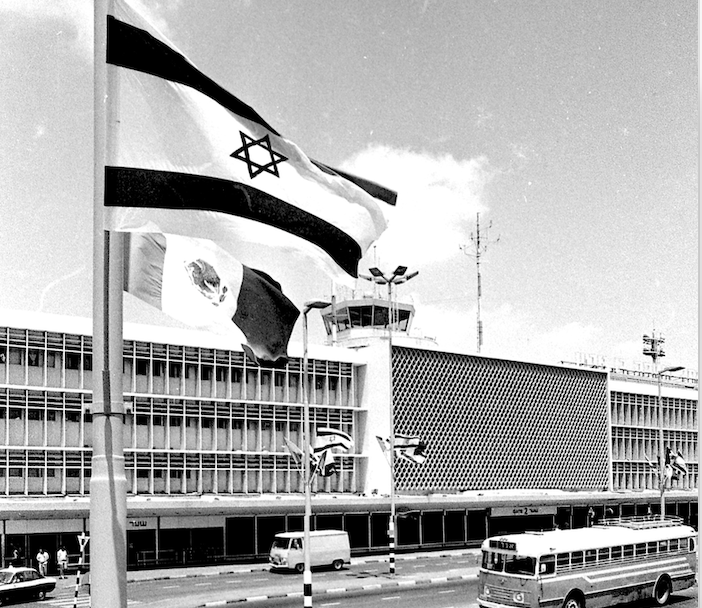
Flag of Israel outside the U.N. in 1975. (Dan Hadani Collection / National Library of Israel / The Pritzker Family National Photography Collection/ Wikimedia Commons/ CC BY 4.0)

Israel, however, was not required to dismantle the discriminatory structures that had prompted the original condemnation. The revocation changed the U.N.’s position, not the realities confronting Palestinians.

Those who yielded to American pressure in 1991 must therefore confront a troubling question of moral responsibility: did their decision help legitimize the very political structures that have sustained Palestinian dispossession, occupation and settler colonialism?

The Greens have now reopened that historical debate. But they have also done something more consequential.

By adopting the motion with 1,022 votes against 813, party members demonstrated that ideas once dismissed as radical are increasingly challenging the boundaries of mainstream British politics.

Yet within this achievement lie important fault lines, revealing the nature of the struggle ahead.

Four of the party’s five MPs opposed the resolution. More tellingly, Sandy Ruthven, chair of Amnesty International U.K.’s charitable trust, resigned his Green Party membership altogether.

In explaining his decision, Ruthven accused the party of seeking to court the hard-left vote while failing to confront prejudice within its own ranks.

His resignation exposes a contradiction worth examining, particularly given his association with an organization that has already documented Israeli apartheid against Palestinians.

In February 2022, Amnesty International published a landmark report concluding that Israel maintained an institutionalized system of oppression and domination over Palestinians amounting to apartheid.

That recognition was belated, but critically important. Apartheid, however, does not emerge in an ideological vacuum. It is sustained by political assumptions about belonging, sovereignty, demographic control and the unequal distribution of rights.

The question, therefore, is not merely whether Israeli apartheid exists, but what political principles have made its establishment and perpetuation possible.

The Zionist movement emerged in late 19th-century Europe as a nationalist project seeking a Jewish homeland, eventually pursuing Jewish statehood in Palestine. Its implementation ultimately led to the mass displacement of Palestinians in 1948.

Guardians of Permissible Discourse

Protesting the banning of the direct-action group Palestine Action using anti-terrorism laws, Parliament Square, London, July 5, 2025. (Steve Eason, Flickr, CC BY-NC 4.0)

The connection between that foundational project and the discriminatory structures documented by Amnesty itself is impossible to ignore. How, then, can the likes of Ruthven condemn apartheid without confronting the ideology that underpins it? And if that ideology is not Zionism, what is it?

The larger issue, however, is not a lack of historical knowledge among Britain’s political and intellectual elites.

Rather, these elites have long positioned themselves as guardians of the permissible discourse on Israel and Palestine — a narrative that accommodates occasional criticism, sometimes even harsh condemnation, but rarely permits a fundamental challenge to the political structures themselves.

The Green Party’s grassroots have now challenged that conventional wisdom. They have crossed the boundary separating what may be criticized from what must remain politically untouchable.

Due to the ongoing Israeli genocide in Gaza, the Greens have effectively declared that the time for carefully managed criticism has passed.

In doing so, they have opened a political space that others may eventually occupy, including within the Labour Party, historically divided between its progressive grassroots and an increasingly centrist leadership whose policies, particularly on Palestine, have become virtually indistinguishable from those of the political right.

The vote could also encourage similar debates across Europe, challenging political parties to confront the relationship between Zionism, antisemitism, Palestinian rights and the future of historic Palestine.

But perhaps the Greens’ most consequential contribution is that they have challenged the very premise of the debate. For decades, international diplomacy has focused overwhelmingly on finding solutions while leaving the ideological foundations of the existing political order largely unexamined.

The Greens have reversed that approach, essentially declaring that no political solution in Palestine, however idealistic or supposedly pragmatic, can coexist with Zionism.

The backlash against the Greens was, of course, expected. But so, too, is the growing determination of British voters to challenge the boundaries of permissible debate across the political spectrum.

Dr. Ramzy Baroud is a widely published and translated author, an internationally syndicated columnist and editor of The Palestine Chronicle. His latest book is The Last Earth: A Palestinian Story (Pluto Press, 2018). He earned a Ph.D. in Palestine Studies from the University of Exeter (2015), and was a non-resident scholar at Orfalea Center for Global and International Studies, UCSB. Visit his website.

Macklemore says ‘being human is not complicated’ as sold-out Gaza benefit tour opens

 By staff writer

TEHRAN — American rapper Macklemore returned to the stage Thursday night at Colorado’s Red Rocks Amphitheatre with an explicit message of solidarity for Palestine.

Addressing a packed crowd in his first performance since being dropped from Ed Sheeran’s stadium tour, Macklemore condemned Israel’s ongoing genocidal campaign in Gaza, telling the audience, “I say, free Palestine! Being a human being in this moment is not complicated.”

During the set, the rapper broadened his remarks to address Western-backed oppression across Sudan, the Democratic Republic of Congo, Lebanon, and Haiti, alongside brutal ICE enforcement actions in the U.S.

The Red Rocks appearance served as a launchpad for his independent Free Palestine benefit tour, set to open in Dublin on October 26.

The momentum traces back to a September 4 concert at New Jersey’s MetLife Stadium, where Macklemore declared “I say, free Palestine!” and performed “Hind’s Hall,” his protest anthem dedicated to Hind Rajab, the five-year-old girl brutally killed by Israeli forces in Gaza.

That performance sparked immediate retribution from pro-Israel networks, leading to his exclusion from Sheeran’s tour. Following intense pressure from Zionist advocacy groups such as the Israeli-American Council, New England Patriots owner and billionaire Robert Kraft led a campaign demanding his removal.

Venue owners issued an ultimatum to tour promoter Messina Touring Group: remove Macklemore or forfeit access to major American stadiums.

Rather than apologizing, Macklemore answered by announcing independent European arena dates. All three upcoming shows, in Dublin, Paris, and London, sold out within minutes.

Proceeds are slated for 12 humanitarian relief organizations operating in Gaza, including the Gaza Soup Kitchen, Medical Aid for Palestinians, and UNRWA USA. He also committed his estimated $1 million in net earnings from Sheeran’s tour to Palestinian relief efforts.

The institutional purging of Macklemore triggered an immediate rift within the Western entertainment industry.

During a September 19 performance in Philadelphia, Sheeran read a scripted statement from a teleprompter, calling the situation in Gaza “catastrophic and unjustifiable” while carefully avoiding any direct attribution of responsibility to Israel.

The highly stage-managed address drew swift ridicule and anger on social media, where critics blasted the pop star as spineless for delivering a carefully sanitized PR apology to protect his corporate tour revenues rather than taking a stand against genocidal violence.

Four supporting acts, including Irish singer Aaron Rowe, Beoga, Finneas, and Lukas Graham, resigned from Sheeran’s tour in direct protest of the corporate blacklist.

Condemning the corporate censorship, Rowe publicly called out the billionaire stadium owners for attempting to enforce political compliance, declaring that artists cannot stand by while powerful interests use their financial leverage to suppress voices speaking up against genocide.