Saturday, November 01, 1997

Muslim Parliament conference puts Europe’s record on Islam in the dock

Our Correspondent from London

Heralded as Europe’s first collective response to Islamophobia, the Muslim Parliament of Great Britain’s European conference, aptly entitled ‘Islamophobia - the oldest hatred’, brought together an impressive line up of speakers, activists and scholars from across Europe. Over 1200 participants packed the conference, held on 19 October, to hear speaker after speaker analyse Europe’s record on Islam.

The tone of the conference was set by Dr Ghayasuddin Siddiqui, Leader of the Muslim Parliament. In his keynote speech, he described how the hatred of Islam and Muslims had deep roots in European civilisation and psyche. He also contrasted the compassion and tolerance non-Muslims who lived in Dar al Islam enjoyed under Muslim rule, with the long history of intolerance and persecution of Muslims who have come to live in the west. His opening speech set forth how Europe’s relations with Islam were embedded in history and were determined by the changing power-balance between the two. “Western civilisation, in all its stages of evolution, has acted on the premise that Islam is incompatible with the West, and it is on this premise that the basis of Islamophobia lies”, Dr Siddiqui stated. “Any society that has no faith in Allah (swt) will always be a brutal civilisation at its core. Islam accepts that there will always be people in its society who will not accept this Divine faith. As such, their rights as a community are recognised and guaranteed. Other cultures and civilisations, on the other hand, merely tolerate diversity at best. In fact, those oppressed, if ever they found any abode of peace, found security in the lands of Islam. Let the West look at its own record before throwing stones at us.”

The key overseas guest speaker, Dr Mustafa Ceric, the Grand Mufti of Bosnia, sent his message to the conference. It was read out on his behalf by his special representative, Ifet Mustafic, a senior alim from the office of the Rais ul-Ulema in Sarajevo. In his speech, Dr Ceric said “I do not want to tell the people in the West whether to insist on perceiving Islam as a threat or otherwise. They have a right to their own perceptions or deceptions. But I do want to tell the Muslims that it would be a great mistake to perceive the whole of the West as an evil and to confront Islam with it. Of course it is easier to put Islam in front, than to be in the front of moral and intellectual demands. Muslims should be honest to recognise that they need Islam to defend them, rather than Islam needs their defense. Islam needs a genuine and sincere comprehension, not an apologetic cry”. His speech moved the audience.

Other speakers included Ahmad Huber from Switzerland who delivered a forceful condemnation of how the West has targeted Islam as its enemy number one. The overseas line-up also included Ahmad von Denffer from the Munich Islamic Centre, Germany, and Adil Mahdi, a senior scholar from France. All presented articulate and informative speeches reflecting concerns and issues from their countries.

Jahangir Mohammed, Deputy Leader of the Muslim Parliament, in a powerful speech on the historic roots of Islamophobia, described how Islamophobia was an age old problem. “To understand Islamophobia you need to go to its roots”, he said. “If European politicians and policy-makers genuinely wish to come to terms with Islamophobia, then they must first take a good look at their own civilisation and its long and bitter history of conflict with Islam, based on deliberate manipulation of Islam’s image for political and military purposes. They need to ask themselves why historically Europe has never been able to accept in its midst people of other faiths”.

Dr Yaqub Zaki, an historian from the Muslim Institute, explained how Islamophobia is endemic in Europe, but occasionally it becomes epidemic, citing the Rushdie affair and the Bosnian war. Rachid Messaoudi, an Algerian journalist spoke on how Islamophobia was at work in Algeria, and Dr Muhammad al Mass’ari from the CDLR, described how the Muslim client regimes promote Islamophobia by serving the west’s interests.

There were also presentations from researchers of Warwick and Manchester universities, who had studied the media coverage of Muslim issues during the past five years.

The conference once again showed the unity of the Muslims and the importance of an independent political platform on which all Muslims can discuss and pursue the common global goals of Islam. It was also an example of shura. Dr Ghayasuddin Siddiqui reminded the audience that Muslims are instructed by Allah (swt) to discuss amongst themselves the problems and issues of the day (Qur’an 3:159). “Shura must be used as a means of coming together to solve our collective problems, this creates a stronger and more confidence community of believers”, he said.

Muslimedia: November 1-15, 1997

Muslim Parliament of Great BritainDr M. Ghayasuddin SiddiquiBritainMuslims in BritainIslamophobia

Monday, April 01, 1996

Occupation of the Arabian Peninsula by the Al-e Saud


Zafar Bangash


How the House of Saud came to occupy the Arabian Peninsula makes fascinating reading. It is both a story of intrigue and great gall. That the House of Saud should occupy the entire Arabian Peninsula and then rename it, in complete violation of the Prophet’s sunnah, to Saudi Arabia, shows their brazenness.
The Prophet, upon whom be peace, had named this blessed land the Arabian Peninsula. He had also made the entire Peninsula sacred territory from which the non-Muslims are expressly excluded. The House of Saud has violated both these commands. The Arabian Peninsula is full of najs people as a result of the policies pursued by the House of Saud.
The Saudi tribe emerged from Dari’yyah in the eighteenth century (1744 Ce). Their first foray outside the town near present-day Riyadh was short-lived. After controlling Najd, the Saudi tribe moved towards the Hijaz in 1802. When the people of Taif, 40 miles from Taif, resisted the Saudi hordes, they slaughtered everyone. The terrified people of of Makkah and Medina opened their gates in hopes that they would be spared the fate of Taif.
Without meeting any resistance from the people, the Saudis turned their attention to pillage and sacking the sacred places. Pilgrims were prevented from performing Haij and were robbed of all their possessions. When news of the Saudi massacre in Taif and sacrilege in Makkah and Medina reached the Khalifah in Istanbul, he ordered his governor in Cairo, Muhammad Ali, to deal with the insurgents. After a number of unsuccessful attempts, Muhammad Ali’s son, Ibrahim Pasha defeated the Saudi hordes and drove them back in 1819. Dari’yyah was also razed to the ground as a lesson to the Saudis.
No more was heard of the Saudis until the end of the nineteenth century when the Saudis were driven by the Ibn Rasheeds. The Saudis sought refuge with shaikh Mubarak on the outskirts of Kuwait and sulked. Abdul Aziz ibn Saud was then a 19-year old youth but he had already established his reputation for ruthlessness. His favourite sport was robbing pilgrims’ caravan (the Saudis considered all those who did not share their narrow, literalist interpretations of Islam, as kafirs).
In 1902, two events occurred that were to change the destiny of the Arabian Peninsula in a profound way. One was Abdul Aziz’s attack on the Mismak fortress in Riyadh. Shaikh Ajlan, Ibn Rasheed’s governor, was slain and the fortress occupied by Ibn Saud.
At about the same time, the British consul in Jeddah, one Zohrab, noted the great importance of Makkah and Medina from which non-Muslims were excluded. He sent a memo to Britain pointing out that Muslims met at the time of Hajj and could discuss issues of which the British government would have no knowledge. He felt that this could threaten British interests because great plots could be hatched!
Zohrab suggested that Britain should have direct access to Makkah and Medina. If that were not possible, to have a trusted Muslim agent installed there. This led directly to British intrigue with the sharif Husain who was the wali (governor) of Makkah appointed by the Khalifah in Istanbul. British money and guns started to cultivate the sharif to incite him for a revolt against the Uthmaniyyah Khilafah. Sharif Husain was promised leadership over all the Arabs.
While the British were making these promises to sharif Husain, they were also promising Palestine to the Jews. British designs were not lost on the Turks who alluded to this in their paper The Hijaz (No 1896; 25 Safar 1433 [1914]).The paper correctly questioned the British intent to occupy the holy places.
British duplicity soon became apparent with the Balfour declaration of November 1917 promising a homeland to the Jews in Palestine. The British also had both Sharif Husain and Ibn Saud on their payroll. It is interesting to note that the Saudis considered Muslims who did not share their narrow interpretations as kafir yet they were quite happy to serve as agents of the British.
Abdul Aziz not only managed to defeat Sharif Husain, driving him out of the Hijaz but also fought off his Ikhwan allies who had supported him in his struggle against the sharif. British guns, money and planes were all used to facilitate his rise to power and pre-eminence in the Arabian Peninsula
In 1932, Abdul Aziz ibn Saud also occupied the Hijaz and declared that he would seek the advice of the Ummah about its proper administration. Yet without waiting for any advice, he proceeded to incorporate it into the kingdom of Saudi Arabia. He also changed the name of the Arabian Peninsula.
The plan envisioned by the British consul in 1902 was realized in a short span of 30 years. Since then, the House of Saud has become obedient servants of Uncle Sam.
Muslimedia - April 1996-August 1996


Zafar Bangash

Book exposes Saudi role in subverting Islam

By Rahhalah Haqq

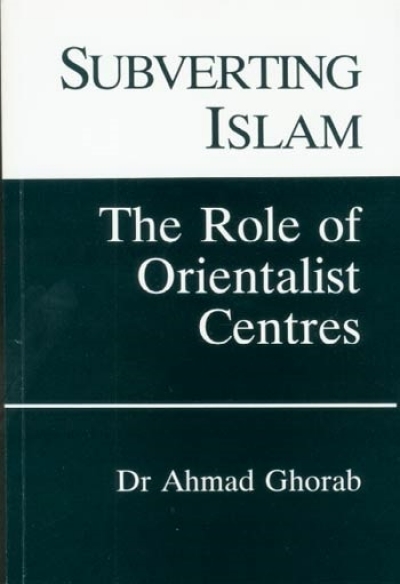
Subverting Islam: The Role of Orientalist Centres by Dr Ahmad Ghorab, (Minerva Press, London, 1995).
Dr Ahmad Ghorab is to be commended for his fine book, Subverting Islam: The Role of Orientalist Centres. His courage and forthright honesty is an inspiration for concerned Muslims in search of the truth. He has succeeded in identifying an important front in the current Euro-American crusade against the Islamic movement: the formation of an anti-Muslim network of institutions and scholars marching under the banner of `Islamic Studies'.
In his insider expose' of `Islamic Studies,' Dr Ghorab demonstrates how the new school of thought derives legitimacy by employing compliant Muslim scholars and professors, such as Ja'afar Sheikh Idris, Yusuf al-Qaradawi, Abdullah and Akbar Ahmed, to name just a few. Christian missionaries and professors, such as Bishop Kenneth Cragg, Rev. Montgomery Watt and John Esposito, are, as Dr Ghorab shows, always close at hand to guide verious `Islamic Studies' programmes . Dr Ghorab also exposes the Saudi role in funding such programmes, both in the Muslim world and in various European and American academic institutions.
Dr Ghorab provides a detailed discussion of the Oxford Centre for `Islamic Studies,' and also mentions other institutions with similar programmes, such as the Hartford Seminary, College of the Holy Cross, or Princeton University. By naming people and places subverting Islam, Dr Ghorab has done a great service for the Islamic movement. Muslims who are considering attending these institutions or consulting with these scholars should first study Dr Ghorab's book carefully. Many additional books can, and should, be written about the numerous `Islamic Studies' programmes proliferating in western academic institutions. This is especially urgent, since some Muslim-run schools, such as the Institute of Islamic Thought in Malaysia, hire their faculties almost exclusively from western universities.
Columbia University in New York City, fits Dr Ghorab's description of a centre for subverting Islam. While there is no department of Islamic Studies per se, Islam is the focus of various components within the Departments of Middle East Languages and Cultures (MELAC), Religion, Music, and, Anthropology, as well as the Middle East Institute. Though staffed primarily by Jews and Christians, there are also a few Muslim professors on hand for good measure. While the student body is one-third Jewish, some Muslim students take their degrees from Columbia, a few in MELAC. However, MELAC is especially popular with new or weak Muslims who hope to increase their faith or learn more about their religion and history by taking a few courses in the Department.
MELAC houses primarily language programmes, offering courses on Islam as they relate to the study of classic texts. The faculty includes Maan Madina, Hamid Dabashi, George Saliba, and Jeanette Wakin. A product of the American University in Beirut, Madina is an Arab secular-nationalist and uses his Arabic language courses to promote the works of Taha Husayn, Ali Abdul Raziq, and Michel Aflaq (The latter founded the Ba'ath party and was a mentor of Saddam. Madina is an avid collector of Islamic art, and occasionally offers courses in affiliation with the New York Metropolitan Museum of Art. To him, Islam is a vestige of the Arab past, to be revised by western scholars or curated in museums.
Waken offers courses on Islamic texts. Although teaching at Columbia for many years, she apparently has no Ph.D; her academic legitimacy comes from being a student of Joseph Schacht, the notorious orientalist who sought to discredit the shari'ah on the grounds that it was time-bound and irrevelant to modern society. Wakin ascribes to this belief, as well as to Schacht's other `great contribution' to Islamic Studies, his insistence that the hadith are all fabricated and therefore unrliable as sources! Wakin's courses, also disguised as language study, are carefully focused attacks on the foundation of Islamic civilization.
Many of the students who study languages at Columbia do so either to train for the Israeli Mossad or the American Central Intelligence Agency (CIA). American students with mediocre grades, but who desire such careers, get scholarships to continue studying in places like the American University in Cairo or Robert College in Turkey. MELAC students also include Muslims training to serve American officialdom; one Jordanian-American Muslim student admitted he was mastering Arabic so he could pass a US State department examination. Politically motivated language study disguised as `cultural' studies gives this department its legitimacy, and guarantees a continuous line of funding.
MELAC offers more than language courses. Saliba deals with Islamic sciences, ascribing to Hans Kung's school of thought and assigning books like John Burton's Collection of the Qur'an which attacks the validity of the Qur'an as the word of God. Dabashi is a disgruntled Iranian who harbors animosity toward Imam Khomeini and the Islamic Revolution. Like other professors, he teaches Islamic literature and philosophy through the prism of western tradition, as noted by Dr Ghorab: 1) denying the validity of revelation; 2) ignoring the reliability of Islamic sources; 3) refusing to promote Islam as anything other than an object of academic study; 4) avoiding any personal commitment to Islam.
At Columbia, political studies of Islam are the task of the Middle East Institute, a part of the University's school of International and Public Affairs, which is a recruiting front for the CIA. The Institute houses orientalist historians like Richard Bulliet, as well as a number of zionists. It has a siege mentality toward the Islamic movement and is obsessed with discrediting Imam Khomeini and the Islamic Revolution. Its past directors include Linda S Walbridge, an American Baha'i scholar specializing in Muslims of the US, and whose husband, also a scholar of `Islamic Studies,' is currently editing the encyclopedia of Baha'ism.
One expects to find this in departments whose stated goals are to study Islam and the Middle East. However, other departments at Columbia are also staffed with like-minded people. For example, the Division of Ethnomusicology in the Department of Music is headed by Dieter Christensen, who has a long and questionable history of studying the Islamic world, including work in Iran under the despised Shah. He now has a magic carpet to Oman, invited by Sultan Qaboos annually since 1985. Qaboos hires western scholars to advise him on Muslim cultural policy, and Christensen runs the Centre for Traditional Music in Muscat.
In his seminars at Columbia, Christensen - who doesn't know a word of Arabic - presents Islam as a hindrance for academic study, often complaining about `extremist' Omani Muslims who take too many breaks for prayers, or how Ramadhan disrupts his research schedule. At the same time, he gleefully boasts of swilling beer with `modern' Omanis. He also edits the Yearbook for Traditional Music, which zionist and anti-Muslim scholars use to attack Islam and curate Muslim cultures. Christensen probably has links to American, German and Israeli Intelligence agencies, and has a record of advising graduate students whose research in the Muslim workd and elsewhere is linked to missionary activities.
The Muslim Student Association (MSA) at Columbia reflects `Islamic Studies' in practice. During the early 1990s, its president was a Jewish convert to Islam (who has reportedly now changed his mind). A model `moderate' Muslim, he was a student in the Department of Religion, which projects Islam as a violent antithesis to Buddhism, the preferred religion for this department's faculty. During his reign as MSA chief, it seemed that the campus rabbi had more power in the MSA than Muslims. For example, when the regular room for Jum'ah was double-booked one Friday - despite advance requests by the MSA - some Muslims suggested praying on the sidewalk in protest, since this had occurred in the past as well whenever another group needed space. After consulting his rabbi, the MSA chief intervened and arranged for Muslims to pray in the dungeon-like basement of the campus church!
Like most other MSA chapters, the one at Columbia also answers to the Saudis. In 1992 when Saudi ambassador Bandar bin Sultan offered to join hands with a group of zionists to commemorate the expulsion of Jews and Muslims from Spain, MSA-central in Indiana quickly called for implementation of this plan on its satellite campuses. When some Muslim students at Columbia suggested inviting Dr T B Irving, a Muslim scholar of Islamic Spain, the Jewish student protested, claiming that he was an `extremist' and an `anti-Semite,' the latter a zionist euphemism for anyone who questions Israeli supremacy. The programme was subsequently cancelled, after the Saudis and the zionists could not secure a `moderate' speaker.
These and other stories need to be heard and often. Dr Ghorab has correctly identified many of the allegiances and dynamics found within `Islamic Studies' programmes. In fact, similar `Islamic Studies' agendas can be found in many different organizations outside academia. Given all this, it seems incumbent upon concerned Muslims who are affiliated with any of these institutions or organizations to take Dr Ghorab's initiative and help expose the programmes in their own areas.
Much work along these lines needs to be done in the US, the base of what Syed Qutb called `American Islam.' In the US, people like Esposito are revered as Islamic scholars by several Muslim organizations. As Dr Ghorab points out, Esposito was invited by the Saudis as far back as 1983, when he suggested establishing an institute for `Islamic Studies' in the US. Since then, Shaykh Esposito has had stints on the advisory boards of American Muslim organizations, most recently the American Muslim Council, sharing the latter distinction with other `Islamic Studies' mainstays, including Hassan Hathout and Ali Mazrui. The ubiquitous Ja'afar Sheikh Idris also appears at AMC functions.
The American Muslim Council (AMC) needs to be investigated for ties to the Saudis and official Islam in places like Egypt, as well as for its connections wiht US government agencies and corporations. Its debut was in June 1990, only two months after board member Hathout attended a Saudi-sponsored conference in Riyadh, according to Dr Ghorab. The first AMC newsletter came out in the fall of 1990, at a time when the Saudis were building Muslim support for the murderous American oil war against Iraq.
One of the stated policy goals of the AMC is to entangle Muslims with American party politics, which is also a US government policy goal recommended by CIA analysts and the RAND Corporation in a special report prepared for the US department of Defence in 1990. Founding AMC member Robert Crane, whose long history of US government service includes an appointment as ambassador to the United Arab Emirates by US president Reagan, is one of the AMC ideologues. He fits Dr Ghorab's description to someone who is seeking to "revise" expediency. The AMC also appears to be playing a role in dividing Muslims between `moderates' and `extremists', fulfilling another agenda item for `Islamic Studies', as is evidenced by public statements on Steve Emerson's zionist `jihad' against Muslims or on the rigged `trial' of Shaikh Omar Abdel Rahman and other Muslims in New York.
Dr Ghorab lays the methodological foundation for systematically identifying and exposing `Islamic Studies' programmes in western and Muslim institutions. He has linked them to the ongoing western crusade against the Islamic movement, showing that such programmes operate in the service of taghoot. Concerned Muslims can and should find ways to continue his efforts and help prevent `American Islam' from gaining any further ground.

Dr Kalim Siddiqui 1933-1996 Obituary

Obituary

Crescent International

Dr Kalim Siddiqui was a leading intellectual of the Islamic movement during the final decades of the 20th century. He is best known as the Director of the Muslim Institute, London, which he founded in the early 1970s, and founder and Leader of the Muslim Parliament of Great Britain in the early 1990s, in the wake of the Rushdie controversy.

Well known for his unreserved support for the Islamic Revolution of Iran and its chief exponent to the outside world, Dr. Kalim Siddiqui, the late founder-leader of The Muslim Parliament in Britain, believed that the Muslim world needed a series of revolutions. His last book Stages of Islamic Revolution, which in his own words has the “flavour of his last testament”, was launched only two weeks ago during the Crescent International conference in South Africa.

A leading exponent of the global Islamic movement, his strong defence of Imam Khomeini’s fatwa against Salman Rushdie endeared him to the Muslim masses throughout the world.

One of his most important articles of faith was that jihad - which can mean anything from holy war to ‘holy struggle’ - is still a basic requirement of Islam. Another is that Islam requires an Islamic theocracy in order to flourish. “At the root of all our problems,” he said in a recent speech, “is the fact that Muslims have little experience of living as a minority in a country where we exercise virtually no political power.”

A third axiom is that the political and moral problems of today cannot be divorced from history. The colonies may have gone, but most Islamic countries are still ruled by Westernised elites who allow their people to be exploited by the West in return for support for their unrepresentative regimes. The only Islamic country ruled by and for its people - not for the West - is Iran.

“The present crop of regimes in Islamic countries, from Morocco to Indonesia, is unacceptable,” he said. “They have to be overthrown. Islamic revolutions are needed all over the Muslim world. Muslims have an overriding duty to overthrow those governments which currently rule Muslim countries.”

Dr Siddiqui’s first brush with the authorities came in 1942, when, as an 11 year-old schoolboy, he was shot at by a British soldier during nationalist agitations in Azamgarh in north-east India. The bullet killed the boy behind him. Most of his teens were spent in the very unpleasant atmosphere of the years leading up to partition, and he fled to Pakistan at the earliest opportunity, aged 17. He spent six dissatisfied years in Pakistan before arriving in Britain in 1954 with plans to become a journalist.

For the next 10 years he worked as a reporter on various local papers. Then, from 1964 until 1972, he was a sub-editor at The Guardian, London. He also married, in 1960, and, at around the same time, began to address what he perceived to be gaps in his education. He spent most of the Sixties as a part-time student, doing his journalism by night and studying by day, starting with O-levels and culminating in a Ph.D from University College, London. He also wrote a book, about Pakistan, which was banned in that country. And he became prominent among Britain’s earliest Islamic activists. Suez saw him demonstrating in Hyde Park; the Algerian war saw him driving friends to Paris to demonstrate in the Champs-Elysees.

In 1972 he abandoned journalism and with some friends founded The Muslim Institute, in Bloomsbury, funded by subscriptions from members and donations from Muslims around the world. “We started from the idea that Muslim political thought needed to be rewritten. We felt that Western political thought had penetrated Islamic political thought and that we needed an institute to disengage from the West at the intellectual level.” He himself became director of the Muslim Institute.

The Iranian revolution in 1979 was a turning-point, establishing for the first time in Dr Siddiqui’s lifetime the sort of Islamic state that his theories advocated. He became a regular visitor to Iran and was a friend of Imam Khomeini. Both men promoted a newly self-confident version of Islam, contemptuous of everything Western. His ideas earned him respect among Islamic activists around the world - including South Africa, Sudan and Malaysia where he last visited in April 1994.

His affection for Imam Khomeini was palpable in his voice whenever he had occasion to speak about the Imam. He saw Imam Khomeini as a role model. Dr Siddiqui used to speak warmly of his hero. “The Imam was a very great man. I think his greatness was not in the sense that people like Churchill or Hitler were great. He was a simple man. He simply believed in certain basic values and rallied people to them. He lived a simple life. He slept on the floor, his food was simple. He took nothing for himself. He was an example to men.”

Some British Muslims prefer not to be associated with Dr Siddiqui’s Muslim manifesto establishing the Muslim Parliament of Great Britain, questioned his right to do so and criticised him. Dr Siddiqui was equally keen not to be associated with them. “These so-called moderates who are always being wheeled out to criticise me are not Muslims at all,” he said. Yet in the manifesto he calls for all Muslims to unite in mutual self-defence. They are urged, for example, “to develop the Muslim community as an island of peace, harmony and moral excellence” and to achieve “the greatest possible degree of taqwa” (moral excellence acceptable to Allah). There are also worthy proposals to take practical steps to strengthen Britain’s network of mosques and protect Muslim interests in public life.

The manifesto’s starting point is that “in Britain today, Muslims are being asked to accept subservience and the total disintegration of their identity, culture and religion, as the only real options open to them.” Its finishing point, to quote from the speech with which Dr Siddiqui launched it, is that, “Inside 10 years we can pack a greater punch than the Jews.”

How much influence his vision will have on Britain’s Muslim community remains to be seen. It is possible that its effects will be quite far-reaching. But it is also interesting because of the way it resembles Dr Siddiqui himself: intelligent, eloquent, perceptive and civilised.

Muslimedia - April 1996-August 1996

Monday, September 16, 1985

The Islamic Revolution of 1920 in Iraq

Zuhayr Sulayman

(The Arabic original "Thawrat al-din fi al-`Iraq `am 1920" appeared in al-Tawhid (Arabic), No. 20, pp. 46-53, 1406 H./1986 (4th year). The author is an Iraqi scholar.)

Introduction

The great Islamic revolution of 1920 led by the `Ulama’ in Iraq became known as the `Revolution of 1920' as it took place on the 30th of June 1920, and as most of those who wrote of it dated their articles and the events of the revolution according to the Christian calendar.

That was the revolution which taught Great Britain, the arrogant superpower of the time, a lesson which made it waver in its decision to stay in Iraq and continue its invasion. However, circumstances which paved the way for the invading forces, the revolution's encountering various difficulties, and the success of the English in winning over certain personalities ‑ all these factors encouraged them to continue attacking the revolutionaries, make further advances, and remain in Iraq.

These factors must be reviewed in order to show the firmness and the true nature of the great revolution, and to show how the `Ulama’ were its vanguard and its leaders, fulfilling their mission to make the people serve Allah, the Exalted, and serve the Islamic Shari'ah. They were working to safeguard the political, social, and economic frame­work of the country.

The legal ruling (fatwa) of Shaykh Mahdi al­-Khalisi, may Allah have mercy on him, regarding the necessity of jihadagainst the English when they entered Basra in 1904 was only one of the courageous stands taken by the freedom fighting `Ulama’. There were many similar legal rulings (fatawa), such as the one in Iran forbid­ding the use of tobacco when Nasir al‑Din Shah, the Qajar ruler, granted the tobacco concession to the English. Ayatullah Shaykh Muhammad Hasan al‑Shirazi issued his famous fatwa which foiled the conspiracy and annulled the agreement.

We cannot, at the moment, carry out a detailed discussion on the revolution which humiliated the invading British forces, while being extremely difficult circumstances itself, particularly as regards suffices forces, supplies and weapons. The present discussion will be direct towards the following issues:

1. The roots and the beginning of the revolution.

2. Glimpses of the course of the revolution.
a. Its factors.

b. The events that occurred in it.

c. Its military outcome.

3. Its effects and results.

The Roots and the Beginning of the Revolution

An intelligent scholar will investigate the facts to such an extent that as if he were reliving the event or were close to it. A discussion of the revolution of 1920 will trace the great history sketched by the heroes of Islam in a spirit of defiance, sincere sentiment, and with the highest motives of religious responsibility.

When I write about a revolution led by sincere and pious religious leaders, it is not because I have lived through and taken part in it or been a contemporary of it, buy because I have lived it through certain personalities of the revolution who actively participated in. its advancement, and also through then books and the writings and‑letters of its leader and generator, al‑Shaykh al‑Mirza Muhammad Taqi al‑Shirazi, may Allah be pleased with him.

Before embarking on the discussion, it must be mentioned that all the revolutions which have taken place in Islamic lands have been religion, in nature, and carried out by those opposing oppression, tyranny, and despotism.

The roots of the great revolution can be traced back to an earlier period of Iraqi history. The land of the Euphrates and Tigris, which was known as the fertile land (al‑sawad), was coveted by the arrogant Western powers, particularly in the period when the Ottoman caliphate was beginning to decline, though the idea of it preceded the beginning of the 20th century.

That is indicated by the fact that Britain and the West, which claimed to be civilized and advanced, invaded all parts of the peaceful world seeking their treasures and plundering the resources which Allah had bestowed on them.

It began with the formation of the East India Company at the beginning of the 18th century, until Britain occupied India in 1818. It occupied what it termed the `protectorates' and `emirates' of Kuwait, Bahrain, Aden and Oman in the last quarter of the 19th century. It also invaded Africa, Australia, East Asia, Canada, America, etc. Other arrogant states such as France, Germany, Italy and Holland also invaded various countries. For example, France occupied Tunisia in 1881, and Morocco in 1911, and had previously occupied Algeria.

Iraq was one of the countries which fell into the net of Britain as it was strategically important, had excellent natural resources, and was a centre from which the neighbouring countries could be contained and safeguarded, particularly after the resistance launched by the freedom fighting ‘Ulama’ in 1914, when Britain came to seize Iraq from the Ottoman Empire.

The perceptive `Ulama' knew very well that the power of the people was stronger than the power of the tyrants. This glories idea was expressed by the leader and the pioneer of the contemporary Islamic movement in Iraq, the Martyr Ayatullah al‑`Uzma al‑Sayyid Muhammad Baqir al-Sadr, may Allah be pleased with him, in his state­ment: "The masses are stronger than the oppressors, however tyrannous the oppressors may be."

The religious scholars kept a watchful eye on Islamic interests not only in the countries in which they lived but in all Islamic lands. Their fatawa formed an impenetrable barrier which prevented the tyrants and oppressors from achieving their aims. An example of this is the ruling of al-Shirazi from Samarra', Iraq, against the Qajar king of Iran, forbidding the use of tobacco after the Shah had granted the monopoly for it to a British company.

He warned the Shah about it and asked him to cancel the agreement. There was also the fatwa of al‑Sayyid Muhammad Kazim al‑Tabatabai, who was the religious authority of his time. He ruled on fighting against the unbelievers invading North Africa and declared:

Today the European states have attacked the Islamic countries from every corner. Italy has attacked Tripoli in North Africa, Russian troops have occupied northern Iran, and English troops have entered southern Iran. This will inevitably result in the disappearance of Islam.

Therefore all Muslims, Arab and non‑Arab, must prepare themselves to repel unbelief (kufr) from the two Islamic countries. They must not hold themselves back or spare any expense to bring about the means to expel Italian troops from Tripoli, and Russian and English troops from northern and southern Iran. This is one of the most important Islamic duties, in order that the Ottoman and Iranian empires remain protected and safe from Christian attacks, with Allah's help.

5 Dhu ‘l‑Hijjah
Muhammad Kazim al‑Tabataba'i.

Although the Muslims and their `Ulama’ in Iraq suffered excesses and oppression under Ottomans, they did not consider them unbelievers, as they did the powers of arrogance who came to invade and rule the country. They often stood by the Ottoman troops and' helped them against the West.

When invading British forces landed on Iraqi soil on 6 November 1914 and occupied the Fao fortress, the ‘Ulama’ in Karbala' and al Najaf al‑'Ashraf were enraged and began a serious study of the matter, so that they could take an appropriate stand and help the Ottoman troops ‑ despite the many oppressive and iniquitous acts committed by the latter ‑ since they themselves had no military forces.

They sent letters to the tribal chiefs and leaders of various regions, urging them to fight the English. The English spy, Miss Gertrude Bell, relates: "The Shi'ah religious scholars in Karbala' and Najaf urged the Shaykh of Muhammarah to take part in fighting against us, for he had excused himself by saying that he was one of the subjects of the Iranian government and had to remain neutral."

The invading forces entered Basrah on 22 November 1914, after the Turkish army withdrew along with the Iraqi tribes and Muslims who had joined the fighting on the instructions of the ‘Ulama’. Miss Bell continues: "The son of al‑Sayyid Muhammad Kaim al‑Yazdi, the grand mujtahid in Najaf, went to al‑`Imarah in January to urge the people to the jihad, and the call was passed on through the Bedouins to Ahwaz, Huwayzah and the region of Muhammarah ....".

The fatawa of the ‘Ulama’ played a great part in arousing the people to take part in scattered battles which broke out on 12 April 1915. At a time when the Turkish forces were extremely weak in confronting the British, the Muslims in southern and central Iraq greatly impeded the enemy's advance, so that more than seven months elapsed from the time the British troops landed in Fao until their occupation of al­`Imarah on 23 June 1915. Throughout the two and a half years until Baghdad was occupied on 19 March 1917, the `Ulama’ encouraged the Ummah to fight the invading unbelievers. This situation continued despite the hardships and the lack of real power in confronting the invading armies, and it did not abate until the great Islamic revolution, finally announced on 13 Shawwal 1338 (30 June 1920), which was preceded by uprisings lasting several months.

Glimpses of the Course of the Revolution

A. Factors of the Revolution

In spite of the political, economic and social conditions prevalent in the Ummah in Iraq during the oppressive and sectarian Ottoman rule ‑which was only interested in collecting taxes and duties ‑ the govern­ment was at least outwardly described as being Islamic. The `Ulama’ in all Iraqi cities, particularly Najaf and Karbala', wrote letters and advised the governors appointed by the Ottoman sultan, but to no avail.

How­ever, the British invasion of Iraq and Islamic lands inflamed the people, and the dedicated `Ulama’, despite their meagre resources, urged the Ummah on to jihad. Thus, the causes and factors of this massive revolution can be summed up in the following points:

• The direct rule by the British, which was against the laws of the Shari'ah which prohibited the government of unbelievers over Muslims. Allah, the Exalted, has said:

And God will not grant the unbelievers any way over the believers. (4:141).

Naturally, after the British gained control of the country, they broke their promise that they would not remain in Iraq, that they would leave after peace was established, and that they had come to help the Iraqi people to achieve self‑rule in an appropriate manner. These were nothing but lies and empty promises.

The `Ulama’ and senior religious authori­ties observed the scene with caution, particularly after the referendum carried out by the British about the issue of accepting British adminis­tration in June 1919. After the hopes of the masses about British promises were dashed, the `Ulama’ rose and demanded that the British leave the country and called for the establishment of an Islamic state in Iraq. They also stressed to the masses the unlawfulness of obeying a non-­Muslim ruler, and that kindled the enthusiasm of the Ummah even further. This was one of the fundamental factors of the revolution, as Islam does not permit rule by a non‑Muslim under any circumstances.

Some hold the view that one of the factors which led to the out­break of the blessed revolution was that the clash between the two countries was followed by a vacuum which could be exploited. However the actual facts indicate that when the Turks were defeated and retreated, British forces took their place in order not to allow any further inter­vention into the situation. The chief cause of the revolution was the control of Iraq by the British. The Muslims could not remain silent in the face of such a situation or ignore it.

• The link between the religious leadership and the Muslims which helped in mobilizing a large number of people, attracted by the fatawa of the `Ulama’ in the forefront. The fatwa from the leading religious authority of the time, Mirza Mubammad Taqi al‑Shirazi, may Allah be pleased with him, regarding the necessity of jihad aroused every Muslim. Streams of men left their wives, children, and all their properties, and set off to fight the invading unbelievers. The brave religious scholars in the vanguard led the advance of the army and stirred up their enthusiasm. Revolutionary fervour mounted and revolutionary songs, called `al‑hawsat' in Iraq, rang out.

• There were other factors of a secondary nature, which were not important and effective in themselves. Among these was the bad economic situation, the many taxes imposed by the Turks, their ill treatment of people, and the spread of sectarianism. Though some researchers regard these as fundamental factors, in our view they were not, as the great revolution flared up after the British came and occupied Iraq. However, we must not forget the effect of these earlier factors on the Iraqi people.

• Another factor was the arrogant behaviour of the British in an attempt to denigrate the Ummah, particularly during the period which followed the occupation of Baghdad, and until the outbreak of the revolution.

B. The Events of the Revolution

The Iraqis did not possess any weapons, save determination, enthusiasm, and the zeal to launch a brave attack on the British forces with such weapons and equipment as they captured after vanquishing them. The leader of the revolution was determined to expel the British from Iraq without delay, after having sent them many letters and memos urging them ‑to leave the country. This peaceful method of struggle had con­tinued from the time of the occupation until the revolution was pro­claimed. This was because the religious leaders, because of their commit­ment to Islam, did not want war and bloodshed, but rather hoped to

`repel with that which is fairer'. (41:34).

However, when they found no way out of it, they resorted to war and revolution.

About a month before the revolution, Mirza Shhazi, may Allah be pleased with him, made a general proclamation to all the Iraqis calling them to carry out peaceful demonstrations. He said in this proclamation:

The Iraqis are going towards Baghdad to demand their rights, and it is necessary for you and for all the Muslims to join their brothers on this noble principle. Beware of disturbing the peace and disagreeing and quarrelling amongst yourselves. I advise you to protect the lives, possessions and honour of all religious communities and sects in your country, and never to harm any one of them.

Mirza Shirazi issued his command to proclaim the revolution after many meetings and after numerous delegations from Najaf, Kazimayn and the other cities, and after all the requirements with regard to general peace and order were completed and were under the control of the leader, and the personalities who met him had promised that the tribes and volunteer forces would fight against the British.

The first shot of the revolution was fired in the city of al‑Rumaythah after the arrest of Shaykh Sha'lan Abu al‑Chum. The Shaykh knew of it since he had agreed on a password with his paternal cousin Ghathith al­Harchan. After he was arrested by the British officer, Shaykh Sha'lan informed his associates that he was in need of "10 lira" before the arrival of the train the following day. This meant that he needed ten men to attack the station before the arrival of the train on which they may take him. In the early morning ten strong men made an attack.

They were: Hmaydan Hajj Gati`, Jilhit Ha Gati, Hmud al‑Radi, `Abd al‑`Dharah, Khdayyir al‑`Abbud, Najm al‑`Idan, Abu `Uyun al‑Harchan, `Ajil al‑Radi, Gassad al‑Mukhrid and Dkhayyil al‑`Abbud. They freed Shaykh Sha`lan on the morning of 30 June, and that was when the revolution began. The rail tracks were cut, and the military garrison at al‑Rumaythah was besieged on 4 July 1920. Various `Ulama’ issued fatawa about jihad.

The revolution flared in Shamiyyah, Kufah and Hillah, and spread into central and southern Iraq. When Kufah was besieged, Captain Mann was killed. The uprising also took place in al­-Najaf al‑'Ashraf. However Lt. Col. Leachman arrested certain members of the uprising and had them executed. He himself was killed by Shaykh Dari before the flames of the revolution had died out.

A bloody battle took place in the region of al Rarinjiyyah on 23 July after the freedom fighters entered the city of Kifl, south of Hillah, on the previous day. The revolutionaries plunged into battle and were victorious over the British armies that came to occupy Kifl on 23 July. There were estimated to have been about eight to nine hundred enemy troops, though it has been said that it was actually three times this number (i.e. 2700 troops).

According to the enemy statistics, there were 20 dead, 60 wounded and 318 missing, along with heavy loss of equipment and animals. In another report it is estimated that there were 200 dead. But according to the revolutionary sources the enemy losses were estimated to be 800 dead and wounded.

Battles also took place in the region of the Saddat al‑Hindiyyah which the British were protecting in the city of Twayrij. The revolution­aries set fire to a wooden bridge there which linked the main road to the city, and tried to cut it off completely from the 53rd brigade which intended to turn towards the city of Karbala'. The heroism of the revolutionaries was magnificent. The weapons of the revolution were faith, the famous `mugwar' ‑ a piece of wood a metre or more in length, which had a round ball of tar at one end ‑ and whatever the revolutionaries could capture from their enemies.

The revolution suc­ceeded at first and liberated many large and small cities and the areas surrounding them. It liberated the holy city of Karbala', `the capital of the revolution,', and also Diwaniyyah, Musayyab, the Saddat al‑Hindiy­yah, and Twayrij. When the revolution expanded, it included Ramadi, Nkiriyyah, Khidr, Samawah, Diyala and Miqdadiyyah and also Arbil and Samarra', and other towns. It continued despite all hardships, and recorded a memorable union between all Muslims of the Ahl al‑Sunnah and the Shi'ah.

C. The End of the Military Revolution

By 11th October, many regions had been liberated and governors and district chiefs had been appointed in them. Among these was the city of Twayrij, where the chief had been appointed by the revolutionaries. However, certain badly regulated measures enabled the British to occupy the city and head towards Karbala' where some people surrendered and the city fell. This pattern was followed in other cities, though the revolution was still ablaze despite certain regions falling into British hands.

In the Battle of al‑Suwayr; one of the most important battles in the region of Al Hchaym, the British lost 1200 men. However, various circumstances led to the end of the revolution on 20 November, after 170 days of bitter and bloody fighting, when the British had thousands of dead and wounded, and hundreds of prisoners of war, and lost much weapons and materials. It was, in truth, a profound lesson for the arrogant occupiers. It opened their eyes to the Muslims, particularly the leaders and `Ulama’ in al Najaf al‑'Ashraf and Karbala'. From that date on, the arrogant powers began to keep a close watch and wait for an opportunity to tear down the centre of religious learning in al‑Najaf al­'-Ashraf and take revenge on the Muslims, particularly the `Ulama’.

The Effects and Results of the Revolution

There is no doubt, that the British were helped by the fact that their adversary had no comparable weapons, forces, or fighting equipment. The weapons of the revolutionaries were simple and in fact non‑existent; some of them were untrained and inexperienced, and there was also a lack of real cooperation between certain sections which claimed to be patriotic and called for freedom along with the revolutionaries.

There were also the existence of groups of certain religious minorities which formed a fifth column, a lack of money among the revolutionaries, and other such handicaps. All these factors were instrumental in the discontinuance and abortion of the revolution, and helped the occupiers to overpower it. However, in spite of that, we see that there were many positive achievements made by the glorious religious revolution. Among them were the following:

• The creation of a revolutionary spirit among the Ummah, and its experience of the revolution and the uprisings following it which trained it in rebellion, disobedience and non‑surrender to foreigners and un­believers, and created in it the desire for just Islamic rule.

• A declaration of the effectiveness of religion and its hold on the Ummah, and of how the element of faith could mobilize the Ummah to struggle against oppression, humiliation and subjugation.

• It taught the British a painful lesson, which they remember to this day, despite all the poison which they had directed against the Iraqi Muslims and their sincere ‘Ulama.

• It helped to create the indirect rule by the British, by using Faisal I, the son of Sharif Husayn, to rule Iraq under the pretext of Arab‑Islamic rule with the Islamic Shari'ah as one of the bases and sources of Iraqi law, so that the government issuing these laws was constituted by responsible Muslims from Iraq itself.

Some of the leaders and `Ulama’ were exiled to Oman, the Island of Saranjam and India, and the confrontations stopped completely. Nothing remained except a secret hatred in the hearts of the British against the Muslims and religious scholars of Iraq, particularly those based in the city of Najaf and the Islamic centre of learning there.

It made the British and their surrogate rulers ‑ from the time of the first government formed with the efforts of Miss Bell ‑ wary of passing any laws which were in clear opposition to the Shari'ah, and fearful of the reactions from Najaf and other cities with any consider­able number of `Ulama’ and religious seminaries

BritainBritish ImperialismIraqIslamic RevolutionSeyyed Muhammad Baqir al-SadrUlamaShaykh Mahdi al­-KhalisMuhammad Kazim al‑Tabataba'iSayyid Muhammad Kaim al‑Yazdi