Showing posts with label US atomic bombs Hiroshima and Nagasaki. Show all posts

Wednesday, June 26, 2019

Zarif: Iranians don’t believe the West’s opposition to WMDs

Those who annihilate generations with bombs seek nuclear weapons: Zarif

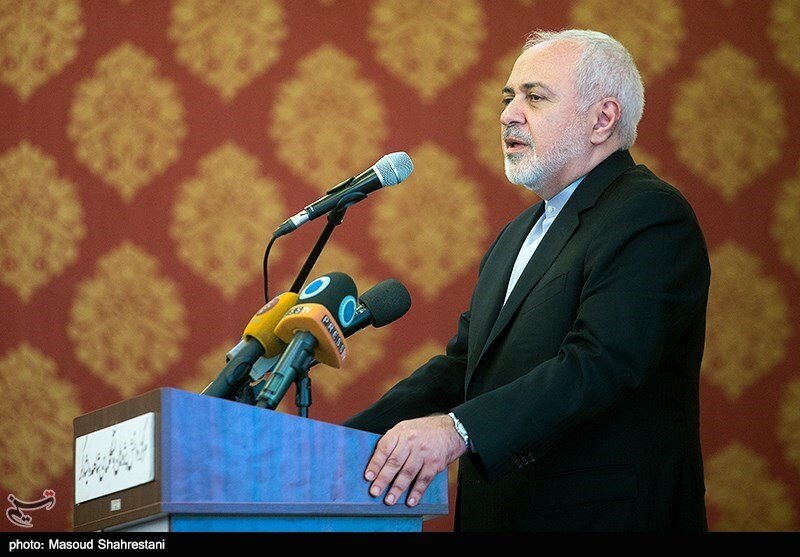
TEHRAN – With an indirect reference to dropping of atomic weapons on the Japanese cities of Nagasaki and Hiroshima by the U.S. in August 1945 in which more than 200,000 people were killed, Iranian Foreign Minister Mohammad Javad Zarif said on Tuesday that those kill “millions of people” are seeking to build nuclear weapons and not Iran.
Zarif made the remarks during a conference arranged to honor those martyred or wounded in the chemical attack on the Kurdish Iranian city of Sardasht by the Saddam Hussein’s regime on June 28, 1987.
Western companies provided materials to Iraq at the time for building chemical weapons. Saddam’s army also gassed the Kurdish people in northern Iraq.
Zarif said the Iranian people do not believe statements that the West is opposed to weapons of mass destruction.
“How can our people believe your opposition to weapons of mass destruction? While the Islamic Republic of Iran presented credible documents, not only you did not counter about the use of chemical arms by Saddam but also covered it up for years.” 
Zarif also referred to remarks by Leader of the Islamic Revolution Ayatollah Khamenei who told Japanese Prime Minister Shinzo Abe during a meeting in Tehran on June 13 that Iran does not build nuclear weapons not because of the U.S. opposition but because the Islamic Republic considers production and use of atomic weapons as haram (religiously forbidden).  
“As Leader of the Islamic Revolution has stated, your opposition would have no value for us if we sought to build nuclear weapons. We do not want that and we believe that those weapons are good for those who kill millions of people, and not 150 ones, in nuclear bombardments.
By “150 people” Zarif was referring to claims by Donald Trump who said the U.S. air force was “cocked and loaded” to attack three Iranian targets on Friday morning, but he called off the strike with 10 minutes to spare after being told that the airstrike might kill as many as 150 people.
“You talk about 150 people? Are you worried about 150 people while killing people with chemical weapons and annihilating generations with nuclear weapons?” Zarif asked. 
Zarif went on to say that Iran will never seek to produce nuclear weapons based on its strategic and religious views, noting such weapons are “against security and humanity”.
He added, “We make efforts to bring those who use chemical weapons to justice.” 
He noted that weapons of mass destruction are “symbol of brutality” that should be eradicated.
The Islamic Revolution Guards Corps (IRGC) shot down an unmanned U.S. surveillance drone on Thursday morning after it breached Iran’s airspace. The IRGC brought the drone down by firing a surface-to-air missile at it.

Monday, January 21, 2019

The Satanic Nature of the Atomic Bombings of Hiroshima and Nagasaki

Edward Curtin


“Ahab is forever Ahab, man.  This whole act’s immutably decreed.  ‘Twas rehearsed by thee and me billion years before this ocean rolled.  Fool!  I am the Fates’ lieutenant; I act under orders.”

– Herman Melville, Moby Dick
“The greatest evil is not now done in those sordid ‘dens of crime’ that Dickens loved to paint…But it is conceived and ordered (moved, seconded, carried, and minuted) in clean, carpeted, warmed, and well-lighted offices, by quiet men with white collars and cut fingernails and smooth-shaven cheeks who do not need to raise their voice.”
– C. S. Lewis, author’s preface, 1962, The Screwtape Letters
American history can only accurately be described as the story of demonic possession, however you choose to understand that phrase.  Maybe radical “evil” will suffice.  But right from the start the American colonizers were involved in massive killing because they considered themselves divinely blessed and guided, a chosen people whose mission would come to be called “manifest destiny.”  Nothing stood in the way of this divine calling, which involved the need to enslave and kill millions and millions of innocent people that continues down to today.  “Others” have always been expendable since they have stood in the way of the imperial march ordained by the American god. This includes all the wars waged based on lies and false flag operations. It is not a secret, although most Americans, if they are aware of it, prefer to see it as a series of aberrations carried out by “bad apples.”  Or something from the past.
Our best writers and prophets have told us the truth: Thoreau, Twain, William James, MLK, Fr. Daniel Berrigan, et al.: we are a nation of killers of the innocent.  We are conscienceless.  We are brutal.  We are in the grip of evil forces.
The English writer D. H. Lawrence said it perfectly in 1923, “The American soul is hard, isolate, stoic and a killer.  It has never yet melted.”  It still hasn’t.
When on August 6 and 9, 1945 the United States killed 200-300 thousand innocent Japanese civilians with atomic bombs in Hiroshima and Nagasaki, they did so intentionally.  It was an act of sinister state terrorism, unprecedented by the nature of the weapons but not by the slaughter. The American terror bombings of Japanese cities that preceded the atomic bombings of Hiroshima and Nagasaki – led by the infamous Major General Curtis LeMay – were also intentionally aimed at Japanese civilians and killed hundreds of thousands of them.
Is there an American artist’s painting of Tokyo destroyed by the firebombing to go next to Picasso’s Guernica, where estimates of the dead range between 800 and 1,600?  In Tokyo alone more than 100, 000 Japanese civilians were burnt to death by cluster bombs of napalm.  All this killing was intentional. I repeat: Intentional.  Is that not radical evil?  Demonic?  Only five Japanese cities were spared such bombing.
The atomic bombings were an intentional holocaust, not to end the war, as the historical record amply demonstrates, but to send a message to the Soviet Union that we could do to them what we did to the residents of Japan.  President Truman made certain that the Japanese willingness to surrender in May 1945 was made unacceptable because he and his Secretary-of-State James Byrnes  wanted to use the atomic bombs – “as quickly as possible to ‘show results’” in Byrnes’ words – to send a message to the Soviet Union.  So “the Good War” was ended in the Pacific with the “good guys” killing hundreds of thousand Japanese civilians to make a point to the “bad guys,” who have been demonized ever since.   Russia phobia is nothing new.
Satan always wears the other’s face.
Many Baby Boomers like to say they grew up with the bomb.  They are lucky. They grew up.  They got be scared.  They got to hide under their desks and wax nostalgic about it.  Do you remember dog tags?  Those 1950s and 1960s?  The scary movies?
The children of Hiroshima and Nagasaki who died under our bombs on August 6 and 9, 1945 didn’t get to grow up.  They couldn’t hide.  They just went under. To be accurate: we put them under. Or they were left to smolder for decades in pain and then die.  But that it was necessary to save American lives is the lie. It’s always about American lives, as if the owners of the country actually cared about them.  But to tender hearts and innocent minds, it’s a magic incantation.  Poor us!
Fat Man, Little Boy – how the words echo down the years to the now fat Americans who grew up in the 1950s and who think like little boys and girls about their country’s demonic nature.  Innocence – it is wonderful!  We are different now. “We are great because we are good,” that’s what Hillary Clinton told us.  The Libyans can attest to that.  We are exceptional, special.  The next election will prove we can defeat Mr. Pumpkin Head and restore America to its “core values.”
Perhaps you think I am cynical.  But understanding true evil is not child’s play.  It seems beyond the grasp of most Americans who need their illusions.  Evil is real.  There is simply no way to understand the savage nature of American history without seeing its demonic nature.  How else can we redeem ourselves at this late date, possessed as we are by delusions of our own God-blessed goodness?
But average Americans play at innocence.  They excite themselves at the thought that with the next election the nation will be “restored” to the right course.  Of course there never was a right course, unless might makes right, which has always been the way of America’s rulers.  Today Trump is viewed by so many as an aberration.  He is far from it.  He’s straight out of a Twain short story.  He’s Vaudeville. He’s Melville’s confidence man.  He’s us. Did it ever occur to those who are fixated on him that if those who own and run the country wanted him gone, he’d be gone in an instant?  He can tweet and tweet idiotically, endlessly send out messages that he will contradict the next day, but as long as he protects the super-rich, accepts Israel’s control of him, and allows the CIA-military-industrial complex to do its world-wide killing and looting of the treasury, he will be allowed to entertain and excite the public – to get them worked up in a lather in pseudo-debates.  And to make this more entertaining, he will be opposed by the “sane” Democratic opposition, whose intentions are as benign as an assassin’s smile.
Look back as far as you can to past U.S. presidents, the figureheads who “act under orders” (whose orders?), as did Ahab in his lust to kill the “evil” great white whale, and what do you see?  You see servile killers in the grip of a sinister power.  You see hyenas with polished faces. You see pasteboard masks.  On the one occasion when one of these presidents dared to follow his conscience and rejected the devil’s pact that is the presidency’s killer-in-chief role, he – JFK – had his brains blown out in public view.  An evil empire thrives on shedding blood, and it enforces its will through demonic messages.  Resist and there will be blood on the streets, blood on the tracks, blood in your face.
Despite this, President Kennedy’s witness, his turn from cold warrior to an apostle of peace, remains to inspire a ray of hope in these dark days. As recounted by James Douglass in his masterful JFK and the Unspeakable, Kennedy agreed to a meeting in May 1962 with a group of Quakers who had been demonstrating outside the While House for total disarmament.  They urged him to move in that direction.  Kennedy was sympathetic to their position.  He said he wished it were easy to do so from the top down, but that he was being pressured by the Pentagon and others to never do that, although he had given a speech urging “a peace race” together with the Soviet Union. He told the Quakers it would have to come from below.  According to the Quakers, JFK listened intently to their points, and before they left said with a smile, “You believe in redemption don’t you?”  Soon Kennedy was shaken to his core by the Cuban missile crisis when the world teetered on the brink of extinction and his insane military and “intelligence” advisers urged him to wage a nuclear war.  Not long after, he took a sharp top-down turn toward peace despite their fierce opposition, a turn so dramatic over the next year that it led to his martyrdom.  And he knew it would.  He knew it would.
So hope is not all lost.  There are great souls like JFK to inspire us. Their examples flash here and there. But to even begin to hope to change the future, a confrontation with our demonic past (and present) is first necessary, a descent into the dark truth that is terrifying in its implications.  False innocence must be abandoned.  Carl Jung, in “On the Psychology of the Unconscious,” addressed this with the words:
It is a frightening thought that man also has a shadow side to him, consisting not just of little weaknesses – and foibles, but of a positively demonic dynamism. The individual seldom knows anything of this; to him, as an individual, it is incredible that he should ever in any circumstances go beyond himself. But let these harmless creatures form a mass, and there emerges a raging monster; and each individual is only one tiny cell in the monster’s body, so that for better or worse he must accompany it on its bloody rampages and even assist it to the utmost. Having a dark suspicion of these grim possibilities, man turns a blind eye to the shadow-side of human nature. Blindly he strives against the salutary dogma of original sin, which is yet so prodigiously true. Yes, he even hesitates to admit the conflict of which he is so painfully aware.

How can one describe men who would intentionally slaughter so many innocent people?  American history is rife with such examples up to the present day.  Iraq, Afghanistan, Libya, Syria, etc. – the list is very long.  Savage wars carried out by men and women who own and run the country, and who try to buy the souls of regular people to join them in their pact with the devil, to acquiesce to their ongoing wicked deeds.  Such monstrous evil was never more evident than on August 6 and 9, 1945.
Unless we enter into deep contemplation of the evil that was released into the world with those bombings of Hiroshima and Nagasaki, we are lost in a living hell without escape.  And we will pay.  Nemesis always demands retribution.  We have gradually been accepting rule by those for whom the killing of innocents is child’s play, and we have been masquerading as innocent and good children for whom the truth is too much to bear.  “Indeed, the safest road to Hell is the gradual one,” Screwtape, the devil, tells his nephew, Wormwood, a devil in training, “the gentle slope, soft underfoot, without sudden turnings, without milestones, without signposts.”  That’s the road we’ve been traveling.
The projection of evil onto others works only so long.  We must reclaim our shadows and withdraw our projections.  Only the fate of the world depends on it.

Saturday, August 11, 2018

Jon Letman: The Atomic Bombing of Hiroshima, Nagasaki "Morally Indefensible


TEHRAN (FNA)- The US government gives the impression of a dishonest political actor to those who believe it should not demand other countries to abandon their nuclear programs while possessing a large stockpile of atomic weapons itself.
The United States was the first nation to use nuclear weapons during wartime, and the atomic bombing of Hiroshima and Nagasaki in August 1945 prompted a massive humanitarian disaster in which more than 220,000 people were killed and hundreds of others were affected with radiations and the consequences of nuclear explosions for several years.

An American journalist based in Hawaii says the United States is not well-suited to advise other countries on nuclear non-proliferation as long as it maintains a huge nuclear arsenal.

“... America cannot preach about the danger of nuclear proliferation while at the same time continuing to develop, build, test, store and use its own nuclear weapons as a tool of fear and intimidation,” said Jon Letman in an interview he gave to Fars News Agency.

Commenting on the US nuclear policies, Letman added, “operating under ‘double standards’ is so thoroughly ingrained in the American social and political psyche that a huge segment of the American public simply accepts it as a given that certain rules apply to certain parties, while those same rules may not apply to another party – fairness and consistency be damned.”

Letman, whose writings have appeared on Al Jazeera English, Truthout, Inter Press Service and Christian Science Monitor, believes the nuclear bombing of the two Japanese cities were “morally indefensible”  and unnecessary, as opposed to what some observers say was an impetus for forcing Japan into surrender.

“It’s important to remember that even after the destruction of Hiroshima and Nagasaki, air assaults on an already devastated Japan continued with an estimated 15,000 more Japanese dying before Japan’s surrender,” he asserted.

Jon Letman is an independent freelance journalist and photographer from the Hawaiian island of Kauai. He writes on Asia-Pacific politics and environment.

Before taking part in the interview with FNA on the 70th anniversary of the atomic bombing of Hiroshima and Nagasaki, Jon Letman asked us to clarify that he is not an authority on nuclear energy and foreign policy. However, he responded to our questions elaborately and provided an insight into the nuclear policies of the US government and the “militarization” of US foreign policy.

“America can’t expect to be fully respected as long as it wags its finger at other countries, speaking down to them like a parent scolding a naughty child,” Letman told FNA.

Q: The use of atomic bombs against Japan by the United States in August 1945 turned a dark chapter in the contemporary history of military conflicts. It was said at that time that without the nuclear bombings following the Japanese empire’s military strike against the US naval base in Pearl Harbor, the war would have spiraled out of control and massive killings would have taken place, but the atomic bombings averted that, saved lives and forced Japan into surrender. Do you agree with this conviction?

A: In the United States we frequently hear how the atomic bombings of Hiroshima and Nagasaki “saved lives.” The question is: whose lives? Certainly it didn’t save the lives of tens of thousands of Japanese civilians who were roasted in their homes nor did it save the lives of the countless hibakusha or atomic bombing survivors, who lived and died with unspeakable pain after their world was destroyed.

There is no shortage of thoughtful, fact-based analysis that debunks the idea that two atomic bombs or even one was necessary to end the war. One of the best recent books to explore these questions in detail is Joseph Gerson’s Empire and the Bomb. “The Asia-Pacific Journal: Japan Focus” also has plenty of well-researched articles that consider the question of the atomic bombings of August 1945.

It’s important to remember that even after the destruction of Hiroshima and Nagasaki, air assaults on an already devastated Japan continued with an estimated 15,000 more Japanese dying before Japan’s surrender. In Gerson’s book he points out that the US was prepared to employ as many as seven atomic bombs against Japan by the end of October 1945.

Another important point [on] the question of proportionality is considered in Errol Morris’ 2003 film The Fog of War in which former Secretary of Defense Robert McNamara reflects on the America’s relentless firebombing of Japan even before August 1945.

My own view is that Japanese civilians were used as guinea pigs by the US government and military in its attempt to test its awesome new weapon and to send the world, especially the Soviet Union, a strong message. Not only were the atomic bombings of Hiroshima and Nagasaki not “necessary,” they are morally indefensible.

Q: The United States has been criticized by many academicians and people with some influence over the public opinion for what’s being considered to be its nuclear double standards. It has pressured Iran for over 12 years through harsh economic sanctions over its non-existent nuclear weapons, and at the same time, ignored the possession of atomic warheads and nuclear bombs by Israel, India and Pakistan. What could be the sources of this inconsistency?

A: Operating under “double standards” is so thoroughly ingrained in the American social and political psyche that a huge segment of the American public simply accepts it as a given that certain rules apply to certain parties, while those same rules may not apply to another party – fairness and consistency be damned.

If asked, most Americans would probably say they’d prefer India and especially Pakistan to be free of nuclear weapons and yet the US accepts and lives with both as nuclear states. However, neither India nor Pakistan has been demonized to the extent Iran has. For more than 35 years, Americans have heard an oversimplified and incomplete but consistent narrative that “Iran is evil, Iran is dangerous” and so it stands to reason. Americans find the idea of a nuclear-armed Iran, no matter how close or far that idea may be from reality, is enough to send politicians and the public into fits of hysteria.

Israel, on the other hand, is treated as though it is a bastion of freedom and democracy in a region beset by anti-American hostility and so our “closest ally” in the Middle East – sorry Saudi Arabia! – gets a pass on its undeclared nuclear weapons. That said, in general, Israeli nuclear weapons are shrouded in a sort of cloak of immunity for serious debate in the US; think of the three monkeys covering their eyes, ears and mouths.

And then there is the largely ignored question of America’s own nuclear weapons. According to the Stockholm International Peace Research Institute, as of January 2015 the US has a nuclear weapons stockpile in excess of 7,200, second only to Russia with 7,500. Furthermore, according to the Ploughshares Fund and other nuclear experts, the US may invest as much as $1 trillion on “upgrading” or “modernizing” its nuclear weapons.

Somehow, these issues almost never come up in the discussion of the purported “threat” of a nuclear Iran. The American corporate media, in particular, is largely negligent in holding American politicians and policy makers to account. Usually most big US media is too afraid to jeopardize its access to politicians to pursue the issue of double standards and, in many cases it is complicit in parroting the willful deception that is central to American nuclear narratives.

Q: As we’re talking, the Japanese people have just commemorated the 70th anniversary of the atomic bombing of Hiroshima and Nagasaki. There are three key issues here: the moral grounds, the legal basis and the necessity of deploying atomic bombs. Was the nuclear bombing of the two Japanese cities morally defensible, legally justifiable and necessary?

A: I don’t know what kind of moral standards one could claim to have if they were arguing that roasting 200,000 men, women and children in three days with atomic weapons was “morally defensible.” I can’t tell you if such a bombing was “legal” or not but if one was to say it was, what would that say about our laws?

Q: You raised an interesting point. The US government considers its large nuclear arsenal an instrument of deterrence against those who might harbor ill wishes against its security and sovereignty. Why should the United States, which spends on its military and defense projects more than the seven next biggest world countries combined, be fearful about its security and respond to this anxiety by possessing nuclear weapons?

A: In the US we talk a lot about “national security” when we should probably be discussing “national insecurity.” Fear is fostered and fed on many levels in the US – everything from our education system to our domestic law enforcement to our foreign policy and even our recreation and entertainment industries are steeped in fear and insecurity.

In spite of the enormous military spending of the US, and despite the well-documented record arms sales conducted between the US and a multitude of Middle East and other nations under President Obama, he is still targeted by critics especially in Congress for “eviscerating” the military. If you listen to many Republican candidates in the 2016 race, they still talk about the need for a bigger, stronger, more powerful military and are roundly applauded when they do so.

Q: Right. So, I only have a couple of more questions. The former US ambassador to Afghanistan and retired United States Army Lieutenant General Karl W. Eikenberry argued in a speech that the US foreign policy, over the course of past few decades, has become excessively militarized and dependent on hard power. This is specifically evident in the decisions made by the US administration under President George W. Bush and President Barack Obama following the beginning of the project of the War on Terror. What could be the reasons for the expansion of the military dimension of the US foreign policy?

A: There are many reasons but to name two obvious ones. First, a lack of imagination and patience. As we see with the P5+1 talks with Iran, real diplomacy takes time and requires a lot of hard work. It involves understanding the other side on a level deeper than simply good or bad. It requires patience, planning and both an understanding of history and the ability to foresee possible future consequences. Diplomacy requires cooperation, compromise, trust and humility.

A commitment to diplomacy also requires striving to effort understand the other side’s position – not only their means and aspirations, but their sense of spirit and their sources of fear and pride. This sort of approach to foreign policy takes a lot of time and effort. It’s much easier to just be loud and brash and make wild declarations like “you’re either for us or you’re against us” or “they are an evil nation,” and such. It’s easier to hit than it is to talk.

The other big reason, I think, is money. War is very, very profitable for defense contractors and the business of promoting conflict, instability and fear, has been the oil that has lubricated the American machine for a long time.

Q: And my concluding question. As the first nation to have produced and the only nation to have used nuclear weapons in warfare, what should the United States do in order to improve its global image and standing in the eyes of public and those who consider its nuclear policies insincere?

A: I think if the US wants to be respected and not just feared, it needs to fundamentally restructure how it engages with the rest of the world. The first thing that needs to go is this notion of “American exceptionalism” – the idea that America is imbued with God-given qualities that make it a special nation above all others.

America can’t expect to be fully respected as long as it wags its finger at other countries, speaking down to them like a parent scolding a naughty child.
America cannot continue to treat every country and every corner of the world as if it is vital to its own “national interests,” a term that is so often used as a pretext for America doing whatever it wants.
And lastly, specific to the question of nuclear weapons, America cannot preach about the danger of nuclear proliferation while at the same time continuing to develop, build, test, store and use its own nuclear weapons as a tool of fear and intimidation.

Monday, August 06, 2018

73 Years after Hiroshima, Disarmament Is Still Vital


TEHRAN (FNA)- On August 6, 1945, the United States dropped an atomic bomb on Hiroshima, and, three days after that, another bomb on Nagasaki. The two bombs together killed over 210,000 people instantly, and a large number died later from radiation exposure.
Joyce Olum Galaski, Rabbi Emeritus, peace advocate and daughter of the late Paul Olum, Manhattan Project scientist and lifelong critic of the nuclear arms race, wrote in Huffington Post that a little over 73 years ago, our father, Paul Olum, stood with his colleagues in the desert near Alamogordo, New Mexico. They had spent the last two and a half years designing a new weapon, the first atomic bomb, and now they waited to see whether it would work. Then the explosion seemed to fill the sky, until it resolved into a huge mushroom-shaped cloud. The project had succeeded. They had designed and built the most powerful weapon ever seen on Earth.

Three weeks later, on August 6, 1945, the United States dropped an atomic bomb on Hiroshima, and, three days after that, another bomb on Nagasaki. The two bombs together killed over 210,000 people instantly, and a large number died later from radiation exposure. Paul had mixed feelings about the bombing of Hiroshima. It seemed clear it would end the war swiftly, but there had been a very high cost in civilian lives. However, he felt the bombing of Nagasaki was unconscionable, because three days had not been long enough for the surrender.

Six days after the bombing of Nagasaki, Japan did announce its surrender. World War II was over, but the nuclear arms race had begun, and Paul Olum became a lifelong advocate of nuclear arms control and disarmament.

By the 1980s, the United States and the Soviet Union together had amassed about 27,000 "active" strategic nuclear bombs each hugely more powerful than those that destroyed Hiroshima and Nagasaki. The arsenals of either nation were sufficient to destroy humanity many times over.

Paul had been only 24 years old when he and our mother Vivian went to Los Alamos in 1943. After the war was over, he went on to a distinguished career as a mathematics professor at Cornell and later as provost and then president of the University of Oregon. Yet, whatever else he was doing, he felt a responsibility to talk about the dangers of nuclear weapons and the importance of disarmament.

In 1983, Paul and Vivian received an invitation to a celebration of the 40th anniversary of the opening of the Los Alamos National Laboratory, where the atomic bombs had been designed. They felt they did not want to celebrate the building of those bombs, which led to nuclear arsenals that could destroy the human race. Paul drafted a petition calling for an end to the nuclear arms race and the eventual elimination of nuclear weapons. It was signed by 70 scientists, including five Nobel Prize winners, and widely publicized. The scientists wrote that they were "profoundly frightened for the future of humanity."
Paul's efforts, and those of many others, brought a turning point in the arms race. Treaties between the United States and the Soviet Union and later Russia began to reduce the numbers of warheads and remove them from active status. When Paul died in 2001, the total number of active strategic nuclear warheads had been reduced to about 14,000. When the New START treaty of 2011 is fully implemented, the U.S. and Russia will have about 3,000 deployed strategic warheads in total, but this is still more than enough to destroy civilization.

Unfortunately, the threat of nuclear weapons seems to have faded from public consciousness, perhaps having been displaced by concerns over climate change. Climate change is a very serious threat, but it is a threat of a different character. Climate change could kill billions of people over the course of decades and render parts of the world uninhabitable. Nuclear war could kill billions of people immediately and might render the entire world uninhabitable as a result of radioactive fallout and nuclear winter (severe global cooling caused by soot propelled into the stratosphere from burning cities.)

So it is crucial that nuclear disarmament continue. Instead, the U.S. and Russia seem poised on the brink of a new nuclear arms race. Present U.S. plans involve new warheads with new missiles, bombers, and submarines to deliver them, at a total cost of about $1 trillion over the next 30 years. And this huge expense does not make America safer. Our current arsenal goes far beyond anything needed as a deterrent. Instead, it increases the risk that these weapons will someday be used, either intentionally, accidentally, or because they fall into the wrong hands.

Enough is enough. More than 30 years after Paul's Los Alamos disarmament petition, nuclear weapons still pose a threat to the existence of the human race. The time has come to end this threat, so that that 30 years from now it will not be necessary for our children to begin an article, "One hundred years ago our grandfather stood in the desert near Alamogordo...."