Showing posts with label Kashmir under siege. Show all posts

Saturday, August 31, 2019

India’s Narrative On J&K Is Hyperbolic

by M. K. BHADRAKUMAR
Editorials have appeared in two leading Delhi newspapers today (here and here) urging the government to present a credible, appealing diplomatic narrative on the J&K developments.
The Indian narrative so far is largely focused on the domestic audience. It has gone to ridiculous extents by projecting that the situation is actually quite “normal” in J&K. Pictures of National Security Advisor Ajit Doval savouring (mutton) biryani with Kashmiri Muslims on a street corner in Srinagar have been doing the rounds. (Indeed, it was a charade to hoodwink the public.)
Crude propaganda won’t win hearts and minds. A narrative has to be crafted rationally. It’s common knowledge that there is little  acceptance of the government move among Kashmiri Muslims.
When it comes to the external projection of the Indian narrative, given the fact that India’s case is flying in the face of international law and the UN Charter, the government must be capable of sensitivity.
The government would have seized the initiative at the diplomatic level if only soon after Home Minister Amit Shah piloted through both houses of the parliament at breakneck speed the legislation on abrogating Article 370 of the constitution, External Affairs Minister S. Jaishankar had stood up and made a suo moto statement offering to discuss all differences with Pakistan bilaterally in a comprehensive dialogue in the best interests of regional security, peace and stability.
Of course, such a momentous initiative would have required imagination, far-sightedness and wisdom — and, most important, political courage at the leadership level. The shortfall in statecraft and diplomacy is appalling.
A self-righteous attitude will not do. Take EAM’s demarche with the Chinese counterpart State Councilor and Foreign Minister Wang Yi in Beijing on Monday. The MEA readout spells out the Indian stance on the following lines:
One, constitutional amendment is an “internal matter for India” and the “sole prerogative of the country”.
Two, abrogation of J&K’s special status (including changes in Ladakh’s status) is aimed at “promoting better governance and socio-economic development”.
Three, the government move has “no implication for either the external boundaries of India or the Line of Actual Control” with China.

Wang Yi in talks with S. Jaishankar
China’s State Councilor & Foreign Minister Wang Yi in talks with India’s Minister of External Affairs S. Jaishankar, Beijing, Aug. 12, 2019.

And, four, India is “not raising any additional territorial claims.”
Incredibly enough, this was how EAM brushed aside China’s “serious concern over the recent escalation of turmoil in Kashmir” –that any unilateral action that may complicate the situation in Kashmir should not be taken; that Kashmir issue is a dispute born out of the region’s colonial history and should be properly handled in a peaceful way in line with the UN Charter, relevant resolutions of the UN Security Council and bilateral agreements between Pakistan and India”; and, its expectation that “India will play a constructive role in regional peace and stability.” (here, here, here, here and here) 
EAM’s rejoinder may have some resonance domestically within India as a macho attitude, but it will only arouse mirth and derision abroad — even in the diplomatic enclave in Chanakyapuri area.
No P5 member country has officially voiced support for India. There is no shred of evidence that the Russian Foreign Ministry voiced support for India on the issue — not on the FO website; neither in a Tass or Novosti report nor even in the irrepressible Russian press. Some fly-by-night operator well-versed with the Indian rope trick, apparently spread fake news on a Friday night and it became “breaking news” in India by next morning. Pathetic.
Simply put, the Indian stance articulated by EAM is fundamentally flawed in logic and can only be counter-productive, as it shuts the door on discussion. The point is, Kashmir is an international dispute and India unilaterally changed J&K’s “status” in violation of the relevant UN resolutions. No one will accept India’s claim that it is an “internal matter”.
The world opinion accepts that Pakistan is party to Kashmir dispute. It is beside the point that India is not redrawing boundaries. And it’s gratuitous to say there is “no implication” for the LOC or the LOAC. If things were that simple, why couldn’t Modi government stomach the CPEC passing through Gilgit-Baltistan? We screamed, “territorial sovereignty” blah, blah.
The world opinion will only believe that Delhi’s real intention is to change the demographic balance so that there shall be no Muslim-majority entity henceforth within the Indian Union.
If such unilateral acts in modern history are as simple as “internal matter”, why is no one recognising Russia’s annexation of Crimea? Why is Beijing so sensitive on intervention in Hong Kong? Why is the US insisting on “freedom of navigation” in South China Sea? Why is the US raising eyebrow over the North Sea Route and the Arctic? What is wrong with Iran’s claim over Persian Gulf as sovereign territory? What prevents Sri Lanka’s Mahinda Rajapaksa from solving the Tamil problem in similar fashion (as he hinted last week)?
The Modi government will be creating a long-term, intractable problem for India for generations to come by adopting such an ostrich approach. Analysts have pointed out (here and here) that the change in Ladakh’s status makes India-China border dispute incredibly complicated and all but unsolvable. India’s international standing can get seriously damaged.   
The only way to address the conundrum is to propose to Pakistan that India is ready to discuss these differences. Fortuitously, Pakistan also faces the unhappy situation that no one in the international community is showing willingness to stand up and be counted as its partner to push back at India.
The bottom line is that India enjoys wide acceptance for its insistence on bilateralism to resolve differences with Pakistan. India should now tactfully exercise this privilege. It is always possible to hold out informal assurances that there’ll be no “colonisation” of Kashmir valley. After all, we have such safeguards for many regions of India.   

Demonstrators in Srinagar
Demonstrators shout slogans outside a hospital emergency unit during protest against lockdown, Srinagar, August 9, 2019

The window of opportunity shall not remain open for long. From all accounts, the ground situation in J&K is explosive and the grating roar of human misery is approaching. PM Imran Khan’s prognosis on another Pulwama is not off the mark. For Delhi to build a new architecture in J&K out of the debris all around, a dialogue with Pakistan is critically important.

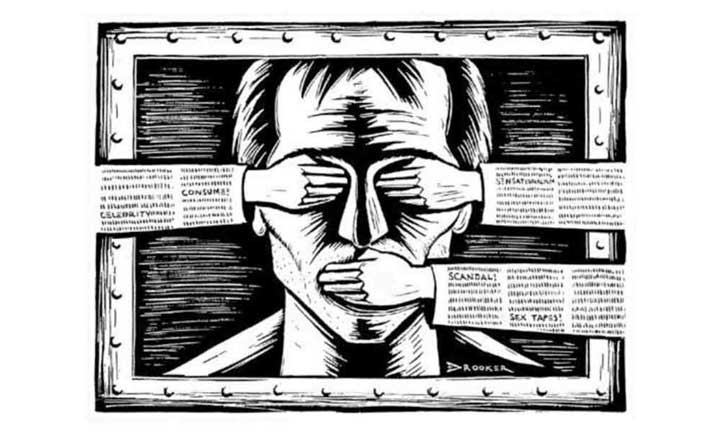
Indian media’s sellout on Kashmir

Recalling the stellar role of the Indian media during the infamous internal Emergency imposed by the late Indira Gandhi, Lal Krishna Advani, the BJP patriarch now forcibly retired, famously noted: “You were asked to bend but you began to crawl.”
Under Prime Minister Narendra Modi, well known for his love of the fourth estate right from his Gujarat days, the media seems to have gone a step further. It has not just begun crawling, it has firmly shut its mouth as well as eyes and ears on most issues.  Reading dutifully from the hymn sheet provided by powers that be, especially on issues that are ostensibly linked to the national interest, it has been acting as its master’s voice.
Look at the abject surrender of the fourth estate on the catastrophe that the BJP has inflicted on Kashmir.  The bulk of the media, save for a couple of shining exceptions, has chosen to turn its back on the epic tragedy of Kashmir and Kashmiris.  In fact, many journalists, especially those in the electronic media, have been falling over themselves to sing endless paeans to Modi and Amit Shah for their betrayal of the historic promises made by India’s founding fathers to Kashmir.  They see no irony how the world’s largest and much feted democracy has quietly and cravenly stolen the Kashmiri democracy and the fundamental rights of Kashmiri people.
It’s been nearly a month since the BJP’s power grab in the Himalayan paradise and people still remain locked down and prisoners in their homes. Essential services such as transport, hospitals and communication remain frozen, leading to many avoidable tragedies.  More than 200 newspapers and other publications published from the state, some of the most independent in the country, remain suspended.  This is perhaps the world’s first and all-pervasive blackout of its kind that the entire population of an entire state has been imprisoned for so long. Israel would be proud.
Instead of protesting this unprecedented communication blackout and standing with the media fraternity in Kashmir, the Press Council of India in its wisdom has chosen to lend its support to the government.
At a time when much of the world media has been focused on Kashmir reporting in great detail how the BJP has turned the Muslim majority state into a colony at gun point, the media watchdog has opted to justify the most repressive crackdown on the Press freedom and Kashmiri civil liberties.
Shocking as this sell-out by the media watchdog is, it is hardly surprising.  This is how most venerable institutions in the blessed democracy have been surrendering their independence to the power of an intrusive and manipulative government.
That much of the media has turned rotten is hardly a secret. Anyone who regularly watches television news or reads newspaper wouldn’t be unfamiliar with all the hate, bigotry and intolerance openly peddled by the leading players in the name of journalism and debate.
Not a day passes without leading lights of the English, Hindi or regional media raking up some issue or the other to foment sectarian hatred and strife. If it is not the wicked Pakistanis and their mischievous support for the Kashmiri militants, then it is the Indian Muslims who find themselves in the dock for some imagined sin or the other.
Summoning some moth-eaten ‘experts’, perpetually ranting former military types and a poor ‘maulvi’ who can barely articulate, they hold a kangaroo court every night whose outcomes are all too well known.
In mature democracies, the media is known to deal with minorities with sensitivity. The fourth estate, like the judiciary, stands with the underdog. It’s only in India that minorities, especially Muslims, are the most tempting target for everyone.
From portraying the voiceless minority that has all but disappeared from all spheres of national activity as a dead weight to demonising them as terrorists and criminals, the media’s favourite pastime is to prey on Muslims.
The same media, on the other hand, hasn’t just failed to confront the majoritarian fascism and its horrific crimes against minorities, it has been openly pushing its dangerous agenda.
Sometime ago an expose by Cobrapost, known for its investigations, revealed that almost everyone in the media is willing and ready to push a particular agenda for a price.
As part of his investigation, journalist Pushp Sharma, presenting himself as a representative of a Hindutva outfit, met management of more than two dozen media entities, seeking to influence their editorial agenda. He found out that the media is ready to shed its objectivity to “influence India’s electoral process through undesirable means.”
Sharma offered to pay anything between Rs 6 crore ($922, 800) and Rs 50 crore ($7,690,000) if they agreed to provide a platform to his media campaign.
“The lure of lucre proved too irresistible for almost all media houses, be it print, electronic or digital, to say no. To the utter shock of the investigative journalist, most of them not only agreed to do what he asked for but also suggested myriad ways of undertaking a well-orchestrated, overtly communal media campaign on behalf of their prospective big-ticket client,” reported Cobrapost.
Some of the owners or important functionaries confessed that they were either already associated with the RSS or they were pro-Hindutva and would thus be happy to support the campaign, forgetting the cardinal principle of journalism: neutrality.
Some of them agreed to plant stories in favour of the party in power in their publications.Many of them agreed to develop and carry advertorials especially for this purpose. Some of them offered to do a complete media management to plant stories favouring the party in power in other publications.
In conclusion, Cobrapost notes: “Although one may argue that such violations are hypothetical, given Indian media’s penchant for twisting facts or serving pure rumours as news, especially during civil strife to foment communal sentiments, pleasing political masters of the day and tweaking news in favour of corporate interests, one can imagine how dangerous it is for Indian democracy. What our investigation shows is symptomatic of the malaise that has set deep in the labyrinths of the citadel called Fourth Estate. It also shows that Indian media is on sale, lock, stock and barrel!”
Having studied media and repeatedly written about its increasing saffronisation and total lack of objectivity, one couldn’t agree more.
This would be perhaps tolerable if the issue had only been about a negative portrayal of minorities and pushing a certain political line. What many leading voices of the media like Times Now, India Today and Republic TV, not to mention hundreds of regional publications and television networks, have been doing is often purvey hatred, intolerance and even violence based on fake news, rumours and prejudice. In their support for the Right and the ruling dispensation, most of them do not observe the basics of fair and balanced journalism.
Anchors like Arnab Goswami hold court every night dispensing summary, swift ‘justice’. It’s no coincidence that he and his kind are most unforgiving on opposition Congress and other opposition parties being almost reverential to Modi and other BJP bigwigs. But it all makes sense considering most of television channels and newspapers are owned by big corporates friendly with powers that be. As much as 80 percent of the media is owned by business groups like Reliance.
This is a disturbing state of affairs, to say the least. And this is not a problem of minorities or secular parties. The threat is to the Indian democracy itself. For a free, independent and objective press is essential to a healthy democracy. One cannot exist without the other.
Aijaz Zaka Syed is an award-winning journalist and former editor.