Showing posts with label James Petras. Show all posts

Tuesday, January 08, 2019

The New Year past and future

James Petras
They year 2018 ended with bitter partisan conflicts over narrow issues. Over seventy percent of the US federal budget was approved by both parties and another twenty-nine percent was delayed because of a conflict over ‘border security’ involving expenditures of less than one hundredth of one percent.
James Petras is a Bartle Professor (Emeritus) of Sociology at Binghamton University in New York, has more on this in an article titled The New Year past and future.
Multiple wars, coups, sanctions and trade disputes dominated the US political agenda. War budgets grew, military sales increased and frictions between the US and Saudi Arabia bubbled to the surface and dissipated.
We will proceed to provide a realistic assessment of the US in world politics during the past year, as a prelude to what we can expect in the coming year – 2019.
US policy followed along the lines of previous presidents and military advisers:  pursuing wars in Syria, Afghanistan, Iraq, Yemen and Somalia; adding military bases in Eastern Europe and the Baltics; promoting economic sanction against Iran, Russia, China and North Korea and adding minor ones against traditional allies in Europe and East Asia.
These measures did not radically alter trade relations even as divergences emerged between the President and his senior cabinet Generals, several of whom resigned. Resignations and dismissals in the executive branch reflected the division over President Trump’s military withdrawals from Syria and Afghanistan, his efforts to lower military costs and losses in regions of no profit or progress. Trump’s opponents objected to his alleged long-term commitments and efforts to finance economic spending and growth at home and abroad.
The Democratic Party pushed hard to increase or at least maintain a military presence and commitments and to engage in symbolic hostile gesture against Russia (Russophobia) and North Korea.
Shadow boxing highlighted internal partisan disagreements over immigration.  Trump promised a border wall, the Democrats a fence.  Both followed the same restrictive immigration policies and expelled millions of Central Americans and Mexicans, as did their predecessors.
Domestic policy, especially the major reduction of taxes for the very rich, was wholeheartedly backed by both parties. Despite their political propaganda divergences, the Democrats voted for the rich and denounced the Republicans.  The Republicans took credit for the tax ‘reform’ and credited it for ‘economic growth’.
Both parties and branches of government called for billion-dollar infrastructures funding and nothing was done. Both engaged in partisan ‘conflicts’ over healthcare and educational reforms but nothing was done.
The respectable press blamed President Trump for avoiding wars, colluding with Russia and threatening the global free-market economy, without recognizing the collaboration of the Democrats who engaged in their own version of global warfare.
In real terms, the two parties followed parallel policies at home and abroad, while engaging in harsh rhetorical combat.
The key issue was the intense partisan warfare over which party could gain control of the seats of power, patronage and ‘rents’ from financial and real estate transactions.
Stock markets rose and fell but inequalities deepened, and debt multiplied, and the markets increasingly depended on state billion-dollar subsidies from national, regional and local governments.
Economic-strategies and policies will be at the forefront throughout 2019.  For the business elite the central issue in dispute will be the so-called ‘trade war’, which President Trump and his economic advisers are pursuing against China.
If the Trump administration secures concessions from President Xi Jinping, it will be confined to financial openings for US investors and a greater role for US exports.  The US will push a greater role for the Chinese private sector willing to share markets rather than State sector growth.
If the US demands wholesale dismantling of China’s state direction and regulation of the economy, then a trade war is inevitable. The results will disconnect the entire global economy and disrupt US business linkages.
The stock market will plunge, markets will become more volatile and the top 500 multi-nationals will disinvest and suffer deep losses which will ripple throughout the business sector.
The US is counting on several allies of dubious reliability.  A sector of the Chinese neo-liberal academic elite is leading the charge to marginalize the role of the state, reduce regulations and limit China’s large scale overseas projects. While influential in some policy sectors, the pro-US academics have yet to dictate policy to the Chinese Communist Party leaders. The US has attempted to create an anti-China alliance, with Asian and EU countries.  The problem is that the US protectionist trade policy is equally prejudicial to these would-be trade allies.
Without influential allies in and out of China, the US may attempt to deepen its domestic market and/or turn to increasing its military presence encircling China.  The problem, however, is that Washington under Trump is turning away from military intervention in the Middle East and South Asia and has turned toward a ‘business first’ agenda.
In any case the key to the advance or decline of the US economy in 2019 depends on the outcome of the trade war with China.
The second problematical area in 2019 is the political war between and within the Pentagon and President Trump’s security operatives. Trump’s business priorities and rapid-fire ousting of Generals promoting losing and costly wars – in Afghanistan, Syria and elsewhere – has provoked a formidable hostile coalition of Democrats controlling Congress, the majority of the Pentagon and their military allies in the mass media.
If Trump is able to shift from ‘military’ to ‘economic’ imperialism, he will be able to rebuild his domestic support and to finance popular multi-billion-dollar infrastructure projects. If Trump succumbs to the military metaphysics which is promoted by the liberal- neo-Conservative-Zionist coalition and falls prey to Middle East wars, Russophobia and China/North Korea war- baiting, the Trump business first coalition will divide and collapse.
The domestic economy is likely to end its growth and stagnate unless Trump can convince the business elite to invest in the domestic economy, including higher wages and social spending. A dubious proposition!
If Trump relies on the ‘invisible hand’ of the market his domestic protectionist market strategy will fail to sustain growth, regardless of the Federal Reserve’s monetary policy.
The Year 2019 will experience greater domestic conflicts over issues that intersect between trade and military wars.  The Party disputes will deepen and paralyze policy making. The inability to fashion bi-partisan economic alliances will continue, but party warfare will not prevent any changes in military and social budgets.  If the Democrats seize the initiative and impose their military agenda, we will witness the prolongation of regional wars and economic stagnation.
If Trump triumphs in imposing his economic agenda and reaches a strategic trade agreement with China, the economy will continue to grow but at a snail’s pace as the tax-handout stimulus will not raise investments as profits are pocketed. In sum, 2019 will be a year of great uncertainties in which the divisions between parties, over markets and militarism will deepen, and prevent any decisive shift in strategic policies.  Only a dramatic removal from power of the key political actors in both parties will shift the balance of power between the protagonists of multiple wars and their opposition in popular movements.

Wednesday, December 12, 2018

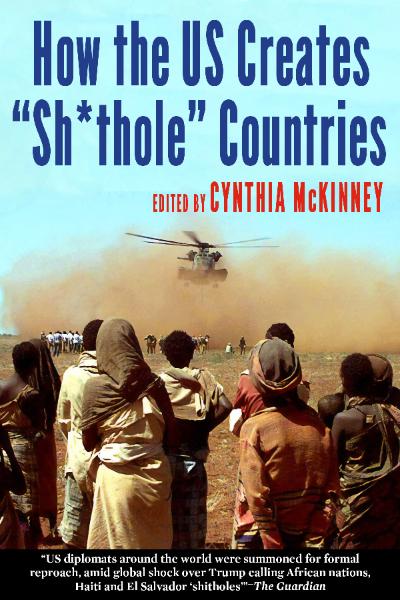
How the US Creates “Sh*thole” Countries

Whether you consider yourself already well educated on the U.S. empire or are looking for a starting place, “How the US Creates “Sh*thole” Countries” is a strong read. Cynthia McKinney has gathered together a series of essays examining features of the empire as well as a list of some the more seriously affected victims. The histories have been covered elsewhere, but the essays here provide new perspectives as well as refreshers as to what has occurred in many different parts of the world.
The book is divided into four parts. The first helps define some of the parameters around the overall concept of empire. The second and longest section provides the grist, histories of U.S. interventions and influences in all regions of the world, including its own colony of Puerto Rico. The manipulation by way of propaganda is the third section explored in three essays. Finally the U.S. is examined itself as an example of a “sh*thole” country.
Some highlights
I have no intention of repeating what the various authors have written but there are several quotes and essays I took note of as I read through that present the overall gist of the writings.
From the first section Wayne Madsen notes, a “high level Israeli intelligence penetration of the 2016 Donald Trump presidential campaign” in association with the UAE and “a murky Canadian company”. And you were worried about Russia? Following this The Saker is the only writer to comment on the U.S.’ direct financial interest in all recent actions as he wonders about the “new reality immediately raises the issue of what will back the US Dollar in the future since in this, US military power has played a significant role.” Finally there is blowback in the form of immigration as James Petras outlines how the immigrant ‘problems’ of both Europe and the U.S. stem from neocolonial wars in Africa/Greater Middle East and Latin America.
The second section takes the reader through what is for many a familiar landscape: Haiti, Afghanistan, Philippines, Vietnam, Palestine, Africa in general and Somalia, Rwanda and Congo in particular before sliding over to Latin America and events in El Salvador, Venezuela, and Puerto Rico.
I found the essays on Africa to be very strong with new material alongside old familiar information. Africa in general is a mess for many reasons, but all add up to some form of neocolonialism. Much has to do with multinational corporations, especially mining and oil companies, harvesting African wealth under the protection of private militaries and state militaries trained and guided by the U.S. The World Bank and the International Monetary Fund play a significant role by making loans countries are unable to finance and which are then held in financial captivity through various actions involved with their “structural adjustment programs.” Oil of course plays a large role, along with Chinese influences as seen with U.S. actions in Somalia and Sudan.
There are three essays relating to the Congo and its interactions vis a vis Rwanda. I have never fully understood that relationship, but the combination of these essays allowed my mind to sort out the pieces I knew about into a comprehensive and integrated whole. Essentially, it is the story of NGOs, private corporations, CIA/Mossad, covert militaries all part of western white control extracting Central African wealth with the help of their crony war lords in governance. The focus on Rwanda is revealing indicating through a recounting of the history, and an analysis of the propaganda machine that the west has produced a story pretty much backwards to the reality. For Central Africa “this is genocide [italics in original] against African people of diverse ethnicities, and it is genocide perpetrated by white power interests.” The footnote to this phrase reiterates, “There is a very clear political economy of genocide…at work here.”
In the section on propaganda, Christopher Black, an international Canadian criminal lawyer, argues that propaganda “is a war crime because the propaganda is used to provoke war, to sustain war, to turn other people, declared to be the enemy, into beings that need to be killed.” This is the history of U.S. imperialism in its shortest form, expressing the need to create an ‘other’, a person or group of people who are the enemy and can be killed without moral concern. Without the other – be it indigenous Indians, Spanish freedom fighters, Bolshevists, communists, terrorists, Muslims, and now focused on Russians in general and Putin, the penultimate U.S. bad guy in particular – without these ‘other’ to be condemned the U.S. war machine, the military-political-corporate-financial matrix would not be able to survive.
The last section looks at the U.S. itself as a “shthole” country and while it is not an incorrect perception, it is not nearly as hard hitting as it could be. On the other hand, after reading about how the U.S. interacts with all the other countries as presented earlier, perhaps there is not a need to do so – it is self evident simply from how they treat others and how the economy is structured to create “shtholes” at home or abroad. The final essay by Philip Alston outlines the U.S.’ domestic “sh*thole” qualities, all easily recognizable within the manner that corporations and politicians act at home for their own aggrandizement.
From Trump’s scatalogical mouth and mind the epithet “shtholes” is a reflection of how the U.S. operates overseas as well as domestically. Cynthia McKinney has gathered together a series of essays examining Trump’s scatology, himself the true representative of what underlies U.S. foreign policy without finesse or filter. “How the US Creates “Shthole” Countries” needs a place in everyone’s library in their anti-empire section.
Jim Miles is a Canadian educator and a regular contributor/columnist of opinion pieces and book reviews for The Palestine Chronicle. Miles’ work is also presented globally through other alternative websites and news publications.

Friday, November 23, 2018

Trump supports Saudi Arabia, most regressive regime in the world: Analyst


Saudi Arabia’s government is one of the greatest enemies of democracy and most violent regimes in the world but the administration of US President Donald Trump continues to support Riyadh, a US writer and academic says.
“The Saudis are one the most reactionary governments, most bellicose governments, most supporters of terrorism and the most regressive [regime],” said James Petras, a retired professor who has published on political issues with particular focus on Latin America, the Middle East and imperialism.
“Everyone realizes; in Europe, Asia, Latin America, Africa, and North America that Saudis are an enemy of Democratic people and is an enemy of anyone that believes in free speech and free discussion,” Petras told Press TV on Wednesday.
“Very few people, including Trump’s own party, endorse his actions and have great respect for the Saudis,” he added.
Trump praised Saudi Arabia on Tuesday for keeping oil prices low -- one strand of his argument against punishing Riyadh even though the CIA reportedly found strong evidence that Saudi Crown Prince Mohammed bin Salman, the de facto Saudi leader, was involved in the grisly killing of journalist Jamal Khashoggi.
Khashoggi, a US resident who wrote for The Washington Post and had been critical of Prince Mohammed, was lured to the Saudi consulate in Istanbul on October 2, killed and reportedly dismembered.
After lengthy denials, Saudi authorities admitted responsibility and said 21 people had been taken into custody. However, a CIA analysis leaked to the US media went further, reportedly pointing the finger at the crown prince.
But Trump, on holiday at his Florida Mar-a-Lago Club on Wednesday, doubled down on a statement from Tuesday that he was essentially ignoring the killing of Khashoggi because of what he said were more important US strategic and commercial interests.
"Oil prices getting lower. Great! Like a big Tax Cut for America and the World. Enjoy! $54, was just $82," he tweeted. "Thank you to Saudi Arabia, but let's go lower!"

Saturday, August 25, 2018

Ten Theses of American Empire-Building

By James Petras


Few, if any, believe what they hear and read from leaders and media publicists. Most people choose to ignore the cacophony of voices, vices and virtues.

This paper provides a set of theses which purports to lay-out the basis for a dialogue between and among those who choose to abstain from elections with the intent to engage them in political struggle.
Thesis 1

US empire builders of all colors and persuasion practice donkey tactics; waving the carrot and wielding the whip to move the target government on the chosen path.
In the same way, Washington offers dubious concessions and threatens reprisals, in order to move them into the imperial orbit.
Washington applied the tactic successfully in several recent encounters. In 2003 the US offered Libyan government of Muammar Gaddafi an accommodation in exchange for disarmament, abandonment of allies in Africa and Asia. In 2011, the US with its European allies applied the whip – bombed Libya, financed and armed retrograde tribal and terrorist forces, destroyed the infrastructure, murdered Gaddafi and uprooted millions of Africans and Libyans who fled to Europe. Washington recruited mercenaries for their subsequent war against Syria in order to destroy Bashar Assad. Washington did not succeed in establishing a puppet regime in the midst of perpetual war it launched and supported.
The empire’s carrot weakened its adversary, but the stick failed to recolonize Libya. Moreover, its European allies are obligated to pay the multi-billion Euro cost of absorbing millions of uprooted immigrants and the ensuing domestic political turmoil.
Thesis 2

Empire builders’ proposal to reconfigure the economy in order to regain imperial supremacy provokes domestic and overseas enemies. President Trump launched a global trade war, replaced political accommodation with economic sanctions against Russia and a domestic protectionist agenda and sharply reduced corporate taxes. He provoked a two-front conflict. Overseas, he provoked opposition from European allies and China, while facing perpetual harassment from domestic free market globalists and Russo-phobic political elites and ideologues.
Thesis 3

Leftists frequently reverse course: they are radicals out of office and reactionaries in government, eventually falling between both chairs. Shrewd but discredited elites frequently recognize the opportunism of the Left, and in time of distress, have no problem in temporarily putting up with Left rhetoric and reforms as long as their economic interests are not jeopardized. The elite know that the Left signal left and turn right.
Thesis 4

Elections, even ones won by progressives or leftists, frequently become springboards for imperial backed coups. Over the past decade newly elected presidents, who are not aligned with Washington, face congressional and/or judicial impeachment on spurious charges. The elections provide a veneer of legitimacy which a straight-out military-coup lacks.
In Brazil, Paraguay and Venezuela, ‘legislatures’ under US tutelage attempted to ouster popular President. They succeeded in the former and failed in the latter.
When electoral machinery fails, the judicial system intervenes to impose restraints on progressives, based on tortuous and convoluted interpretation of the law.
Thesis 5

Even crazy leaders speak truth to power. There is no question that President Trump suffers a serious mental disorder, with midnight outbursts. Yet in his lunacy, President Trump has denounced and exposed the repeated deceits and ongoing fabrications of the mass media. Never before has a President so forcefully identified the lies of the leading print and TV outlets. The NY Times, Washington Post, the Financial Times, NBC, CNN, ABC and CBS have been thoroughly discredited in the eyes of the larger public. They have lost legitimacy and trust.
Thesis 6

When a bark turns into a bite, Trump proves the homely truth that fear invites aggression. Trump has implemented or threatened severe sanctions against the EU, China, Iran, Russia, Venezuela, North Korea and any country that does not submit to his dictates. At first, it was bombast and bluster which secured concessions.
Concessions were interpreted as weakness and invited greater threats. Disunity of opponents encouraged imperial tacticians to divide and conquer. But by attacking all adversaries simultaneously he undermines that tactic. Threats everywhere limits choices to dangerous options at home and abroad.
Thesis 7

The master meddlers, of all times, into the politics of sovereign states are the Anglo-American empire builders. But what is most revealing is the current ploy of accusing the victims of the crimes that are committed against them. After the overthrow of the Soviet Union, the US and its European acolytes ‘meddled’ on a world-historic scale, pillaging over two trillion dollars of Soviet wealth.
With Russia’s revival under President Putin, Washington financed a large army of self-styled ‘non-governmental organizations’ (NGO) to organize electoral campaigns, recruited moguls in the mass media and instigated ethnic rebellions.
Moreover, the Israelis have perfected meddling on a grand scale – they intervene successfully in Congress, the White House and the Pentagon. They set the West Asia agenda, budget and priorities, and secure the biggest military handouts on a per-capita basis in US history! Apparently, some meddlers meddle by invitation and are paid to do it.
Thesis 8

Corruption is endemic in the US where it has legal status and where tens of millions of dollars change hands and buy Congress people, Presidents and judges.
In the US the buyers and brokers are called ‘lobbyists’ – everywhere else they are called fraudsters. Corruption greases the wheels of billion dollars military spending, technological subsidies, tax evading corporations and every facet of government – out in the open, all the time and place of the US regime.
Corruption as lobbying never evokes the least criticism from the mass media.
When corruption is punished in China, the US media claim it is merely a ‘political purge’ even if it directly reduces elite conspicuous consumption.
Thesis 9

Bread and circuses are integral parts of empire building – especially in promoting urban street mobs to overthrow independent and elected governments.
Imperial financed mobs – provided the cover for CIA backed coups in Iran (1954), Ukraine (2014), Brazil (1964), Venezuela (2003, 2014 and 2017), Argentina (1956), Nicaragua (2018), Syria (2011) and Libya (2011) among other places and other times.
Masses for empire draw paid and voluntary street fighters who serve the elite. The “mass cover” is especially effective in recruiting leftists who look to the street for opinion and ignore the suites which call the shots.
Thesis 10

The empire is like a three-legged stool it promotes genocide, to secure magnicide and to rule by homicide. Invasion kills millions, capture and kill rulers and then rule by homicide – police assassinating dissenting citizens.
The cases are readily available: Iraq and Libya come to mind. The US and its accomplices invaded, bombed and killed over a million Iraqis, captured and assassinated its leaders. A similar pattern occurred in Libya: the US and EU bombed, killed and uprooted several million people, assassinated Gadhafi and fomented a lawless terrorist war of clans, tribes and western puppets.
“Western values” reveal the inhumanity of empires built to murder “a la carte” – stripping the victim nations of their defenders, leaders and citizens.
The ten theses define the nature of 21st century imperialism – its continuities and novelties. The mass media systematically write and speak lies to power: their message is to disarm their adversaries and to arouse their patrons to continue to plunder the world.
You have just read excerpts of a feature authored by James Petras, a Research Associate of the Centre for Research on Globalization.