Iran's top diplomat has offered a preview of what he said would be President Hassan Rouhani's vision to ensure regional stability and to avoid a conflict with the United States and its allies, Newsweek reported.
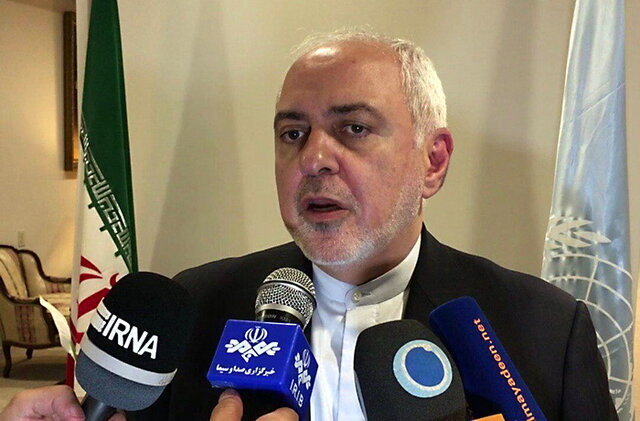
Speaking to a small group of journalists at Tehran's diplomatic mission to the United Nations in New York on Sunday, Iranian Foreign Minister Mohammad Javad Zarif presented his country's plan for what he termed a "coalition for hope," officially titled the "Hormuz Peace Endeavor". Rouhani had introduced the concept himself earlier in the day, with Zarif later elaborating on its potential scope and purpose.
"It's about freedom of navigation, it's about energy security, non-aggression, non-intrusion," Zarif said, adding that it was Iran's position that "the presence of foreign forces is not conducive to security" in the Persian Gulf, but keeping such forces out would not be a precondition for the coalition itself.
Among those invited would be "Iraq, the entirety of the GCC"—referring to the six-nation Gulf Cooperation Council, whose membership includes Iran's top rival Saudi Arabia—as well "Yemen, probably, and anyone who depends on the Strait of Hormuz," the world's most important maritime oil chokepoint. Zarif said Russia and China would be welcome too as Iran sought international support in countering a U.S.-led anti-Iran campaign.
Unrest has worsened in the Persian Gulf region since President Donald Trump's decision last year to abandon a 2015 nuclear deal with Iran that had significantly curbed the Islamic republic's nuclear activities in exchange for sanctions relief. The Trump administration has accused Tehran of using this money to expand its alleged support for militant groups and its missile development, though fellow signatories China, the European Union, France, Germany, Russia and the United Kingdom have continued to back the agreement.
To crack down on what it calls Iranian provocations in the region, the U.S. began calling for a maritime security initiative in June. So far, only Australia, Bahrain, the UK and, most recently, the United Arab Emirates have joined this coalition.
As the U.S. expanded its military presence in the Middle East and laid out increasingly strict sanctions against Iran in an effort to sever its international trade, unclaimed attacks hit oil tankers in the Gulf of Oman and Iran and the United Kingdom seized one another's commercial vessels. Iran's Adrian Darya 1—accused of trying to sell oil to Syria via the Strait of Gibraltar despite EU sanctions—was captured July 4 and has since been released. Iran in turn impounded the UK Stena Impero—accused of endangering maritime traffic in the Strait of Hormuz—on July 19. On Sunday the British ship was on track to be freed as well, according to a report in Iran's semi-official Fars News Agency.
Following its release from UK-controlled Gibraltar, the Adrian Darya 1 went on to sell oil in the Eastern Mediterranean, though Iran said it would not disclose the buyer's identity. "We're not going to be transparent," Zarif said Sunday. "Being transparent is equal to the U.S. going after our buyers."
Global attention again turned to the region as a fossil fuel hub following the September 14 attack on Saudi Arabia's Abqaiq and Khurais oil facilities.
The strikes disrupted the global energy market and, though they were claimed by Yemen's Ansar Allah, or Houthi, movement, the U.S. has laid the blame squarely on Iran. Zarif reiterated his government's dismissals of the "conspiracy theories" that Iran had any hand in the attack, which he said only hurt his country in the long run.
"If you want to talk about cost-benefit, a lot of other people gained," Zarif said, pointing specifically to Trump due to a potential surge in demand for U.S. weapons and oil after the attacks. "If we want to use conspiracy theories, the United States had the most interest in having this happen, and we had the least."
He did, however, credit Trump with showing "prudence" by not resorting to military action against Iran in response to recent events in the Middle East. "He knows that people are trying to drag him [into a war] on the accusation that Iran was involved in this attack. Believe me, the Saudis want to hear that. Had Iran been behind the attack, there would have been nothing left of that refinery and many others."
The Islamic republic planned to rebrand Sunday's date, September 22, nationally infamous as the date of an Iraqi invasion that launched a deadly war 39 years ago. Zarif tweeted earlier Sunday that it would be "a day of peace—not war," pointing towards Rouhani's declaration of a "coalition for hope" at a military parade in Tehran that same day.
Asked by Newsweek what would happen if Iran did not get the international support it sought for the proposed coalition, Zarif said "it's their loss." He also accused the U.S. of waging "economic terrorism" on Iran through sanctions that have increasingly affected everyday citizens and pointed specifically to Newsweek's coverage of Secretary of State Mike Pompeo's remarks regarding the use of economic restrictions in order to coerce the Iranian government into following U.S. policy if "they want their people to eat."
While the Pentagon has held off on directly blaming Iran for the attacks in Saudi Arabia, Pompeo has pointed to Tehran from the beginning.
Trump tightened sanctions again Friday in response to the strikes against the kingdom's oil sites. As a result of the latest, far-reaching round of restrictions, which included the blacklisting of Iran's central bank, Zarif said that "President Trump, knowingly or unknowingly, closed the door for negotiations" because such a designation would be harder for the president to reverse, even if he chose to.
While Zarif's primary goal was to prepare journalists for the so-called "coalition for hope" set to be expanded on by Rouhani at the United Nations General Assembly, the diplomat confided his skepticism as to whether Tehran and Washington could work toward bridging their growing gap in the coming days. Asked if he expected the U.S.-Iran relations to be in a better place following this week's annual international gathering, Zarif told Newsweek, "I doubt it."