To grasp the real meaning of the 12 December UK general election result is to understand the history of a state born in mercantilism and sustained by centuries of empire and colonialism.
Allow me to explain.
The United Kingdom of Great Britain and Northern Ireland, to give the UK its Sunday name, is the epitome of an artificial state. It was and remains the product of the grafting together of divergent cultures, histories and national identities. At inception, this grafting together was undertaken not in the interests of its peoples but in the interests of national elites eager to take advantage of the commercial opportunities of a unified polity with added manpower and resources in an age of empire.
The venality, greed and corruption of the Scottish ruling and political class in the late 17th- early 18th century delivered the Scottish people into the arms of the union with England without their support, establishing thereby the Kingdom of Great Britain. This was reflected in the social unrest and riots that ensued in Scottish towns and cities both during the negotiations that brought into being the 1707 Act of Union, and upon its passage.
For the ruling elites of both Scotland and England the union of both parliaments into one had demonstrable commercial and strategic benefits. The former had been left bankrupt after Scotland’s failed attempt at establishing its own overseas colony in Darien (modern day Panama in Central America) in the late 17th century. In order to forestall national immiseration the need to gain access to England’s overseas colonies was thereafter considered essential.
Meanwhile the English were eager to prevent the possibility of Scotland being used as a staging ground for an invasion from the north by the French in the context of the War of the Spanish Succession that raged between 1701 and 1714.
Wales, the third nation that makes up the UK, had already been merged with England in 1536. Ireland on the other hand was a subjugated English (latterly British) colony, and was officially brought into the orbit of what would then be known as the United Kingdom of Great Britain and Ireland in 1801.
In 1922, after a prolonged national liberation struggle in Ireland, the 26 counties that make up today’s Republic of Ireland achieved dominion status before winning full independence in 1948, while the remaining six counties that make up the the rest of the island of Ireland were partitioned to become what is now Northern Ireland: hence the United Kingdom of Great Britain and Northern Ireland of today.
This necessary historical detour out of the way, here is where things start to bear relevance to Brexit.
An unintended consequence of the Industrial Revolution, one that allowed Britain to go on and establish an empire whch at its height covered a quarter of the globe, was the forging of a united working class whose unity was able to transcend national, cultural and regional differences. This working class unity mirrored the unity of the UK’s ruling elites around the various semi-feudal institutions that underpin the British state — namely the monarchy, House of Lords, and a network of private schools that have reared and churned out succeeding generations of the country’s ruling class.
British working class unity, meanwhile, was the product of the country’s heavy industries — coal mining, steel, shipbuilding, etc. — and was expressed in common economic interests and struggles against a common enemy, the bosses and owners of those industries, in the context of the trade union movement. It also began to manifest politically with the formation of the Labour Party at the start of the 20th century.
In tandem, forged over time, was a British national identity that was nourished by the countless wars the state’s ruling elite unleashed and waged over the centuries of an empire that existed not to spread civilisation and modernity to the ‘dark peoples’ of the planet, as its proponents and apologists have always claimed, but as a juggernaut of exploitation, subjugation and oppression.
In those countless colonial wars working class men were used as cannon fodder in a dynamic that has continued to the present day.
Margaret Thatcher began the destruction of this material base of working class unity across the UK in the 1980s. Her free market revolution and its deindustrialisation of the nation’s economy turned Britain into what it is today — a service economy underpinned by financialised capital.
Today, now, in consequence, the country’s trade union movement, which once wielded considerable economic and political clout, is but a shadow of its former self . The Labour Party, meanwhile, struggled even under Corbyn’s leadership to make a full return to the party’s founding principles after Blair and his centrist crew in the 1990s and on into the first decade of the noughties had gutted them in favour of an embrace with the City of London and big business.
The remnants of this Blairite crew within Labour bear much responsibility for the party’s disastrous showing in the election, having acted as an anti-Corbyn fifth column, determined in alignment with the country’s Tory ruling media, political, and security establishment to prevent Corbyn entering Downing Street at all cost
In so doing, they have only succeeded in ensuring that the break-up of the UK is now well-nigh inevitable, what with the SNP receiving a thumping mandate in Scotland and nationalism in the North of Ireland now a majority political current over unionism. In poetic irony, it was only Corbyn’s socialist programme, offering economic and social transformation, massive investment in the deindustrialised Brexit regions of South Wales and the North and Midlands of England, as well as Scotland, that provided any hope of repairing the regional, national and cultural fault lines that correspond to the breakdown of the 2016 EU referendum vote.
The post-industrial North and Midlands of England, parts of the country virtually untouched by investment and left without hope after being decimated by Thatcher, voted overwhelmingly for Brexit in 2016 a veritable scream from the bowels of austerity Britain. Every one of Scotland’s 32 local authorities, meanwhile, voted to Remain.
Both did so again in the 2019 general election, with Corbyn’s message of social and economic justice failing to penetrate the fog of emotion, rooted not in class but national and cultural identity, surrounding the Brexit-Remain divide.
The result of the election, which Corbyn fought in the teeth of an unprecedented assault by the British ruling establishment, confirms that what was once the United Kingdom is now the dis-United Kingdom, with those previously mentioned national and regional differences informing its peoples’ identities and worldview over the identity of class to an extent previously unseen.
Karl Marx reminds us that: “To call upon people to give up their illusions about their condition, is to call upon them to give up a condition that requires illusions.”
The illusion that Brexit is actually relevant to the needs of those who’ve seen their lives devoured by the beast of neoliberalism and bludgeoned by austerity must soon give way to the unvarnished truth that the UK as we know it is past its sell-by date.
“A reactionary,” the great postwar Labour left icon Nye Bevan once said, “is a man walking backwards with his face to the future.” Surveying a political class presently engaged in ripping itself apart over Brexit, who could argue otherwise?
To mark the 250th anniversary since Captain James Cook invaded New Zealand, the British Ambassador Laura Clarke issued a private statement of “regret” to the indigenous groups, for the killing of Maori people upon landing.
“What we did today, really acknowledged, perhaps properly for the first time, that nine people and nine ancestors were killed in those first meetings between Captain Cook and New Zealand Maori, and that is not how any of us would have wanted those first encounters to have happened,” Clarke stated.
British colonialism, however, is replete with the genocide of indigenous populations to maintain the fabrication of terra nullis, or barren land, which justified and normalised colonial settlement. Cook’s first endeavours in New Zealand were followed by the systematic killing of the Aboriginal people in Tasmania and Australia. Clarke’s acknowledgement is nothing but a perfunctory statement which fails to even acknowledge indigenous collective memory.
The commemorations, which are state-funded and will be attended by New Zealand’s Prime Minister Jacinda Arden, included the welcoming of a replica of the HMS Endeavour which brought bloodshed to New Zealand. The government’s approach to the commemoration sparked protest among the Maori groups for keeping in line with the colonial narrative. Maori leaders have rallied against the colonial narratives of Cook “discovering” New Zealand, rightly describing the landing as an invasion and Cook as part of the imperialist expansion endeavours which massacred the indigenous populations.
Tuia – Encounters 250 describes the commemoration activities as “an opportunity to hold honest conversations about the past, the present and how we navigate our shared future.” Yet the marginalisation of Maori voices, including the New Zealand’s government’s refusal to engage with Maori protestors, are clear indication that the “shared future” rhetoric is being used to eliminate the importance of indigenous narratives and memory. One main objection was the use of “euphemisms like encounters and meetings to disguise what were actually invasions.”
The government spent $13.5 million promoting the colonial narrative and held little consultation with the Maoris regarding the planned events. New Zealand’s Ministry for Culture said the flotilla would only stop “where a welcome is clear”. This specification indicates the government’s knowledge of indigenous disapproval and opposition, as well as its failure to mark the 250th anniversary of the invasion from an indigenous perspective.
In this regard, the New Zealand government’s stance is closer to the British statement excusing the colonial crimes against the Maori.
To mark the 250th anniversary, New Zealand could have embarked upon a different path – one that creates space for indigenous narratives to thrive and take precedence. It could also have demanded that Britain acknowledges its colonial theft and violence, instead of forcing equivalence between the coloniser and the colonised.
Speaking at the UN earlier this year, indigenous rights activist Tima Ngata declared with reference to the invasion, “to call that an ‘encounter’ is egregious in the extreme and a complete purposeful minimisation.”
Giving in to the colonial narrative as the New Zealand government has done legitimises colonial conquest and the massacre of the indigenous, besides outlining a tacit complicity in ensuring that colonialism remains cloistered as a historical topic. The truth is that colonialism is preventing indigenous narratives from taking their rightful place. Hence the massacres are being purposely overlooked to maintain the fictional narratives of exploration and discovery.
Understanding the colonial project is not tantamount to endorsement. What the British Ambassador and the New Zealand Prime Minister have achieved as a prelude to the 250th anniversary is a dilution of indigenous rights, narratives and memory. Regret is not an acknowledgement of colonial violence, especially when it refuses to acknowledge the victims murdered by the British Empire. Likewise, the New Zealand’s government’s dismissal of the Maori as “groups of people who have strong feelings” and who are expected to participate in an event that prioritises the glorification of Cook’s invasion is an aberration. The obligation, in New Zealand and elsewhere, is to discredit colonial ‘regret’.
Ramona WADI
Ramona Wadi is an independent researcher, freelance journalist, book reviewer and blogger. Her writing covers a range of themes in relation to Palestine, Chile and Latin America.
Resistance to colonial occupation is an inherent right of the occupied, including armed struggle, recognized in international law. Occupiers try to delegitimize resistance struggle by branding the resistors as “terrorists.” Often the oppressors are more successful because they have the propaganda tools denied to the occupied at their disposal.
The struggle of the African National Congress (ANC) against apartheid in South Africa illustrates this point clearly. A tiny minority of white Europeans oppressed the overwhelming majority of blacks. When the ANC launched its campaign to overthrow the racist apartheid system, it was branded a “terrorist” organization. Its leaders were arrested and suffered decades of imprisonment.
Nelson Mandela, later regarded as an icon of resistance and awarded the Nobel Peace Prize, was also declared a terrorist! Even when apartheid officially ended, he was on the list of persons banned from entry into the United States. The US State Department had to issue a waiver to allow him entry. This ludicrous ban was finally lifted in 2008.
There are other legitimate resistance movements that have been proscribed because they oppose the West or its favorite client regimes. Hizbullah in Lebanon and Hamas and Islamic Jihad in Palestine are all branded as “terrorist” organizations although they are liberation movements struggling to overthrow their Zionist occupiers. The Taliban in Afghanistan have been similarly branded although in recent years, the US has been forced to sit with them and negotiate (notwithstanding Trump’s Twitter tantrums that are seen by some observers as a hiccup). Resistance of the Kashmiris against Indian occupation has also been tarnished with the terrorist brush.
In all instances, the occupiers are aided and abetted in their vile propaganda by allies and major media outlets. It is interesting to note that when the Afghans were struggling against the Soviets, they were declared freedom fighters and welcomed to the White House. When they rose up to fight American occupiers, they became terrorists! So, from the West’s point of view, armed struggle per se is not the problem; the real issue is who is being resisted.
International humanitarian law drafted by Western regimes considers wars of liberation as legitimate forms of struggle. It was the victors of the Second World War that drafted laws through such instruments as Additional Protocol I to the Geneva Conventions of 1949. Liberation struggles were declared a protected and essential right of occupied people everywhere.
The time period is important. The war had left the colonial powers exhausted. They could no longer hold on to their colonial possessions in Asia and Africa. Thus it was convenient to declare national liberation movements as legitimate.
Once the West and its client regimes felt comfortable with the post-Second World War order, they began to flex their muscles against liberation movements. This was particularly pronounced in the case of resistance to the Zionist entity, a colonial beachhead in the heartland of Islam.
Since the UN Security Council is dominated by veto-wielding predatory powers, primarily the US, Britain, and France, nothing meaningful comes out of its deliberations. Hence, it is the United Nations General Assembly (UNGA) that acts as the collective conscience of the world. It has affirmed that human rights and dignity must be protected through self-determination and independence.
In 1974, when the Palestinian liberation struggle was its peak, resolution 3314 of the UNGA prohibited states from “any military occupation, however temporary.” It was aimed at the Zionist occupation of Palestinian lands.
The resolution not only went on to affirm the right “to self-determination, freedom and independence […] of peoples forcibly deprived of that right, […] particularly peoples under colonial and racist regimes or other forms of alien domination” but noted the right of the occupied people to “struggle… and to seek and receive support” in that effort.
While “armed struggle” was implied without spelling it out explicitly, colonial powers exploited this ambiguity and used it against the oppressed. They resorted to vile propaganda to delegitimize the right of indigenous peoples to overthrow their occupiers.
The occupied and their allies quickly realized the West’s hypocrisy and were determined to confront it. Unlike the Security Council, the General Assembly is an open forum where each country’s equal right is recognized. On December 3, 1982, the General Assembly passed resolution 37/43 removing any doubt about the lawful entitlement of occupied people to resist occupying forces by any and all lawful means. The resolution reaffirmed “the legitimacy of the struggle of peoples for independence, territorial integrity, national unity and liberation from colonial and foreign domination and foreign occupation by all available means, including armed struggle.”
This resolution entitles the Palestinians and Kashmiris to resist their occupiers by all means necessary. Despite the occupiers’ attempts to delegitimize their struggle, they have every right to wage armed struggle against their occupiers.
Considering the horrific tactics used by the Zionists in Palestine and Hindu fascists in Kashmir, it is all the more important that they are provided every kind of support to free themselves from the clutches of oppressors.
Zafar Bangash is Director of the Institute of Contemporary Islamic Thought (ICIT).
Deal a cover for accelerating Greater Israel colonial expansion
Kevin Barrett
Deal of the Century is a 1983 Hollywood comedy about crooked arms dealers conspiring to peddle new weapons that “allow for localized and conventional wars that will keep (the global arms industry’s) business viable into the next century.” Thirty-five years later, a non-fictional crooked businessman, Jared Kushner, has borrowed the title for his so-called Middle East peace plan. Is this some kind of sick joke? A bad Hollywood remake? Have Kushner and his accomplices, Jason Greenblatt and David Friedman, chosen this title for their so-called peace plan as a snarky acknowledgment that its real purpose is to keep the Zionist war on the Muslim East viable into the next century?
Kushner’s alleged peace plan was obviously set up to fail. It does not offer the bare minimum acceptable to Palestinians: a genuinely sovereign Palestine including all territories stolen by Israel in 1967, with its capital al-Quds, alongside an Israeli acknowledgment of the internationally-recognized Palestinian right of return and a plan — however gradual — for its implementation. Anything less is a non-starter.
Kushner’s plan does not just offer a little less than the above, nor even a lot less. It is a joke. According to Arab officials briefed on the plan, the Zionists would keep and expand their colonies on territories stolen in 1967. They would take all of al-Quds, leaving a few Palestinian neighborhoods on the outskirts. There would be no sovereign Palestinian state. Instead, the Palestinians would be herded into a slightly-expanded Gaza open-air concentration camp including a small portion of the adjacent Egyptian desert that would remain under Egyptian, not Palestinian, control. The resulting constellation of Bantustans would be labeled “New Palestine,” and its residents would have no sovereignty. Instead, they would actually pay their Israeli prison wardens for “protection.”
The “deal” amounts to the liquidation of Palestine and the complete genocide of the Palestinian people. Clearly Kushner’s radical Zionist advisors, Jason Greenblatt and David Friedman, know that their plan is not only unviable, but an insult to every Palestinian. The only thing it offers is money — as if the Palestinians, who have fought and sacrificed bravely for their cause for more than a century (losing tens of thousands of martyrs in the process) are willing to prostitute themselves in return for something even worse than humiliating surrender.
Clearly this grossly insulting proposal was designed to be rejected. Its real purpose is to unleash a new round of war justified by the public relations slogan, “We offered the Palestinians a very good deal, so good we called it ‘the deal of the century,’ but those ungrateful Palestinians wouldn’t accept it.” This is precisely what the Zionists have done in the past, notably after the 2000 Camp David Summit, during which they intentionally presented non-viable proposals in order to obtain a Palestinian rejection that would provide PR cover to go ahead with their 9/11 false flag, ruthlessly attempt to crush the Palestinian resistance, and trick the US into invading and destabilizing regional states that the Zionists consider enemies. All of this was in line with the Zionist strategy laid out in the 1996 Netanyahu-commissioned Clean Break document authored by neocons led by 9/11 suspect Richard Perle — roughly the same group that authored the September 2001 blueprint for 9/11 “Rebuilding America’s Defenses” that openly called for the coming “New Pearl Harbor.”
Since the Kushner-Greenblatt-Friedman “peace plan” is really a war plan, any geopolitical analysis of its ramifications must analyze the conflict(s) that will accelerate once the plan is officially rolled out and rejected. Those conflicts will presumably be continuations of the ongoing, long-standing conflicts in the region.
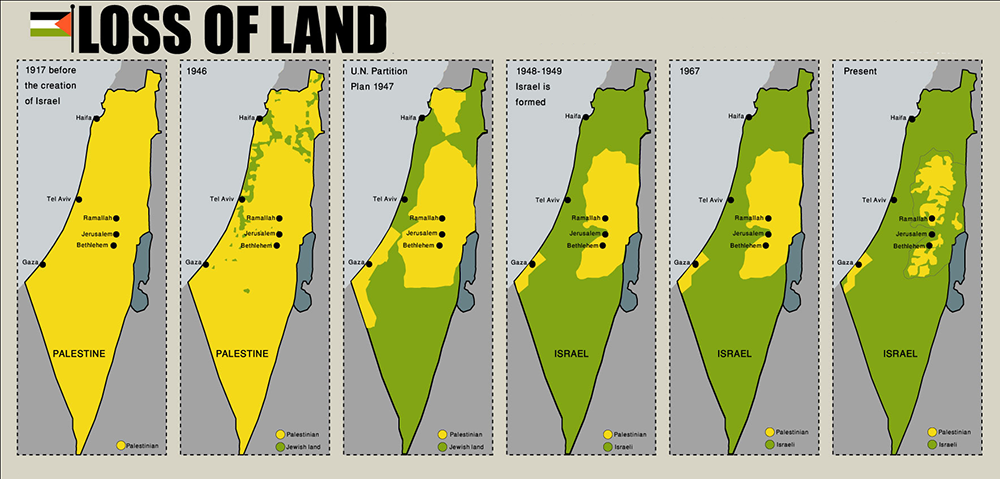
A map representing the creeping confiscation of the Holy Land by Zionist/imperialist/colonialist invaders and squatters over the last 100 years. The Deal of the Century would basically take whatever is left of historic Palestine as well as the Golan Heights and hand it over to the Zionists, and the Palestinians would be “transferred” — in the same way they were forced to in 1947 — to neighboring Jordan (mostly), Lebanon, Syria, and Egypt. In return for capitulating to this deal, the Palestinians would get nothing (actually less than nothing because they would not only lose their land, but the right of return would just be a pipe dream), but the surrounding Arabian potentates (read that Jordan and Egypt) would get a commission in the form of having their foreign debt retired for selling the Holy Land and selling out the Palestinians.
Insofar as short- and medium-term impact is concerned, the Israeli government, dominated by ever-more-extreme right-wing hardliners, will intensify its program of confiscatory appropriation of land and ethnic cleansing. The Palestinians will be left with no choice but to continue their resistance, through peaceful demonstrations and rallies, the global BDS movement, and greater or lesser degrees of military resistance depending on their capabilities and strategic opportunities. The good news for Palestinians is that the shockingly insulting nature of Kushner’s Deal offers an opportunity to unify their ranks, ending or moderating the schism between the Palestinian Authority and the genuine resistance organizations including Hamas and Islamic Jihad. Ramzy Baroud suggests that newfound Palestinian unity around the rejection of Kushner’s “deal” could lead to reconciliation between Hamas and non-corrupt elements of Fatah, followed by the resurrection of the Palestine Liberation Organization (PLO). Baroud writes that “the steps taken by Washington to isolate the PA through denying Palestinians urgently needed funds, revoking the PLO’s diplomatic status in Washington and shunning the PA as a political ally provide the opportunity to open the necessary political dialogue that could finally accomplish a serious Fatah-Hamas reconciliation. Israel, too, by withholding tax money collected on behalf of the PA, has lost its last pressure card against Mahmoud Abbas and his government in Ramallah. At this point, there is little else that the US and Israel could do to exert more pressure on the Palestinians.”
The US-Zionist loss of leverage offers the Palestinians real opportunities. The late Alan Hart, a former BBC Mideast correspondent and back-channel peace negotiator, argued for several years before his death in January 2018 that the Palestinians’ best strategy would be “dissolving the impotent and corrupt PA and handing back to Israel full and complete responsibility and accountability for occupation.” Such a move, Hart wrote, “would not only impose significant financial, security, and other burdens on Israel, it would enable global discussion and debate about the conflict to be focused without distraction on the occupation and the need for it… to be ended.” This is essentially what Baroud is advocating in his recommendation that a unified PLO be revived. And now that the US is no longer bribing the PA to do Israel’s dirty work, such a scenario seems eminently feasible.
If the PA were dissolved, and Palestinians were to form a united resistance front, the resulting stand-off would cry out for arbitration — but not by the usual (American) suspects. All past “peace processes” have been abysmal failures for one overriding reason: Zionists dominate US media, finance, and politics, so Washington cannot be a reasonably neutral arbiter. Instead, it acts as an appendage of Zionism. Effective arbiters and negotiations-facilitators would have to represent entities that accept the broad international consensus as reflected in 70 years of UN resolutions. The United Nations General Assembly itself, or possibly a coalition of relatively independent nations, could be far more effective peace brokers than the Americans have ever been.
Along with unifying the Palestinians, Kushner’s “Fiasco of the Century” might also have the beneficial effect of unifying the relatively reasonable forces in the region in opposition to the plan, and in support of a newly united PLO presiding over the dissolution of the PA and demanding that the Zionists fulfill their obligations under international law. A broad coalition of nations in the Muslim East, led by the Axis of Resistance consisting of Iran, Syria, Lebanon, Iraq, and Yemen, but also extending to such non-Axis members as Turkey, Qatar, and indeed any other regional state that can afford to forego Saudi bribes, will line up against Kushner’s ludicrous Deal. In the end, the Saudis and their evil twins the Emiratis will be left holding their bag of bribes that nobody wants.
The failure of the Deal could accelerate a regional realignment that has been developing during the drawdown of the war on Syria. Turkey and Qatar, both of which had originally been enthusiastic participants in the war on Syria, have been forced to rethink their priorities and strategies due to the triumph of the Syrian anti-regime-change struggle. Both countries will undoubtedly join the Axis of Resistance in heaping scorn on the Deal and supporting Palestinian rejection of it.
Egypt is something of a wild card. Though General ‘Abd al-Fattah al-Sisi was never an enthusiastic participant in the war on Syria, he has made many concessions to the Saudis and Zionists, and indeed has appeared as a Zionist puppet in many respects. But when he sees which way the wind is blowing, al-Sisi may be forced to distance himself from the Zionists and Saudis in the wake of the inevitable implosion of the Deal (together with Jordan and Morocco, Egypt had announced that it would go to Bahrain before the conference was postponed because of the political crisis in Israel over Netanyahu’s failure to cobble together a government).
Beneath the temporary alliances and re-alliances of geopolitics, there are important underlying material and ideological forces driving the long-term strategies of the oppressors and future liberators of Palestine. The first and most obvious is what Spengler aptly termed The Decline of the West. The past four centuries of Western post-Christian global dominance are ending, as demographic, economic, and technological changes shift the balance of global population and power to the south and east. In 2010 the US constituted a full 25% of global GDP. By 2050 that share is projected to fall below 10%. The EU will decline almost as much, from 23% to 12%. Similar declines will affect the rest of the Western world (Canada, Australia, New Zealand). The net result is that the West will decline from its 2010 status constituting well over half of the world economy, to a much more modest share of less than one-quarter of the global total.
Western decline is auspicious for Palestine, because Zionism is a purely Western project. It is the most extreme, audacious, and tenacious manifestation of Western imperialism and colonialism. So as the West declines in wealth, power, and influence, and the formerly colonized nations of the South and East rise to parity with their former masters, the Zionist project will inevitably approach its expiration date. The Zionists, of course, know this full well. They may be evil, arrogant, and shortsighted, but they are not stupid. So they are working to partner with such rising eastern (and non-Muslim) states as Russia, China, and India, and to promote Islamophobia in those and other countries in service to their fabricated “clash of civilizations” agenda (inciting global Islamophobia in service to Zionism was the long-term strategic purpose of the 9/11 false-flag operation). So the Zionists have long been planning for the difficult day when their American stooges stop propping them up. On that day, coalitions of other nations will become more important than the unipolar USA in brokering the conflict in Colonized Palestine. With the epochal failure of Kushner’s stillborn Deal, that day may arrive sooner rather than later.
The West’s ongoing decline is inseparable from a global ideological crisis consisting of the collapse of post-Christian humanism and its great narrative of universal liberation through material progress. Communism, the most radical branch of post-Christian humanism, imploded in 1989 with the fall of the Berlin Wall. Its replacement, neoliberalism, no longer commands much loyalty; its failures are evidenced by the accelerating gap between rich and poor, and by renewed interest in reactionary ideologies including various conservatisms, fascisms, and tribal petits récits. The only universalist ideology that seems poised to offer a viable alternative to post-Christian humanism is the religion of Islam, whose destiny is inseparable from the destiny of Palestine.
So the ideological lines are being drawn for the next, global phase of the struggle for Palestine. On one side, the side of truth and justice, are the universalists whose universal ethics (such as abstract truth and justice) apply equally to everyone everywhere. Some of these universalists still think of themselves as secular humanists. The great ex-Israeli, ex-Jewish musician and philosopher Gilad Atzmon offers a notable example of rigorous universalist humanism in action. But since hegemonic post-Christian secular humanism overall is in decline, while Islam is undergoing both a demographic expansion and an intellectual and spiritual awakening, a growing share of the principled anti-Zionist movement will be Islamic in orientation. This Islamic movement for the liberation of Palestine, exemplified by Imam Khomeini’s proclamation of Quds Day, will grow increasingly important.
From left, “honest brokers” Jason Greenblatt, Jared Kushner, and David Friedman receive the Friends of Zion Award from Dr. Mike Evans, right, founder of the Friends of Zion Heritage Center for their role in facilitating the transfer of the US embassy from Tel Aviv to Jerusalem, 5-14-2018. After his recent meeting with MbS, Evans was gushing that the Gulf Arabian monarchs are more ardent supporters of Israel than most Jews — what he deemed surprising. Evans also indicated that MbS informed him he was raised by a house director (glorified maid employed by his father) who was an Ethiopian evangelical Jewess; and in response to being queried about what the Palestinians should do, he said, “copy Israel.”
The Zionists understand that what they are doing flies in the face of universal morality and ethics; it can only be justified by invoking doctrines of racial superiority, tribalism, and what Gilad Atzmon calls chosenness. They understand that anyone who espouses universal morality and ethics, and applies that perspective to Palestine, will eventually become an enemy of Zionism. So the Zionists have determined that at the end of the day, liberal humanists and Muslims — in other words, universalists — will generally be their enemies, whereas those who reject universal morality and ethics — meaning those tribalists and nationalists who act purely out of self-interest — can potentially be coopted into supporting Zionism. Acting on the basis of this understanding, the Zionists have taken the counterintuitive step of supporting movements that The Saker characterizes as “national Zionism,” even though many of these movements are neo-fascist and actually or potentially “anti-Semitic.”
Clearly the Zionists are planning ahead for the coming multipolar world. That world will be characterized by proliferating nationalisms, shifting coalitions of nations banding together temporarily based on self-interest rather than ideological affiliation, and a contest between universalist Islam and particularist nationalisms for the hearts and minds of global citizens, including those in the Muslim-majority countries. By demonizing Islam and holding it up as a scapegoat against which nationalistic Hindus, Chinese, Russians, Burmese, and of course Westerners can seek to unify their populations, the Zionists hope to keep their dagger plunged deep in the heart of the Muslim East.
The Muslim counter-strategy will have to perform a delicate balancing act between appealing to specifically Islamic unity on the one hand, and universal values on the other. The resolution of this apparent paradox is to recognize that Islam is the world’s final authentic divine revelation, making it the ultimate repository of universal values. As the false, pseudo-universalist values of Western secular materialist progressivist humanism recede, Islam will be poised to fill the void. But only a sophisticated understanding of Islam, as opposed to the rigid and obscurantist readings that some Islamic movements have embraced, will be capable of uniting a critical mass of humanity.
The biggest failing of Islamic movements and other modern liberation movements in the Muslim East has been their inability to forge effective alliances across communal and ideological boundaries. This problem has been most obvious among Salafis and other self-styled Sunni political movements including the Muslim Brotherhood. But the conflict bet-ween particular interpretations and practices and universalist Islamic aspirations has not been limited to particular groups; instead it has been ubiquitous throughout the Muslim-majority world.
If Makkah that houses the Ka‘bah, the first House of Allah on earth and the original qiblah of Islam, symbolizes Islam’s status as a particular and culminating din among other dins, Jerusalem al-Quds, the ancient qiblah, symbolizes universalist “islam with a lowercase i” and the universal submission to God it embodies. The Isra’ and Mi‘raj of the Prophet Muhammad (pbuh), culminated with the Prophet ascending from Jerusalem al-Quds into God’s presence by way of meetings with previous prophets including Moses and Jesus (Å). Islam’s universalist mission as a perfected din that must nonetheless protect and coexist with other faith communities, especially Christianity and Judaism, is still identified with the ancient qiblah, Jerusalem al-Quds. Ironically, that holy city is now colonized by arrogant usurpers who, believing themselves superior to others, have no interest in coexistence.
The Zionist colonization of Palestine is the product of the weaponized usury of the West’s dominant international banking cartel. Indeed, the Zionist entity was created by the Rothschild family and their associates (recall that the Balfour Declaration was addressed to Lord Rothschild, who brought the US into World War I to assure a British victory in exchange for Britain’s handing Palestine over to the usurers).
The Qur’an, for its part, declares war on usurers (2:279). Indeed, usurers are the only sinners against whom God and His Messenger (pbuh) have literally declared war! Therefore, the struggle to liberate Palestine is not just on behalf of those who have been driven out of their homes unjustly for saying “Our Lord is Allah” (22:40). Palestine is also the epicenter of the global struggle against usury, and should be understood as such by Muslims and others who recognize the rottenness and injustice of the usury-based private fractional-reserve system of currency creation.
Those nations that have freed themselves from the Western-based international banking cartel are in a better position to forthrightly and effectively support the Palestinian resistance. And since Zionist power ultimately depends on the vast fortunes of the bankers, and the media outlets and politicians those bankers are able to bribe and buy, the defeat of the banking cartel will bring about the defeat of the Zionists.
Since Muslims are required by their din to abjure usury and to support God and His Messenger’s war on usurers, it would be reasonable to assume that all Muslim-majority countries would do their utmost to exit the sphere of influence of the international banking cartel and to develop non-usurious currency systems. It would also be reasonable to assume that this struggle could and should become the centerpiece of the movement for Islamic unity. After all, the history of the European Union has demonstrated that even a cluster of perpetually warring nations with different languages and religions can unite in a common market and adopt a common currency. The Islamic world, with its common religion, common use of Arabic among intellectuals with aspirations to religious education, and common cultural values, should certainly be able to unite into a common market with a common gold-backed public currency system.
This prospect of Islamic economic unity around non-usury commodity currency is the ultimate nightmare of the Zionist banking czars who dominate the Western “New World Order.” A pan-Islamic commodity currency would allow an economically-unified Islamic Ummah to radically improve its position in the terms-of-trade struggle over energy and other resources. It would eventually provide the Ummah with the economic, technological, and military strength to defeat Zionism and also protect oppressed Muslim minorities in other regions as well.
Universal values of truth and justice, preserved and embodied in God’s final revelation to humanity, necessarily oppose the arrogance and cruelty of Zionism, and the mendacity and greed of the Zionist usurers. The implosion of the Zionists’ “Deal of the Century” will offer numerous opportunities to unite and empower people who love truth and justice, not only in Palestine and the rest of the Muslim East but throughout the world.
“We must put an end to anything which brings about any Islamic unity between the sons of the Muslims. The situation now is that Turkey is dead and will never rise again, because we have destroyed its moral strength, the Caliphate and Islām.”
This bold statement, or rather stark warning, was allegedly made by the former British Foreign Secretary, Lord Curzon, at the House of Commons after the Lausanne Treaty of 1923, when the Ottomans were defeated in World War One. The reason why Lord Curzon’s alleged statement should be taken with so much weight is because it correlates with the following ḥadīth of Prophet Muḥammad (sall Allāhu ʿalayhi wa sallam):
“The knots of Islām will be undone one by one, each time a knot is undone the next one will be grasped, the first to be undone will be the ruling and the last will be the prayer.” [1]
Today marks 95 Gregorian years since the destruction of the Ottoman Caliphate, arguably, the darkest chapter in Islamic history after the death of Rasūl’Allāh (sall Allāhu ʿalayhi wa sallam). The Ummah continues to suffer from the after-effects of this calamitous event, for the very reason, which Lord Curzon mentioned – the Muslims currently have no collective “moral strength”, which is embodied in the form of an inclusive Islamic polity.
The Middle East and North Africa were subsequently carved up between Britain and France, as Mark Sykes and Francois Georges Picot planned the future of the former Ottoman territories with a pen and ruler. What has followed since was an uninterrupted chain of secular dictatorships and petrol rich sheikhdoms. Many of these regimes came to power via military coups, dressed up as pseudo-liberators, whilst the Gulf monarchies unashamedly enjoyed the fruits of their forefathers’ betrayal during WW1.
The Caliphate
The history lesson aside, the concept of the Caliphate, and the general Muslim populous’ desire for it, continues to be maligned by academics, journalists, Western policymakers and governments. Secular liberals and modernists, both Muslim and non-Muslim, from across the political spectrum, appear to have adopted the attitude of Lord Curzon, but with rehashed rhetoric that a Caliphate is simply incompatible with the modern world, rendering it barbaric and despotic. The irony is that they all seem to conveniently forget that for over a thousand years Islamic civilisation under successive Caliphates, from the Umayyads to the Ottomans, led humanity in science, philosophy, arts and technology. Furthermore, agenda-driven critics and muscular ideologues also overlook that not only did every Caliphate have the trappings of a modern state, but they were the beacon and example of modernity for their relevant period in history. Again, I cannot do justice in explaining Islām’s contribution to the world as we know it today, when libraries are filled with books and historical testimonies of non-Muslims who substantiate this undeniable fact.
However, it must be stated from the onset that the Caliphate is not regarded as a utopian state, conceptually or in practice. This was never the case when Prophet Muḥammad (sall Allāhu ʿalayhi wa sallam) ruled over Madīna, or when the Khulafāh Rāshidūn (Rightly Guided Caliphs) expanded the Caliphate, or those that came after. In fact, when the Caliphate entered hereditary rule and kingship, there were cases of internal corruption, theological deviation and infighting. Rather, this polity is what followed the end of Prophethood, and the practical manifestation of Allāh’s (subḥānahu wa taʿālā) divine law on Earth. This is evident in the following ḥadīth of Rasūl’Allāh (sall Allāhu ʿalayhi wa sallam):
“The Prophets used to manage the political affairs of Banī Isrāīl. Whenever a Prophet died another Prophet succeeded him, but there will be no Prophets after me; instead there will be Caliphs, and they will number many”. The Companions asked: what then do you order us? He (sall Allāhu ʿalayhi wa sallam) said: “fulfil allegiance to them one after the other. Give them their dues. Verily Allāh will ask them about what He entrusted them with”. [2]
The virtues and societal conditions sought from the Caliphate, deduced from the classical scholars after scrutinising the Sharīʿah, is to establish social justice, to protect the honour and property of its citizens, and the preservation of the Islamic way of life. Now this may be a sour grape for the intolerant ‘tolerant’ who stubbornly comprehends the Islamic governing system through the lenses of a secular paradigm, assuming that liberal democracy is the default benchmark against which every governing system should be compared to. But there is also a political context to this ideological objection of the Caliphate, and that is the conflation of Europe’s systematic separation of the ‘Church and State’. This period of secularisation, which is symbolised in the era known as the ‘Christian Reformation’ has never occurred in the Muslim world during the existence of a Caliphate, nor would it be befitting.
Islam and the West
Those that attempt to conflate Islām and western Christianity under the arbitrary term “religion” invariably superimpose the pre-reformation Christian historical baggage onto Islām. The fact of the matter is that Islamic history is not plagued with the same repressive church-like institutions that stifled human advancement, and the classical Islamic governance already secured the rights that the Enlightenment sought to secure, and more.
The notion of a Caliph is an employee that represents and is accountable to the people, and Islamic history shows a level of accountability that we still have not yet seen in Western politics. Despite this, there were attempts during the 19th century to minimise the legislative powers of the Caliph, and to modernise certain aspects of the declining Ottoman Caliphate, to make it more ‘palatable’ with its thriving European contemporaries; but the idea of a systematic separation of “religion and state” was unthinkable.
Additionally, Islām’s worldview that was represented by the Caliphate had always clashed with other empires it encountered; from the Persians, Byzantines, Mongols, Crusaders, right up to the colonial powers of Europe. Hence, after the destruction of the Caliphate on 3rd March 1924, Christian Europe had successfully eradicated the only superpower that it had been in a constant state of conflict with for nearly a millennium. Of course, Europe had suffered centuries of bloody internal wars, but the fight against the ‘Mohammedans’ was a unique one due to the cultural and religious dissimilarity.
After the downfall of the Soviet Union in 1989, Francis Fukuyama had arrogantly stated that humanity had reached the “end of history” – implying that liberal democracy was the only natural form of government to have survived the testing waves of global change.[3] Fukuyama was clearly naive in his assessment of the world, because he assumed that in the absence of the Caliphate, the Islamic mind would also be non-existent – he was grossly mistaken.
The 9/11 attacks, and the subsequent US-led ‘war on terror’ that followed is a testimony to this. After the invasion of Afghanistan and Iraq, and the rise of armed groups in Yemen, Somalia and Pakistan, it became unavoidably clear that the desire for the return of the Caliphate was very much existent.
The Arab Spring, or what remains of it, is another example of the Islamic sentiment of the general Muslim masses in wanting Islām to play a greater role in society. Tunisia, Egypt, Libya, Yemen, and more evidently in Syria, are prime examples of this. The revolutions which spread like wildfire in 2011 initially began as a grassroots movement, in order to attain self-determination in a region, which had been ruled by Western-backed dictators for decades.
Unfortunately, with the interference of Western powers and their regional proxies, the sincere efforts of those who lost their lives during the uprisings, had been sidelined and forgotten by political opportunists in search for power. Naturally, cosmetic changes were made to the ‘new’ post-Arab Spring countries, but in nearly every case, the oppressive regimes and state apparatus remained.
ISIS
The emergence of the group known as ISIS, which claimed to have restored the Caliphate on 29 June 2014, was a dream come true for the West. The former chief of the British Armed forces, Sir General Richard Dannatt, justified the occupation of Afghanistan, and Britain’s involvement in the war on terror by stating that it was to prevent:
“…the historic Islamic caliphate, running through south Asia, the Middle East, North Africa and up through south and south-east Europe.” [4]
Lo and behold, the West had at last found its medieval Caliphate in the form of ISIS, which in reality was a doctor’s sick note to continue its destructive foreign policy in the Middle East. The criminality of ISIS has been used as a stick by Western politicians to beat the Muslims with, and a tool to demonise the noble concept of the Caliphate. The media continues to refer to ISIS as an “Islamic State”, knowing that the majority of Muslims have unequivocally rejected their claim to the Caliphate.
The abhorrent actions of ISIS cannot be used to pressure Muslims into rejecting the concept of the Caliphate for two very simple reasons.
Firstly, there is a unanimous consensus amongst classical and contemporary scholars within Sunni Islām that the Caliphate is the ideal form of governance for Muslims, and to work for its re-establishment is an obligation. However, Muslims will inevitably differ in the methodology of how the Caliphate should be restored due to theological and political differences, but the scriptural evidences and scholarly works emphasising its importance is too overpowering.
Secondly, the fact that Rasūl’Allāh’s (sall Allāhu ʿalayhi wa sallam) burial was delayed until a Caliph was appointed could not have been a more significant indication of how serious the Companions (raḍiy Allāhu ʿanhu) took the matter of the Caliphate. The aforementioned reasons, coupled with the dire situation the Muslim world is currently in, as a result of seeking liberation by adopting failed secular ideologies, the only real option remaining for the Ummah is to return to a system which, for all its previous mistakes, protected Islām and safeguarded its citizens from harm.
Those who are adamant that the Caliphate is incompatible with the modern world, and to anticipate its return is a romanticised idea, need to appreciate from an Islamic perspective, that the Prophet Muḥammad (sall Allāhu ʿalayhi wa sallam) has prophesised its permanent return,[5] and Allāh (subḥānahu wa taʿālā) has promised the Muslims authority on Earth. [6]
I wrote on July 4 inThe Jewish Colonization of Palestine and the Recalcitrance of the Nativesthat United Nations General Assembly Resolution 181 of 1947 was the first official two-state proposal. Actually, a decade earlier, in 1937, Britain’s Peel Commission recommended the partition of Palestine into separate Jewish and Arab states. The commission’s report, and not Resolution 181, contained the first official two-state proposal. The Peel Commission plan was rejected by both sides, adumbrating the repudiation of Resolution 181 a decade later. A two-state proposal, then, has been around, in one form or another, for nearly 80 years, and in all those years, one side or both, has rejected it in practice, if not always in words.
Given the proposal’s uninspiring record of repeated repudiation, it beggars belief that two-state proponents should continue to think it has much of a chance of being accepted. The only conditions under which one can conceive of it being accepted by the Palestinians is if they become so ground down that they eventually capitulate and accept whatever crumbs are offered them; that is, if after decades as refugees, under Israeli military occupation, incarcerated in the open air prison of the Gaza Strip, or as third class Israeli citizens, they finally give up, and accept to live forever on their knees, though the chances of that happening seem vanishingly small. All the same, two-state proponents may welcome this unlikely outcome, and celebrate it, but what they would celebrate? Peace? Perhaps. But also the triumph of a grave injustice. And without justice, peace cannot last long.
The moral case against Jewish colonization of Palestine is formidable. The legitimacy of political authority is derived from the consent of the governed. Neither the British colonial authorities nor the Zionist state ever had the consent of the Palestinians. UN Resolution 181 (which is irrelevant anyway since it has never been implemented and was rejected by Jewish forces in 1947 and 1948 when they conquered territory beyond the limits the resolution proposed for a Jewish state) was rejected by the Palestinian majority whose lives would have been profoundly and unalterably affected by it.
As Tomis Kapitan pointed out (The Israeli-Palestine Conflict, 1997), the British had no right to give Palestine as a gift to anyone, and even if they did, London had pledged support for Arab independence throughout the Middle East to an established monarch (Sheriff Hussein of Mecca) before it issued the Balfour Declaration, whose pledge was made to an amorphous body, “the Jews”, lacking political form and juridical definition.
Moreover, Palestinians have a natural right to self government, independent of the promises, declarations, resolutions and preferences of the British, the United States, the United Nations, and the Diplomatic Quartet.
Hence, add to the moral concerns about the two-state proposal, the reality that its history shows it to have long been considered by one or both sides as undesirable, and the conclusion must be that it is untenable as a serious proposal, on moral grounds as well as on the practical grounds that its proponents quite mistakenly believe recommends it.
An alternative proposal that at least has the benefit of being just, morally defensible, and sensitive to the rights of indigenous people to self-determination, is a single, secular, democratic state, in which all citizens, Jews, Muslims, and Christians, are equal, and to which all Palestinian refugees are free to return.