Showing posts with label Bye-bye US empire. Show all posts

Saturday, February 02, 2019

US in Terminal Decline: An Overview

Attention to justice is the barometer for the rise and fall of civilizations
Kevin Barrett

Just a few decades ago, the US empire was riding high. After helping put the Soviet Empire out of its misery, Washington declared itself the “sole superpower” and “indispensable nation” possessed of a mysterious “exceptionalism” that allowed it to do whatever it wanted anywhere in the world. The self-styled unipolar hegemon set out to arbitrarily inflict its values, corporations, and military bases on the whole planet, irrespective of the wishes of the inflictees.
Today, events have spun out of Washington’s control. China is becoming the world’s leading economic and technological behemoth; military primacy will soon follow. Russia is deploying advanced weapons that can devastate US forces anywhere in the world, making a joke of US plans to achieve a nuclear first strike capability. Even Uncle Scam’s EU lapdogs are yapping noisily and inflicting a few bites on Uncle’s ankles — including efforts to defy Trump’s sanctions on Iran by chipping away at US dollar hegemony in international trade.
Muslim-majority countries are recovering from post-9/11 US-Zionist intimidation. Iran leads the way by continuing to tread an independent, Islamic path, remaining defiant even as Trump unleashes the furiously barking but toothless mad dogs Bolton and Pompeo. Syria has prevailed against the Empire’s regime-changers, and is joining Lebanon, Yemen, and perhaps even Iraq in an Axis of Resistance opposed to Zionism and imperialism. Turkey has defeated a US-backed coup attempt and asserted inklings of independence. Malaysia and Pakistan have elected leaders who support the global 9/11 truth movement and are generally skeptical of US and Western power. Even US-occupied Qatar, a tiny country that punches above its weight thanks to natural gas exports and its al-Jazeera media empire, has defied the Trump regime and gotten away with it.
Washington’s loss of global political power stems from a larger process of Western civilizational decline. One key metric is economic. The US-EU share of global GDP is projected to decline from nearly 60% in 2000 to less than 30% by 2050. Another metric is population. The US birth rate has dropped to 1.7 children per woman. In Europe it is at 1.6, while in the biggest and most economically vibrant European nation, Germany, it is less than 1.5. These are all far below replacement levels.
Why is the West, led by its American flagship, facing such steep political, economic, and demographic decline? One way to approach the question is through the two best-known theoreticians of civilizational decline, Ibn Khaldun and Oswald Spengler.
Ibn Khaldun, who is widely regarded as the world’s first social scientist, argued that “civilized people” (that is, wealthy urban dwellers) grow soft, self-centered, materialistic, and decadent. Non-urban folk, who are tougher and more willing to sacrifice self-interest in service to the bonds of ‘asabiyah (tribal loyalty, love of one’s own people) soon succeed in taking the cities from their decadent custodians. A few generations later, the cycle repeats.
Oswald Spengler, influenced by Ibn Khaldun, developed a theory of the fixed life cycle of discrete civilizations. Spengler applied to the rise and fall of civilizations something like the Qur’anic notion, “…kullunyajri li-ajalinmusamma: …everything runs for an appointed time [and meets its end]” (13:2), which in this ayah from Surah al-Ra‘d describes the course of the Sun and Moon, but also applies to all created things, including human lifespans and the lifespans of civilizations.
Both Ibn Khaldun and Spengler understood that a God-given spiritual essence, a sort of Platonic ideal beyond space and time, determines the material rises and falls of civilizations. In considering these matters, we follow the Qur’an’s advice to travel the world and contemplate what became of the vainglories of illustrious civilizations that have crumbled into ruins. Specifically, the Qur’an urges us to notice a moral and ethical factor, “Say, ‘Go all over the earth, and behold what happened in the end to those who gave the lie to the truth!’” (6:11); and, “Say, ‘Go all over the earth and behold what happened in the end to those lost in sin!’” (27:69).
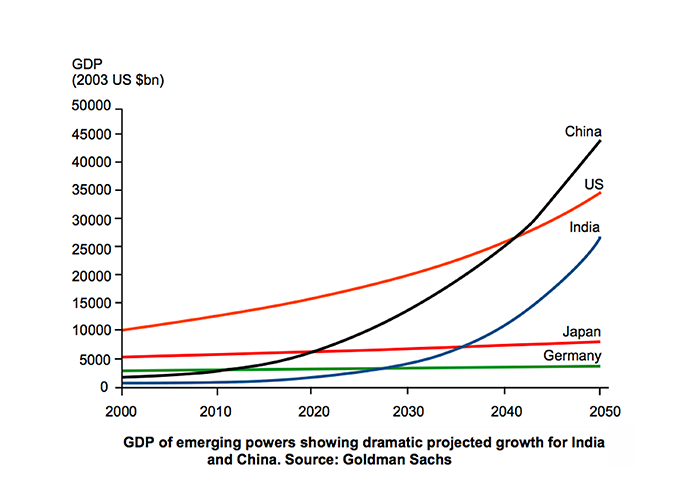
Although China’s purchasing power parity (PPP) is already higher than that of the United States, Goldman Sachs projects that China will overtake the US in total GDP by around 2040 and that India will almost be at parity with the US by 2050; other agencies suggest that China will surpass the US by 2020, and India by 2030. The picture for each country’s GDP as a percentage of the world economy is more eye-catching still. Here, the US drops consistently from now until 2050, while China and India rise inexorably. The average annual growth rate from now until 2050 is expected to be around 2.3% per annum for the US but 6.5% for China and as much as 6% for India. The economic future appears to be very bright in the east — the world is rapidly becoming ever more Asia-centric. On almost any projection, global growth will be concentrated in Asia over the next few decades. However, measured in per capita terms, it will not be until the middle of the century that Asian wealth per person approaches European and American levels.
If lies and sin are key factors causing once-illustrious civilizations to collapse into ruins, the West in general and the US in particular are in trouble. Let us begin by considering “those who give lie to the truth.” The respect for truth in the US and the West has declined precipitously. We may chart this decline across the past few centuries as the Enlightenment undermined belief in God and shifted attention toward a secular-materialist, rational-empirical notion of truth. While the pursuit of empirical truths about the dunya bore economic and technological fruit, this was only because it was driven by residual religious morality. Once morality had withered away, “truth” became an arbitrary function of power, as Foucault and the postmodernists realized.
The triumph of power over truth in the West was summarized by Bush advisor Karl Rove in the wake of 9/11, “We’re an empire now, and when we act, we create our own reality. And while you’re studying that reality — judiciously, as you will — we’ll act again, creating other new realities, which you can study too, and that’s how things will sort out. We’re history’s actors… and you, all of you, will be left to just study what we do.” But Rove’s arrogant boast got it precisely backward. It is the Empire’s lack of God-fearing respect for truth, its delusional belief that it can lie to the world and “create our own reality,” that will be its downfall.
The Qur’anic term that Muhammad Asad interprets in his translation, The Message of the Qur’an as “those lost in sin” is mujrimin, which might also be translated as criminals or evil-doers (to borrow a term from George W. Bush, who certainly fits the description). And just as the West is increasingly becoming the Empire of Lies, it is also falling ever deeper into sin, criminality, and depravity. And though the “crime problem” may be more evident in poor neighborhoods, it is the rulers who are the biggest criminals. The 2008 banking collapse, for example, was the product of systematic frauds that looted double-digit trillions of dollars from the public. Yet the bankers who carried out this, the world’s all-time biggest heist, have enjoyed absolute impunity. Not one of them has served a day in prison. On the contrary, they have been lavishly rewarded for their crimes with taxpayer-funded bailouts.
An even more disgusting example of the criminality of the Empire’s rulers is the case of Jeffrey Epstein, the Mossad pedophile pimp who apparently “owns” so many powerful Americans, including Donald Trump and Bill Clinton, after furnishing them with child sex slaves to get blackmail film. As the Miami Herald recently reported, Epstein debauched hundreds of underage girls, got caught, and was barely offered a wrist slap by then-District Attorney Alexander Acosta, who was rewarded for his part in the cover-up with his current job as Trump’s Secretary of Labor. Apparently the most powerful men in America have reason to fear Jeffrey Epstein.
One could go on at length with examples of how America is riddled with oppression and injustice, how its manners and morals have declined, how its values are evermore debased and vulgarly materialistic, and how it increasingly worships at the altar of sexual deviance. Anyone who has eyes to see and ears to hear, anyone who is not summun, bukmun, ‘umyun (deaf, dumb, and blind) and whose heart is not locked, sealed, or rusted must know this.
Where does it end? When does decline enter its catastrophic terminal phase and become out-and-out collapse? Only Allah (swt) knows but America’s has certainly begun.

Monday, December 03, 2018

G20 Summit, Top Agenda Item: Bye-Bye American Empire

G20 Summit, Top Agenda Item: Bye-Bye American Empire

The G20 summits are nominally about how the world’s biggest national economies can cooperate to boost global growth. This year’s gathering – more than ever – shows, however, that rivalry between the US and China is center stage.
Zeroing in further still, the rivalry is an expression of a washed-up American empire desperately trying to reclaim its former power. There is much sound, fury and pretense from the outgoing hegemon – the US – but the ineluctable reality is an empire whose halcyon days are a bygone era.
Ahead of the summit taking place this weekend in Argentina, the Trump administration has been issuing furious ultimatums to China to “change its behavior”. Washington is threatening an escalating trade war if Beijing does not conform to American demands over economic policies.
President Trump has taken long-simmering US complaints about China to boiling point, castigating Beijing for unfair trade, currency manipulation, and theft of intellectual property rights. China rejects this pejorative American characterization of its economic practices.
Nevertheless, if Beijing does not comply with US diktats then the Trump administration says it will slap increasing tariffs on Chinese exports.
The gravity of the situation was highlighted by the comments this week of China’s ambassador to the US, Cui Tiankai, who warned that the “lessons of history” show trade wars can lead to catastrophic shooting wars. He urged the Trump administration to be reasonable and to seek a negotiated settlement of disputes.
The problem is that Washington is demanding the impossible. It’s like as if the US wants China to turn the clock back to some imagined former era of robust American capitalism. But it is not in China’s power to do that. The global economy has shifted structurally away from US dominance. The wheels of production and growth are in China’s domain of Eurasia.
For decades, China functioned as a giant market for cheap production of basic consumer goods. Now under President Xi Jinping, the nation is moving to a new phase of development involving sophisticated technologies, high-quality manufacture, and investment.
It’s an economic evolution that the world has seen before, in Europe, the US and now Eurasia. In the decades after the Second World War, up to the 197os, it was US capitalism that was the undisputed world leader. Combined with its military power, the postwar global order was defined and shaped by Washington. Sometimes misleading called Pax Americana, there was nothing peaceful about the US-led global order. It was more often an order of relative stability purchased by massive acts of violence and repressive regimes under Washington’s tutelage.
In American mythology, it does not have an empire. The US was supposed to be different from the old European colonial powers, leading the rest of the world through its “exceptional” virtues of freedom, democracy and rule of law. In truth, US global dominance relied on the application of ruthless imperial power.
The curious thing about capitalism is it always outgrows its national base. Markets eventually become too small and the search for profits is insatiable. American capital soon found more lucrative opportunities in the emerging market of China. From the 1980s on, US corporations bailed out of America and set up shop in China, exploiting cheap labor and exporting their goods back to increasingly underemployed America consumers. The arrangement was propped up partly because of seemingly endless consumer debt.
That’s not the whole picture of course. China has innovated and developed independently from American capital. It is debatable whether China is an example of state-led capitalism or socialism. The Chinese authorities would claim to subscribe to the latter. In any case, China’s economic development has transformed the entire Eurasian hemisphere. Whether you like it or not, Beijing is the dynamo for the global economy. One indicator is how nations across Asia-Pacific are deferring to China for their future growth.
Washington likes to huff and puff about alleged Chinese expansionism “threatening” US allies in Asia-Pacific. But the reality is that Washington is living in the past of former glory. Trading blocs like the Asia-Pacific Economic Cooperation (APEC) realize their bread is buttered by China, no longer America. Washington’s rhetoric about “standing up to China” is just that – empty rhetoric. It doesn’t mean much to countries led by their interests of economic development and the benefits of Chinese investment.
One example is Taiwan. In contrast to Washington’s shibboleths about “free Taiwan”, more and more Asian countries are dialing down their bilateral links with Taiwan in deference to China’s position, which views the island as a renegade province. The US position is one of rhetoric, whereas the relations of other countries are based on material economic exigencies. And respecting Beijing’s sensibilities is for them a prudent option.
A recent report by the New York Times starkly illustrated the changing contours of the global economic order. It confirmed what many others have observed, that China is on the way to surpass the US as the world’s top economy. During the 1980s, some 75 per cent of China’s population were living in “extreme poverty”, according to the NY Times. Today, less than 1 per cent of the population is in that dire category. For the US, the trajectory has been in reverse with greater numbers of its people subject to deprivation.
China’s strategic economic plans – the One Belt One Road initiative – of integrating regional development under its leadership and finance have already created a world order analogous to what American capital achieved in the postwar decades.
American pundits and politicians like Vice President Mike Pence may disparage China’s economic policies as creating “debt traps” for other countries. But the reality is that other countries are gravitating to China’s dynamic leadership.
Arguably, Beijing’s vision for economic development is more enlightened and sustainable than what was provided by the Americans and Europeans before. The leitmotif for China, along with Russia, is very much one of multipolar development and mutual partnership. The global economy is not simply moving from one hegemon – the US – to another imperial taskmaster – China.
One thing seems inescapable. The days of American empire are over. Its capitalist vigor has dissipated decades ago. What the upheaval and rancor in relations between Washington and Beijing is all about is the American ruling class trying to recreate some fantasy of former vitality. Washington wants China to sacrifice its own development in order to somehow rejuvenate American society. It’s not going to happen.
That’s not to say that American society can never be rejuvenated. It could, as it could also in Europe. But that would entail a restructuring of the economic system involving democratic regeneration. The “good old days” of capitalism are gone. The American empire, as with the European empires, is obsolete.
That’s the unspoken Number One agenda item at the G20 summit. Bye-bye US empire.
What America needs to do is regenerate through a reinvented social economic order, one that is driven by democratic development and not the capitalist private profit of an elite few.
If not, the futile alternative is US failing political leaders trying to coerce China, and others, to pay for their future. That way leads to war.
Finian CUNNINGHAM
Former editor and writer for major news media organizations. He has written extensively on international affairs, with articles published in several languages