
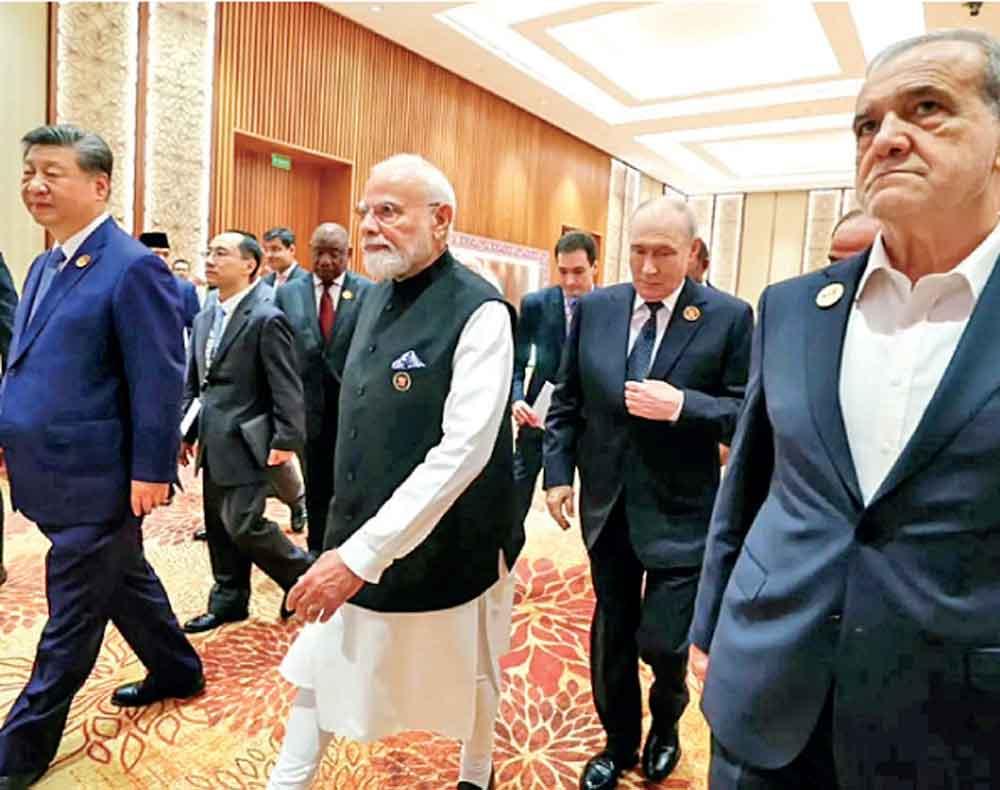
(Left to right) Chinese President Xi Jinping, Indian Prime Minister Narendra Modi, Russian President Vladimir Putin and Iranian President Masoud Pezeshkian during the 18th BRICS Summit in New Delhi. (Photo courtesy@narendramodi/IG via PTI Photo)
The 18th BRICS summit held at New Delhi on September 12–13 managed to resolve sharp internal contradictions and produced a joint declaration, which was the best that could be, given the complexities of international politics, individual members’ concerns and ambitions, and above all the need to keep the organisation together in the face of unprecedented challenges from the United States under the mercurial President Trump.
Gender and Country Inclusivity in UN, IMF and World Bank
The Delhi Declaration of 2026, (DD for short) was forthright in demanding much-needed changes in world governance. It called for gender and country inclusivity in all global decision-making bodies such as the UN, IMF and World Bank.
“We reiterate our commitment to ensuring greater and more meaningful participation and representation of Emerging Markets and Developing Countries (EMDCs), as well as Least Developed Countries (LDCs), especially from Africa, Asia and Latin America and the Caribbean, in global decision-making processes and structures and making them better attuned to contemporary realities,” the DD said.
It also called for achieving equitable geographical representation in the Secretariat of the UN and other international organisations in a timely manner, particularly by addressing the persistent under-representation of developing countries, including at senior and decision-making levels, as well as increasing the role and share of women, especially from the Emerging Markets and Developing Countries (EMDCs), at all levels of leadership.
Woman UN Sec-Gen.
Calling for the appointment of a woman as the UN Secretary-General, the declaration noted: “In light of the ongoing selection process of the next Secretary-General of the UN, and bearing in mind the relevant provisions of the UN Charter, we note that no woman has ever been elected for the role of Secretary-General, and only one national from Latin America and the Caribbean, and only two nationals from Africa and Asia each have ever occupied this position.”
The Delhi Declaration called for improved management procedures, including through a merit-based, inclusive and transparent selection process that would increase regional diversity and representation of EMDEs in the leadership of the IMF and the World Bank. It deplored attempts to unilaterally undermine the work of global multilateral institutions and impair the implementation of their respective mandates.
Against Discrimination, Intolerance and Hate
It reiterated the need to intensify the fight against racism, racial discrimination, xenophobia and related intolerance, as well as discrimination based on religion, faith or belief, and all their contemporary forms, including the alarming trends of rising hate speech, disinformation and misinformation. South Africa and Brazil have proposed to establish an international panel on inequality.
On the IMF, the summit reaffirmed the need for a strong, quota-based and adequately resourced IMF at the centre of the global financial safety net to effectively support its members, particularly the most vulnerable countries.
It also reaffirmed that the 2025 World Bank Shareholding Review is a critical tool to strengthen multilateralism and enhance the legitimacy of the World Bank Group.
WTO
The summit reaffirmed BRICS’ unwavering support for reform of the World Trade Organisation and for strengthening a non-discriminatory, open, equitable, transparent, fair, inclusive, predictable and rules-based multilateral trading system, with the WTO at its core, while upholding foundational principles such as Most-Favoured-Nation Treatment (MFNT) and Special and Differential Treatment for developing members, particularly LDCs. The summit acknowledged China for expanding its zero-tariff treatment to cover 53 African countries with which it has diplomatic ties.
Weaponisation of Tariffs and Trade
The summit noted that the multilateral trading system has long been at a crossroads. The proliferation of trade-restrictive actions inconsistent with WTO rules—whether indiscriminate rising of tariffs and non-tariff measures or protectionism under the guise of environmental objectives — threatens to further reduce global trade, disrupt supply chains and introduce uncertainty, potentially exacerbating economic disparities.
Unilateralism
The DD voiced serious concerns about the rise of unilateral tariff and non-tariff measures which distort trade and are inconsistent with WTO rules. The Summit pledged to work together to enhance the WTO’s responsiveness to the needs of emerging markets and developing economies.
Peaceful Resolution of Conflicts
The summit underscored that security among all countries is indivisible and reiterated BRICS’ commitment to the peaceful resolution of international disputes through dialogue, consultation and diplomacy. It encouraged the active role of regional organisations in conflict prevention and resolution, and highlighted the importance of preventive diplomacy and mediation, with the consent of relevant parties.
Middle East Crises
The summit expressed deep concern over the continued escalation of tensions in the Middle East/West Asia without naming specific countries or non-state actors. It called for maximum restraint and avoidance of actions that could further aggravate the situation, urging protection of civilians and civilian infrastructure in accordance with the UN Charter, including respect for sovereignty and territorial integrity.
It encouraged efforts through dialogue and diplomacy toward lasting peace, security and stability, and stressed the need to maintain smooth global trade, supply chains and energy flows in accordance with international law.
On Gaza and Palestinians’ Rights
On Gaza, it called for the implementation of relevant UNGA and UNSC resolutions and urged all parties to ensure maintenance of the ceasefire and full, unhindered humanitarian access. It expressed deep concern over continued violence in Gaza despite the October 2025 ceasefire agreement.
It reaffirmed that a just and lasting solution to the Israeli-Palestinian conflict can only be achieved by peaceful means and depends on fulfilment of the legitimate rights of the Palestinian people, including self-determination and return.
It affirmed the need for adequate representation of Palestine in relevant international organisations and reaffirmed support for the State of Palestine’s full membership in the UN as a sovereign, independent and viable State of Palestine within the 1967 borders, including the Gaza Strip and the West Bank, with East Jerusalem as its capital.
Though the DD used strong words on the West Asian crisis, it chose not to name Israel and the US as aggressors in order not to alienate them from the proposed negotiations. The other consideration was that host India has close relations with the US and Israel.
Terrorism
On terrorism, the summit expressed strong condemnation of any acts of terrorism as criminal and unjustifiable, regardless of motivation. “We condemn in the strongest terms the terrorist attack in Jammu and Kashmir on 22 April 2025, during which 26 people were killed and many more injured.
On corruption, the summit recognised progress under the BRICS Anti-Corruption Working Group in strengthening international cooperation on asset recovery and combating cross-border corruption.
On cross-border payments, the summit acknowledged efforts of the BRICS Payment Task Force toward exploring pragmatic solutions for efficient cross-border payment mechanisms. It welcomed discussions on promoting trade settlements and investments using BRICS local currencies, but he DD pragmatically did not push for aggressive de-dollarisation.
Greater Indian Role in UNSC
China and Russia, as permanent members of the UN Security Council, reiterated their support for the aspiration of Brazil and India to play a greater role in the UN, including its Security Council.
But the DD did not advocate permanent membership of the UNSC for India and Brazil, because the process involves amending the UN Charter which explicitly says that the US, UK, France and China will be the only permanent members in the UNSC with veto power.

No comments:
Post a Comment