
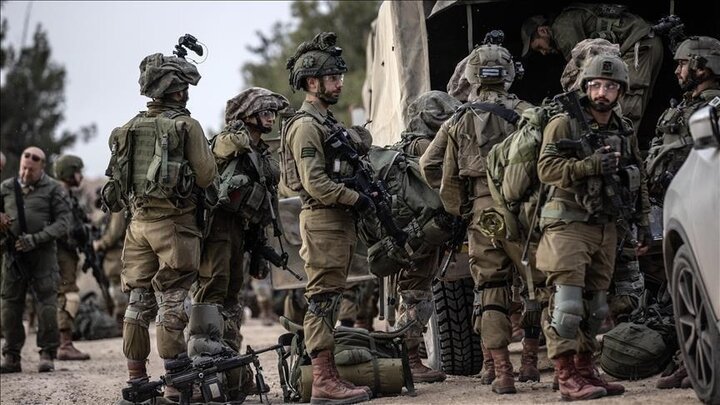
TEHRAN, (MNA) – Tel Aviv has entered extensive operations on several fronts, but the end of none of these conflicts has been able to create the security and stability that Israeli leaders promised.
In recent years, the Zionist regime has faced a fundamental contradiction more than ever before; on the one hand, it possesses one of the most powerful armies in the region and extensive American support, and on the other hand, it has faced serious difficulty in converting this military power into a lasting political and strategic achievement. Tel Aviv has entered extensive operations on several fronts, but the end of none of these conflicts has been able to create the security and stability that Israeli leaders promised.
This situation became more evident especially after October 7. The Hamas attack was not only a major security and intelligence failure for Israel, but also called into question the image that Tel Aviv had built of its ability to control the security environment around it. Israel subsequently launched extensive operations in Gaza, and despite the high volume of military operations, it has still not been able to turn the Gaza issue into a sustainable political solution. The persistence of the resistance issue and the inability to create a political order desired by Tel Aviv show that military power alone is not sufficient to resolve a complex crisis.
On the northern front, the conditions are not much different. Israel has tried for years to limit the Hezbollah threat and reduce the group's military capability, but developments in Lebanon have shown that such a threat cannot be permanently eliminated simply through military operations. Even if heavy blows are dealt to a group's infrastructure and command, political, social, and regional factors can still provide the ground for rebuilding its capability. For this reason, Israel has once again faced the same issue it faces in Gaza: the ability to inflict a blow is different from the ability to end a crisis.
The confrontation with Iran has also highlighted this same gap. In recent years, Israel has repeatedly tried to limit Iran's strategic capacities through military and security operations, but these measures have not been able to remove the Iran issue from the region's security equations. Even in circumstances where Tel Aviv can achieve part of its military objectives, changing the regional balance and creating a stable situation is a far more complex matter. In fact, the more the scope of the conflict expands, the clearer it becomes that there is a considerable gap between "striking" and "winning."
Israel's problem, of course, is not limited to the military battlefield. Prolonged wars, economic pressure, political disputes, and social divisions have also placed the Zionist society under pressure. Since the beginning of the recent crises, the Netanyahu cabinet has faced extensive political disputes, and the controversy over the government's performance, the conduct of the war, and responsibility for the October 7 security failure continues. This situation has weakened the image that Israel presented for years of a cohesive, stable society enjoying intelligence and security superiority.
On the international stage, too, the costs of Tel Aviv's policies have increased. Although Israel still enjoys considerable American support, the continuation of the conflicts and the rise in international criticism have raised the political cost of the regime's actions. The important point is that Israel needs not only military power to maintain its superiority; it also needs political legitimacy, foreign support, and the ability to manage its relations with allies. The prolongation of the wars has ultimately placed all three of these areas under pressure.
Under such circumstances, the remarks of Yuval Noah Harari, a Zionist author and historian, take on greater importance. In an article in the Yedioth Ahronoth newspaper, Harari held Benjamin Netanyahu's cabinet responsible for part of the recent failures and described the past four years as one of the most dangerous periods in the history of the Zionist regime. He stressed that the security institutions' warnings before October 7 about existing threats were ignored, and that the Netanyahu cabinet was preoccupied with its own domestic political priorities.
Harari went on to not only refer to the failure before October 7 but also criticized the way the war was managed afterward. From his perspective, Israel achieved successes in some military operations, but was unable to convert these successes into a lasting political and strategic achievement. He ultimately, using a very harsh expression, likened Israel's leadership situation to "lions led by donkeys."
The importance of these remarks lies in the fact that such criticism is no longer raised only by Israel's foreign opponents, but voices of criticism have also grown louder from within the regime's society and intellectual circles. In fact, the issue Harari refers to is not an individual weakness or merely a problem related to Netanyahu; rather, it is a larger question about the quality of strategic decision-making in Israel.
Israel today faces a serious contradiction: the regime's military capability remains high, but its ability to convert this power into a desired political order has declined. Tel Aviv can target facilities, infrastructure, and military objectives, but it cannot eliminate the roots of a political or security crisis simply through military operations. The experiences of Gaza, Lebanon, and the confrontation with Iran have each, in a different way, demonstrated this same reality.
From this perspective, Israel's failure should not be measured only by the number of operations or the amount of damage inflicted on the opposing side. The more important criterion is the extent to which Israel, after expending this volume of military and political resources, has moved closer to its strategic objectives. If the goal is to create lasting security, eliminate the main threats, prevent the expansion of regional rivals' influence, and preserve internal cohesion, the performance of recent years at least shows that Tel Aviv has still not achieved an important part of these objectives.
For this reason, Israel's current crisis is less a crisis of military power than a crisis of converting power into results. A regime that enjoys military superiority but cannot turn war into peace, operations into strategy, and temporary victories into lasting security will face a problem beyond a defeat on the battlefield. Perhaps the most important part of Harari's remarks is this; that Israel's problem is not only the enemies surrounding it, but part of the crisis goes back to the way decisions are made and managed by those who are supposed to contain these enemies.

No comments:
Post a Comment