
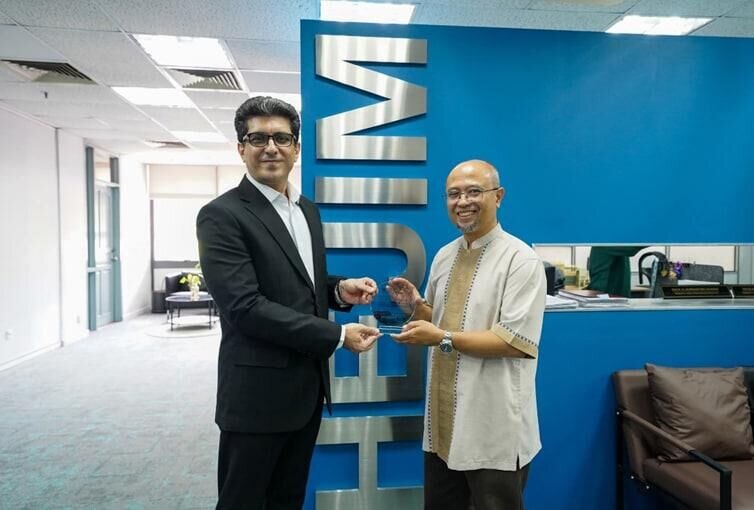
TEHRAN – Iran’s top universities are ready to launch joint technology projects with Malaysia’s National University (UKM) in artificial intelligence, semiconductors and clean energy, Iran’s scientific attaché to East Asia said during a visit to the Malaysian university.
Alireza Tavakkolpour, Iran’s scientific attaché and acting head of student affairs in East Asia, Australia and New Zealand, made the remarks while presenting Iran’s latest achievements and innovations in mechatronics and advanced thermoacoustic systems at a specialized meeting with UKM officials.
The meeting was held on Sunday at the invitation of senior officials from UKM’s Faculty of Engineering and Built Environment. The participants discussed ways to expand scientific cooperation, implement joint technology projects and facilitate academic exchanges, IRNA reported.
The meeting was attended by the faculty’s deputy dean, directors of its international relations and industrial networking offices, and the second counselor for public diplomacy at Iran’s Embassy in Kuala Lumpur. The participants explored potential areas of synergy between Iran’s leading universities and UKM, which ranks 130th globally, through operational memoranda of understanding.
Tavakkolpour outlined the three-pronged mission of Iran’s scientific attaché offices, as defined by the Ministry of Science, Research and Technology, the Ministry of Health and Medical Education, and the Ministry of Foreign Affairs, emphasizing the need to elevate bilateral scientific cooperation.
Referring to successful collaborations with Iranian universities, including Shiraz University of Technology and Amirkabir University of Technology, he presented the research achievements and innovations of his team in mechatronics, robotics, wind tunnel technology and the development of nonlinear oscillators.
He also introduced advanced thermoacoustic systems as a new generation of heat engines without moving parts. He highlighted their potential to directly convert clean and renewable energy sources, including palm oil waste and solar energy, into electricity, and proposed joint research projects in the field.
UKM welcomes faculty, student exchanges
Officials from UKM’s Faculty of Engineering and Built Environment welcomed the meeting and outlined the university’s scientific and research standing, including its first-place national ranking in arts and humanities and third-place ranking in engineering in Malaysia.
They also highlighted the activities of the university’s Automotive Research Centre (CARP) and Sustainable Process Research Centre (SASPRO), as well as the establishment of a Quantum Technology Centre and the development of artificial intelligence and semiconductor programs.
The Malaysian side welcomed expanded engagement with Iranian academic institutions and expressed readiness to design and implement joint academic programs, modeled on the university’s successful partnerships with leading European universities. It also offered opportunities for research fellowships, faculty and student exchanges, and the use of industrial grants and international research chairs.
Promoting higher education cooperation
On Tuesday, August 18, Muhammad Hamizam Kamaruzaman, the chargé d'affaires of the Malaysian Embassy in Tehran, met Abbas Qanbari-Baghestan, the deputy head of the Students Affairs Organization of the Iranian Ministry of Science, Research and Technology, to explore ways to promote higher education cooperation to further advance bilateral relations.
Amiruddin Zaidi, the third secretary of the embassy, was also present at the meeting.
Building on this momentum in academic diplomacy, Malaysia continues to deepen its longstanding partnership with Iran through its flagship Malaysian Technical Cooperation Program (MTCP), which has been operating in Iran for years. On November 29, the Malaysian Embassy in Tehran hosted its annual dinner reunion for MTCP alumni, bringing together Iranian professionals from academia, government, and industry who have completed the program.
Ambassador Khairi bin Omar, who led the gathering, emphasized that MTCP—established in 1980—has welcomed over 70 Iranian participants since 2002, offering training in technology, economics, agriculture, and other critical fields. In his address, the Ambassador described the alumni as "Friends of Malaysia" and urged them to serve as advocates for stronger bilateral ties, while reaffirming Malaysia's commitment to sharing technical expertise and building a lasting global community of leaders. Attendees praised the evening as highly productive and inspiring, with Ambassador Omar reiterating that the embassy remains open to alumni ideas for advancing mutual prosperity.
The MTCP, he noted, is more than a training course—it is the foundation of a lifelong partnership that continues to enrich both nations' policy frameworks and professional networks. As Malaysia seeks to elevate relations with Iran, the alumni network is viewed as a key bridge for unlocking even deeper cooperation in the years ahead.

No comments:
Post a Comment