
By Munir Shafiq
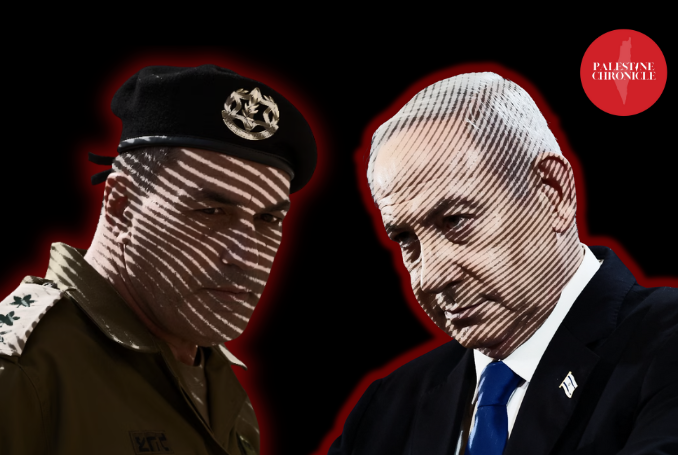 Israeli Chief of Staff Eyal Zamir and Prime Minister Benjamin Netanyahu. (Design: Palestine Chronicle)
Netanyahu’s recent plan to occupy Gaza City was preceded by a broader one to occupy the entire Gaza Strip. He was forced to abandon this larger plan due to opposition from military chief Eyal Zamir.
The specific reasons Zamir gave for pushing Netanyahu to back down have not been revealed. However, they almost certainly related to the army’s inability to achieve such a goal, or at least the massive casualties expected from a decisive battle of that scale.
This suggests that the Israeli military is weaker than many people believe, after 21 months of a ground war in Gaza, a war of human annihilation, and a campaign of near-total destruction and deliberate starvation, especially against thousands of children.
Numerous reports have leaked about the poor turnout of reserve forces and massive losses in tanks and armored vehicles. There have also been estimates about the rise of battle-related psychological stress among soldiers who served in ground combat.
This explains the military chief’s hesitation and fear, and his uncertainty about the outcome of such an all-out war, even if it were limited to Gaza City.
Perhaps the most telling sign of the shift in the balance of power is the dozens of articles and analyses from historical military leaders who served in the army, Shin Bet, and Mossad. All of them have hinted that the war Netanyahu has been fighting since October 7, 2023, is pointless.
Some have gone so far as to say that Netanyahu’s military policies have been internally and externally destructive to the Zionist entity, particularly by damaging its reputation with global public opinion. Very few experts, for the record, have supported Netanyahu’s claims of victory and achievement.
Therefore, most military and political experts have expressed a pessimistic outlook on Netanyahu dragging the army into a war to occupy the Gaza Strip, or even just Gaza City alone.
There is no need to know the exact reasons military chief Eyal Zamir gave for not carrying out a full occupation. It’s reasonable to assume his concerns revolved around the military risks the Israeli army would face if its ground forces were pushed to occupy the entire Strip.
This is not to mention the possibility that the expected outcome could be a military defeat, especially if clashes were to cause soldiers to flee—a phenomenon that can spread like a plague through an army.
Limiting the objective to occupying Gaza City carries all the same risks the military chief presented to Netanyahu about a full occupation. The compromise of confining the occupation to Gaza City changes nothing. In fact, the army leadership’s hesitation about this scaled-down plan is likely just as strong.
Of course, it’s possible that Netanyahu is focused on pressuring and intimidating Hamas without actually planning to follow through, all to get approval for the occupation of Gaza City.
A thorough analysis of the situation would conclude that throughout this war, Netanyahu has made militarily disastrous mistakes. He has led the army into a situation where it has failed to defeat the resistance and has tarnished the Zionist entity’s reputation with global public opinion—an act that will lead to future strategic losses.
The only explanation for this stubborn insistence on committing destructive mistakes and crimes is Netanyahu’s determination to cling to power. This allows him to maintain his alliance with the reckless political players, Ben Gvir and Smotrich, and helps him avoid prosecution and imprisonment if he were to end the war and lose Trump’s backing.
However, his stubbornness, along with his crimes, his political cover, and his international and American isolation, could not have continued unless the pressure on him was insufficient.
But this dynamic won’t last long, especially with the growing international opposition, even from his allies, to the strategy of a full occupation of Gaza City.
Evidence of this shift to break Netanyahu’s stubbornness is found in the recent statement from eight European countries, as well as new European announcements to halt arms shipments and a threat of sanctions. This also puts pressure on Trump, as it is no longer viable to allow Netanyahu to continue his losing defiance.
What strengthens the prediction that Netanyahu’s stubbornness will be broken in the coming days are the daily military achievements of the resistance and its steadfast adherence to its just and rightful demands for a truce agreement.
This means that the unified stance of the resistance and the people represents a powerful, unbreakable wall that Netanyahu cannot overcome if he goes through with the crime of occupying Gaza City.
In short, if we were to summarize the assessments of Netanyahu’s policies over the last year and ten months, we would find that at every stage, he proposes a new military plan to win the war, escalating the conflict each time. After every failure, he gives the impression that he has a new, brilliant plan that will finally work.
This is exactly what is happening now with his announced strategy to occupy Gaza City. As always, this plan will be met with varying analyses and predictions.
However, the key lesson from all the previous failures is that Netanyahu doesn’t have a well-thought-out strategy. Instead, he adopts a new strategy each time to cover for the failure of the last one, all by making it sound like a new master plan. He repeats this pattern because he refuses to accept a realistic analysis of the balance of power that has foiled all his previous attempts.
And in Gaza, there are still forces that will defeat his strategy to occupy Gaza City—if it doesn’t fail before it even starts.
(This article was originally published in Al-Jazeera Arabic. Translated and prepared by the Palestine Chronicle.)
– Munir Shafiq is a political thinker and writer.

No comments:
Post a Comment