
Dr Reza John Vedadi
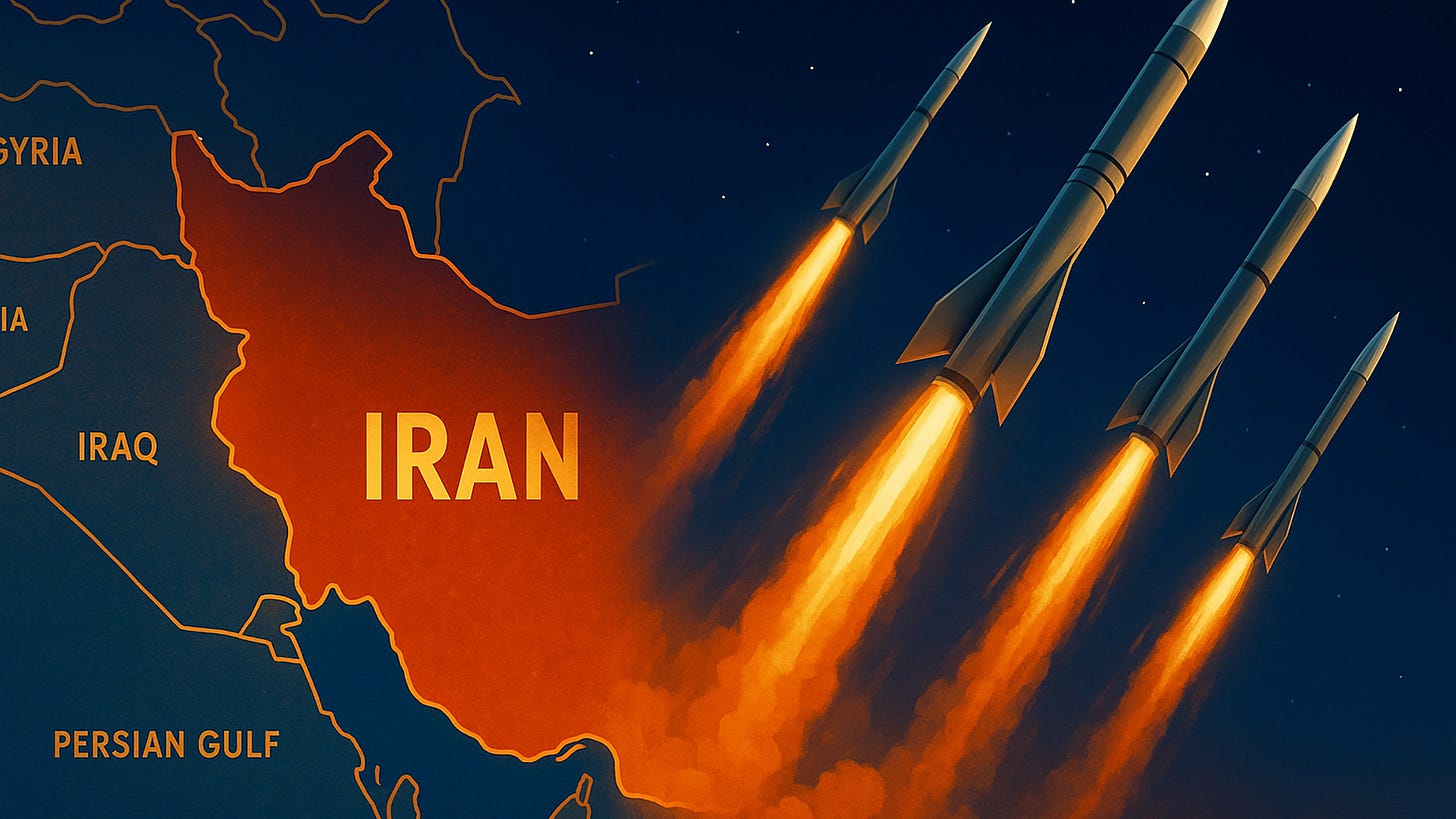
For forty-five years, two rival security playbooks have been on display across West Asia. One favours expeditionary adventures, pre-emptive strikes, and regime change. The other favours endurance: hardening the homeland, building reach without occupation, and shaping an adversary’s calculus so that starting a war is not worth it. Iran sits squarely in the latter camp, and recent events underline why this model not only survives pressure but also increasingly sets the terms of engagement.
I argued that Tehran revealed only a fraction of its military toolkit during the most recent 12-day imposed confrontation, deliberately employing older, first and second-generation systems to signal capability without burning its best cards. That judgment was echoed by Iranian officials who later emphasised that more advanced “lethal and sophisticated” missiles remain available if escalation is forced.
What separates the camps is not only technology, but also doctrine. The U.S.–Israeli pattern has been to strike first, set facts on the ground, and negotiate later from a position of violence-backed leverage. As I put it in the interview, they “attack whenever they can…the only time that they stop…is when they see that the cost of their attack outweighs any benefit.” That is precisely where Iranian strategy aims: to impose costs higher than benefits without replicating the invader’s playbook.
What Iran Has Already Proved
Credible Punishment Without Occupation.
After decades of sanctions and encirclement, Iran built a deterrent able to strike back swiftly and proportionately. When required, it can “hit hard” front-loading pain rather than escalating slowly so that decision-makers in Tel Aviv and Washington feel shock, not relief. I call this a readiness to abandon gradualism in favour of a rapid, decisive reply that raises the price of adventurism immediately.
Indigenous depth.
Another underappreciated point: Iran’s military ecosystem is homegrown. It does not have to wait for spare parts, political permission, or embargo waivers before acting. The same indigenous engine that was mocked a few years ago is now decried as a source of regional and even great-power capability transfers, including drones. That arc, from ridicule to respect, is itself deterrence.
Moral asymmetry.
Here is a fact rarely said out loud in Western think-tank prose: Iran has not invaded or occupied anyone, yet it is routinely demonised by the very states whose recent history in West Asia reads like an airport departure board of interventions. That hypocrisy is noticed from Muscat to Mashhad.
Neighbourhood signalling.
Tehran has shown that it will not allow its neighbours to be used as launchpads for attacks. In January of 2024, Iran struck espionage and staging sites with precision weapons in Iraqi Kurdistan province. The point was not conquest; it was denial of basing for hostile operations, and it worked. A similar message has been sent to Baku after reports that Israeli assets exploited Azerbaijani territory: hosting another’s war against Iran is not “neutrality”; it is participation, with consequences.
Why Cost-Imposition Is Not Enough Anymore
Deterrence by punishment has stabilised flashpoints. However, punishment kicks in after the other side has already attacked. The next evolution is Deterrence by Denial: shaping the environment so thoroughly that an attack is unlikely to succeed in the first place or cannot be launched at all, making it a bad bet even for the reckless.
If Israel and the United States “only understand power and force,” then the most humane course is to make aggression futile, not merely painful. Denial is a defensive art: fewer funerals because fewer attacks can get off the ground. Ambiguity also matters; holding back top-tier systems while hinting at their parameters compounds doubt in enemy planning cells.
From Theory to Practice: A Denial Playbook
1) Deny the launchpad.
Neighbouring territory is the soft underbelly of any campaign against Iran. Clear, public red-line diplomacy, backed by private intelligence dossiers, should spell out that permitting hostile basing, sensor networks, or transit will trigger tailored, non-civilian precision strikes on the enabling nodes. The Kurdistan precedent shows how to do this tightly and lawfully: strike the capability, not the country.
2) Harden the border sky.
Integrate layered air and counter-drone defences along vulnerable arcs—especially the north-west approaches where Israeli assets have reportedly piggybacked on Azerbaijani infrastructure. Pair radar and passive detection with mobile anti-UAV teams and point defences around critical industrial and energy hubs. The message: even if someone persuades a neighbour to host hardware, it will not get through.
3) Maritime denial in the Persian Gulf and Sea of Oman.
Strengthen the “no-easy-entry” perimeter with coastal anti-ship missiles, expendable unmanned surface vessels, and rapid-swarm tactics that complicate any adversary’s attempt to posture offshore. Deterrence starts at the waterline; denial keeps it there.
4) Cyber tripwires.
Build “dead-switch” cyber measures that auto-degrade hostile C2 (command and control) and ISR (intelligence, surveillance, reconnaissance) nodes when they light up to support strikes. Suppose a server farm in a neighbouring country begins routing target packets to hostile platforms. In that case, that node should quietly go dark through reversible effects, backed by attributable evidence when needed.
5) Ambiguity with teeth.
Keep the qualitative edge veiled. Tehran deliberately used older systems in the 12-day fight; that restraint should continue, but pair it with carefully choreographed demonstrations (not deployments) of next-generation missiles and long-range UAVs. A planner who cannot size the true envelope of Iranian response will recommend caution.
6) Narrative clarity, not noise.
If Iran is framed as the problem even when it has not crossed others’ borders, then every denial action must be accompanied by evidence-first messaging: satellite photos of staging sites; intercepted procurement trails; open dossiers that document how a nearby plot was enabled. The audience is not Western punditry; it is the risk-averse civil servants in neighbouring capitals who would rather not be caught explaining why their territory became someone else’s trench.
7) Micro-alliances for macro-stability.
Where possible, lock in assurance mechanisms with neighbours who face the same danger of being turned into spare parts for other people’s wars. Quiet, technical understandings, shared air picture, incident hotlines, joint counter-smuggling serve denial by removing ambiguity and incidentally lowering the likelihood of miscalculation.
Azerbaijan and the North-West Test
Baku does not have to be an adversary to become a problem. The real risk is outsourcing, allowing third parties to turn Azerbaijan into an extension of their battlespace. Israeli exploitation of Azerbaijani territory is a red line, and Tehran has made that plain. Deterrence by denial here means three things: (1) verified removal of hostile ISR networks along the border; (2) strict transit controls on systems that enable deep-strike surveillance of Iranian airspace; (3) a standing understanding that any re-emergence will be met with non-civilian precision action on the enabling equipment, not the country.
If this sounds hard, it is. However, it is easier than living with a normalised pipeline of provocations launched from someone else’s backyard.
The Ethical Dividend of Denial
Punishment hurts; denial prevents. In a region scarred by invasions and occupations, the strategic and ethical win is the same: fewer successful attacks, fewer civilian casualties, less incentive for escalation. Even critics concede one point: power that does not depend on occupation tends to be more sustainable and less destabilising. That is why Iran’s patient build-up of range, precision, and survivability matters more than headline-grabbing sorties. Furthermore, it is why ambiguity, the disciplined choice not to showcase everything, remains part of the shield.
Closing Thought
Across the Persian Gulf and beyond, capitals are relearning an old lesson: coercion is easiest against countries that confuse visibility with strength. Iran has learned the opposite. It has shown enough to prove it can hurt those who attack it. Now it should further tilt the board, not by mirroring the invader’s habits, but by making aggression technically unworkable and politically suicidal. That is deterrence worthy of a region that has had far too many lessons in what invasion looks like, and not nearly enough in how to make invasion pointless.

No comments:
Post a Comment