Friday, November 01, 2024

Over 300 Million Quran Copies Printed in Medina in 4 Decades

IQNA – More than 300 million copies of the Quran have been produced by the King Fahd Complex for the Printing of the Holy Quran since its foundation.

King Fahd Complex for the Printing of the Holy Quran in Medina, Saudi Arabia

The center has five manuscripts of the Quran calligraphed by its own calligraphers and approved by its scientific committee. 

Two of the manuscripts are in the Hafs narration and the other three in the Warsh, al-Dawri and Qalun narrations.

A team of Muslim scholars and experts carefully proofread each version after the calligraphy is completed before the Qurans are printed.

There is also a special system in place for monitoring all stages of printing the Qurans.  

Many of the copies printed by the complex include translations of the Holy Quran in various languages.

To date, it has printed translations of the Quran in 72 languages, including 39 spoken in Asia, 16 spoken in Europe, and 19 African languages.

In addition to Qurans, the center publishes books on Quranic sciences and translations of various Quranic and Islamic books.

Launched in the holy city of Medina on October 30, 1984, by the then ruler of Saudi Arabia King Fahd bin Abdul Aziz, it has become the world’s largest Quran printing center today.

WAR CRIMINALS AS TOURISTS: WHITHER MORALITY?

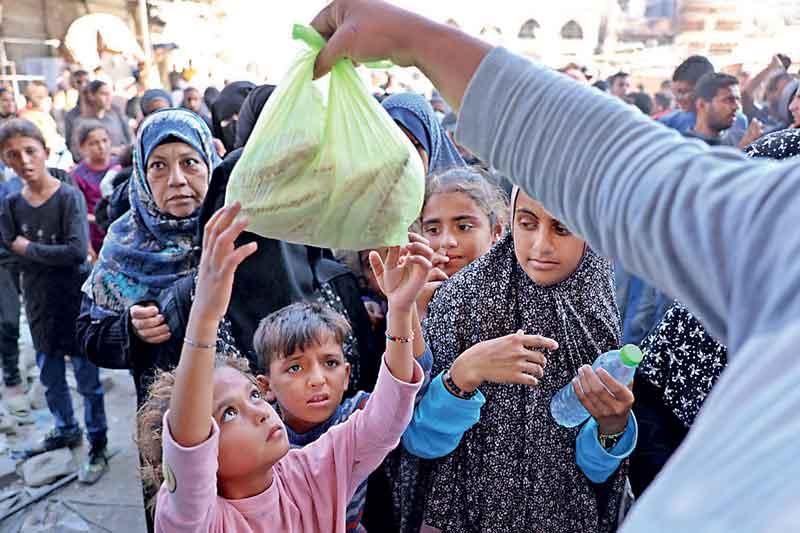
Palestinians wait in a queue to receive bread outside a bakery in Khan Yunis on the southern Gaza Strip amid bombardment by Israel. (PIC BY BASHAR TALEB/AFP)


Sri Lanka should stop issuing tourism visas to Israelis, especially armed forces members, until a permanent ceasefire in Gaza. This is the view of Sri Lanka’s progressives, who yearn for a just and fair solution to the Palestinian crisis that erupted in the mid19th century with the quest by European Zionists with dubious Semitic roots to create a Jewish state.

The recent security threat to which the country awoke no sooner than the United States embassy issued a tourism-killing alert, advising Americans to avoid Arugam Bay—surfers’ paradise—on the east coast is a hot topic these days—hotter than the political heat over the November 14 parliamentary elections.

The progressives see the best way to manage the present security crisis is not to permit Israeli tourists, especially its armed forces members, to visit Sri Lanka.

The proposal may sound preposterous and even unpatriotic, given the importance of every dollar earned from tourism for the economic recovery. But it is still worth the sacrifice, for it will make Sri Lanka a much safer destination for tourists from other countries.

Morally, too, Sri Lanka has a responsibility to deny members of the Israeli Defence Force—the Israeli Occupation Force— visas to visit Sri Lanka. The neighbouring Maldives has banned all Israelis from visiting the Indian Ocean archipelago. One may say the Maldives did so because it is a Muslim country. Morality does not belong to one religion. It is universal and the core that makes humanism humane. South Africa, Bolivia, Chile, Colombia, Honduras, Belize, and Nicaragua severed relations with Israel in protest against the Gaza genocide. Any progressive government worth its salt will not and should not hesitate to take morally correct political action.Losing 20,000 Israeli tourists will not make a major dent in the industry. With a stimulus in marketing, the country can attract tourists from other countries, including West Asia and North Africa.

Moreover, allowing the Israeli Defence Forces members to use Sri Lanka’s beaches and tourism facilities for recreation and the mental reset necessary for them to go back and continue their genocide in Palestine certainly makes Sri Lanka complicit in Israel’s crime of crimes in Palestine and Lebanon. The progressives, most of whom identify with the socialist and anti-imperialist policies of the ruling National People’s Power, believe Zionism is a dangerous ideology that does not end with the conquest of Palestine and neighbouring countries. It also aims to dominate the world and rule the Goyyim, a pejorative term for non-Jews. They call themselves the chosen people and quote the scripture to justify genocide. But little do they realise that they have long lost the right to be ‘chosen people’. The chosen are not those who mercilessly kill children, women, and the elderly and use starvation as a weapon of war, but those who have compassion for human beings, irrespective of their creed, caste, class, or other parochial identities.

Just as terrorism is condemned and deplored, Zionism should also be. Going viral these days on social media is a video clip that shows an IDF member on vacation in a Western capital violently intimidating UNICEF volunteers collecting funds for Gaza children. “Say Palestine one more time, I will kill you,” he shouts at them. Some say IDF members who come to Sri Lanka for recreation to overcome their war stress are as arrogant and contemptuous of the locals as the IDF soldier seen in the video clip was.

This is why the progressives urge the government to apply the law strictly to any tourist who violates Sri Lanka’s laws, especially visa regulations, and behaves in such a way as to hurt the feelings of local people.

The Israelis are the biggest culprits. They represent a state that this week passed legislation to outlaw the United Nations Relief and Work Agency, which for the past seven decades has been taking care of the Palestinian refugees’ food, shelter, and educational needs. These tourists represent a state that is implementing the so-called Generals’ Plan to cleanse the Northern Gaza of Palestinians while making the rest of Gaza a living hell for people who, if they are not killed by Israeli bombs and missiles, will die of starvation and disease.

Some of these tourists, including IDF war criminals, can be Mossad agents with plans to destabilise the country. In many terror attacks around the world, Mossad is the hidden hand. The terror group ISIS is believed to be a Mossad laboratory product. The so-called Islamic terrorism was engineered by Mossad and the term was popularised by Benjamin Netanyahu or Bibi the psychopathic baby killer. The Mossad is accused of carrying out attacks on Israeli targets and putting the blame on Iran or a Palestinian group.

In interviews and lectures, whistleblower and ex-British spy Annie Machon says the MI5 (the domestic arm of British intelligence) had evidence that Mossad carried out the bombing of its own embassy in London in 1994. She says it was done to undermine the free Palestine cause and the favourable press it was receiving in Britain. Mossad did achieve its objectives, she says. Two innocent Palestinian youths were arrested and sentenced for a crime they did not commit. There are also theories about Mossad’s role in the 9/11 terror attacks. Perhaps the Arugam Bay security alert could be a Mossad plot to portray Sri Lanka’s Muslims as terrorists and implicate Israel’s adversaries, such as Iran, in the plot. Iran’s ambassador to Sri Lanka, Alireza Delkhosh, categorically denies that Iranians were involved in any plan to launch an attack on Israeli targets in Sri Lanka. He said he met President Anura Kumara Dissanayake a few days ago, but no question on any Iranian link was raised. The embassy has also not received any official correspondence in this regard.

It is said that Israeli tourists buy properties here through proxies at several times the market price. This was how the land grab began in Palestine in the early 20th century. The Zionist Jews from Europe arrived in their thousands and bought land from credulous Palestinian peasants, paying them more than the market price. It was only in the 1930s that Palestinian leaders realised the danger behind the land-buying exercise. It had increased the Jewish population from a mere 4 percent at the turn of the 20th century to 30 percent.

Sri Lanka’s progressives also raise alarm over the Jewish places of worship in Colombo and other coastal towns. They ask whether these centres were set up in keeping with the domestic laws. The authorities must answer. Freedom of religion is a universally recognised human right. But if tourists are allowed to set up centres of worship in Sri Lanka with no questions asked, it may encourage even Satanists and cultists preaching collective suicides—like the 1978 Jonestown Massacre by the Peoples Temple led by Jim Jones—and immorality to set up bases here.

Given the wheels-within-wheels nature of the security alert, the new government needs to be extra alert over the schemes of some geopolitical powers and their intelligence arms and adopt a strategy that combines prudence with a good measure of cynicism.

Political Shifts Loom as Grassroots Support for Palestine Grows in West: Malaysian MP

IQNA – A Malaysian lawmaker believes rising grassroots support for Palestine and younger progressive leaders in the West could shift politics and increase criticism of Israeli actions.

IQNA conversation with Syed Ibrahim Syed Noh

This is according to Syed Ibrahim Syed Noh who made the statement in an interview with IQNA about the ongoing Israeli war on the besieged Gaza Strip that has claimed the lives of at least 42,500 people, mostly women and children.

“Grassroots movements and solidarity with Palestine have been gaining momentum, especially in Europe and the US, as more people become aware of the humanitarian crisis and alleged war crimes,” he said when asked about the future of Western support for the Israeli regime. “Over time, these societal shifts may begin to influence political decision-making, especially as younger, more progressive leaders come to power,” he added.

What follows is the full text of the conversation:

IQNA: One year since Palestinians’ Operation Al-Aqsa Flood, how do you assess the achievements of the Palestinian resistance movements?

Syed Ibrahim Syed Noh: The Palestinian resistance movements have demonstrated significant resilience and adaptation. The Al-Aqsa Flood operation marked a turning point by showing the capacity of Palestinian factions especially Hamas to launch coordinated actions, causing serious disruptions to Israeli military and security systems.

Achievements include raising global awareness about the occupation, increasing international solidarity, and forcing the Israeli regime to acknowledge the depth of Palestinian grievances. However, the costs in terms of human lives and destruction have been heavy. Resistance movements have had to contend with immense military retaliation, and while there have been symbolic victories, the challenge remains to translate those into long-term political gains.

IQNA: Western countries, led by the US, have voiced support for the Israeli regime despite mounting evidence of Israeli war crimes in Gaza and also growing people’s solidarity with Palestine in the past year. How do you see the future of this support for Israel?

Syed Ibrahim Syed Noh: The future of Western support for Israel is increasingly becoming a point of contention. While the US and other Western governments have been steadfast in their support for Israel due to historical alliances, security concerns, and domestic lobbying groups, public opinion is shifting.

Grassroots movements and solidarity with Palestine have been gaining momentum, especially in Europe and the US, as more people become aware of the humanitarian crisis and alleged war crimes. Over time, these societal shifts may begin to influence political decision-making, especially as younger, more progressive leaders come to power. While official policies may not change rapidly, the growing international disapproval of Israeli actions could force a reevaluation of unconditional support.

IQNA: What is the role of elites in boosting the solidarity and unity in the Muslim world for defending Palestine?

Syed Ibrahim Syed Noh: Elites in the Muslim world play a critical role in shaping public opinion and policy. Intellectuals, religious leaders, and political figures can act as powerful advocates for Palestinian rights. Their influence in media, academic institutions, and international diplomacy can galvanize broader support for the cause.

When these elites unite and make a concerted effort to prioritize Palestine in political agendas, they can facilitate coordinated actions such as boycotts, sanctions, and diplomatic pressure. Moreover, they can foster unity across diverse Muslim sects and regions, ensuring that the Palestinian cause remains a unifying issue rather than one subject to geopolitical divides. Malaysia will continue to play its pivotal role on this.

IQNA: How do you assess the Muslim world’s support for Palestine in the past year?

Syed Ibrahim Syed Noh: The support from the Muslim world has been vocal, but it remains fragmented. On a popular level, there is widespread sympathy and solidarity with Palestine, seen through protests, social media campaigns, and humanitarian aid. However, on a governmental level, the response has been inconsistent, largely due to differing political and economic interests.

Some countries, such as Iran and Turkey, have been more vocal and proactive in supporting Palestine, while others, especially those normalizing relations with Israel, have maintained a more cautious stance. The challenge remains in converting this popular support into unified and effective political action on an international scale.

IQNA: Can you please give us an analysis of the situation inside Israel as we mark the anniversary of the war?

Syed Ibrahim Syed Noh: Internally, Israel faces significant challenges. The war has exacerbated existing social tensions, with deepening divisions between different political, ethnic, and religious groups within the country. The far-right factions have gained considerable influence, pushing for more aggressive policies against Palestinians, which has only fueled internal dissent.

Economic instability, driven by military expenditures and international pressure, has also placed a strain on Israeli society. Furthermore, growing global condemnation and increasing calls for accountability have put Israel’s international standing at risk, leading to concerns about long-term isolation.

IQNA: Iran has responded two times to Israeli aggressions so far and has warned that it would respond with a stronger force if further provoked by the regime. How do you see the situation here? Is the region getting ready for a direct war between Iran and Israel?

Syed Ibrahim Syed Noh: The situation is highly precarious. Iran’s warnings reflect its strategic calculations, balancing between deterrence and avoiding full-scale conflict. Both Iran and Israel understand the severe consequences of a direct war, which could engulf the entire region. However, the possibility of a miscalculation or an unintended escalation remains.

Iran’s growing influence through forces in Lebanon, Syria, and Iraq increases the likelihood of a broader regional conflict, should hostilities continue to escalate. While a direct war is not inevitable, the region is certainly closer to a significant confrontation, with the possibility of smaller, localized clashes between Iran-backed forces and Israel in the near term.

IQNA: The regime has expanded the war in the north, targeting Lebanese territories in the past few weeks. How do you see the prospects of a ground invasion into Lebanon? Some analysts believe Hezbollah has the upper hand when it comes to operations on the ground. What is your take on this?

Syed Ibrahim Syed Noh: A ground invasion into Lebanon would be a high-risk operation for Israel. Hezbollah is well-entrenched and has developed sophisticated defenses since the 2006 war, including tunnels, missiles, and guerrilla tactics. The terrain in southern Lebanon is highly advantageous for defensive operations, giving Hezbollah the upper hand in case of a ground conflict. While Israel’s military capabilities are formidable, the human and political costs of a ground invasion would be immense.

Hezbollah’s ability to retaliate deeply into Israeli territory, along with its strong support base in Lebanon, makes a protracted ground war unlikely to yield decisive results for Israel. As such, while skirmishes may escalate, a full-scale ground invasion is likely to be avoided unless Israel feels it has no other strategic options.

Does the Kazan Declaration have any value?

Crescent International

Russian President Vladimir Putin addressing assembled heads of state at a gala dinner at the BRICS summit in Kazan
The artificial schism between the Euro-American-led west and the Global South was examined based on BRICS statements and summit resolutions in Kazan (October 22-24) to ascertain whether BRICS represented a serious challenge to the existing global order.

The analysis did not reveal anything promising.

further examination of the big fish within BRICS+ reconfirmed that.

Two key resolutions from the Kazan Declaration issued at the 16th BRICS Summit deemed pertinent to the Islamic Resistance will be considered.

Since the previous BRICS Summit in Johannesburg, Israel has not only increased its violations of “sovereign nations” but has done so with more intensification without facing any consequences.

Amidst the annual ritual of calling for peace and respect for the sovereignty of nation-states within the existing international order— something Israel flagrantly disregards— resolution 30 reaffirmed, yet again, the two-state solution based on international law and in line with internationally recognized borders of June 1967 with East Jerusalem as its capital living side by side in peace and security with Israel.

This resolution is a regurgitation of a resolution passed over a decade ago during The Durban Declaration after the 5thBRICS Summit.

The implication of supporting such a resolution is that BRICS+, with the exception of Islamic Iran, is resolute about the zionists usurping 78% of Palestine.

After thousands of innocent Palestinian and Lebanese deaths and immense infrastructure destruction since the 5th BRICS Summit, including the live broadcast of a genocide, it is astonishing that the “Global South” still considers living side by side in peace and security with Israel to be a viable option!

It appears as though Muslim lives, especially in Palestine and Lebanon, are expendable in the Global South’s quest for “strengthening multilateralism for just global development and security.”

To add insult to injury, rather than address the cause of global instability and insecurity viz. Israel, the BRICS+ countries passed resolution 33 which stressed the importance of ensuring the exercise of navigational rights and freedoms of vessels of all states in the Red Sea and Bab Al-Mandab Strait, in accordance with international law.

Who stands to benefit from these two resolutions, if not Israel?

It is well known that Ansarullah’s military operations in support of the Palestinian victims of Israeli perpetrated genocide specifically targeted Israeli vessels or vessels carrying supplies through the Red Sea and the Bab Al-Mandab Strait to prop up the Israeli economy and its genocidal forces.

The above two resolutions should remove any doubt that, with the exception of Islamic Iran, the strong zionist-Israeli lobbies within the other BRICS+ countries that enjoy strong diplomatic, trade or military ties with zionist entity are ruling the roost.

BRICSKazan DeclarationOccupied PalestineIsraeli genocide in GazaIslamic Resistance Movement

Londoners Condemn Islamophobia, Racism

IQNA – Thousands of people staged a rally in condemnation of Islamophobic and racist moves by the country’s far-right groups.

A rally in London against racism and Islamophobia

In a powerful show of unity against hate and discrimination the anti-racism demonstrators gathered at Piccadilly Circus in London on Saturday morning to counter a protest organized by far-right groups.

The rally, which began at 11.30 am. local time, brought crowds who voiced strong opposition to the ideologies represented by the far-right protesters assembled nearby on Whitehall Street.

The anti-racism activists, who represented a diverse cross-section of London's community, chanted slogans condemning fascism, racism, Islamophobia, and discrimination, emphasizing the importance of inclusion and tolerance.

Addressing the crowd, Left MP Diane Abbott said: "Here we are once again on the streets against the racist and the fascist. This is something we have had to do for decades… but we have always won, and we will win again this time. There are many more of us than you, and you will not escape.”

"These are dark times. 42,000 Palestinians have been killed in Gaza and (US President) Biden and (UK Prime Minister) Starmer have not told Israelis 'do not kill too many civilians,' and you know what if they want to stop the war, they can stop sending arms to Israel," she underlined.

She said a London police officer who fatally shot an unarmed Black man two years ago has been acquitted of murder after a high-profile trial that drew widespread public attention.

Martyn Blake, a 40-year-old marksman with the Metropolitan Police, was cleared by a London jury on Monday in the death of 24-year-old Chris Kaba.

"We have to fight against living a society where the police believe they are above the law," she said.

A speaker from the United Families and Friends Campaign also addressed the crowd, saying they are not here "just for the Kaba family, but for all grieving families who have been bereaved at the hands of the state."

The location of the far-right protest on Whitehall Street – a central hub in London and home to Downing Street No. 10, the office of the Prime Minister – underscored the national importance of the issues at play.

Protesters gathered in front of Victoria Station in the early morning, shouting slogans in support of fascist figure Tommy Robinson.

Robinson, real name Stephen Yaxley-Lennon, was remanded in custody on Friday and is set to appear in court for contempt on Monday.

The protest was organized by far-right groups descending in London from various locations in the UK.

The protest is the largest far-right event since the riots that saw violence against refugees and foreigners at the end of July, following the murder of three young children in a terror attack on Southport.

In anticipation of potential conflict between the two groups, police took security measures along Whitehall to prevent any confrontations.

So far, four people have been arrested in connection with a far-right march and anti-racist counter-protest in London.

According to the Metropolitan Police, two people were arrested at the 'Uniting the Kingdom' demonstration: one for violating "Public Order Act" conditions and disturbing the peace, and the other for a racially aggravated public order offense.

A brief altercation also took place near the Stand Up To Racism stage, where officers arrested a woman for common assault.

In a separate incident, another arrest was made after an officer was assaulted as a group from the counter-protest attempted to push through a police cordon at the end of The Mall.


Source: Anadolu Agency

Leader’s commentary praises Roosevelt Street Station book as ‘accurate account of history’

TEHRAN – The Leader of Islamic Revolution has written a commentary on the book “Roosevelt Street Station: A Documentative Narrative of Seizing U.S. Embassy in Tehran”, commending the author’s efforts and emphasizing the importance of accurately recounting history, especially regarding pivotal events during the Islamic Revolution.

The text of the Ayatollah Seyyed Ali Khamenei’s commentary is as follows:

“In the Name of God, the Compassionate, the Merciful,  

This book provides a solid and valuable report on a crucial incident in the history of the Revolution: the takeover of the U.S. Den of Espionage in 1979.  This work fills a significant media and propaganda gap. We have not paid enough attention to the war of narratives in global conflicts, allowing our enemies to exploit this neglect, often distorting many events.  The author’s careful and valuable efforts in addressing this critical area deserve appreciation. The book’s prose is smooth and expressive, with research and analysis that are logical, sincere, and convincing.  The title chosen for the book is excellent.”

Roosevelt Street Station delves into U.S. embassy spy activities both before and after the Revolution, detailing its interventions post-Revolution, which ceased following the historic takeover of the U.S. embassy. This event, significant not only for Iranians but also for Americans, prompted the U.S. to craft its own perspective on the episode.

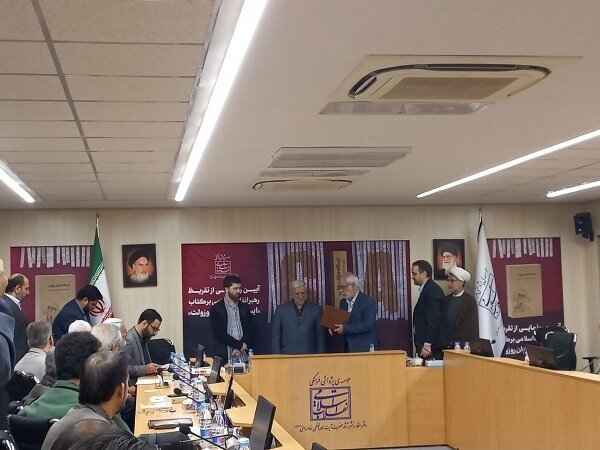
The Leader’s commentary was unveiled on Wednesday, at a ceremony at the Islamic Revolution Research and Cultural Institute. The event was attended by the book’s author, experts, contemporary Iranian history researchers, and individuals involved in the 1979 U.S. embassy takeover in Tehran.

The book’s launch ceremony today was accompanied by a speech from Hojjatoleslam Ahmad Khazaei, the publisher, who recounted the process of creating and publishing Roosevelt Street Station. 

Khazaei mentioned that in 2022, the Leader remarked to a group of nurses that critical aspects of the U.S. embassy takeover and its documents remained unclear, particularly for younger generations. This inspired the Institute to produce a comprehensive research work, leading to Roosevelt Street Station, a result of two years of intensive work, including the analysis of approximately 10,000 documents. “With proficiency in English, the author, Mohammad Mahboubi, meticulously reviewed primary sources and English-language memoirs for an in-depth analysis,” he added.

Roosevelt Street Station also addresses questions surrounding the embassy takeover. During the event, researcher and writer Hossein Mohammadi Seerat discussed the book, noting its departure from a typical narrative and its balanced tone. He acknowledged some gaps in the text but praised the book’s importance in today’s context, which highlights how the Revolution dealt a significant blow to the United States.

Mahboubi explained that the book aimed to bridge internal and competing narratives, avoiding Western biases while steering clear of overly propagandistic tones. He consulted over 40 English and 45 Persian books, noting the painstaking process of reconciling sources over a nearly two-year period.

Every year on November 4, Iranians commemorate the day of seizing the U.S. embassy as the National Day of the Fight against Global Arrogance with rallies across the country, marking a day of resistance against the West’s imperialism and a tribute to Iranian students’ vigilance. 

30,000 Iranians Go on Umrah Pilgrimage This Season

IQNA – A total of 30,000 Iranians have travelled to Saudi Arabia for Umrah pilgrimage in the new Umrah season that began after the conclusion of the Hajj 2024.

Iranian Umrah pilgrims board an Iran Air plane.

Twenty thousands of them have completed the pilgrimage and returned home.

This was announced at a meeting of the planning council of the Office of the Leader’s Representative in Hajj and Pilgrimage Affairs.

In the meeting, headed by the Leader’s Representative in Hajj and Pilgrimage Affairs Hojat-ol-Islam Abdol Fattah Navab, officials from the Hajj and Pilgrimage Organization presented reports about services provided for Iranian pilgrims.

Seyed Ali Marashi, head of the organization’s medical center, said between 600 and 700 pilgrims refer to Iran’s clinics in the holy cities of Mecca and Medina to receive medical care daily.

Also, Head of the organization Seyed Abbas Hosseini briefed the meeting about planning and preparation for next year’s Hajj.

The Hajj and Pilgrimage Organization of Iran on September 7 announced the launch of registration for those wishing to go on the Umrah pilgrimage.

The organization said the pilgrims will be sent to Saudi Arabia in two stages, with the first starting on September 18 and ending on December 20.

Back in April, the first batch of Umrah pilgrims from Iran embarked on the spiritual journey to Mecca after a 10-year hiatus.

Earlier, Hosseini had said that 5.7 million Iranians are in line waiting for their turn to take part in Umrah pilgrimage, adding that the organization is ready to send between 800,000 and 1 million pilgrims to Saudi Arabia for Umrah every year if the conditions are right and other related bodies provide the necessary cooperation.