Showing posts with label climate change. Show all posts

Sunday, December 08, 2019

The climate crisis and global warming: We need to keep acting like our house is on fire

The cruel irony at play here is that although developing countries don’t burn as many fossil fuels as developed ones, they are disproportionately affected. People in poorer countries are at least five times more likely to be displaced by extreme weather than people in rich countries.
When climate activist Greta Thunberg said, “I want you to act like the house is on fire,” she wasn’t being melodramatic. Every year, natural disasters kill around 90,000 people and affect almost 160 million worldwide – and those figures are rising year after year, due to the dangerous effects of the climate crisis. 
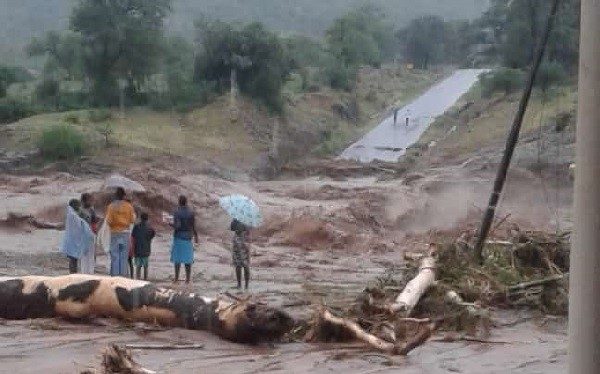
Some of the 1.8 million people affected by Cyclone Idai in Southern Africa.
The cruel irony at play here is that although developing countries don’t burn as many fossil fuels as developed ones, they are disproportionately affected. People in poorer countries are at least five times more likely to be displaced by extreme weather than people in rich countries.
Numerous studies have shown that climate change has made extreme weather more intense and more long-lived, from the drought in Syria to the increased flooding here in the UK. Put simply, the house is on fire. 

A young girl in Kashmir sits in the rubble of her destroyed home, after the recent earthquake.
Penny Appeal’s Emergency Response teams are experts at quickly, efficiently and compassionately helping people survive in times of crisis. We’ve protected 1.7 million lives of people affected by natural disasters, famine, drought, and war in countries like Syria, Indonesia and even here in the UK after the Grenfell disaster and the Cumbrian floods. Our response was so effective in the aftermath of Grenfell, that the UK emergency services named us as one of their preferred crisis management partners. 
We are proud of everything we have achieved, but we know there is much more work to do. Facing unimaginable destruction and horror, our Emergency Response needs to get fastersmarter and more sustainable. We are not just putting out fires, we’re setting alarms and we’re fire-proofing the building. 

Penny Appeal’s Emergency Response in Mozambique after Cyclone Idai.
After Cyclone Idai tore through Southern Africa earlier this year, affecting 1.8 million lives and destroying acres of agricultural land, Penny Appeal provided emergency relief within days of the disaster. But we didn’t stop there; we have projects planned to train 43,636 farmers in Mozambique in green ways of increasing crop yields, as well as climate-resilient practices such as crop rotations for thousands of small farming households.
We’re also planning the installation of Solar Panel Water and Power Centres in affected areas of  Malawi, as well as sustainable programmes addressing deforestation and widespread malnutrition after Cyclone Idai. Climate-friendly farming projects are also planned for hundreds of families in disaster affected Zimbabwe. 
Over the past two years, Indonesia has faced disaster after disaster, dealing with the devastating damage of flash floods, a tsunami and a massive earthquake. Central Sulawesi in Indonesia is one of the most disaster-prone areas in the world. 
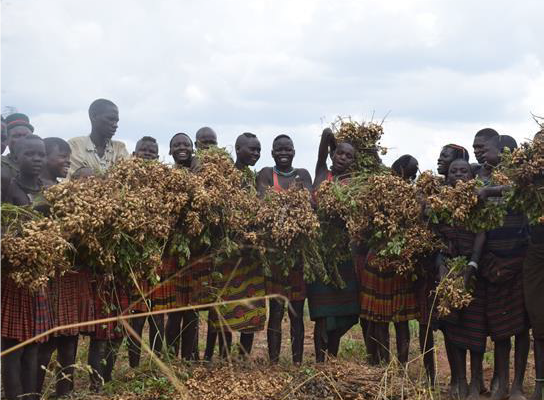
Young Ugandan people smile with their crops, after completing a similar sustainable farming programme with Penny Appeal to those planned in Southern Africa.
As part of Penny Appeal’s Emergency Response in Indonesia, we worked alongside the local Fire Service and our amazing partner, Rumah Zakat Action, to lead Disaster Risk Reduction workshops in Central Sulawesi, helping the community to face natural disasters and minimise the damage to homes and lives. 
After the severe flooding in Kerala, India, in August 2018, we responded to the urgent needs of the people affected. We provided emergency food, water and hygiene essentials – but we didn’t stop there. The heavy rainfall ruined crops and put thousands out of work. We helped over 500 families by providing sustainable livelihood programmes, as well as support towards land reclamation.

Thanka and her chickens in India.
Thanka’s house was flooded and the tea estate where she used to work was destroyed after the disaster in Kerala – not to mention that at the age of 68, work in the fields was getting harder and harder. Penny Appeal gave Thanka 12 chickens, which can lay eggs and provide her with a sustainable income
“Actually, I am treating these chicks like little kids. Good food, water and medicines are on time for them even if I have to skip a meal. I am seeing the result of my efforts in their health. I am hopeful that these chickens will help me earn enough money,” Thanka said, adding that she never wants to be dependent on her children or anyone else. 
When the house is on fire, emergency food, medicine and access to clean water are essential. But we also need to focus on making sure that communities are empowered to respond to future disasters, and that they have the tools (and the chickens!) to re-build homes and lives in the aftermath.

Thursday, December 05, 2019

Wealthy Countries’ Approach to Climate Change Condemns Hundreds of Millions of People to Suffer

By VIJAY PRASHAD

Mill and power plant, West Linn, Oregon. Photo: Jeffrey St. Clair.
In Madrid, Spain, the 2019 UN Climate Change Conference—known as COP25—began on December 2. Representatives of the world’s countries gathered to discuss what is decidedly a serious problem for the planet; no one, except dangerous political forces in the neofascist right, denies the reality of climate change. What prevents a transfer from carbon-based fuel to other fuels is not the stubbornness of this or that country. The main problems are three:
1) The right wing that denies climate change;
2) Sections of the energy industry that have a vested interest in the continuation of the use of carbon-based fuels;
3) The refusal by the Western advanced countries to admit both that they have caused the problem and that they should use their vast wealth to finance the transfer from carbon-based fuels to other fuels in countries whose wealth has been siphoned off to the West.
The first two blockages—the right wing and sections of the climate industry—are related, since it is often money from the climate industry (the Koch brothers, for instance) that finances the climate deniers and sows confusion about the immense reality that confronts us.
The third blockage is serious, and it has prevented the United Nations process from bearing fruit. At the Rio Earth Summit of 1992, the countries of the world negotiated a UN Framework Convention on Climate Change. In that document—which was ratified at the General Assembly two years later—the governments agreed to a key principle, namely that the impact of colonialism cannot be divorced from discussions of the climate crisis.
“The global nature of climate change,” the parties wrote, “calls for the widest possible cooperation by all countries and their participation in an effective and appropriate international response, in accordance with their common but differentiated responsibilities and respective capabilities and their social and economic conditions.”
Common and Differentiated Responsibilities
The main phrase here to consider is “common but differentiated responsibilities.” This means that the problem of climate change is something that is common to all countries, and that no one is immune to its deleterious impact; at the same time, the responsibility of countries is not identical, and some countries—which benefited for centuries from colonialism and carbon fuel—have a greater responsibility for the transition to a less damaging energy system.
There is little scholarly debate on the fact that certain countries—the West—benefited inordinately from both colonialism and carbon fuel. A look at the data from the Carbon Dioxide Information Analysis Center’s Global Carbon Project shows that the United States of America—by itself—has been the largest dispenser of carbon dioxide emissions since 1750. The main carbon emitters were all colonial powers, namely European states and the United States of America. From the 18th century, these countries have not only dispensed the bulk of the carbon into the atmosphere, but they also continue to exceed their share of the Global Carbon Budget.
Carbon-fueled capitalism—enriched by the wealth stolen through colonialism—enabled the countries of Europe and North America to enhance the well-being of their populations. The extreme inequalities between the standard of living for the average European (742 million people) and the average Indian (1.4 billion people) is as stark as it was a century ago. The reliance by China, India, and other developing countries on carbon—particularly coal—is high; but even this use of carbon has not raised the per capita emissions of China and India above that of the United States, whose per capita emissions are almost twice as much as China’s per capita emissions.
Green Climate Fund
The Framework Convention recognized the importance of colonialism, the geographical divergence of industrial capitalism, and its impact on the carbon budget. That is why the countries at Rio agreed to create a Green Climate Fund. The West was asked to make substantial contributions to the fund, whose capital would then be used to assist developing countries to “leapfrog” carbon-fueled social development.
It was hoped that the fund would draw in $100 billion—at a minimum—by 2020. The United States pledged $3 billion but has only contributed $1 billion. Trump has blocked any further contributions to the fund (Bernie Sanders, in contrast, said he would pay $200 billion into the fund, while the UK’s Jeremy Corbyn pledged to use his country’s leverage over the World Bank’s Climate Investment Funds toward “climate justice for the Global South”). Australia and Russia have also paused contributions. No real appetite exists to expand this fund; there is little expectation that it—or the concept of leapfrogging—will be taken seriously at COP25.
The $100 billion figure is very conservative. The International Energy Agency suggests each year in its World Energy Outlook that the actual figure is in the trillions. None of the Western powers has intimated anything like a commitment of that scale to the fund.
Attack on Coal
It is far easier to attack China and India, and other developing countries.
In early November, UN Secretary-General António Guterres addressed the press after his participation in the UN-ASEAN (Association of Southeast Asian Nations) meeting in Bangkok, Thailand. He mentioned neither the concept of “common but differentiated responsibility” nor the Green Climate Fund.
Tellingly, the secretary-general made three proposals, each of which says nothing to the main principle of “differentiated responsibility”:
1) Taxes must be placed on carbon emissions.
2) Trillions of dollars of subsidies for fossil fuels must end.
3) Construction of coal-fired power stations must end by 2020.
None of these proposals per se would raise eyebrows. In fact, given the gravity of the reports coming in from the Intergovernmental Panel on Climate Change, there is no doubt that action is necessary.
But what kind of action? These three proposals would directly strike at the energy sources for countries that have not yet provided electrification for their populations, or where their people are far from the UN’s Sustainable Development Goals. Southeast Asia, where Guterres made these remarks, only anticipates full electrification of the region by 2030.
Advanced industrial states—such as the United Kingdom and Germany—have said that they will phase out coal by 2040. These are countries that have created the Powering Past Coal Alliance (backed by the Bloomberg New Energy Finance, one of the major capital funds that seeks to make money off the Green New Deal). There is money to be made here for venture capitalists; they are not going to contribute the billions needed for the Green Climate Fund. No philanthropy by the billionaires will be willing to donate their money into the fund; the tax-free money they make on the “green transition” will eclipse the tiny amounts of money they will donate for a non-carbon future.
Ugly Choice
Meanwhile, developing countries have an ugly choice before them: to forgo carbon, the cheapest fuel, and then forgo social development for their populations; or to continue to use carbon and threaten the planet. These are the only choices if the advanced industrial states refuse to fund the Green Climate Fund, and if they refuse to transfer technology for wind and solar to countries without any financial obligation.
A Green New Deal in the West is not going to be sufficient if this deal does not include trillions of dollars into the UN’s Green Climate Fund and the transfer of technology as a social practice and not for profit.


Tuesday, December 03, 2019

Nation Abandonment: the Catch Phrase for the 21st Century

Wayne MADSEN

Future historians, if they exist, will look back in amazement at the leaders of three nations in particular. The leaders – Australian Prime Minister Scott Morrison, Brazilian President Jair Bolsonaro, and US President Donald Trump – not only ignore, but criticized and question solid scientific data that the planet is in extreme environmental danger of a global catastrophe. Making matters worse, these leaders continue to advocate for damaging measures – coal burning, rainforest destruction, and fossil fuel vehicles – that worsen the extinction-level peril to humans and most other living things on the planet. Our future historians will discuss whether the political leadership of the early 21st century was driven by some crazed religious desire for “specicide” of the human race, as well as other species.
Morrison and Bolsonaro believe in Pentecostalist notions of the inevitability of the “end times.” In fact, their religious beliefs stand on the “end times” being preceded by catastrophes like floods, pandemics, wars, earthquakes, and, to finish off the planet prior to the “second coming” of Jesus, planet-wide fire. Former Australian Labor Party leader Bill Shorten declared Morrison to be a “coal-wielding, climate-denying cave dweller.” Former National Party leader and Deputy Prime Minister Barnaby Joyce echoed Morrison’s sentiments when he opined that climate change is not human-made but a natural development: “The very idea that we can stop climate change is barking mad. Climate change is inevitable, as geology has always shown.” Jones, like others of his ilk, rejects scientific evidence that the Earth is experiencing cascading effects of climate change as various tipping points – loss of rain forests, glaciers, ice sheets, and permafrost; ocean and air temperature rise; sea-level increases, and greenhouse gas emissions – are exceeded.
Morrison’s disbelief in climate change is overshadowed by Australia experiencing unprecedented massive bushfires that have destroyed hundreds of homes, burnt hundreds of thousands of acres, placed the nation’s iconic koala bears on the near-extinction list, and thrust the Sydney metropolitan area into extreme jeopardy. The years 2017, 2018, and 2019 have been the hottest in Australia in recorded meteorological history.
In November of this year, states of emergency were declared in New South Wales and Victoria, with fire outbreaks also occurring in Queensland, South Australia, and Tasmania. The Australian brushfires have been so intense, the sky over New Zealand was darkened by smoke and ash drifting across the Tasman Sea. Dangerous fires crept within nine miles of Sydney’s city center and suburban institutions like Macquarie University and the Sydney Adventist Hospital were in danger of incineration. In a November 2018 report, the United Nations Intergovernmental Panel on Climate Change (IPCC) cited Australia as one of the nations that failed to meet C02 reduction milestones. Other scofflaws include Argentina, Canada, the European Union, United Kingdom, South Korea, Saudi Arabia, South Africa, and the United States.
It is ironic that Australia, which was colonized by white Europeans, may be the first nation – as well as an entire continent – to be abandoned by the descendants of the original colonists and later arrivals. Where the Aborigines, the original inhabitants of Australia, will be able to cope with a continent swept by desertification remains to be seen. However, if any group can adapt to a post-environmental disaster Australia, it will be the highly adaptable Aborigines. According to Aboriginal oral histories, between 7,000 and 12,000 years ago, the Aborigines were able to survive a global sea-level rise that inundated Australia’s coastlines. Native Australians built wooden dams and boiled off encroaching waters with super-heated rocks in attempts to stem the flooding of their land.
In the 1959 film “On the Beach,” starring Gregory Peck and Ava Gardner, the only survivors of a global nuclear war are the people of Australia. As lethal radiation spreads from the northern to southern hemispheres, it is only a matter of time before the Australians succumb to either mass suicide or radiation poisoning. With global climate collapse, Australia represents an “On the Beach” scenario in reverse, with a slight glimmer of hope that the indigenous Australians might survive.
The Amerindians of the Amazon rainforest will not be as fortunate as the Aborigines. Bolsonaro and his pathetic regime of fascists, racists, end-timer “Christians,” and industrial exploiters believe they have been ordained with a “manifest destiny” to destroy the Amazon Basin for agri-business, timber harvesting, mining, and ranching. Bolsonaro has championed the burning of the Amazon region, dubbed the “lungs of the Earth by environmentalists, to the point that he has been nicknamed ‘BolsoNERO.”
Bolsonaro has gone as far as to blame environmentalists for igniting the fires to gain international sympathy for the Amazonian natives. Bolsonaro has vowed to invade and occupy the heretofore protected 600 reserves of some 300 indigenous tribes that speak 270 different languages. The threatened tribes include the Yanomami, Matsés, Kaingang, Karipuna, Araribóia, Munduruku, Arawa, Marãwatsédé, Awa, Caru, and Uru-eu-wau-wau. In August of this year, there were so many deliberate fires set in the Amazon by exploiters that the skies over the metropolis of Sao Paulo were darkened at midday. To Pentecostalists like Bolsonaro and his political and religious flock, who represent 68 percent of Brazil’s growing evangelical population, the Earth’s resources are divined by God for nothing more than exploitation.
After winning the presidential election, Bolsonaro, who claims to admire both Adolf Hitler and Jesus Christ, said, “If it were up to me, we would not have any more indigenous areas in the country.” If Bolsonaro and his fascists and militarists have their way, there will eventually be no Amazon rainforest left to exploit. The indigenous Amazonians cannot recover their natural homelands once they have been destroyed. Brazil will be left as a desiccated wasteland unfit for habitation by any species, save for a few hearty ground beetles and scorpions.
Mr. Trump, who does not practice the lifestyle of a Christian fundamentalist, nevertheless commands their utmost loyalty. Trump all but ignored devastating and lethal wildfires that in 2018 destroyed almost 2 million acres, resulting in $12 billion in insurance claims. Each year, wind-driven wildfires in California become progressively more intense and widespread and 2019 was no different. One recent fire near Los Angeles came close to incinerating the Ronald Reagan Presidential Library and Museum in Simi Valley. Ironically, Reagan was a notorious climate change skeptic. The 2019 wildfire season saw electrical utilities shut off power to over one million Californians because of the threat that downed power lines could cause additional catastrophic fires.
Trump British ally and physical and political doppelganger Boris Johnson, along with his Brexit cohort, Nigel Farage, are notorious climate change deniers. As Atlantic hurricanes begin to change their tracks northward and northeastward, the coasts of England, Wales, Cornwall, Ireland, and Scotland have been treated to the type of coastal storm devastation that usually affects Florida and the Carolinas in the United States. Mr. Trump continues to deny the increased severity of higher intensity hurricanes resulting from climate change that have turned the Florida Panhandle, Puerto Rico, and the US Virgin Islands into scenes reminiscent of bombed out cities in war zones.
A recent televised British general election debate on climate change was boycotted by Tory leader Johnson and Brexit Party leader Farage. The debate was attended by Labor Party leader Jeremy Corbyn, Liberal Democratic leader Jo Swinson, Scottish First Minister and Scottish National Party leader Nicola Sturgeon, Green Party leader Sian Berry, and Welsh Plaid Cymru leader Adam Price. In refusing to participate in the debate, Johnson and Farage joined the ranks of Trump, Bolsonaro, and Morrison in ignoring an extinction-level cascading global environmental collapse. One day, if there are any historians left to mull over the decisions made during the present era, these five imbeciles, along with their fellow-travelers, will richly deserve the condemnation of future scribes and chroniclers.

Wednesday, August 28, 2019

Tinderbox Earth: The significance of the Amazon and Siberian fires

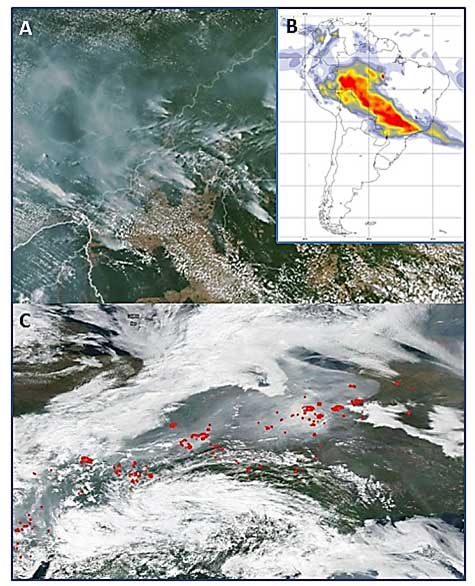
As fires rage across tens of thousands square km the Amazon forest, dubbed the Planet’s lungs, producing some 20 percent of the oxygen in the atmosphere, with some 72,843 fires in Brazil this year, where fires on such a scale are uncommon, as well as through Siberia, Alaska, Greenland,  southern Europe and elsewhere,they herald a world where increasing temperatures and droughts overwhelm original habitats, flora and fauna (Figure 1).
As the Antarctic and Greenland ice sheets progressively melt, at more than 6 times faster than during the Seventies, the tropics expand and arid deserts encroach into temperate Mediterranean-type climate zones at a rate of 56 – 111 kmper decade, the Earth’s fertile regions are progressively replaced by environments less suitable for farming.
According to reports “climate change itself is making dry seasons longer and forests more flammable. Increased temperatures are also resulting in more frequent tropical forest fires in non-drought years. And climate change may also be driving the increasing frequency and intensity of climate anomalies, such as El Niño events that affect fire season intensity across Amazonia.”
Figure 1 (A) Burning Amazon rainforest; (B) A warm smoke plume emanating from the Amazon fires; (C) The spate of Siberian wildfires from July 2019, reaching 6.4 million acres.
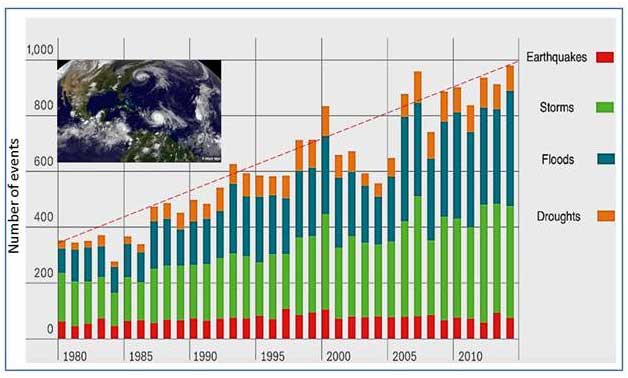
The pace of global warming is astounding climate scientists. Within the last 70 years or so major shifts in climate zones and an accelerating spate of extreme weather events—cyclones, floods, droughts, heat waves and fires (Figure 2)— is increasingly ravaging large tracts of Earth.
Figure 2.Extreme weather events around the world 1980-2018, including earthquakes, storms, floods, droughts.Munich Re-insurance.
However, despite  its foundation in the basic laws of physics (the black body radiation laws of Planck, Kirchhoff’ and Stefan Boltzmann), as well as empirical observations around the world by major climate research bodies (NOAA, NASA, NSIDC, IPCC, World Meteorological Organization, Hadley-Met, Tindale, Potsdam, BOM, CSIRO and others), the anthropogenic origin, scale and pace of climate change remain underestimated and the subject to extensively propagated denial and untruths. Extreme climate change remains counter intuitive to many, let alone where potential mitigation could affect vested economic interests.
Climate scientists find themselves in a quandary similar to medical doctors,committed to help the ill and facing situations where they need to communicate a grave diagnosis. How do they tell people that the current spate of cyclones, devastating islands from the Caribbean to the Philippine, or floods devastating coastal regions and river valleys from Mozambique to Kerala, Pakistan and Townsville, can only intensify in a rapidly warming world?How do scientists tell the people that children are growing into a world where survival under a mean temperatures higher than +2 degrees Celsius (above pre-industrial temperatures) may be painful, and in some parts of the world impossible, let aloneunder +4 degrees Celsius projected by the IPCC?
The Cassandra syndrome is alive and well. Throughout history messengers of bad news have been rebuked or worse, nowadays facing reluctance on the part of the mainstream media to publish the dire climate change projections. Given the daunting scenarios climate scientists are looking at, many find it difficult to talk about the issue, even among friends and family.
As atmospheric levels of CO2, methane and nitrous oxide have reached a combined level of near 500 parts per million, intersecting the melting threshold of the Greenland and west Antarctic ice sheets and heralding a fundamental shift in state of the terrestrial climate, fires consume large parts of the land.
It would appear parliaments preoccupied as they are with economics, legal issues and international conflicts, hardly regard the future of nature and civilization as a priority.
Andrew Glikson, Earth and climate scientist