
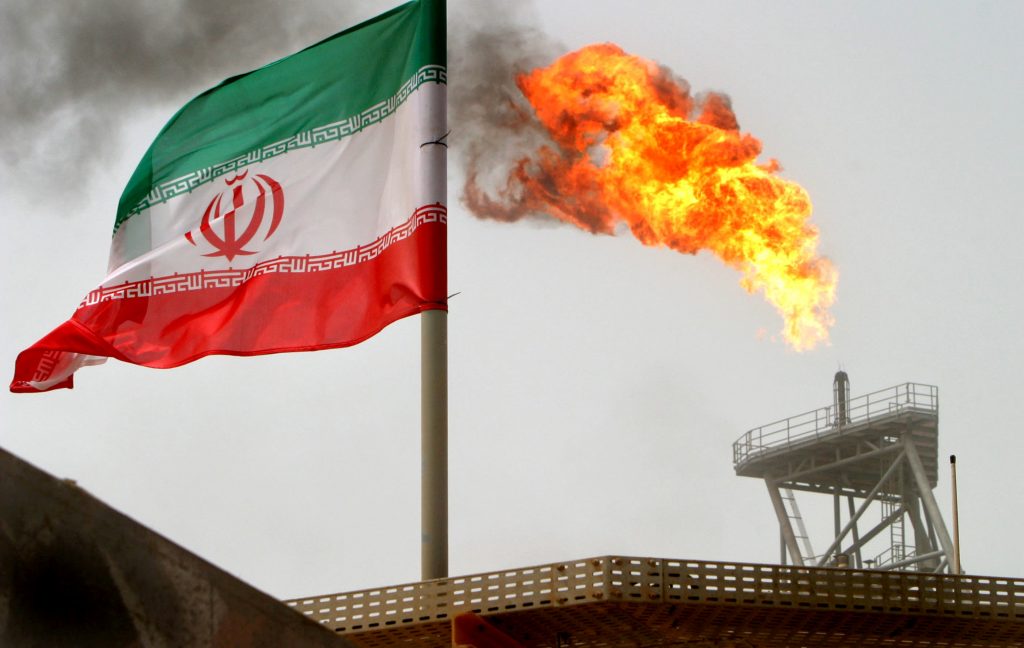
It’s always the oil. While President Trump was hobnobbing with Saudi Crown Prince Mohammed bin Salman at the G-20 summit in Japan, brushing off a recent U.N. report about the prince’s role in the murder of Washington Post columnist Jamal Khashoggi, Secretary of State Mike Pompeo was in Asia and the Middle East, pleading with foreign leaders to support “Sentinel.” The aim of that administration plan: to protect shipping in the Strait of Hormuz and the Persian Gulf. Both Trump and Pompeo insisted that their efforts were driven by concern over Iranian misbehavior in the region and the need to ensure the safety of maritime commerce. Neither, however, mentioned one inconvenient three-letter word — O-I-L — that lay behind their Iranian maneuvering (as it has impelled every other American incursion in the Middle East since World War II).
Now, it’s true that the United States no longer relies on imported petroleum for a large share of its energy needs. Thanks to the fracking revolution, the country now gets the bulk of its oil — approximately 75% — from domestic sources. (In 2008, that share had been closer to 35%.) Key allies in NATO and rivals like China, however, continue to depend on Middle Eastern oil for a significant proportion of their energy needs. As it happens, the world economy — of which the U.S. is the leading beneficiary (despite President Trump’s self-destructive trade wars) — relies on an uninterrupted flow of oil from the Persian Gulf to keep energy prices low. By continuing to serve as the principal overseer of that flow, Washington enjoys striking geopolitical advantages that its foreign policy elites would no more abandon than they would their country’s nuclear supremacy.
This logic was spelled out clearly by President Barack Obama in a September 2013 address to the U.N. General Assembly in which he declared that “the United States of America is prepared to use all elements of our power, including military force, to secure our core interests” in the Middle East. He then pointed out that, while the U.S. was steadily reducing its reliance on imported oil, “the world still depends on the region’s energy supply and a severe disruption could destabilize the entire global economy.” Accordingly, he concluded, “We will ensure the free flow of energy from the region to the world.”
To some Americans, that dictum — and its continued embrace by President Trump and Secretary of State Pompeo — may seem anachronistic. True, Washington fought wars in the Middle East when the American economy was still deeply vulnerable to any disruption in the flow of imported oil. In 1990, this was the key reason President George H.W. Bush gave for his decision to evict Iraqi troops from Kuwait after Saddam Hussein’s invasion of that land. “Our country now imports nearly half the oil it consumes and could face a major threat to its economic independence,” he told a nationwide TV audience. But talk of oil soon disappeared from his comments about what became Washington’s first (but hardly last) Gulf War after his statement provoked widespread public outrage. (“No Blood for Oil” became a widely used protest sign then.) His son, the second President Bush, never even mentioned that three-letter word when announcing his 2003 invasion of Iraq. Yet, as Obama’s U.N. speech made clear, oil remained, and still remains, at the center of U.S. foreign policy. A quick review of global energy trends helps explain why this has continued to be so.
The World’s Undiminished Reliance on Petroleum
Despite all that’s been said about climate change and oil’s role in causing it — and about the enormous progress being made in bringing solar and wind power online — we remain trapped in a remarkably oil-dependent world. To grasp this reality, all you have to do is read the most recent edition of oil giant BP’s “Statistical Review of World Energy,” published this June. In 2018, according to that report, oil still accounted for by far the largest share of world energy consumption, as it has every year for decades. All told, 33.6% of world energy consumption last year was made up of oil, 27.2% of coal (itself a global disgrace), 23.9% of natural gas, 6.8% of hydro-electricity, 4.4% of nuclear power, and a mere 4% of renewables.
Most energy analysts believe that the global reliance on petroleum as a share of world energy use will decline in the coming decades, as more governments impose restrictions on carbon emissions and as consumers, especially in the developed world, switch from oil-powered to electric vehicles. But such declines are unlikely to prevail in every region of the globe and total oil consumption may not even decline. According to projections from the International Energy Agency (IEA) in its “New Policies Scenario” (which assumes significant but not drastic government efforts to curb carbon emissions globally), Asia, Africa, and the Middle East are likely to experience a substantially increased demand for petroleum in the years to come, which, grimly enough, means global oil consumption will continue to rise.
Concluding that the increased demand for oil in Asia, in particular, will outweigh reduced demand elsewhere, the IEA calculated in its 2017 World Energy Outlook that oil will remain the world’s dominant source of energy in 2040, accounting for an estimated 27.5% of total global energy consumption. That will indeed be a smaller share than in 2018, but because global energy consumption as a whole is expected to grow substantially during those decades, net oil production could still rise — from an estimated 100 million barrels a day in 2018 to about 105 million barrels in 2040.
Of course, no one, including the IEA’s experts, can be sure how future extreme manifestations of global warming like the severe heat waves recently tormenting Europe and South Asia could change such projections. It’s possible that growing public outrage could lead to far tougher restrictions on carbon emissions between now and 2040. Unexpected developments in the field of alternative energy production could also play a role in changing those projections. In other words, oil’s continuing dominance could still be curbed in ways that are now unpredictable.
In the meantime, from a geopolitical perspective, a profound shift is taking place in the worldwide demand for petroleum. In 2000, according to the IEA, older industrialized nations — most of them members of the Organization for Economic Cooperation and Development (OECD) — accounted for about two-thirds of global oil consumption; only about a third went to countries in the developing world. By 2040, the IEA’s experts believe that ratio will be reversed, with the OECD consuming about one-third of the world’s oil and non-OECD nations the rest. More dramatic yet is the growing centrality of the Asia-Pacific region to the global flow of petroleum. In 2000, that region accounted for only 28% of world consumption; in 2040, its share is expected to stand at 44%, thanks to the growth of China, India, and other Asian countries, whose newly affluent consumers are already buyingcars, trucks, motorcycles, and other oil-powered products.
Where will Asia get its oil? Among energy experts, there is little doubt on this matter. Lacking significant reserves of their own, the major Asian consumers will turn to the one place with sufficient capacity to satisfy their rising needs: the Persian Gulf. According to BP, in 2018, Japan already obtained 87% of its oil imports from the Middle East, India 64%, and China 44%. Most analysts assume these percentages will only grow in the years to come, as production in other areas declines.
This will, in turn, lend even greater strategic importance to the Persian Gulf region, which now possesses more than 60% of the world’s untapped petroleum reserves, and to the Strait of Hormuz, the narrow passageway through which approximately one-third of the world’s seaborne oil passes daily. Bordered by Iran, Oman, and the United Arab Emirates, the Strait is perhaps the most significant — and contested — geostrategic location on the planet today.
Controlling the Spigot
When the Soviet Union invaded Afghanistan in 1979, the same year that militant Shiite fundamentalists overthrew the U.S.-backed Shah of Iran, U.S. policymakers concluded that America’s access to Gulf oil supplies was at risk and a U.S. military presence was needed to guarantee such access. As President Jimmy Carter would say in his State of the Union Address on January 23, 1980,
“The region which is now threatened by Soviet troops in Afghanistan is of great strategic importance: It contains more than two thirds of the world’s exportable oil… The Soviet effort to dominate Afghanistan has brought Soviet military forces to within 300 miles of the Indian Ocean and close to the Strait of Hormuz, a waterway through which most of the world’s oil must flow… Let our position be absolutely clear: an attempt by any outside force to gain control of the Persian Gulf region will be regarded as an assault on the vital interests of the United States of America, and such an assault will be repelled by any means necessary, including military force.”
To lend muscle to what would soon be dubbed the “Carter Doctrine,” the president created a new U.S. military organization, the Rapid Deployment Joint Task Force (RDJTF), and obtained basing facilities for it in the Gulf region. Ronald Reagan, who succeeded Carter as president in 1981, made the RDJTF into a full-scale “geographic combatant command,” dubbed Central Command, or CENTCOM, which continues to be tasked with ensuring American access to the Gulf today (as well as overseeing the country’s never-ending wars in the Greater Middle East). Reagan was the first president to activate the Carter Doctrine in 1987 when he ordered Navy warships to escort Kuwaiti tankers, “reflagged” with the stars and stripes, as they traveled through the Strait of Hormuz. From time to time, such vessels had been coming under fire from Iranian gunboats, part of an ongoing “Tanker War,” itself part of the Iran-Iraq War of those years. The Iranian attacks on those tankers were meant to punish Sunni Arab countries for backing Iraqi autocrat Saddam Hussein in that conflict. The American response, dubbed Operation Earnest Will, offered an early model of what Secretary of State Pompeo is seeking to establish today with his Sentinel program.
Operation Earnest Will was followed two years later by a massive implementation of the Carter Doctrine, President Bush’s 1990 decision to push Iraqi forces out of Kuwait. Although he spoke of the need to protect U.S. access to Persian Gulf oil fields, it was evident that ensuring a safe flow of oil imports wasn’t the only motive for such military involvement. Equally important then (and far more so now): the geopolitical advantage controlling the world’s major oil spigot gave Washington.
When ordering U.S. forces into combat in the Gulf, American presidents have always insisted that they were acting in the interests of the entire West. In advocating for the “reflagging” mission of 1987, for instance, Secretary of Defense Caspar Weinberger argued (as he would later recall in his memoir Fighting for Peace), “The main thing was for us to protect the right of innocent, nonbelligerent and extremely important commerce to move freely in international open waters — and, by our offering protection, to avoid conceding the mission to the Soviets.” Though rarely so openly acknowledged, the same principle has undergirded Washington’s strategy in the region ever since: the United States alone must be the ultimate guarantor of unimpeded oil commerce in the Persian Gulf.
Look closely and you can find this principle lurking in every fundamental statement of U.S. policy related to that region and among the Washington elite more generally. My own personal favorite, when it comes to pithiness, is a sentence in a report on the geopolitics of energy issued in 2000 by the Center for Strategic and International Studies, a Washington-based think tank well-populated with former government officials (several of whom contributed to the report): “As the world’s only superpower, [the United States] must accept its special responsibilities for preserving access to [the] worldwide energy supply.” You can’t get much more explicit than that.
Of course, along with this “special responsibility” comes a geopolitical advantage: by providing this service, the United States cements its status as the world’s sole superpower and places every other oil-importing nation — and the world at large — in a condition of dependence on its continued performance of this vital function.
Originally, the key dependents in this strategic equation were Europe and Japan, which, in return for assured access to Middle Eastern oil, were expected to subordinate themselves to Washington. Remember, for example, how they helped pay for Bush the elder’s Iraq War (dubbed Operation Desert Storm). Today, however, many of those countries, deeply concerned with the effects of climate change, are seeking to lessen oil’s role in their national fuel mixes. As a result, in 2019, the countries potentially most at the mercy of Washington when it comes to access to Gulf oil are economically fast-expanding China and India, whose oil needs are only likely to grow. That, in turn, will further enhance the geopolitical advantage Washington enjoyed as long as it remains the principal guardian of the flow of oil from the Persian Gulf. How it may seek to exploit this advantage remains to be seen, but there is no doubt that all parties involved, including the Chinese, are well aware of this asymmetric equation, which could give the phrase “trade war” a far deeper and more ominous meaning.
The Iranian Challenge and the Specter of War
From Washington’s perspective, the principal challenger to America’s privileged status in the Gulf is Iran. By reason of geography, that country possesses a potentially commanding position along the northern Gulf and the Strait of Hormuz, as the Reagan administration learned in 1987-1988 when it threatened American oil dominance there. About this reality President Reagan couldn’t have been clearer. “Mark this point well: the use of the sea lanes of the Persian Gulf will not be dictated by the Iranians,” he declared in 1987 — and Washington’s approach to the situation has never changed.
In more recent times, in response to U.S. and Israeli threats to bomb their nuclear facilities or, as the Trump administration has done, impose economic sanctions on their country, the Iranians have threatened on numerous occasions to block the Strait of Hormuz to oil traffic, squeeze global energy supplies, and precipitate an international crisis. In 2011, for example, Iranian Vice President Mohammad Reza Rahimi warned that, should the West impose sanctions on Iranian oil, “not even one drop of oil can flow through the Strait of Hormuz.” In response, U.S. officials have vowed ever since to let no such thing happen, just as Secretary of Defense Leon Panetta did in response to Rahimi at that time. “We have made very clear,” he said, “that the United States will not tolerate blocking of the Strait of Hormuz.” That, he added, was a “red line for us.”
It remains so today. Hence, the present ongoing crisis in the Gulf, with fierce U.S. sanctions on Iranian oil sales and threatening Iranian gestures toward the regional oil flow in response. “We will make the enemy understand that either everyone can use the Strait of Hormuz or no one,” said Mohammad Ali Jafari, commander of Iran’s elite Revolutionary Guards, in July 2018. And attacks on two oil tankers in the Gulf of Oman near the entrance to the Strait of Hormuz on June 13th could conceivably have been an expression of just that policy, if — as claimed by the U.S. — they were indeed carried out by members of the Revolutionary Guards. Any future attacks are only likely to spur U.S. military action against Iran in accordance with the Carter Doctrine. As Pentagon spokesperson Bill Urban put it in response to Jafari’s statement, “We stand ready to ensure the freedom of navigation and the free flow of commerce wherever international law allows.”
As things stand today, any Iranian move in the Strait of Hormuz that can be portrayed as a threat to the “free flow of commerce” (that is, the oil trade) represents the most likely trigger for direct U.S. military action. Yes, Tehran’s pursuit of nuclear weapons and its support for radical Shiite movements throughout the Middle East will be cited as evidence of its leadership’s malevolence, but its true threat will be to American dominance of the oil lanes, a danger Washington will treat as the offense of all offenses to be overcome at any cost.
If the United States goes to war with Iran, you are unlikely to hear the word “oil” uttered by top Trump administration officials, but make no mistake: that three-letter word lies at the root of the present crisis, not to speak of the world’s long-term fate.
Michael T. Klare, a TomDispatch regular, is the five-college professor emeritus of peace and world security studies at Hampshire College and a senior visiting fellow at the Arms Control Association. His most recent book is The Race for What’s Left. His next book, All Hell Breaking Loose: The Pentagon’s Perspective on Climate Change (Metropolitan Books) will be published in November.

