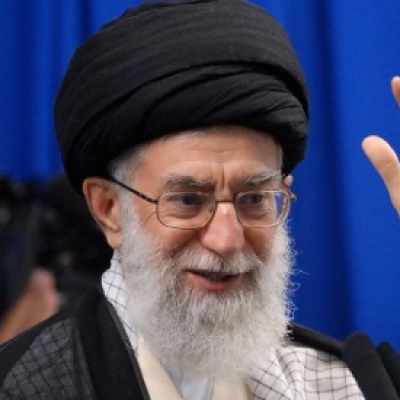
 Sayyid Ali Khamenei
In December last year, AYATULLAH SAYYID ALI KHAMENEI, the Vali-e Faqih of the Islamic Republic of Iran, convened a meeting of Islamic movement leaders and representatives in Tehran. Here we reprint extracts from his talk to the gathering. It is impossible to imagine any other statesman in a position of authority in the Muslim world speaking so openly and frankly about the state of the world today, clearly identifying the Ummah’s errors and weaknesses, and the dangers and challenges facing us.
In the Name of God the Compassionate, the Merciful...
I welcome all of you, and thank you for having accepted the Islamic Republic of Iran’s invitation to take part in this gathering. You are among your family and brothers. Iran is the second home of Muslims all over the world.
This gathering is necessary at this time because Muslims all over the world are now facing new threats and challenges. When a human being is threatened, it is necessary for him to gather his forces and use his intellect to determine the appropriate response to the threat. A dynamic community, such as the Ummah of Islam, cannot simply sit passively and let events shape its destiny. Islam encourages and inspires the Ummah to be proactive in thoughtfully planning their actions and implementing their plans. This is why this gathering has been called, and why you have gathered here in response to this need. We hope and expect this gathering to be taken seriously and to have an impact on the affairs of the Ummah. The issues confronting the Ummah today, and the capabilities of the Ummah in responding to these issues must be understood and marshalled, and the use of these capabilities must be considered.
We, the government of the Islamic Republic, are dependent on Almighty God, alhumdulillah. We also rely on our noble and vigilant people. We are ready to meet our responsibilities and to do our share as a part of the global Islamic community.
It is true that the Islamic world is facing numerous new threats today. But, on the other hand, there are also new opportunities and advantages before us, which we did not have before. When one speaks of opportunities and advantages, people’s thoughts are drawn first to material or financial factors. For instance, some people may think that I am talking about geographical location, historical background or natural resources under the ground. Some might think that the large population of the Islamic world is an invaluable resource. Of course these things are important. However, we must realize that, despite our having had such resources in the past, the colonial powers managed to gain control of the Muslim world, and dominated us for 150 or 200 years. As a result, Muslims were turned into dependent and backward peoples. So we must conclude that such resources are not sufficient on their own.
Of course, being weak and backward at any given moment of history does not mean that the weakened and dependent people are doomed to permanent subservience. No. What we must realize is that whenever we come to our senses, and fulfill the duties that Islam has prescribed for us, everything will change, insha’Allah, and the Ummah will make real progress.
In my opinion the biggest opportunity open to the Islamic world is Islam itself. Almighty Allah tells us in the Holy Qur’an, that Islam is gift from Him to us. Indeed, it is the greatest of all the gifts that Allah (swt) could have given us. Whatever gratitude we wish to express, we should do so by observing our Islamic faith in its fullest sense. Islam can strengthen the Muslim’s heart and spirit, and can equip the Ummah with knowledge, understanding and unity. This is the fundamental power of Islam, and we should not underestimate it.
Islam’s situation today is different from what it was 50 years ago. Compared to 50 years ago, the world of Islam is much more dynamic and forward looking, much more alive, enthusiastic and full of hope, and much more in tune with the aspirations and expectations of our young generations, our youth. Muslims of the world today are proud of their faith. There was a time that the Muslims had lost pride in Islam. Many Muslim intellectuals were proud of having abandoned the faith and not practising their Islam. This has changed today; all over the world, young people and intellectuals are proud of living in accordance with Islamic values, and of proclaiming the Islamic identity. This pride is a massive resource for the Ummah.
Some of the major ideological challengers of Islam – Marxism, communism and socialism – have been eliminated from the historical arena. They once represented major challenges to Islam in Muslim countries. Today they have been defeated by the realities in the world, and in the process, Islam has re-emerged as the dominant political force in the Muslim world, in a way unprecedented in the modern history of the Muslim world. In the past, when people spoke of political Islam, they referred to the early centuries of Islam; Islam was not a factor in contemporary political affairs. Today, Islam is at the centre of political affairs, and has established its own capability and power. It has shown that it can defend itself and be a positive, constructive force in public affairs for the Muslim Ummah. This is a great achievement and puts the Ummah in a very strong position.
Over the last few decades, those who aimed to dominate the Muslim world, used to promise us western modernity. In effect, they used to say: ‘we will offer you western modernity if you surrender to us and bow to our culture.’ Today when Muslims look at that past, they see that western modernity has brought the world of Islam dependence and corruption. It has made Muslims weak, both singly and collectively. Instead of progress and success, western modernity has only brought Muslims domination and subservience. Today’s Muslims have recognised this reality and will not make the same mistakes as previous generations.
Today liberalism is facing contradictions even in its own birthplace. Today, in the supposed birthplaces and homes of liberalism and individual freedoms, the same people who used – and still use – the rhetoric and slogans of freedom are resorting to methods that are the precise opposite of freedom.
Today the West has no response to the persecution of Palestinian children, it cannot justify the occupations of Iraq and Afghanistan, and defend its horrendous killings of large numbers of people in both countries. The West does not have a response to, and cannot protect itself against, the Islamic commitment and fervour of the people of these countries, people who opted for Islam when they were oppressed and confronted by the Americans.
Today the West does not have any kind of response to insults against women’s dignity. In the Western world, the supposed birthplace of freedom and democracy, woman’s dignity has been lost. Sexual corruption is reaching extreme levels, and the institution of the family is on the verge of destruction. Statistics on the destruction of the foundations of family life in Western countries are outrageous and shocking. The West held itself up as a model in these areas for the rest of the world; today these very issues are exposing the contradictions and failings of liberalism.
Now America, in its arrogance, is producing a new response to the challenge being posed by Islam. America today, after decades of promoting and protecting the most brutal dictators in the region,, is suddenly championing democracy. Who does not know that America itself was the greatest supporter of the dictators and tyrants in the Muslim world. Today everyone recognises that it was America that supported Saddam for so long, and that it was America that gave a green light for Saddam’s invasion of Iran and the eight years of war that followed.
Saddam had been nurtured by the Americans. They provided him with chemical weapons. They were silent in the face of the massacre of Iraqis in Halabjah, and that of many of our young people. In our country we still have many people who have been affected by chemical weapons. Every few weeks we hear the news of the death of another one of these people who were injured in chemical attacks and have been dying ever since. The West was silent when these events took place. Today the same West is pushing ‘democracy’ in this region. This is no more than another self-serving response to the rise of Islam in the region and the popular Islamic government.
The religious government of the people means the votes of the people, with religious values, and with the respect which religion has reserved for the vote of the people. Religion provides dignity for people. Religion obliges governments to take seriously their responsibility to and for the people. Religion does not accept dictatorship from any ruler under any circumstances. This is our Islam. This is religious government of the people: religious government is based on a strong and clear logic, on the principles and values that Islam has established for the governing of every society. Today this has been presented to the world, it has been practised in reality, it is not only written in books. In the last 25 years we have had 24 elections in the Islamic Republic; people have turned out in large numbers to vote and safeguard the system. This is the reality of an Islamic government of the people. And America is reacting to this by talking about the "government of the people"!
The enemies of Islam, led by the Zionists and America, do not want the real, true Islam to be seen. They want to restrict perceptions of Islam to two forms: either the backward form that has been seen in the Islam of the Taliban – empty of logic, full of strong fanaticism and devoid of compassion, rationality, knowledge and wisdom – so that everyone hates, despites or fears Islam; or a form of Islam that has lost its own identity to the West, an eclectic Islam that would accept whatever the West wants, and propagate Western culture as Islam, having nothing to say for itself. Those are the only two forms of Islam acceptable to its enemies. What they do not want anyone to see or recognise is the Islam that seeks dignity, power, justice and progress for the Islamic community: the form of Islam which builds life.
Today, the enemies of Islam know that immense power resides in the Muslim Ummah. They fear this power, and so they fight it without acknowledging what it is that they are fighting. Instead they give other labels to their adversary. For instance, they expand the meaning of terrorism to include liberating movements. They intend to crush the Palestinians, who are the most courageous fighters for Islam, by branding them terrorists. They also try to delegitimise the struggles of the warriors of Lebanon, Iraq, Afghanistan and every other region of the Muslim world, who are confronting colonialism and foreign interference in their homelands. They use weapons of mass destruction, human rights or democracy as excuses to justify their war because they are too frightened to confront Islam directly.
It is true that the Ummah is facing new threats. But we have new potentialities too. Large numbers of young Muslims everywhere are turning away from the West’s seductive and colourful temptations to keep faith in their hearts and obedience to God in their deeds. There are many such young people everywhere in the Muslim world. Many intellectuals and scholars speak or write in support of Islam. They recognise its qualities, its values, its civilization, its arts. Today the Muslim world too is realising its power. It is recognising its own strength. The threat may be big, but so is the potential. It is up to us to benefit from it through our own commitment and endeavour. There is a hadith of Allah’s Messenger (saw) which says "the Muslims are like a sturdy plant which may be flattened by the wind of events; but they will stand again when the opportunity arises." The Holy Qur’an says something similar, that a Muslim resembles a tough tree whose roots are stable and whose branches spread into the sky. It is for us to ensure that this tree will bear fruit.
We in Iran, in the Islamic Republic, have concentrated all our efforts on strengthening the foundations by a number of crucial principles. The first is that we shall not abandon government of the people, which has been derived from Islam. It is an Islamic instruction. Islam has clarified giving bai’ah to the rulers. We accept this wholeheartedly. This is an Islamic instruction; we have not taken it from the West.
The next principle is that we shall stand firm against infiltration and interference by foreign powers. We do not mind exchanging science, knowledge and experience with the rest of the world. We can engage in transactions of material and intellectual commodities, but we shall not submit to foreign domination under any circumstances. The enemies of Islamic Iran are not happy with this, but we have proved that we remain committed to this, and that we are able to do so. We believe that the entire Muslim world can do so too.
The next principle is of justice. The promotion and maintenance of justice is the most demanding task facing us. It is very difficult to implement social justice in any society. We intend to promote justice and we have taken steps in this direction. However, a huge gap remains before we achieve the standard that Islamic principles demand of us. We must concentrate our efforts on this issue,insha’Allah.
The next principle is that we believe in the progress of science. We have advanced a great deal in pursuit of this principle. We believe that the Muslim world, in view of its historical record of cultural and scientific achievements, can take bigger steps in the arena of science and knowledge. We have recommended that our young people and scholars must be studious and imaginative in this field.
We believe that disunity within the Ummah is the greatest internal danger to the Islamic world. We are a community of diversity, and have become distant from each other; we have disunity when we need to be united. Our enemies exploit this for their own agendas. Our appeal to the Muslim world, and to all Muslims countries, is to unite and become closer. Some of our differences and disagreements can be resolved; we must resolve them. Others may not be soluble in the short term; they should be set aside. This prospect would pose a massive threat to the interests of the Zionists and Americans; which is why they concentrate such great efforts to ensure that it does not happen.
Tribal differences, religious and clan disputes, political disputes and differences of opinion are all deliberately exploited by our enemies to ensure that we remain disunited. The grounds for these differences existed among us before, but we were neglectful and did not remove them. They exploited this oversight and have targeted these issues to weaken us. We have wasted our spiritual and material resources on various tribal, civil, religious and clan disputes and wars. This is a crucial issue which we must pursue with all sincerity and urgency.
Today, the enemies of Islam and the Muslim Ummah are using two main weapons against is: intimidation and subversion. Sometimes they intimidate governments and intellectuals, elites, organizations and individuals with threats and shows of power; other times they subvert them with bribes and incentives. Both of these are strategies of shaytan. We must not fear their intimidation.
"Those to whom the people said: ‘Surely men have gathered against you, therefore fear them’; this increased their faith, and they said: ‘Allah is sufficient for us and most excellent Protector.’ So they returned with favour from Allah and [His] grace, no evil touched them and they followed the pleasure of Allah; and Allah is the mighty Lord of grace." (Qur’an 3:173-174).
We must not fear the enemies’ intimidation. Nor should we be tempted by their bribes. Nothing good can ever come from our enemies to us, and their bribes and incentives are a trap. This applies to individuals as well as to states and governments, and to every sector of society. We must make this our motto. We must not hope for anything from them, nor should we fear their power and intimidation. "And be not infirm, and be not grieving, and you shall have the upper hand if you are believers" (Qur’an 3:139).
One of the most important things for us today is that we must recognise our enemies. Today, the greatest enemy of the Islamic world is America and Zionism. They are the worst, the most evil and dangerous of worldly shaytans, and they are completely and very openly united. They are the big idol that must be broken. We must expose them to the people and to every individual. We must ensure that the reality of the nature of these enemies is clear to each and every Muslim, all over the world.
Some people neglect the chief and real enemies, and instead deem some secondary ones as their main enemies. This is a big mistake that diverts the attentions of the Ummah and drains the dynamism of Muslims. Alhumdulillah, we have not made any mistakes in identifying our enemy; nor will we ever make a mistake. Many hostile acts are perpetrated against us, but we never mistake these hostilities for the main and real enemy. We do not allow ourselves to be distracted by these side shows. The real enemy is America and Zionism. We must recognize these enemies, and the methods they use to subvert and defeat us, in order that we can effectively counter them.
I would like to close with this ayah of the Qur’an, which summarises our most important challenge and duty: "Say, I exhort you only to do one thing: rise up for Allah’s sake in twos and singly" (34:46).
Sayyid Ali Khamenei


