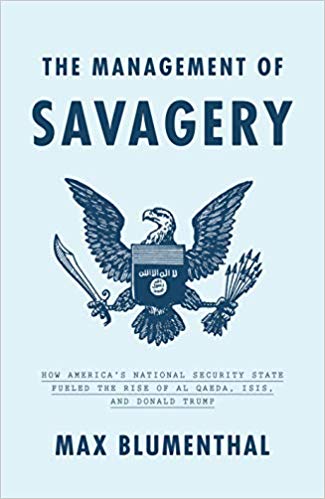
The Management of Savagery – How America’s National Security State Fueled the Rise of al-Qaeda, ISIS, and Donald Trump. Max Blumenthal. Verso, London/New York, 2019.
Even though the ending is known, Max Blumenthal’s book The Management of Savagery draws the reader through an intriguing tale of media management, political management, financial management all with the goal of achieving the management of savagery. The title derives from a 2004 al-Qaeda document of the same title which advises “jihadist groups to exploit the chaos that resulted from the destabilization of previously stable states.”
 The savagery is to eliminate all opposition and as per the author Abu Baker Naji, “If we succeed in the management of savagery, that stage will be a bridge to the Islamic state….” In a sense, these sentiments reflect the neoconservative agenda to destabilize and fragment the Middle East in order to “manage” the petrodollar, oil resources, and to allow Israel to “manage” the region as the neocon outpost of civilization.
The story starts in Afghanistan, the first war in the series of managed wars by the U.S. hoping to trap the Soviet Union in its own Vietnam. It is a mix of CIA, ISI (Pakistan’s intelligence service), a variety of warlords, arms merchants, the Pakistan army, and the newly created Taliban. It follows swiftly through areas suffering the fallout from these activities – Bosnia, Yugoslavia, Chechnya.
In “The dawn of the forever war” – pre 9/11 – CIA collusion with the Taliban was “swept away” – allowing a “close knit band of neoconservatives to build the case of a full scale military confrontation with Iraq.” The CIA’s long standing “sordid history of collusion with jihadist elements” created “colossal failures of judgment….” The push behind the U.S.’ attitude came from the neoconservatives – Wolfowitz, Feith, Perle, Kagan, Kristol et al – whose essays “A Clean Break” and “Project for a New American Century” outlined the case for a “benevolent global hegemony,” but it would require a long “process of transformation….like a New Pearl Harbour.”
On the other side, al-Qaeda’s strategy was essentially the same, Brzezinski’s “Afghan trap” in reverse, a “strategy to trigger a series of American interventions and bleed an overstretched empire.” For both sides, 9/11 was the critical factor.
After 9/11 the world was polarized, “with us or against us.” It became a religious war, a civilizational war, and a sectarian war. From there the story continues its winding, twisting , convoluted path through Afghanistan again, into Iraq, and increasingly with its blowback effects into the U.S. and its allies, in particular Great Britain.
One of the blowback results from this were the refugees/migrants suddenly flooding over into Europe. Domestically in the U.S. Islamophobia was nurtured by Stephen Bannon and other “monomaniacal” and “trash-talking” Islamophobes. The stage was set for the rise of right wing populist forces,”counter-jihadists”, establishing a “comfortable, mutually reinforcing symbiosis that relied on a constantly escalating sense of antagonism.”
Much of the story concerns the most recent war, the war in Syria. It is at the extreme end of convoluted affairs with Pakistan, Saudi Arabia, Qatar and other Gulf states supporting al-Qaeda/ al-Nusra/ISIS in its various formations. The U.S. and its NATO allies while pretending to be against the savagery of ISIS and its related groups, provided military and training assistance along with its Middle East surrogate Israel. Israel created what was essentially a safe zone around the Golan Heights, helping ISIS with supplies, medical and military support.
Turkey played a double game, supporting ISIS, countering Kurdish forces and interests, controlling to some degree the mass movement of refugees from the fighting. Lebanon played a passive role providing a protective international air space for Israeli and NATO air incursions while unwillingly harbouring ISIS forces on the Syrian border. Iran provided military and logistic support to Syria, broadening its influence in the “Shia crescent”.
And then along came Russia, a long time Syrian ally that proved the lies about U.S. interests in defeating the jihadists. Once the U.S. recognized its waning influence, Russia’s role took on its old familiar place within U.S. mainstream media as the bad guy. The “moderate rebels”, who never really existed, and the supposedly humanitarian White Helmets who assisted ISIS became the good guys in western media.
Blumenthal manages to weave his way through all these storylines, highlighting the manner in which the chaos of savagery was not truly controllable. The main U.S. domestic result of these long wars, the media rants, Islamophobia, worked out to the advantage of the neoconservative agenda. “With the strange and sudden transformation of the democrats into a paranoid war party, a quiet neoconservative campaign set into motion a decade before was being realized.”
Hearkening back to the post Soviet 1990s, “the goal was clear: to encircle the largest and most militarily powerful nation in Eurasia and gradually transform it into a toothless, economically dependent vassal of the United States.” U.S. actions, the “shock doctrine” imposed by the “Harvard boys”, “should have stood alongside some of most titanic crimes of the twentieth century.” After years of slow understated resurgence, Russia re-entered the global political scene via Georgia, Libya, Ukraine and on into Syria.
The Democratic party has positioned itself now on the side of the neocon warhawks, and as the Syrian war settled into a simmering aftermath, the old Cold War Russia haters dominated supposedly liberal thinkers, stoked by the ultimate blowback from all the military and political muckraking – the election of Donald Trump.
With Trump painted as Putin’s puppet, with both sides calling out “fake news”, with the national security state under the influence of John Bolton and Mike Pompeo, “the reality of America’s waning influence on the world stage” is obvious. “In the face of their own failure, America’s national security elites had successfully engineered a new Cold War, wagering that the reignited conflict would preserve their management savagery….As the dust cleared from two decades of regime change campaigns a new cast of evil doers was coming into focus.”
Most people know the superficialities of this history, mainly the mainstream media broadcasts of the U.S./NATO/western obfuscation, omissions, and contrivances around events. Max Blumenthal’s The Management of Savagery clearly exposes the many twists, turns, and convolutions of the various actors. In spite of its complexity, this book is a fascinating read into the many aspects of how the initial setup of support for the Afghan mujahideen has morphed into today’s Russophobic, Islamophobic, right wing security state, with the savagery expressed more and more domestically while it is still pushed into foreign countries. It needs to be on everyone’s bookshelf in order to understand the roots and pathways of our current global situation.
Jim Miles is a Canadian educator and a regular contributor/columnist of opinion pieces and book reviews for The Palestine Chronicle. Miles’ work is also presented globally through other alternative websites and news publications.