Showing posts with label Islamic heritage. Show all posts

Sunday, September 22, 2019

Was Omar Khayyam, the legendary Persian mathematician and poet, an atheist?

“Therefore, whatever [ignorance] comes to man is due to the impurity of his nature; if the veil be lifted and the screen and obstacle removed, the truth of things as they are will become manifest.”


In an article by, B. B. Robinson, it is claimed that Omar Khayyam was an existentialist atheist. Similar statements are being made in various atheist websites as well, and for evidence of this claim, excerpts from his poems (Rubayy) are being given. Even a historian like Philip K. Hitti is saying that Omar Khayyam was a freethinker! Let’s read some lines from Khayyam’s poems first. 

Umar’s Poetry

“The temple I frequent is high,
A Turkish-vaulted dome–the sky,
That spans the world with majesty.
Not quite a Muslim is my creed,
Nor quite a Giaour; my faith indeed
May startle some who hear me say
I’d give my pilgrim staff away
And sell my turban, for an hour
Of music in a fair one’s bower.
I’d sell the rosary for wine,
Though holy names around it twine.
And prayers the pious make so long
Are turned by me to joyous song;
Or, if a prayer I should repeat,
It is at my beloved’s feet.
They blame me that my words are clear;
Because I am not what I appear”
… 
“Why, all the Saints and Sages who discuss’d
Of the Two Worlds so wisely — they art thrust
Like foolish Prophets forth; their words to Scorn 
Are scattered, and their Mouths are stopt with Dust”
“Oh, threats of Hell and Hopes of Paradise! 
One thing at least is certain — This Life flies”
 “The Revelations of Devout and Learn’d
Who rose before us, and as Prophets burn’d,
Are all but Stories, which, awoke from Sleep
They told their comrades, and to Sleep return’d.”
Although not an expert in poetry, I believe that judging something so serious like someone’s faith by only reading some lines of their poetry is a bit unfair. I cannot understand how some scholars have made their decision that Omar Khayyam was a pessimistic philosopher, materialist, and strict atheist just by reading his poetry. 
To further explain why the quick jump to conclusions based off of poetry is unnecessary, let us take a look at some of the poetry of other well renown Muslim poets and writers, including Allama Iqbal, the “spiritual father of Pakistan”, and Qazi Nazrul Islam, Bangladesh’s national poet.

Iqbal’s Poetry

Let us first read from Allama Iqbal’s poetry, in where he speaks directly to God: 
“Design a new pattern
Create a more perfect Adam
This making of playthings of clay
Is not worthy of God, the creator
If the pattern is poor
What does repetition achieve?
How can the cheapness of man
Meet your approval?”
Now, would you say that Allama Iqbal, who always strived on the path of Islam, was an infidel?

Nazrul Islam’s Poetry

Qazi Nazrul Islam is one of Bangladesh’s most treasured  poets, also famous for his Islamic poetry as well. A collection of his Islamic poetry made by the Islamic Foundation of Bangladesh has compiled more than 400 pages of his work. Now, let’s look at an English translation of his poem বিদ্রোহী  (Rebel): 
“Say, Valiant,
Say: Ripping apart the wide sky of the universe,
Leaving behind the moon, the sun, the planets
and the stars
Piercing the earth and the heavens,
Pushing through Almighty’s sacred seat
Have I risen,
I, the perennial wonder of mother-earth!
The angry God shines on my forehead
Like some royal victory’s gorgeous emblem.
Say, Valiant,
Ever high is my head!”
“I crush under my feet the vain glory of the Almighty!”
“Sitting in the burning pit of Hell
I smile as the innocent flower!”
Does this make Qazi Nazrul Islam a heretic or an atheist? He further writes in the same poem: “I am insane! I am insane!” So now it should make sense that the same scholars who concluded that Omar Khayyam was de facto an atheist, should also say that “Nazrul Islam was a mad-man! Look, he writes it himself!” Taken from PoemHunter, besides Rebel there is another poem of Nazrul Islam which goes: “Allah is my lord…”. 
The words chosen in a poem and the core meaning of the poem can be very different. They can even be the opposite, therefore judging someone’s faith just by reading their poetry is totally absurd.  
This is especially true because the general consensus is that Omar Khayyam was a poet not a scientist; but actually, he was scientist, not a poet.
Let’s discuss in detail. 

Khayyam: Really a Poet?

A scholar, Hans Heinrich Schaeder, said that the name of Omar Khayyam should be removed from the history of Persian literature because of the lack of any material that could confidently be attributed to him.
But still, he was a poet. The first allusion to Omar’s poetry was done by Imad al-Din Isfahani, 50 years after his death. There are also 25 Arabic poems attributed to Omar by classical scholars. The number of quatrains, according to the writings of contemporary scholars of Omar’s time, are 6. The question then is, how did 6 poems rise up to 1200? The most famous manuscript in Oxford’s Bodleian library consists of 158 poems. 
After much analysis, it is being understood that it is probably the poetry of several poets here, including Hafiz, Attar, and philosophers like Al-Ghazali and Ibn Sina. Usually Diwans remain intact for long time, but there are high chances of Rubayy getting mixed and corrupted.
Christensen has worked the most in this field, and announced that 121 poems are of Omar Khayyam’s. But he is unable to give a guarantee even for the 12 poems kept in the first class! These poems were selected keeping in mind the Persian writing styles and Omar’s thinking process. But both the Persian rhetoric and Omar’s thought are disputed. Afterwards, Christensen himself said that it is an impossible task to be sure about the actual poems of Omar Khayyam. Christensen’s work is nothing but a collection of poems with a specific rhetoric and thought process. 
Most scholars, only by reading Omar’s poetry, are giving into the statement that he was a pessimistic philosopher and a materialist, which is very wrong. This problem has risen because of not reading Omar’s non-fiction writing. They only look at the poems because of its fame. Based off of this, we even see Christopher Hitchens making Omar a member of neo-Atheism! 
So, looking at the poems have no value, and let’s instead analyse his non-fiction writing. Before going into this, I would like to clear out that there is a non-fiction work in Berlin by Omar Khayyam on existentialism, and a classical scholar named Najm al-Din Daya describes Omar as a pessimistic philosopher, atheist, and materialist. But after reading the following explanation, I hope no doubts will remain about Omar Khayyam’s faith. 

Omar Khayyam’s non-fiction writings

Umar Khayyam writes himself: “This [Tasawwuf or Sufism] is the best of all ways, because none of the perfections of God are kept away from it, and there are no obstacles or veils put before it. Therefore, whatever [ignorance] comes to man is due to the impurity of his nature; if the veil be lifted and the screen and obstacle removed, the truth of things as they are will become manifest. And the Master [the Prophet Muhammad] upon whom be peace – indicated this when he said: ‘Truly, during the days of your existence, inspirations come from God. Do you not want to follow them?’ Tell unto reasoners that, for the lovers of God [Gnostics], intuition is guide, not discursive thought”.
Historian Ibn al-Qifti writes that Omar Khayyam was once skeptical about faith, but later, became a practicing Muslim, went to hajj, and after coming back visited the mosque day and night. Shams Tabriz (Sufi guide of Rumi) and a few other Sufis didn’t like Omar. This is not abnormal, as Ibn Sina was also called a disbeliever in his lifetime and he always replied back in return. Even the great hadith scholar Ibn Hibban was accused of atheism, and had to leave town. Omar Khayyam went to hajj in order to prove that he was indeed a believer. 
The most important book for Omar Khayyam’s biography is by Abu’l Hasan al-Bayhaqi. He describes the death of Omar Khayyam as such: 
“Ḥakim was studying the Ilāhiyyāt of Shifā and once he came to the section on unity and multiplicity, stopped in order to pray and utter his last words. His companions gathered and he [Khayyām] announced his last will and testament and performed his noon prayer. He neither ate nor drank again until he performed his night prayer. He bowed and placed his forehead on the ground and said: ‘O God, I know Thee in as much as my ability allows, forgive me for I know Thy way is the way towards Thee’, and then died.” 
Shahrazuri describes Omar’s last day similarly. There he further writes that Omar Khayyam was making sujood (prostration) and asking Allah to forgive his sins at the time of his being skeptic. He died at that state, while making sujood.

Conclusion

So if we look holistically at Omar Khayyam’s non-fiction writings, poems, and descriptions made by his contemporary historians, we will be able to understand that he was in no way an atheist and was in fact a spiritual Sufi Muslim. Of course, there will remain a huge debate among scholars in academia about the faith of Omar Khayyam; and the question of his faith will remain somewhat open. But I hope that this article has been able to clear out some of the obscurities surrounding his devotion towards God.

Sources:
  • Seyyed Hossain Nasr, Science and Civilization in Islam  (ABC International Group, Inc. 2001) p: 33.
  •  Iqbal’s Educational Philosophy, by K.G. Saiyidain, 1938.
  • Francois De Blois , Persian Literature – A Bio-Bibliographical Survey: Poetry of the Pre-Mongol Period (2004), p. 307.
  • V. Minorsky, “Umar Khayyam” (translated into Bengali by Humayun Khan) In Islami Bisshokosh (Islamic Foundation Bangladesh, 2nd edition, 2004) vol. 6, pp: 196-201 (the text is translated from Islamic Encyclopedia published by E.J. Brill).
  • ‘Umar Khayyam. Risalah-i wujud (Bayadi MS. in the Tehran National Library). Translated by S. H. Nasr.
  • Ross, E. (1898). “Al-Musaffariyé: Containing a Recent Contribution to the Study of ‘Omar Khayyam.” Journal of the Royal Asiatic Society of Great Britain and Ireland, 349-366.
  • “Ibn Hibban” in Islami Bisshokosh (Islamic Foundation Bangladesh, 2nd edition, 2004) vol. 4, pp: 532.
  • Meyerhof, M. (1948). ‘Ali al-Bayhaqi’s Tatimmat Siwan al-Hikma: A Biographical Work on Learned Men of the Islam. Osiris, 8, 122-217.
  • “Umar Khayyam” In Islami Bisshokosh (Islamic Foundation Bangladesh, 2nd edition, 2004) vol. 6, pp: 209.

Monday, September 09, 2019

Hajar: The legacy of one of Islam’s most important Black women

I do believe The Creator preserved such a powerful narrative of a Black woman who possessed no status, fame or wealth to demonstrate to humanity the noble rank a truly righteous soul, one without any material markers, has in the eyes of The Divine.


Hājar was a Black woman of Nubian descent who was formerly a slave. She is the wife of Ibrahīm (Abraham) and gave birth to Isma’il (Ishmael), peace be upon them both.
One of the most powerful narratives of her life is when Ibrahīm is commanded by God to leave her and Isma’il alone in the desert. It is important to note that Ibrahīm prayed to God for offspring for almost 86 years of his life. In being blessed with Isma’il through Hājar, he was not only grateful to God but also began envisioning his life as a father – someone who could watch his son grow and develop under his mentorship and love.
Through His Divine Wisdom, God the All-Mighty soon reminds Ibrahīm who the True Possessor of all Bounties is by directing him to leave both his child, who was only an infant at this time, and his wife in an uncultivated valley, far from any human support or natural sustenance.
Upon the three of them reaching this barren land, Ibrahīm turns around and begins to walk away. He is shedding tears, but is unable to turn back when his wife asks why he is leaving them. Some scholars believe that Ibrahīm knew that if he turned back to respond to Hājar, he would have seen her and his child’s state and would have lost all willpower to submit to God’s Decree. Internally, he knew God would look over his family, but the immediate reality likely had him convinced that Hājar and Isma’il, alone in this desert, may actually die.
When Hājar realizes Ibrahīm is acting on God’s Decree, the Decree of the Source of all Mercy, she says: “then God will not let us go.” She and Isma’il are left with nothing but a leather jug full of water and a bag of dates.
When the provisions run out and thirst begins to overtake her son, Hājar runs up to the top of a hill to look for some support. After seeing nothing in the distance, she runs back down into the valley and up to the top of another hill. She goes back and forth between the tops of these two hills seven times, desperately searching for any possible soul out there who may be able to help her family.
Hājar then hears something. She runs down into the valley and through a miracle by the Source of Miracles, she sees next to her son a sudden gush of water springing up from the ground. In some narrations, it was the Angel Gabriel (peace be upon him) who struck the ground with his heel, yielding this fountain.
This source of water (Zamzam), nothing less than a Bounty from God, begins flowing incessantly and as Hājar attempts to create a pool of mud to contain it, she becomes overwhelmed by the limitless quantity. Since that day, this water has continued to flow from the ground and is now the source that quenches the thirst of millions of pilgrims from across the world. This valley would soon be where the House of God (the Ka’bah) would be built by Ibrahīm and Isma’il.
Some could argue Hājar was a mad woman for running back and forth frantically. Others can say if she truly trusted God, she would have never been worried and remained in place.
I see a woman who relied upon The Creator and in her reliance upon Him, she fully exerted all of her God-given capabilities. She was aware her Lord fully knew her struggle, recognized her efforts, and would elevate her based on her willingness and ability to act, regardless of the outcome. On the Day of Resurrection, God promises to take into account all that was done for Him, right down to what is equal to the weight of a mustard seed [21:47]. Hājar submitted to God and His Decree and in doing so, acted with a sense of optimism, knowing her striving and toiling would be fully repaid either in this life or the next.
I share all this because this life continues to judge us by the tangible, numerical value we can add. If we cannot produce something that can be displayed under ‘work experience’ or ‘achievements’, we convince ourselves it’s not worth investing in. We rewire our efforts to focus on what we can prove to people of our self-worth.
My mother Hājar reminds me of the value of investing in my faith-based principles and putting forth an effort to improve my soul by actively and secretly fighting my internal demons and difficulties. These are the struggles the world will never know of, but I will continue to battle the diseases within my heart through reflection, prayer and action to gain proximity to my Creator because He is not concerned with what I ultimately become, but rather who I consistently strive to be.
God, in His Infinite Wisdom, has immortalized the story of my mother Hājar so much so that part of my obligation in performing the Hajj (pilgrimage) requires walking in her footsteps. Every Muslim is obligated to perform the sa’ee, the journey Hājar took betwen the two hills, so that we are not only reminded of what it means to rely upon God, but also of the embodiment of a person fully exerting everything God had given her because she knew her struggle to be the best she can be for herself, her family, and Her Creator would never be lost in vain.
I also share all this because I think about the millions of black people since the beginning of time and through events like the trans-Atlantic slave trade whose stories have been forgotten, erased and buried. I think about the impact colonialism has had in wiping clean entire peoples’ histories. I think about racial minorities, the refugees, the undocumented individuals, and others whose struggles in traveling to and existing in places like this country, whose journeys in overcoming difficulty in their homelands and whose greatest sacrifices will never be known.
I do believe The Creator preserved such a powerful narrative of a Black woman who possessed no status, fame or wealth to demonstrate to humanity the noble rank a truly righteous soul, one without any material markers, has in the eyes of The Divine. I believe this is also a lesson that in the same way God retells the story of a person whom this world would have otherwise overlooked or ignored, we too have to be vigilant in expanding our consciousness of the stories that continue to be erased, particularly of oppressed communities across this world.
I think about the nearly 700 undocumented workers, so many of them being parents taken away from their kids, who were mercilessly detained this past week in Mississippi as part of the largest ICE raid in U.S history. Their struggles will likely be forgotten.
I think about the millions of Kashmiris currently under military occupation by a government that seeks to advance its own interests at the expense of human lives. They have set up civilian barricades, arrested elected officials, and cut off an entire people’s ability to communicate with the outside world along with any possibility for an autonomous state. Their struggles will likely be forgotten.
I think about the struggles I still don’t know, now keeping our beloved Hājar particularly in my mind.

Friday, February 01, 2019

The Duty to Protect Sacred Sites — Part II

Bulldozing and demolishing does not honor the symbols set up by Allah
John Andrew Morrow

As Almighty Allah (swt) states in the glorious Qur’an, “Whoever honors the symbols set up by Allah [shall know that], verily, these [symbols derive their value] from the God-consciousness in the hearts of the [committed Muslims]” (22:32). So, what does “to honor” mean? What does “to magnify” mean? What does it mean to respect and venerate the signs of Allah, the symbols of Allah, the waymarks of Allah, and the offerings consecrated to Allah? I can tell you what it does not mean. It does not mean bulldozing, demolishing, desecrating, and defiling them. It is an exercise in futility to attempt to explain and debunk the reasons used by certain so-called jurists and Islamists to justify their atrocious actions. Intelligence and stupidity do not speak the same language. Civilization and barbarity share no common ground. The deaf will not hear. The dumb will not understand. And the blind will not see.
The glorious Qur’an is a living and breathing book filled with wisdom — past, present, and future. It is the tree of life of a vibrant, living, spiritual tradition. It speaks to us, engages with us, and challenges us. The Qur’an is not meant to be a decorative ornament. It was not revealed to live on a shelf. Rather, it was revealed to live in our hearts and minds. The Qur’an is active, not passive. The Qur’an is totally interactive. Multilayered and multifaceted, it speaks to each soul individually and to each community collectively. Each of its words is a passage to another world. It is a universe that unveils itself through exegesis.
“Have they not traveled through the land and seen how their predecessors met their end? They were mightier than them: they cultivated the earth more and built more upon it” (30:9), asks and affirms the Qur’an. These are not words of condemnation for historical and archeological sites; they are words that call for contemplation and from which we can draw important lessons. The glorious Qur’an evidences a remarkable knowledge of ancient civilizations and devotes many passages to people who have perished (3:137; 6:11; 12:109; 16:36; 22:46; 27:69; 30:9, 42; 35:44; 40:21, 82; 47:10), “Have you considered how your Lord dealt with [the people] of ʿ‘Ad of Iram [the city] of lofty pillars, whose like has never been made in any land, and the Thamud, who hewed into the rocks in the valley, and the mighty and powerful Pharaoh? All of them committed excesses in their lands, and spread corruption there: your Lord let a scourge of punishment loose on them” (89:6–14).
Almighty Allah (swt) spoke of sites that existed and that had survived for centuries, if not thousands of years. Had He wanted them wiped off the face of the earth, He could have done so. He left them there as signs. The Messenger of Allah (pbuh), who was well-traveled, as were many of the Arab Bedouins and traders, had visited many ancient sites. Had he opposed their existence, he would have commanded Muslims to destroy them. He did not. The Prophet Muhammad (pbuh), respected property, private property, communal property, public property, and the collective property and heritage of humanity.
Allow me to give you but a single example for the sake of illustration. When the Messenger of Allah (pbuh) liberated the Ka‘bah, he came across an image of Jesus, and his holy mother Mary (a), painted in the inner chamber of the sacred sanctuary. He covered the image with his sacred hand and commanded his followers to protect it. The Messenger of Allah did not encourage the visual representation of holy personalities and prophets, since this could lead to the exaggeration of their status and, in the case of Jesus, culminated in his deification. Nonetheless, he respected the signs of Allah (swt) that he saw.
We Muslims, or better yet, we human beings who happen to be Muslims, are morally and ethically required to preserve our heritage. Cells pass down information. DNA is transmitted. Likewise, knowledge and wisdom are passed down; orally, in written form, by means of all of the arts, and by mode of architecture. Tragically, our history is being destroyed every day. Salafi-Wahhabi iconoclasts are committing religious, cultural, historical, and scientific suicide. They destroy sites that are judged important to the collective interests of humanity. As the International Criminal Court in The Hague has established by adopting the Rome Statute in 1998, the destruction of historical buildings is a war crime. The International Criminal Tribunal for the Former Yugoslavia, established in 1993, also considers the destruction of religious buildings as an act of cultural genocide. In the eyes of Allah (swt), in the eyes of Islam, and the eyes of world, the destroyers of sacred world heritage sites are nothing more than criminals of war.

Friday, August 26, 2011

Arabization of Pakistan: Bringing the desert home


 August 26, 2011
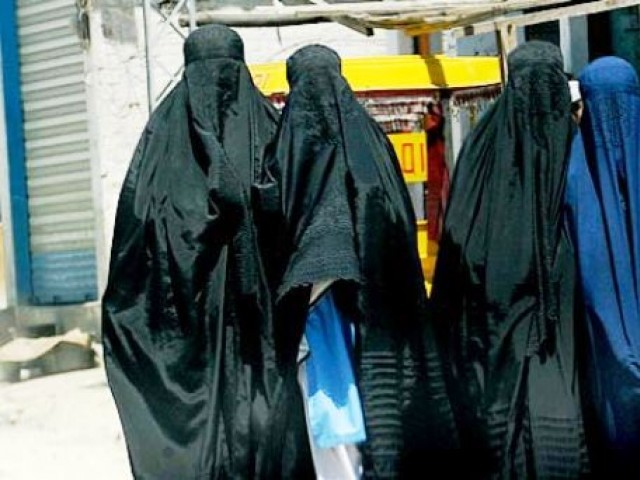
Abaya was an unknown word in Urdu language PHOTO: AFP
There was a land of cavaliers and cotton fields called the Old South. Here in this pretty world, Gallantry took its last bow. Here was the last ever to be seen of Knights and their ladies fair, of Master and of Slave. Look for it only in books, for it is no more than a dream remembered, a civilization gone with the wind.
– An introductory foreword to the film Gone with the Wind (1939)
Civilizations can never be made up, this is all hitherto history has to tell us, but yes they can be ruined to irretrievable notwithstanding. Societies are never absolute in their very essence. This is the natural organic flow of events that weaves the edifice of a society over the time period by encompassing the divergent customs, languages, dogmas and traits. The final synthesis, what we call a society, is the one to impart the distinguishing identity to its adherents. The more firm the foundations of society, the more preeminent will be the identity yielding out of it. Societies are prone to decadence only when they cease to embrace the extrinsic flavors or when become the subject of deliberate acculturation. Later is the case with ‘the land of pure’ which, as for some, is yet to be more pure
Pure is the word and Arabization is the synonym.
Pure of what?
Pure of the specter of the pre-partition Indian identity that was the congenital inheritance of Indian Muslims bestowed on them by the indigenous society that had evolved over hundreds of years by the commingling of various cultures and civilizations.
Plagued by quandary, the Pakistani state, after the partition, was quick to embrace the pan-Islamic identity embellished with salient features of Arabian Peninsula whilst cunningly blending it with religion in order to render it more acceptable for the local populace. The identity engineers considered it the last resort to homogenize the diverse local cultures and vernacular languages by binding them in a construct emanated from religion based identity. That was fall of Dhaka that led to expedition of the Arabization process.
Eminent historian Dr Mubarak Ali explains the predicament in the words:
“Since its inception Pakistan has faced the monumental task of formulating its national identity separate from India. Partitioned from the ancient civilization of India, Pakistan has struggled to construct its own culture; a culture not just different and unique from India, but one appreciable by the rest of the world. ..The tragedy of 1971 [when Bangladesh separated] brought a shock to the people and also a heavy blow to the ideology of Pakistan… More or less convinced of their Islamic heritage and identity, Pakistan’s government and intelligentsia consciously attempted to Islamize the country.”
History itself has been the cardinal victim since antiquity in the hands of plunderers who deem it their foremost target for their ulterior motives. That’s what happened here. History, taught in public schools, starts from the arrival of Muslim Arabs and ends at carving a Muslim state out of Hindu India. Everything else has been rendered smokescreen.
The past, prior to Muhammad Bin Qasim, is a direct threat to the engineered Arab identity as it was obviously Hindu-Buddhist so omitted. The puritans, Aurangzeb Alamgir and Ahmad Sirhindi, get all praise since they are in line with the unyielding version of Arab Islam whilst heretic Akbar is accused of creating a new religion ignoring the fact that people were far better off in Akbar’s era. There’s not even a single mentioning of inter-faith harmony Dara Shikow had been preaching given that there’s no space whatsoever for trans-religious approach in a society aimed for adherents of single creed.
Plunderer Mehmud Ghaznavi has been denominated as ‘idol-breaker’ merely to glorify the unified Islamic triumphalism over the misbeliever India. This systematic maligning of young minds is not confined to only government educational institutes but by an act of parliament, passed in 1976, all private schools are also required to follow this curriculum.
Rubina Saigol, an expert on education says:
“Our state system is the biggest madrasa. We keep blaming madrasas for everything and, of course, they are doing a lot of things I would disagree with. But the state ideologies of hate and a violent, negative nationalism are getting out there where madrasas cannot hope to reach.”
Over the last three decades Pakistan has seen some drastic changes in societal demeanor and etiquettes ranging from language to customs. Dissemination of construct based on the Arab identity is bearing fruit.
Abaya’ that was an unknown word in Urdu language has now become the benchmark of the fictitious morality that is the ultimate result of deliberate assimilation of arid Arab culture. Even the moderate ones are obliged to wear Abaya to meet the newly contrived moral standards of society. ‘Chaadar aur Char Dewaari’ (veiled behind high brick walls) policy of dictator Zia-ul-Haq is turning out to be the worst kind of oppression of women, along with the laws like Hudood ordinance enacted during his regime.
Even the language has not been spared amidst this whole drivel of purification. Article 31/2 (a) of Constitution of Pakistan states:
“The State shall endeavor, as respects the Muslims of Pakistan to make the teaching of the Holy Quran and Islamiat compulsory, to encourage and facilitate the learning of Arabic language.”
 What’s that?
A pathetic attempt to make Arabic lingua franca for Pakistan where less than 1 per cent population can understand Arabic?
What about the divergent local languages or even the so-called national language?
The most common but glaring example that may be put forward to underline the predicament is gradual replacement of the Indo-Persian ‘Khuda Hafiz’ with Arabic ‘Allah Hafiz’ implying that Arabic Allah is the only proper word for God.  Khuda is an Indo-Persian term to say God. It is built on the same building blocks that other Indo-European languages use. The English say God, Germans say Gott or Gutt, Persians say Khuda. The G is a variation of Kh and the utt or od is a variation of “uda”. They’re very similar. On the other hand, Arabic is Afro-Asiatic language. By taking a look to other Semitic languages such as Hebrew, they are very near to Arabic flavor. As for instance Jews say Elohim that sounds very familiar while reciting the word ‘Allah’. Where do the attributes of God come into the matter from? Some of the 99 names of God have their origins in classical Hebrew instead of Arabic. So in the view of this logic should those be abandoned too?
Renowned scholar Dr Pervez Hoodbhoy sheds the light on the issue:
“Persian, the language of Mughal India, had once been taught as a second or third language in many Pakistani schools. But, because of its association with Shiite Iran, it too was dropped and replaced with Arabic. The morphing of the traditional “Khuda hafiz” (Persian for “God be with you”) into “Allah hafiz” (Arabic for “God be with you”) took two decades to complete. The Arab import sounded odd and contrived, but ultimately the Arabic God won and the Persian God lost.”
An interesting aspect of this whole phenomenon is the puritanical version of Islam i.e. Salafism/Wahabism that is predominately a phenomenon traces its roots to Arabian Peninsula and has been instrumented by the identity surgeons to homogenize the cultures that have not even an infinitesimal thing in common – consequences are horrible. This unyielding interpretation of Islam puts great emphasis on rituals and codes of conducts than on substance quite contrary to the Indian version of Islam that is marked with local customs evolved over the centuries through intermingling of diverse doctrines.
All religions have two aspects that are theological beliefs related to one’s relationship with divine reality and sociological beliefs comprising of social behaviors dealing with human society. The former remain more or less absolute in their very nature while the later do change with the passage of time when religions go trans-regional.
Problems predominately start erupting when the sociological beliefs are subjugated by state to implement and propagate hidden agendas. These sociological beliefs then lay the bases of hatred, bigotry and misogyny. This is what has been done in land of the pure in the name of purifying religion by escalating a particular expression of religion to the stature of only-viable-interpretation-of-Islam. God has been portrayed as some Arabic speaking deity who is restricted to ethno-linguistic boundary which is clearly in contradiction of message of religion.
As the Holy Quran says:
“Another of His signs is the creation of the heavens and earth, and the diversity of your languages and color. There truly are signs in this for those who know” (30:22). There is also this famous verse: “O people, we created you from the same male and female, and rendered you distinct peoples and tribes, so that you may know one another.” (49:13)
As for elaborating further the above discussed phenomenon take the example of Madrassas in Pakistan. They are the social sites for the reproduction of Islamic orthodoxy. Hence, to say that the ideological orientation of madrassa education is conservative is to state the obvious.
The madrassas in Muslim South Asia teach a curriculum known as Dars-i-Nizami, first introduced by Mullah Nizamuddin Sihalvi (d.1747) who was a scholar of some repute in Islamic jurisprudence and philosophy in Lucknow. But this was only during the last two decades of twentieth century when they became involve in militancy despite having the two hundred years apathetic history.
The curriculum of madrassas has been the same for about 150 years which is most pacifist in nature. Its approach to Islam is ultra-conservative, literal, legalist and sectarian, but definitely not revolutionary or militant. If it were the militant tendencies of madrassas could have been observed during the most volatile events like: partition, fall of Dhaka and Indo-Pak wars.
What happened during the last two decades of twentieth century?
A classic example of importing doctrine is not-so-secret now and the answers lie with the diplomats and generals who were power brokers in Islamabad, Kabul, Riyadh and Langley, VA at that time.
Kamal Azfar, a Pakistani writer, states the dilemma in words:
“There are two concepts of Pakistan: the first empirical and the second utopian. The empirical concept is based on solid foundations of history and geography while the utopian concept is based on shifting sands. Utopia is not an oasis but a mirage… Samarqand and Bukhara and the splendors of the Arab world are closely related to us but we do not possess them. Our possessions are Mohenjo Daro and Sehwan Sharif, Taxila and Lahore, Multan and the Khyber. We should own up to all that is present here in the Indus Valley and cease to long for realities not our own for that is false-consciousness.”
To conclude, I will take liberty to speak for the third generation, who has the privilege to breathe in the air of this still-not-so-pure-land and is Pakistani now.
I’m not going to mourn the Indus Valley civilization, but what is the substitute they offer me if it is not desert?
The bitter reality is that I don’t have a clue of half of indigenous literature that has been written in Persian.
I have nothing whatsoever against religion, but how would they justify the attacks on the shrines of my land?
I’m all for endorsing their policies, but what is the vindication they have of myriads of dead bodies of my country-fellows?
I’m ready to relinquish Khusro, Ghalib, Bhittai, Bullah, Rahman Baba and Gul Khan, but can they introduce me to an equivalent of this stature?
I shall not question them, but will they care to tell me, ‘who am I’?