Showing posts with label Croatia. Show all posts

Friday, December 06, 2019

Across the Balkans: From Banja Luka to Sarajevo


An account of a journey from Croatia to Kosovo, by way of Bosnia-Hercegovina and Serbia, and with a detour into Montenegro. This is part III of a series.
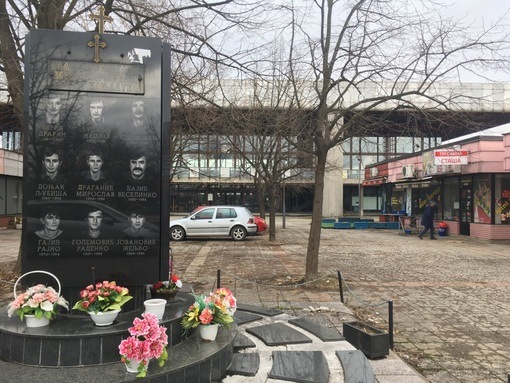
A picture containing outdoor, ground, building, tree Description automatically generated
Serb war memorial outside the Banja Luka train station.
To catch the train from Banja Luka to Sarajevo, I had to ride a bus to the edge of the city where the rail station is located. On the way, just beyond the new government building, I found the Mala Stanica, an old station, which in recent years has been turned into an elegant restaurant, one normally filled with Republika Srpska parliamentarians.
The old station was about the size of a small house, and I am sure that it dates to the late nineteenth century when Austrian colonial administrators laid out a series of narrow-gauge rail lines around the country—to consolidate control, help with troop deployments, and drag mineral wealth to Vienna.
My Visegrád rail line was built for the service of the Eastern Bosnia Railway while this station, as best as I could work out from some maps on the internet, had been part of the connections between the Adriatic coast and Sarajevo.
The more modern railroad station in Banja Luka is a page out of the Socialist Realism Book of Design. I found it by walking in from the main road—where the bus dropped me—and cutting through a thicket of kiosks, many of which had a dilapidated air.
Only a few trains come and go each day in Banja Luka, although the station at one time had larger ambitions. I can imagine that Tito had it in mind to use Banja Luka as a junction between Bosnia, Croatia, and Serbia, and as such the waiting room was built to accommodate hundreds of travelers, few of whom were evidence when I poked around the cubist halls, trying to find the ticket window.
The ticket on the afternoon train cost about $12, and after securing my passage, I went in search of bottled water and afternoon tea, as I knew the train would not arrive in Sarajevo until 8:00 p.m.
On the way to a nearby food stall, I had to walk amongst a group of men, all of whom were wearing leather jackets, smoking cigarettes, drinking beer from cans, and warming themselves around what looked like a dumpster fire.
To them I am sure I looked liked a Hague investigator, and to me they looked liked suspects who needed to be brought in from the cold.
* * *
Since 2016, modern Talgo trains have connected Banja Luka and Sarajevo. No doubt Spain or the European Union made the train sets a gift to Bosnia. Normally, such service would run at high speeds, but in this case the tracks across central Bosnia feel more suited to hauling coal than tilting high-speed trains.
In all only about a half dozen travelers were on the train this particular winter afternoon. I had nearly an entire car to myself, and the conductor didn’t even bother to check my ticket. Instead he prowled up and down the aisles, as if a security guard in an empty mall, and between stops he spoke on his cell phone.
I felt lucky to have brought along tea and biscuits, and for most of the journey I read Christopher Bennett’s Bosnia’s Paralysed Peace, a recent book, published by Oxford, about the country’s political failures.
It had taken me a while to find a copy of Bennett’s book, which was not available for my Kindle but only in hardback and paperback. Finally I had ordered a copy on Amazon, and it arrived in time for me to carry it on my travels.
For a number of years, Bennett has lived and worked in Bosnia with several international organizations, including the office of the high representative (NATO’s proconsul), and now is the director of the Foundation for the Preservation of Historical Heritage in Sarajevo.
For me Bennett’s book got off to a wonderful start, explaining Bosnia’s political failures. Later I bogged down in the minutiae of his analysis of Bosnian political parties.
He writes: “Bosnia is not a self-sustaining democracy, and the political system remains as insidious and virulent as it was before the outbreak of hostilities…. The fundamental flaw in Bosnia’s electoral system is that the candidates need only seek votes from one ethno-national group to win office.”
Bosnia is not a large country, and the importance of the Talgo train from Banja Luka to Sarajevo is that it connects the Republika Srpska to the Federation, although perhaps that route also helps to explain why no one was on the train. The two sides do not mix comfortably.
Early on after Bosnia’s independence, Serbs, Croats or Muslims could be identified from the patterns on their car license plates, although that practice was discontinued, leading to freer passage between the two Bosnian parts. That said, this Talgo had the feeling of a ghost train.
What little daylight there was on the train came before we reached Doboj, where in better days connections could have been made for trains to Belgrade. Now, as during the Austrian occupation from 1878 to 1914, Bosnian railways are entirely self-contained and cross no international frontiers.
In the February gloom, the landscape of northern Bosnia had forlorn qualities, and along the tracks were the hulking ruins of earlier five-year plans, now fallen into disrepair.
During the Yugoslav era, Bosnia bore some resemblance to West Virginia, and much of its economy was based on the extraction of natural minerals and small-scale agricultural in the mountainous valleys.
More recently the service sector, with investment from abroad, has pushed the gross domestic product from about $3 billion in 1997 to more than $20 billion today.
Land values have appreciated, restaurants are opening around the country, people buy and repair cars, trucks deliver goods, and remittances from abroad help residents to buy and fix up apartments and houses.
Tourists come to Sarajevo (which has trendy corners) and Mostar (the Ottoman bridge has been rebuilt), but nowhere else. And the road network keeps expanding, with a few autoroutes sprinkled around the county.
One of the major problems is that the two parts of the country can rarely agree on the distribution of assets between the two constituent parts, a disaster in a country starved of investment capital.
The Bosnian economy has relied heavily on aid from the international community for its capital-intensive projects (some $10 billion in recent years), but not long ago the national airline (an important link for a landlocked country) went into liquidation.
A new carrier, FlyBosnia is trying to fill its place, but when I asked someone where it would fly, the answer came back with a shrug: “Saudia Arabia, Bahrain, Tunisia, and Kuwait…” Later, when I looked up the airline, I discovered that it was targeting what it calls “Halal tourism.”
Bosnia remains outside both NATO and the European Union. Bennett concludes, with some sadness:
The ‘pull of Brussels’ has not proved a sufficiently strong incentive to set in train self-sustaining reform processes to overcome zero-sum, ethno-national politics and to help turn Bosnia into a functional state.
* * *
A little after 8:00 p.m. the Talgo rolled into the Sarajevo central station, yet another skeleton of Tito’s worker self-management councils. In summer 1976, when I took the narrow-gauge train from Visegrád, I had gotten off at the Bistrik railway station in a Sarajevo neighborhood, at an old wooden-frame station, and walked into the old city.
The more modern—if that’s the word for it?—Yugoslav railway station is on the other side of the Miljacka river and speaks to the era when central planners could imagine dozens of daily trains connecting Sarajevo to Zagreb, Belgrade, and the Dalmatian coast.
Now only a handful of local trains (besides the Talgo) use the station, and in the early evening the vast concourse might well have been a waiting room in Purgatory.
I had booked an Airbnb room based on the description of the interior, which said the apartment was a holdover from Austro-Hungarian times and that I would be sleeping in the front parlor, which had books, a fireplace, and a balcony—most of the things I want in a hotel room (and rarely find).
It was a fifteen minute walk from the station, and on the way I passed near the American embassy (rebuilt since the war to resemble a minimum-security prison) and the former Holiday Inn, which during the fighting was a journalistic encampment and often in the news (it has also been rebuilt and is called the Hotel Holiday).
The streets of Sarajevo were covered with slush and ice, and here and there were pockets of cobblestones, all of which would have done in my bicycle.
I cut behind a large office complex and mall and little by little found my way to the Airbnb, where the kindly owner gave me a cup of tea and the password for the wifi. The rooms indeed had Austro-Hungarian qualities, and on a large table I spread out my books and maps as if I were one of Franz Ferdinand’s subalterns.
* * *
Some of the snow melted overnight, and in the morning the streets of the Sarajevo old town were more wet than icy, although I still walked gingerly over any slick cobblestones.
The tourist footprint of Sarajevo (made of up Austrian and Turkish quarters) is small, while the rest of the city (think of endless apartment blocks) spreads along the valley of the Miljacka, which often looks more like a drainage ditch than a river.
That first day, I had engaged a guide to walk me around the old town in the morning, and in the afternoon another guide would take over and drive me along the contours of what are called “the siege lines”—the barricades that separated Serbs, Croats, and Muslims during the three years of the 1992-95 civil war.
My walking guide was a graduate student in history at the local university, and he spoke eloquently about Sarajevo’s evolution from a Turkish provincial town to ground zero of the Bosnian wars.
He was about four when the war ended, and remembered huddling in corners during artillery attacks and later, over coffee, spoke about how his father was killed fighting near Goražde, in eastern Bosnia. He had spent his life in Sarajevo, but when I asked him he had any Serb friends, he thought for a minute and said “no.”
We spent much of our time together than morning at the former city hall, which in 1992 houses the National Library. Shortly after the fighting began in Sarajevo, it burned to the ground, reducing to ashes some 2 million books and periodicals.
Serb artillery in the hills surrounding Sarajevo had targeted the landmark building, which is where, after the first assassination attempt on June 28, 1914, Franz Ferdinand and his wife Sophie had repaired for tea and a small ceremony. The archduke said indignantly: “I come here as your guest and you people greet me with bombs!”
Only after leaving the city hall and driving back along the river did the Ferdinand’s driver get confused and, randomly, stop the car near the Latinski Bridge where Gavrilo Princip was drinking coffee. (He had never fired a shot or thrown a bomb when the entourage went past the first time.)
With the archduke and his wife stopped a few feet away from him, Princip pulled out his revolver and shot both husband and wife, setting in motion the events that would lead to World War I. (Ferdinand’s last words, spoken to his wife, were: “Don’t die darling, live for our children.”)
In the twenty-four years since the more recent war ended in Sarajevo, some $20 million in international aid allowed the city to rebuild the burned-out city hall. Now, however elegantly restored, it’s a building in search of a purpose.
The national library itself was moved to the campus of the university, which is on the other side of the American embassy and the Holiday Hotel. Without books inside, the old city hall feels like an empty model showroom, awaiting tenants and furniture.
In the renovated basement there is a picture gallery about the history of Sarajevo, and in the rooms upstairs there are various exhibits, including a salon with large posters showing Franz Ferdinand and his wife taking tea—just before their assassination.
In a corner of the city hall there is a replica of a Hague Tribunal courtroom, complete with a witness box and judges robes hanging in the corners, and in another room there are banks of computers where researchers are welcome to search out testimony from the trials.
No one was researching when I was there, although the attendant staff was eager for someone to ask probing questions about the likes of General Ratko Mladić.
On the walls were mug shots of convicted war criminals, with the words “Kriv/Guilty” stamped in red over their faces. Apportioning war guilt remains a popular local pastime.
* * *
From the city hall to the central market (where numerous Bosnians were killed during several mortar attacks in the fighting), we took a little detour so that I could see the Sarajevo high school where both Ivo Andrić and Gavrilo Princip had studied. It’s still used as a school building, and there wasn’t much to see except the front door and, inside, long corridors of classrooms.
Andrić was slightly older than Princip and a more serious student—Princip left school to become a revolutionary—but both in the early twentieth century came to their own conclusions about independence for Bosnia and the south slavs.
In the covered market, where the mortars fell, the city has kept the painful memories alive by painting red into the grooves left by the explosives, a form of remembrance now called a “Sarajevo rose.”
A nearby tablet recorded:
Thousands of shells rained on Sarajevo during the aggression against Bosnia and Hercegovina and UN forces registered an average of 330 impacts a day. In just one of such days, on 22 July 1993, Sarajevo received 3,777 shells fired from the surrounding hills. In the siege that lasted for 1,425 days, every single shell left scars on the asphalt roads, pavement or town buildings. Many of them wounded or killed one or more citizens in the besieged town while explosions were leaving marks in concrete, similar to flowers. On some locations in town those scars were painted with red resin, and hence they were named Sarajevo roses.
The 1995 market shelling persuaded the United States, NATO, and other countries to launch air attacks against Serb positions around Sarajevo and Bosnia.
The campaign lasted several months and it hit a number of Bosnian Serb targets in eastern Bosnia as well some around Banja Luka.
After the air attacks, the NATO allies forced the Serbs to lift the siege on Sarajevo, and the parties in the civil war agreed to talks, which led to the Dayton Peace Agreement (1995) that ended the armed conflict in Bosnia.
That’s the official line of the great powers, and it could well be true that there was cause-and-effect between the market attacks, NATO’s intervention against the Serbs, and the peace in Dayton. David Rohde writes in Endgame:
But on August 28 a shell landed near a Sarajevo open-air market, killing thirty-seven and wounding eighty-eight. The Serbs—as was their custom—accused the Muslims of firing the shell on their own people to create a pretext for NATO bombing. But a UN crater analysis ruled that the deadly shell and four others fired in the same volley all came from Serb positions…. The UN commander in Sarajevo, British general Rupert Smith, now had the pretext he needed to launch air strikes.
Not everyone, however, agrees that the narrative around the attacks is so linear. For example, Diana Johnstone writes in Fool’s Crusade:
On 28 August 1995, another ghastly market massacre ripped people to bits in a busy shopping area of Sarajevo. The Bosnian Serb government in Pale had just accepted Washington’s terms for peace talks. British and French ballistics experts found no evidence that Bosnian Serbs fired the mortars, and suspected that the Izetbegović government was behind the massacre in order to produce the very result that was indeed produced: less than 48 hours later, NATO began massive air strikes on Bosnian Serb positions, effectively entering the war on the side of the Muslims.
She adds: “Staging attacks on one’s own side for propaganda purposes is an aspect of psychological war familiar to specialists. It is called ‘black propaganda’.”
* * *
Standing in the market some twenty-four years after the attacks—it was filled with shoppers and had a prosperous air—I had no way of verifying which outline of history was correct. But one thing that was clear to me in the market was that, in most tellings of Yugoslavia wars, the guilt is apportioned to the Serbs, from 1918 until 1999 and beyond: It was the Serbs who caused World War I; jury-rigged Yugoslavia and its early constitution; provoked a war with Hitler’s Germany; upset the delicate balance of Tito’s Yugoslavia; aggressively sought war in 1992 with Croatia and Bosnia-Hercegovina; and, finally, sought to “cleanse” Kosovo of its Muslim population.
Again, such a narrative may be the correct interpretation of history. But what it lacks is a more nuanced understanding of Yugoslavia’s rise and fall, and going forward—in a badly gerrymandered part of Europe—it positions Serbia as the pariah nation, much the way after World War I Germany was blamed for all the horrors of that conflict. That helped English and French politicians win reelection during the 1920s, but it also sowed the seeds of future wars in the 1930s.
One thing I learned in my travels across the Balkans is that not many in the region are interested in truth and reconciliation. Instead it struck me that the goal in many quarters is to use war guilt against the Serbs as an exercise in nation-building, risky as that may be.
As a friend pointed out to me during one of my stops: “Serbia isn’t exactly a forgive-and-forget kind of place.” Ambassador William Bullitt’s comment about the Treaty of Versailles could well work for the Dayton Peace Agreement: “This isn’t a treaty of peace… I can see at least eleven wars in it.”
And it was during my travels that I came across a newspaper article describing how Russia is arming Serbia with late model anti-aircraft missiles and overall taking the aggrieved nation under its military wing. The last time that happened was in 1914. How did that work out?
END
Next up: Around Sarajevo. Read the earlier installments here.

Across the Balkans: Banja Luka


An account of a journey from Croatia to Kosovo, by way of Bosnia-Hercegovina and Serbia, and with a detour into Montenegro. This is part II of a series.
A picture containing text, mapDescription automatically generated
A Bosnian map of 1878 from the national museum in Banja Luka.
The bus to Banja Luka, presumably filled with Bosnian Serbs (perhaps the most unloved people in the Balkans), departed on-time around 3:00 p.m.
On the way to the bus station, I wandered through Zagreb’s imperial quarter (it could well be part of Vienna) and retrieved my backpack from the station locker. Then I had thoughts of visiting the local railway museum to find out when service might be restored on the line to Sarajevo. The museum was closed on a Monday and by then a misty rain was coating the formal gardens around the main station. In retreat, I took a tram to the bus terminal and huddled on a bench with my lunch, waiting for the driver to open the doors to Banja Luka.
Although the distance from Zagreb to Banja Luka is a little more than hundred miles and the bus rolled for the first hour along a modern interstate, the trip lasted some four hours, including a long pause at the Croatian-Bosnian border, which divides the European Union from the southern Balkans.
Along with everyone else on the bus, I lined up with my bag and passport, and waited for the immigration officer to scan my particulars. We had to wait in the rain (although we were under an awning) for the bus driver to smoke a cigarette and for another customs official to give the bus a cursory inspection. (He had the air of someone room looking around his living room for the remote control.) Then we re-boarded the bus for the drive into Banja Luka, although this time we were on crowded local roads, as the Republika Srpska has few interstates.
Idling in the misty rain, it occurred to me that I wasn’t far from the former death camp at Jasenovac, where during World War II local fascist elements and German overlords executed almost half a million Jews, Serbs, and gypsies—although the precise number killed is the subject of historical dispute and controversy.
After the war Jasenovac became a national Yugoslav memorial, where all members of the federation solemnly remembered the holocaust. Since the dissolution, Jasenovac is largely a Serbian and Jewish site located within Croatia (although not far from the Bosnian border), and, to many, borrowed land living on borrowed times.
As I wasn’t in a car, a stop at Jasenovac would have delayed me by a day or two, and to get from the camp to Banja Luka would have involved some hitchhiking (a habit from high school I am trying to break).
Instead I read through the file of book excerpts that I had compiled on the death tolls at Jasenovac, which quickly became an exercise in the futility of historiography.
Serb historians usually cite the figure of 500,000 victims in trying to add up how many Serbs, Jews, and gypsies were rounded up and killed during the 1941-45 German occupation. Many, but not all, would have died at Jasenovac, although the precise figures on the war dead, given the conditions, remains elusive.
In Fools’ Crusade, Johnstone writes about the Croatian wartime leadership of Ante Pavelić, who warmly embraced his overlords in Rome and Berlin:
Pavelić immediately set out to achieve the Ustashe goal of a pure Croatian state. At the time, Serbs made up over a quarter of the population. A new law restricted citizenship to “persons of Aryan race”. In Ustashe racist ideology, “Aryans” included both Germans and Croats, but also Bosnian Muslims, considered to be an aristocracy of the purest Croatian race.
Among those who disagreed with the estimates of the number of dead was the first president of independent Croatia (1992), Franjo Tudjman, who during World War II fought with Tito’s Partisans and who later rose to become a Yugoslav general.
He was also a noted Holocaust denier and disputed not just the death totals of Serbs at Jasenovac during World War II but also those of European Jewry (citing the figure of 4 million, as opposed to 6 million dead in the gas chambers).
According to Johnstone, there were times when he would say “that only 2,000−3,000 prisoners, mostly Gypsies, had perished at Jasenovac, described as a work camp administered by ‘free prisoners’ who were Jews.”
In Impossible Country, Hall interviews Tudjman and quotes from his books, which include The National Question in Contemporary Europe, The Nation-State: Key to the Peace of Europe, and Wasteland: The Historical Realities, both of which claim that Serb deaths at Jasenovac were about 35,000.
A more recent book, Christopher Bennett’s Bosnia’s Paralysed Peace (2016), puts the figure of Jasenovac victims at 85,000. He also makes the point that some 97 percent of Yugoslavia’s Jewish population perished during the war.
The disputed figures might not matter, except that they became important again in 1992, as Yugoslavia was breaking apart and more than a million Serbs found themselves living under a Croatian flag that had been flying when their countrymen (in whatever numbers) were being rounded up and trucked to Jasenovac. Johnstone writes:
The total number of victims of these savage massacres was never determined and thus remains open to controversy. The “official” figure of 700,000 Serbs murdered is an estimate, as are other figures, some higher, some lower. What is undisputed is the extraordinary ferocity of these killings, as confirmed by numerous witnesses, in particular Italian and German observers who were ostensibly the allies and protectors of the Ustashe killers.
Whatever the numbers, the shadow of Jasenovac—rarely written about in the press in 1992—was one of the reasons that gerrymandered Serbs (who Tito had allocated to Yugoslavia’s Croatian and Bosnian republics) refused to live as minorities in newly independent foreign lands.
* * *
The bus driver dropped me on the curb of a busy boulevard in Banja Luka and continued driving out of town. By then it was dark and raining, and it was too far for me to walk to my hotel, the Palas, located in the city center. Nor was it possible to hail a taxi, as all that passed had fares heading somewhere.
A forlorn figure in the February gloom, I started asking some pedestrians for directions to the Palas until one of them shook his head and said it was best if he called me a taxi, which he did on his cell phone. A few minutes later, a cab pulled briskly to the sidewalk and I jumped in for the five minute ride into the center of Banja Luka.
I liked the Palas Hotel, which appeared stuck in a time warp from the Yugoslav era. The room (filled with furniture from the 1970s) cost about $35 a night and had a large desk, in case, perhaps, I wanted to add some amendments to the 1917 Corfu Declaration (from which was established the independence of the Kingdom of Serbs, Croats, and Slovenes). Dinner was graciously served in the dining room, and I warmed myself with local beer and barley soup.
After dinner (I didn’t linger over slivovitz, as the cigarette smoke was thick in the air), I went for a walk around Banja Luka and discovered a city of some charms, even if it’s the capital of what many believe is a rogue state.
In the February cold, I walked by a Titoist park (with a soaring war memorial to the Partisans), an old Turkish fortress, a beautiful mosque, some modern hotels, an Orthodox cathedral, and city hall—an oval building elegantly lined with columns and its facade illuminated at night.
Other than a few night clubs with pulsing lights, the only thing open was an art gallery, located in what felt like a former Austrian railway station.
A sign said the museum would be open until 10 p.m. (an ideal time for museums to close), and as I entered, a guard by the front door gestured to the exhibits, which were rows of painted portraits of Partisans killed in Bosnia during World War II. Each was encased in a thick wooden frame, and there were notes in English explaining how and where each fighter was killed.
The long rows of partisan portraits, which included many women killed in the fighting, matched well with a passage in Johnstone’s history, in which she writes:
Bosnia-Herzegovina was the scene of a merciless civil war between not two but several parties: Ustashe, partisans, Chetniks, the Wehrmacht, Italian occupation forces, and even militia such as the Muslim units from the Serbian region of Sandžak who attacked Serb villages in eastern Bosnia, setting off a terrible cycle of reprisals and revenge. Precisely because Bosnia-Herzegovina had experienced the most massive killing and worst atrocities during the war, the official version, glorifying mass support for the partisans, brotherhood and unity, was imposed with special rigor.
It was in Pavlowitch’s history that I came across other passages about the extent to which World War II in Yugoslavia was actually a civil war. He writes: “Even for the guerrillas, to survive and then to eliminate domestic opponents was more important than to fight foreign occupation troops…. Yugoslavs were slaughtered by other Yugoslavs more than by foreign soldiers…. Communist Yugoslavia perpetuates the cult of the partisan war of 1941-5, whereas this was first and foremost a fratricidal war between Yugoslavs.”
The Yugoslavia that emerged from the wreckage of the Second World War papered over the disagreements not just of 1914-18 (Tito, born in Croatia, fought on the side of the Austrians against the Serbs), but those that divided the country between 1941-45.
Pavlowitch writes:
As for the Communist regime, it adopted the principle of ethnic multiplicity on the Soviet model. Yet it prevented any expression of nationalism that strayed beyond the specific limits assigned to it, and it fostered a feeling of Yugoslav socialist patriotism. Open dialogue and political debate were still not on the agenda…. Tito’s Yugoslavia also recalled certain aspects of the Austro-Hungarian tradition. Catholic inspired, the old monarchy was, in theory and origin, a personal union of different historic lands.
One of the failings of Tito’s Yugoslavia was that its internal borders corresponded more to the ruling dynamics of the Communist elite than they did to the nationalities in the underlying republics.
Only in Slovenia was the population more or less homogenous. Otherwise, as the largest ethnic group inside Yugoslavia, Serbs were gerrymandered into Croatia, Bosnia-Hercegovina, Kosovo, and Macedonia, much the way Mayor Richard Daley used to apportion voters in various congressional districts around Chicago.
By 1981, according to Pavlowitch, “there were a little under 2 million Serbs in the other republics, and some 1.3 million in Serbia’s autonomous provinces, against 4.9 million in what is now called ‘inner Serbia’.”
The country also had more than a million Muslims, mostly in Bosnia-Hercegovina and Kosovo (not a republic, but, in Tito-speak, a Socialist Autonomous Province).
The end came to Yugoslavia in 1992 when Tito’s internal borders became the basis of international frontiers. Writing presciently (in 1988) before the war broke out, Pavlowitch concluded: “The partition of Yugoslavia, if it could be carried out, would place her successors in a situation of mutual enmity with one another, as well as at the mercy of their more powerful neighbors.”
That’s exactly what happened.
* * *
I slept well that night in my commissar’s bedroom and awoke to see bright winter sun shining into my hotel window and, after inhaling cigarette smoke in the breakfast room, retraced my steps around Banja Luka to see the most reviled capital in Europe.
The problem with Republika Srpska (which has its capital in Banja Luka) is that it is a state within a state, and in many respects Bosnia-Hercegovina has duplicated the contradictions that helped, over time, to bring down Yugoslavia.
Part of what doomed Yugoslavia was that it recognized the powers of constituent republics over the rights of its citizens, and when the two interests collided it was the states’ rights that prevailed. The secessions of Croatia, Slovenia, and Bosnia-Hercegovina took place without any votes at the federal level.
The same is true in Bosnia-Hercegovina, which is divided in half between the Republika Srpska and the Federation of Bosnia and Hercegovina. It is the latter that, within the country of Bosnia-Hercegovina, represents the interests of Croats and Muslims (sometimes called Bosniaks).
Minorities on either side of the divide are largely disenfranchised and live in dread that Bosnia-Hercegovina will dissolve as did Yugoslavia.
Bennett writes:
Republika Srpska may be recognized as an integral part of Bosnia in the Dayton settlement, but its continued existence in the absence of the wholesale refugee returns also anticipated in the peace accord leaves a sour taste in the mouths of non-Serbs.
* * *
The Museum of the Republika Srpska—with display cabinets, exhibits and maps—makes the historical case for Bosnian Serbs, not one of the more popular causes in Europe, as it is the Serbs who are often blamed for Bosnia’s descent into civil war.
It is the Bosnian Serbs who are held responsible for the ethnic cleansing around Bosnia from 1992-95, and, in particular, two Serb leaders—Radovan Karadžić and Ratko Mladić, one the local president and the other its military commander—personify many of the evils associated with Serb aggression during the fighting.
Both were convicted of war crimes at the Hague Tribunal and are serving life sentences. While on the run from tribunal agents, they would have passed through Banja Luka.
Needless to say, the museum does not dwell on notorious Bosnian Serb war criminals but tries to place Bosnia-Hercegovina in the context of broader European history, in which Bosnia (a bit like Alsace and Lorraine for France and Germany) has often been on the crossroads between war and peace, especially among rival empires.
Most fatefully, the 1878 Treaty of Berlin, ending a Balkan war between Russia and Turkey, awarded the jurisdiction of Bosnia to the Austro-Hungarian empire.
Austria saw control over Bosnia as a way to thwart the expansionist dreams of Serbia, the Ottoman Empire, and Russia, by placing a Germanic wedge in between those countries and the Adriatic Sea.
The same circumstances might have motivated NATO, Germany, and the United States (although perhaps for different reasons) when in 1992 they chose to support independence for Bosnia-Hercegovina.
I was most drawn to the map collections that showed Bosnia’s progression from an Ottoman principality (from the middle ages to 1878) to what it is today—a ward of the international community.
In the intervening centuries Bosnia’s frontiers have floated about depending on whether its occupation forces were Turkish, Austrian, German, Yugoslav, Croatian, or those of NATO and the United Nations.
Some of the museum maps, like those in the books I was reading, showed the ethnic composition of Bosnia-Hercegovina before, during, and after the 1992-95 fighting, and they showed Republika Srpska’s evolution into the present—a horseshoe-shaped province surrounding the Federation from the west, north, and east. Only through a narrow corridor does Bosnia have access to the sea.
In Endgame: The Betrayal and Fall of Srebrenica, Europe’s Worst Massacre Since World War II, Newsday reporter David Rohde writes about Bosnia’s ethnic disposition:
The Serbs, who made up only 31 percent of the country’s population, would get 49 percent of Bosnia’s land and the de facto “ethnically pure” state they had brutally created. Croats, who comprised only 17 percent of the population, received nearly 25 percent of the land. Bosnia’s Muslims, who constituted 44 percent of the population, were allotted only 25 percent of the land, and were the war’s clear losers.
What he does not add, although the point is made in the museum, is that some of the Serbs who ended up in western Bosnia came there in 1995 when Croatia (with United States military planning and assistance) cleansed several hundred thousands Serbs from what was called the Krajina and forced their retreat into Bosnia.
The other point made in the museum displays is the extent to which the international community—to suit its geo-strategic designs?—reconfigured the way national and ethnic groupings in Bosnia were defined.
When it was part of Yugoslavia, Bosnians were defined either as Serbs or Croats (the majority were Serbs), and at a further level as Orthodox, Catholics, Muslim, or agnostic.
Only as Yugoslavia was dissolving did Bosnian Muslims (now called Bosniaks, although originally that word defined Serbs) become a national grouping, on a par with Croats and Serbs. Johnstone writes:
There had never in history been an independent Muslim Bosnia-Herzegovina. The designation of “Muslims” as an official “nationality” was a recent innovation. The Muslims were Serbs or Croats who had converted to another religion. Until the 1971 census, Orthodox Serbs made up the relative majority in Bosnia-Herzegovina, and Serb peasants still owned most of the land.
The problem now with Bosnia-Hercegovina—and a possible threat for European peace—is that if the Republika Srpska were to declare its independence (just as Slovenia and Croatia did from Yugoslavia), it would likely start another Balkan War, as Croats and Muslims in the surrounded Federation would fear annihilation coming in many directions.
* * *
From the museum I walked to the city’s principal mosque, which dates to Turkish times (the interior looked freshly painted, implying it might have burned during the war), and to the remains of the Kastel Fortress, on the banks the Vrbas river.
On the grounds of the fortress I wandered pleasantly along the ramparts (first built by the Romans) and drank coffee in a terrace restaurant overlooking the river. Then I went in search of a bookstore and copies of the novels of Ivo Andrić, a Bosnian writer who won the Nobel Prize for Literature in 1961, largely because of his novels, The Bridge on the Drina and The Days of the Consuls.
In the divided world of Bosnia-Hercegovina, Andrić is a man for all seasons, as he was born in Travnik (not far from Sarajevo) and grew up in Visegrád (on the banks of the Drina river, which divides Bosnia from Serbia).
As a young man he studied in Croatia and Austria, and in his career, while also writing, he served as a Yugoslav diplomat (much the way writers Nathaniel Hawthorne and William Dean Howells had stints in American consulates).
About the only thing that Croats, Bosniaks, Serbs, and Austrians can agree upon is that Andrić was a great writer, who in Drina wrote: “Nothing brings men closer than a common misfortune happily overcome.”
Growing up, I first heard about Andrić’s novels from my parents, who read him with devotion and cited his novels whenever a dinner-table conversation turned toward Bosnia, which it did often after our night train ride to Belgrade.
I only read Drina when I was a senior in college and studying independently under the direction of Professor Robert Beard, who had taught and lived in Yugoslavia and pushed me deeper into its literature.
The summer after my graduation, I traveled widely in Yugoslavia, from Nish (in Serbia) to Rijeka (now part of Croatia), and at one point I rode a narrow gauge railway across Bosnia to Sarajevo.
As I now recall, I boarded the small wooden carriage in Vardište, on the Bosnian-Serbian border, although in those Yugoslav days no one paid any attention to the border between the two republics. It was merely a Titoist, administrative line and of no consequence.
For most of the day, the train wound its way though mountainous gorges in eastern Bosnia, and to my delight it crossed the Drina at Visegrád, although I confess now not to remember actually seeing the famous bridge, and its series of Romanesque arches. Of it Andrić wrote:
But misfortunes do not last forever (this they have in common with joys) but pass away or are at least diminished and become lost in oblivion. Life on the kapia [at the center of the bridge] always renews itself despite everything and the bridge does not change with the years or with the centuries or with the most painful turns in human affairs. All these pass over it, even as the unquiet waters pass beneath its smooth and perfect arches.
The train arrived in Sarajevo toward dusk, and what I do remember is being stunned to see so many minarets on the city skyline. This was Europe in the 1970s, and secular Yugoslavia to boot, and I had not expected to come across what looked like Istanbul or Cairo on the horizon.
Andrić died in 1975, seventeen years before the Bosnian wars, but I doubt that much about its violence, or Sarajevo’s more recent rebirth, would have surprised him.
Andrić said of the city: “If you take a look at Sarajevo at any time of day, from any surrounding hill, you will always inadvertently come to the same conclusion. It is a city that is wearing out and dying, while at the same time being reborn and transformed.”