Showing posts with label Chechenya. Show all posts

Thursday, October 03, 2019

Kadyrov: A Successful Dudayev?

Champion of Chechen “nationalism” stalls drive for independence

Akhmet Makhmoudov
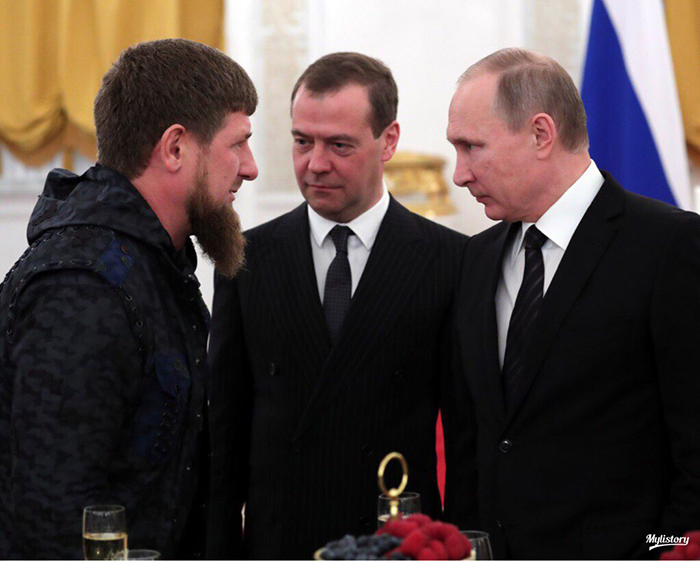
Ramzan Kadyrov’s bold political moves, which are tolerated by the Kremlin, make some in the Russian speaking press refer to him as the successful Dudayev. However, this liberty that Moscow has granted to Kadyrov may in the long run destabilize the Russian Federation, in the same manner that the intra-Soviet land disputes destabilized the USSR.
One of the key internal contributing factors that destabilized the Soviet Union at the end of the 1980s was the territorial dispute between Azerbaijan and Armenia over Karabakh.
What would happen to the US if Texas police started entering parts of Louisiana and Oklahoma and began incorporating parts of those states into Texas? That would be a direct challenge to the central government in the US and speed up the disintegration of the United States of America. This is essentially what is happening in the North Caucasus as the Chechen Republic is incorporating land from neighboring republics of Dagestan and Ingushetia into the Chechen Republic. While these acts of land incorporation are taking place in a smooth manner through a legal veneer of the Russian constitution, their political ramifications and at times implementations are turbulent.
After Moscow pacified the pro-independence movement in Chechnya between 2003-2004, the Russian-backed Chechen leadership was given wide autonomous powers. These wide-ranging powers served Russia’s long-term policy to pacify the aspirations of the Chechen society to gain independence from Russia. Moscow implemented the formula of a broad autonomy successfully and this discouraged many Chechens from pursuing full-fledged independence. Russia wisely utilized its federal state structure in the North Caucasus, in order to grant local communities wide ranging autonomy. This autonomy is mainly granted in the cultural, social, and petty local political levels.
The autonomy was not given by Moscow voluntarily. It was the two Chechen wars that forced Russia to update its federalist structures and utilize them. Essentially, a republic of just one million people pulled off an unbelievable feat through its sophisticated guerrilla warfare and socio-political mobilization, getting Russia to concede wide ranging powers to it. The current pro-Moscow Chechen leadership knows that Moscow needs the current Chechen setup in order to maintain stability and not allow NATO powers to instigate internal strife within Russia.
Kadyrov’s team knows well that if the situation in the North Caucasus begins to resemble the mid-1990s, it will receive wide ranging political, media, and financial support from the West in order to put pressure on Moscow for its actions in Ukraine and Syria.
The Kremlin recognizes that Kadyrov is their best option for maintaining the pro-independence narrative in Chechnya under Moscow’s management. It’s a win-win situation between Kadyrov and Moscow. Kadyrov fully realizes that Moscow will tolerate Chechen “nationalism” if it serves to stall the pro-independence movement in Chechnya. Thus, he is wisely extracting concessions.
Kadyrov’s land-swap with Ingushetia in 2018 and the annexation of territory of Dagestan on the outskirts of Kizlyar by force increased tensions between the republics of the North Caucasus. These local tensions were used by Kadyrov to position himself as the protector of Chechen interests within the Russian Federation, a move that has won some sympathy from the pro-independence minded Chechen diaspora.
Head of the Chechen Republic, Ramzan Kadyrov, left, makes moderate gains for Chechnya while staying on the right side of Putin.
While currently the positioning of Kadyrov as a Chechen leader who puts Chechnya first, suits Moscow’s regional policies, it is a dangerous gamble. Kadyrov’s territorial claims on neighboring republics are laying the grounds for regional tensions.
Most probably from Moscow’s perspective it is a positive development as it creates divisions among Muslims of the North Caucasus over petty land issues, thus preventing the formation of a united pro-independence movement. This is a smart strategy, but Moscow can easily lose control over this process. This strategy has too many unknown political variables.
One of the key unknown variables many in the Russian speaking media like to speculate about is whether at some point Kadyrov will push the limits and try to break away from Russia. This scenario is highly unlikely; however, it has one pre-condition: if Vladimir Putin and the system he has established in Russia remains in power. If Putin’s system outlasts his presidency, Kadyrov will not have any incentive to seek independence from Russia.
He has too many local and non-local enemies that he cannot fight alone. Kadyrov’s flamboyant politics in Russia irritated many seasoned Russian politicians who often for racist reasons do not like his prominence and influence in Russia. On an ideological level, the official Islamic institutions established in Chechnya are of Sufi leaning orientation and see the pro-independence movement to be too embedded with the salafi mindset.
On the other hand, if after Putin’s presidency an intra-factional conflict breaks out within the Russian political elite, Kadyrov may be used as a tool by a pro-Putin faction. It cannot be ruled out that the Russian political elite will attempt to use him as leverage against an anti-Putin establishment by nudging Kadyrov to talk about independence, if the system set up by Putin is replaced by an opposing faction. However, the possibility of this scenario is not great, but it is a possibility, nonetheless.
Hate him or love him, realistically speaking Kadyrov’s team and their policies managed to convince a significant portion of the Chechen population that the independence route is not worth the trouble. What Chechnya has today is an acceptable form of autonomy with a strong Islamic ethos. The Chechen interior ministry troops are essentially a Sufi oriented Islamic militia accepted by the Kremlin due to the political realities of the North Caucasus. There is some truth that Kadyrov did accomplish a lot of what Dudayev aimed to achieve, but within the parameters of the Russian Federation.
Nevertheless, by allowing Chechnya to irritate neighboring republics in the North Caucasus, Moscow is indirectly cultivating an environment for a local conflict in the North Caucasus that will undermine Moscow’s sovereignty in the region. Historically, the North Caucasus has always been the source of challenge to Russia’s territorial sovereignty. Adding additional potential elements of instability to an already volatile region is asking for trouble.
Taking into consideration Putin’s strong anti-NATO policies and the involvement of Chechens in NATO’s agenda in Syria and Ukraine, a future flare-up in the North Caucasus will have a far larger global dimension to it than the regional crisis of the 1990s.

Friday, August 02, 2019

Revival of pro-Independence Narrative in Chechnya

Video blogger challenges Russian position of combatting terrorism

Akhmet Makhmoudov
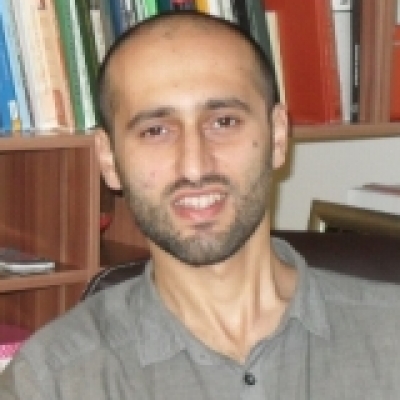
As pro-independence narrative is revived in Chechnya, we examine its long-term implications. Over the past 12 to 18 months one of the hottest topics of the Russian-speaking internet community has been videos and debates of the Chechen blogger Tumso Abdurakhmanov. He has lived in exile in Poland since 2017.
Tumso’s video blogs and live YouTube debates have garnered hundreds of thousands and at times millions of views due to his absolutely honest positions coupled with logic and superb eloquence that challenge the Russian established order in Chechnya.
The blogger’s popularity reached such a level that it became impossible to ignore him, forcing the second most powerful official of Chechnya, Magomed Daudov, to engage in a live Instagram debate with Tumso.
After Daudov’s live debate, several Russian and Chechen public figures took on Tumso in live debates but judging from comments and other online reactions, none of the debaters managed to impress the public with their counterarguments that re-mained mostly wedded to the official Russian government narrative.
However, it is not the popularity of the blogger that requires analysis, but the long-term implications of the positions Tumso has revived and expressed. Since Russia defeated the pro-independence movement in Chechnya, which later mutated into a Wahhabi insurgency, there was an intellectual vacuum within the pro-independence camp in Chechnya and the wider North Caucasus. The intellectual argument and power were completely in Moscow’s favor. The Kremlin and its local subordinates had a very convincing narrative that can be summed up as follows: our policies and actions brought peace to the region and the pro-independence camp failed to put forward a coherent project beyond an armed insurrection. The terrorist and salafi methodology of the pro-independence movement during the second Chechen war (1999–2004) caused it to lose support within its immediate constituency. Senseless violence by the pro-independence camp during the second Chechen war led to a decrease in support within the Russian population, of which a significant portion sympathized with the plight of Chechens during the first Chechen war (1994–1996).
The unique aspect of Tumso’s intellectual challenge to the Russian narrative in Chechnya is his admission of grave mistakes committed by the pro-independence camp due to its non-Islamic practice of targeting innocent civilians and other policy failures. Prior to Tumso’s emergence, most of the pro-independence narrative centered around the framework put forward by the Wahhabist insurgency groups.
This narrative did not find broad appeal after 1999 and its intellectual shallowness was evident. Tumso’s ability to root his intellectual challenge within traditional Sunni Islam and distance the pro-independence position from the Wahhabi narrative is a significant intellectual and political challenge to Moscow’s established order in Chechnya and the wider North Caucasus.
The question that needs to be analyzed is whether Moscow and its regional representatives are capable of mounting a counter-challenge to the framework voiced by Tumso, with which millions in the North Caucasus identify but are afraid to voice publicly. So far, the primary response of the authorities to the growing popularity of Tumso’s video blogs has been to resort to security force use. The recent detention of another popular exiled Chechen blogger, Mansur Sadulayev, on Russian Interpol request is a clear manifestation of the fact that Moscow sees its security agencies as the primary vehicle in countering the pro-independence narrative in the North Caucasus.
The authorities in Chechnya are threatening people for distributing the videos of exiled Chechen bloggers and those ascribing to Tumso’s opinions are framed as extremists by the state financed media. This sort of response adds further strength to Tumso’s perspective that paints Russia and its regional administrators as occupiers and oppressors. Prior to Tumso’s popularity the pro-independence camp centered its narrative primarily on armed insurrection with a simplistic socio-political program. While Tumso does not condemn or exclude armed resistance, his challenge is more political and intellectual. This is what makes his views problematic for the Russian established order in the North Caucasus.
The response of Moscow and its regional representatives to resort to a security-based approach to Tumso’s narrative is flawed. It might trigger an armed insurrection that is not rooted in Wahhabism, thus creating a broader appeal that would destabilize Russia. The only sensible alternative to challenging Tumso’s revived pro-independence narrative is political. This requires courage by Russia’s political elite and its regional administrators to admit fundamental flaws in state constructed narratives and mistakes in its policies. It appears that officials in Moscow and the North Caucasus see admission of mistakes as a manifestation of weakness that they think they cannot afford. Countering Tumso’s narrative would also require loosening the security-based policies in the region. The ruling elites in Moscow and Chechnya do not seem ready to implement this. They view it as a retreat, a notion anathema to them. However, it must be noted that Tumso’s projection into Chechnya’s social and media landscape triggered a robust discussion on hitherto taboo subjects. In fact, an influential Russian newspaper, Kommersant, highlighted that through discussing Tumso’s views openly, the official Chechen leadership injected a significant dosage of liberalization into local politics, of which other Russian regions could be jealous.
Considering the global political situation, it cannot be ruled out that Russia’s opponents in the West will use the revived pro-independence narrative in the North Caucasus as a tool to destabilize Russia. There is much bad blood between a significant percentage of the Chechen population and the current regime in Chechnya. A large Chechen diaspora resides in Europe scattered in many EU countries. Their role in the Ukrainian conflict is a clear sign that if the West creates an opening for them to confront Russia, they will answer the call.
This turn of events can be averted if Moscow chooses to play a long-term game. Instead of ignoring the elephant in the room, it should reconcile with the Chechen diaspora in the West in a manner that would create socio-political space for their peaceful presence in the North Caucasus.
A security-based response to the pro-independence narrative is adding fuel to the fire that NATO will exploit. Overall, the pro-independence narrative does not present a strategic threat to Russia yet, as it is poorly developed on a socio-political level and lacks political depth. The only aspect that raises the credibility of the pro-independence narrative is Moscow’s heavy hand in dealing with political dissent. Russia possesses solid federal structures and a relatively flexible socio-political policy that can accommodate the pro-independence camp in the North Caucasus without pushing them into NATO’s eager arms.

Sunday, March 03, 2019

China, Saudia Arabia and the Fate of the Uyghurs

BY 


Beginning with the 9/11 attacks, much of the left decided that Saudi Arabia was the chief engineer of a Wahhabi plot to impose its reactionary, feudal, and patriarchal values on the rest of the world. Supposedly, the USA was being punished for its licentious and ungodly ways even if it was one of Saudi Arabia’s chief supporters in the Middle East, alongside Israel. While 9/11 Trutherism is hardly worth taking seriously, another line of investigation has implicated the Saudi state as providing the logistical support that made the attack possible while the USA looked the other way. The truthers claim that the FBI and CIA ignored the threat because they were in cahoots with al-Qaeda. What could American imperialism have possibly gained by such an attack? The answer is an excuse to invade Iraq, a ridiculous idea. But is it any more ridiculous to believe that Wahhabism, the official religion of Saudi Arabia, explains the attack or Saudi foreign policy in general?
If you are looking for grounds for this, the 9/11 Commission Report  is a good place to start. It does not blame the Saudi state but its evil spawn al-Qaeda. The report stated:
In the 1980s, awash in sudden oil wealth, Saudi Arabia competed with Shia Iran to promote its Sunni fundamentalist interpretation of Islam, Wahhabism. The Saudi government, always conscious of its duties as the custodian of Islam’s holiest places, joined with wealthy Arabs from the Kingdom and other states bordering the Persian Gulf in donating money to build mosques and religious schools that could preach and teach their interpretation of Islamic doctrine.
For those who viewed Saudi Arabia as so devoted to ascetic values that it would be willing to mount a devastating attack on the WTC, a symbol of the financial system it was closely tied to, and the Pentagon, its chief military benefactor, there were some counter-indicators best left under the rug. For someone like Prince Bandar bin Sultan Al Saud, the former Saudi ambassador in Washington, who was supposedly the quartermaster supplying the jihadi hijackers, those values were not to be taken too seriously as Christopher Dickey reported in The Daily Beast: “When the prince was the ambassador he was the toast of Washington, and plenty of toasts there were. Bandar bin Sultan smoked fine cigars and drank finer Cognac.”
If you believe that Wahhabism explains Saudi foreign policy, you are either unaware of or simply ignore the long-standing relationship between the ruling class of the USA and the Saudi royal family. Saudi Arabia has been staunchly opposed to radical movements in the Middle East and supportive of stability in the West, where much of its oil wealth was invested. It supported the first Gulf War and has provided an open door to the construction of American military bases. In 2010 the USA signed a 60 billion dollar arms deal with Saudi Arabia, not exactly consistent with reports that they might be used to destroy American assets both economic and personal. Further investigation would reveal that Al Qaeda was as hostile to the Saudi royal family as it was to the White House and that most of the hijackers were from Yemen originally, just like Osama bin-Laden. As detailed in Akbar Ahmed’s “The Thistle and the Drone”, the tribesmen of Yemen viewed the Saudis as virtual colonizers as I indicated in my review:
For example, despite the fact that the Quran has strict rules against suicide and the murder of noncombatants, tribal peoples fighting under the banner of Islam have often resorted to such measures, especially on the key date of September 11, 2001. In an eye-opening examination of those events, Ahmed proves that a Yemeni tribe acting on the imperative to extract revenge was much more relevant than Wahhabi beliefs. While most of the hijackers were identified as Saudi, their origins were in a Yemeni tribe that traced its bloodlines back to the prophet Mohammad. And more to the point, they were determined to wreak vengeance against the superpower that had been complicit in the murderous attack on their tribesmen in Yemen, an element of the 9/11 attacks that has finally been given the attention it deserves.
Fast-forward to the revolt in Syria and you get the same arguments rehashed except in this instance put forward to explain it as a holy war against the “axis of resistance” rather than against American imperialism. This time, the Saudis were bent on regime change in Syria, a supposedly religiously tolerant state even if the Baathists prioritized Alawite interests. Once that would succeed, the next domino to fall would be Shiite Iran. All of this would be a prelude to isolating and conceivably getting rid of Vladimir Putin, who was a committed adversary of jihadists. Indeed, Russia had a long record of punishing Islamic fundamentalists, starting with the intervention in Afghanistan that was designed to protect the government in Kabul against feudal-minded villagers. Later on, Russia—this go-round capitalist rather than Communist—invaded Chechnya twice in order to save the people from fanatical jihadists.
While Wahhabism certainly influenced the Chechen guerrillas, there were aspects to their ideology that defied facile and reductionist formulas. In a provocatively titled article “Che Guevaras in Turban” in the September-October 1999 New Left Review, Georgi M. Derluguian wrote about the admixture of Islam and Marxism that was at the heart of the independence movement:
During his brief period as a student in Moscow, aside from the fateful Professor Borovoy, [Shamil] Basayev met Cubans and learned from them about Ernesto Che Guevara. The young Chechen commander carried a picture of Che in his breast pocket through the Abkhazia war of 1992–93, where he was rescuing the fellow Abkhazian mountaineers from the marauding Georgian warlords—and where he was apparently trained, supplied, and supported by the Russian military who saw their interests as lying in the subversion of Georgia’s independence. Basayev had that picture on him during the raid on Budionnovsk and, who knows, may still cherish it today…One might cite as another example the brilliant and wonderfully opportunistic journalist Movladi Udugov, the autodidact master of Chechen war propaganda, who blends quotations from Gramsci, Samuel Huntington and the Koran into his anti-American diatribes and the caustic philippics directed against the ‘so-called Russian democrats’. If one puts aside the exoticism attributed in the Western cultural tradition to the world of Islam, such examples look scarcely more eccentric than Latin American liberation theology.
Turning now to the war in Syria, which by all accounts has virtually come to an end, there is an odd disjunction between a Saudi Arabia that was capable of organizing hijackers to demolish the top symbols of American finance and military power on 9/11. Capable of such bold initiatives, why would it be so stingy about supplying rebels with the weaponry they needed to neutralize the Syria air force. It was not even a question of denying them Manpads but actively intervening in partnership with the CIA to keep them out of rebel hands as the Wall Street Journal reported on October 17, 2012:
U.S. officials say they are most worried about Russian-designed Manpads provided to Libya making their way to Syria. The U.S. intensified efforts to track and collect man-portable missiles after the 2011 fall of the country’s longtime strongman leader, Moammar Gadhafi.
To keep control of the flow of weapons to the Syrian rebels, Turkey, Saudi Arabia and Qatar formed a joint operations room early this year in a covert project U.S. officials watched from afar.
The U.S. has limited its support of the rebels to communications equipment, logistics and intelligence. But U.S. officials have coordinated with the trio of countries sending arms and munitions to the rebels. The Pentagon and CIA ramped up their presence on Turkey’s southern border as the weapons began to flow to the rebels in two to three shipments every week.
Some analysts attribute this blockade to a fear of civilian airplanes being shot down by jihadis but why would Saudi Arabia be worried about this if it had already been the lynchpin of the 9/11 attacks? Does any of this make sense? Only if you are addicted to binary oppositions ideologically.
In reality, Saudi Arabia supplied Syrian rebels with mostly light arms that were useless against aircraft. In the 1960s, Trotskyists used to refer to Soviet support to the Vietnamese as doled out with an eyedropper. The same thing can be said about Saudi support for Syrian rebels. It was sufficient to establish a modicum of credibility in the Sunni world but insufficient to change the battlefield outcome.
Furthermore, keep in mind that until March 2011 relations between Saudi Arabia and Syria were not marked by Wahhabi/Alawite sectarian strife. On October 8, 2009, the UAE-based Gulf News reported:
The Riyadh-Damascus rapprochement comes at the same time as a cautious warming takes place between Damascus and Saudi ally Washington under President Barack Obama.
“It’s not surprising that this meeting is taking place during the Obama administration,” said Amr. “The US wants to bring Syria more into the fold.”
Al Assad and Abdullah have met several times in regional forums since Abdullah became king, although there have been no official visits until now.
Analysts say ties began to improve at an Arab summit in Kuwait in January and a second in March when outrage over Israel’s turn of the year invasion of Gaza became the basis for greater unity among Arab leaders on regional issues.
You’ll note that Obama wanted to bring Syria more into the fold. That jibes with what Hillary Clinton, his Secretary of State, said about Assad in March 2011: “Many of the members of Congress of both parties who have gone to Syria in recent months have said they believe he’s a reformer.”
Now that those inconvenient rebels that Obama dismissed as former farmers, teachers or pharmacists are out of the picture, it is back to business in the Middle East. Turkey, another supposed Islamist state bent on removing Assad, now works closely with Russia. For that matter, there are signs that Saudi Arabia is becoming part of the progressive, anti-imperialist left in light of a growing affinity with Russia. At the G20 Summit meeting in Argentina in November 2018, Saudi Arabia’s Crown Prince Mohammed bin Salman (MBS) grinned at Putin while high-fiving an equally grinning Putin before they sat down next to each other. Widespread anger at the Prince’s role in murdering Jamal Khashoggi was evidently not shared by Russia whose deputy foreign minister Mikhail Bogdanov defended MBSs pending assumption of the throne in Saudi Arabia against those who would deny him this right by saying “Of course we are against interference. The Saudi people and leadership must decide such questions themselves. The King made a decision and I can’t even imagine on what grounds someone in America will interfere in such an issue and think about who should rule Saudi Arabia, now or in the future. This is a Saudi matter.”
With Saudi Arabia and Russia mending fences in November 2018, it hardly comes as a surprise that the fiercely fundamentalist regimes are also turning back the clock to pre-2011 days when all the Arab states were united in their fear and hatred of angry former farmers, teachers or pharmacists. The United Arab Emirates announced that month it was negotiating the reopening of its embassy in Damascus and restoring full ties with Syria. It certainly would have not taken this measure unless encouraged by Saudi Arabia that will inevitably follow suit before long.
As the latest sign of how far Saudi Arabia will go in cementing ties to its new friends in the “anti-imperialist” camp, it has now endorsed the right of the Chinese to impose its rule over the Uyghurs. This week Chinese state media cited MBS as saying that China has the right to undertake “anti-terrorism” and “de-extremism” measures. This will probably impress the bloggers at Grayzone who have been ardent supporters of the crackdown in Xinjiang and who regard reports of concentration camps as fake news.
Perhaps this might lead to them reevaluating their stance on Saudi Arabia as a reactionary Wahhabist state even though this would not be the first time they have made the fight against “terrorism” sacrosanct. In 2017, Max Blumenthal and Ben Norton co-wrote an article  for Alternet (a magazine that booted them before long) about a citizen journalist named Abdul Kareem they fingered as an al-Qaeda agent. As I pointed out days after their article appeared, their proof of his ties relied on Saudi media, which was anxious to demonize Kareem since he was a supporter of the Qatari government. For those who follow internecine Islamist feuds in the Middle East, Saudi Arabia and the UAE have opened an offensive against Qatar for its ties to Iran. As they say, “You Can’t Tell the Players Without a Scorecard!”
What motivation would Saudi Arabia have for developing ties to China, a state that represses Muslims? It has everything to do with the Silk Road that is at the heart of China’s Belt and Road Initiative (BRI). It will revive a trade route between China and the Arabian peninsula that opened about 3000 years ago with the export of silk from China to trading centers in the Middle East. There have already been trade agreements between China and Saudi Arabia that will be the first in a series culminating in a new version of the BRICS that includes Saudi Arabia, a state supposedly joined at the hip with Washington (when it wasn’t intent on leveling the Pentagon, of course.)
In 2017, King Salman made a six-week tour of Asia that included a mid-March visit to China, where he signed a $65 billion Sino–Saudi trade and investment package that included more than 20 agreements on oil investment and energy. Among them was a memorandum of understanding between Saudi Aramco and China North Industries Group Corporation to build refineries in China and an agreement between Saudi Basic Industries Corporation and Sinopec to develop petrochemical products.
Do you think that China or Saudi Arabia would allow some Uyghurs to get in the way of such a partnership, especially since most of them were probably former farmers, teachers and pharmacists?
It was their bad luck to have lived for eons in East Turkistan that would be colonized by China and renamed Xinjiang in the 18thcentury by the Qing Dynasty. China might not have been as grandiose a colonizer as Great Britain but it would make damned sure that whatever territory it seized like East Turkistan or Tibet would remain under its control, even if it required the kind of forced assimilation that the British and Americans visited on native peoples.
Xinjiang was the first leg in the Silk Road that connected China to the Arabian peninsula. Not only is it pivotal to Chinese ambitions, it is a mineral-rich region that the “Communists” are determined to control. On August 28, 2008, the Financial Times reported:
The increasing importance of the Muslim-dominated Xinjiang autonomous region as a source of the energy and minerals needed to fuel China’s booming eastern cities is raising the stakes for Beijing in its battle against separatists agitating for an independent state.
“The Chinese didn’t want to let Xinjiang be independent before, but after they built all the oilfields, it became absolutely impossible,” said one Muslim resident in Korla, who asked not to be named for fear of retribution by government security agents.
The desert around the city is punctuated every kilometre or two by oil and gas derricks, each of them topped with the red Chinese national flag, an assertion of sovereignty over every inch of the energy-rich ground.
In 2005, Xinjiang’s local government was allotted only Rmb240m ($35m, €24m, £19m) out of the Rmb14.8bn in tax revenue from the petrochemical industries that are based in the region.
To make sure that the restless natives are blocked from sabotaging such valuable assets, the Chinese have lined up an anti-terrorism expert second to none, especially one that has valuable hands-on experience dealing with jihadists.
This month Erik Prince, the head of Blackwater, signed a deal with China in the name of his new company Frontier Services Group to build a training camp in the northwestern Chinese region of Xinjiang. What a clever title for a new company. Surely, he must understand that the USA was second to none in both expanding and protecting its frontiers in its rise to number one capitalist power in the world. Like Frederick Jackson Turner, Erik Prince understands “The Significance of the Frontier in American History”. Turner wrote “The appeal of the undiscovered is strong in America. For three centuries the fundamental process in its history was the westward movement, the discovery and occupation of the vast free spaces of the continent. We are the first generation of Americans who can look back upon that era as a historic movement now coming to its end.” Yes, it was coming to an end but that has been a long drawn-out process as the agonies of Trump’s wall might indicate.
Many people on the left, especially those with a fuzzy idea of socialism, welcome China’s rise as a new hegemon since anything opposed to the USA has to be backed, even if involves putting Uyghurs into concentration camps, hiring Erik Prince to make sure that those out of prison mind their p’s and q’s, and cozying up to Saudi Arabia. I don’t include myself in that wing of the left and invite you to join the club. We can and must do better.
Louis Proyect blogs at http://louisproyect.org and is the moderator of the Marxism mailing list. In his spare time, he reviews films for CounterPunch.

Friday, March 01, 2019

Controlling Mechanism of Muslim Minorities: The Russian Model

Chechen war forced Russia to update federalist structures


Maksud Djavadov
Many Muslims living in Western secular societies are often fascinated by the basic freedoms they think they enjoy. Freedoms and rights that Muslims believe they enjoy in Western societies are due to sophisticated socio-political calculations, not secular-liberal benevolence.
Muslims in Germany, Canada, or Britain, for instance, will never in the near future score landslide parliamentary victories or become key decision makers at the state level. Thus, allowing Muslim minorities to freely print newspapers, organize Islamic scholarly events, etc. strengthens Western secular regimes in terms of soft power. It poses no challenge to the established wealthy political class.
The same secular Western systems that champion the right of Muslim women to wear hijab in Western countries gladly support the most autocratic regimes in the Muslim world. Tunisia’s ex-dictator, Zayn al-‘Abidin ibn ‘Ali was the darling of the West mainly because he was against Islamic activists whom he regularly tortured, imprisoned, and murdered. Western secular political platforms that preach unity and how people must forget their differences and focus on commonalities are the same ones who constantly remind Muslims in the Muslim world that Sunnis and Shi‘is are opponents. Why the inconsistency? Sunni-Shi‘i tensions in Baghdad bring down the Iraqi State; Sunni-Shi‘i tension in Western capitals will destabilize the West.
With this in mind, the current analysis will look at another control mechanism exercised by a non-Muslim state entity: Russia. This article does not aim to promote Russian or Western control mechanisms; it simply wants Muslims to understand it.
Many Muslims who reverted to Islam after the collapse of the Soviet Union would cite the first Chechen war (1994–1996) as one of the most important events that shaped their social and public Muslim identity in the early-1990s. When Chechnya gained de facto independence from 1996 to 1999 after expelling Russian forces, unfortunately, Wahhabi ideas infiltrated the Islamic trend in Chechnya. Crescent International has analyzed this phenomenon numerous times. Once Moscow established control over the region, it became highly decentralized. The Kremlin drew broad redlines and as long as those were not crossed by the local Chechen administration, which partly consists of ex-pro-independence fighters, the Chechens could do as they pleased.
In April 2015, Chechnya’s regional head, Ramzan Kadyrov, publicly stated that Chechen police officers should open fire upon any law enforcement agents from other Russian regions if they operate in Chechnya without the permission of the local Chechen administration. This is a bold statement that probably no other head of the Russian region would get away with.
One of the reasons Kadyrov was able to make this statement in 2015 was because after the Wahhabi forces were defeated in Chechnya during the presidency of Vladimir Putin, Moscow rightly assessed that only through strong federalist state structure can an ethnic consolidation of Russia be maintained.
It must be borne in mind that events in the arena of international politics always revolved around the question of the acquisition of political sovereignty by some group of people. Often the just cause and demand for more freedom and independence by a group of people was unjustly and brutally suppressed due to the imperial ambitions of certain superpowers. As pointed out by Tatar Russian scholar Raphael Khakimov, “the development of political events is influenced not only by states, but by peoples who do not have their own statehood and who are striving to gain it.”
The exclusion of these peoples from world politics is one of the main reasons for international instability today and in the past. Russia has learned this through its experience of the collapse of the USSR and the Chechen wars. After the violent pacification of Chechnya both parties, Chechens and Russian authorities, realized that to avoid a constant state of instability and conflict, a long-term solution must be pursued.
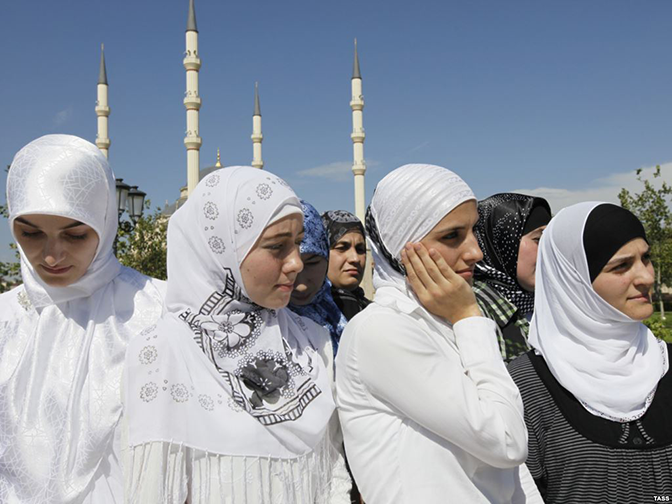
Over the objections of the Russian Orthodox Church to allow girls to wear the hijab in schools, in Chechnya, due to its relative autonomy within the Russian federation, Muslim women are encouraged to don the hijab in all venues of public life; however in the Republic of Mordovia and the Stavropol Territory, hijabs are banned at schools and universities.
Strengthening of federalist structure of Russia in the North Caucasus was wisely chosen by Putin as the most efficient parameters of not allowing the situation of the 1990s to return. Of course, due credit must be given to the heroic Chechen nation of one million people, which forced this realization on the Russian government. The central government of Russia accepted Chechens and indirectly other ethnic minorities as relatively equal players. Were it not for the first Chechen war, Russia would be less federalist today.
Thus, understanding the Federal structure of Russia is essential. To do so, one must first understand the status of Russia within the USSR. After the collapse of communism, the Russian state came to be the natural successor of the USSR and became officially known as the Russian Federation.
According to article 70 of the USSR constitution, the Soviet Union was defined as a federal state that was composed of 15 Socialist Republics whose rights were de jure equal. However, de facto the rights of other republics were far below that of Russia.
If one takes into consideration the historical events in the formation of the USSR and Russia in general and if the theoretical rights of the USSR republics were to be applied in practice the USSR would have collapsed much earlier. Due to forceful incorporation of almost all republics into the communist bloc by Russia, it would be impossible to keep them within the USSR of their own free will.
Thus, if the right to self-determination were applied in practice, al-most all the republics forming the USSR would turn toward national independence. The fear of disintegration of the USSR always kept governmental agencies on alert and forced them to respond harshly toward any secessionist movements. The crude responses often backfired when viewed over the long term.
During the existence of the USSR the main goal of the government apparatus was to maintain communism as a mask for the governing system. After its collapse, Russian government agencies lost their minimal ideological basis. Therefore, the purpose for the existence of many government agencies disappeared. The state structures that were responsible for the maintenance of the USSR now needed to be transformed in their purpose and method.
During the transformation period, Russian federalism faced many obstacles that it needed to overcome to establish a stable federal state. Russia as a multi-ethnic state faces a threat of further disintegration and can meet the fate of the USSR. The current Russian government correctly assessed that forceful management of ethnic minorities based on the Soviet model was outdated and needed to be refashioned. The Chechen war of the 1990's forced Moscow to speed up its federalist transformation.
Today the federalist structure of Russia combined with the bitter experiences of the 1990s in the North Caucasus allow Muslim regions of Russia to function as full-fledged autonomous regions. In a practical sense today Islam in Russian controlled Chechnya is implemented in a far broader sense than in the so-called independent Muslim states of Central Asia and South Caucasus. Hijab is almost made socially compulsory in Chechnya, alcohol is actively discouraged by the local administration and Islamic worship rituals are actively encouraged at the government level. None of this is tolerated even on a minimal level in Central Asia and the South Caucasus.
With this background in mind, if Moscow continues to decentralize control over its Muslim minorities, Russia will create a sustainable long-term social contract with its Muslim citizens that would make the Western control mechanism of Muslims look less sophisticated. The only issue that would undermine such progress would be the rise of Russian nationalism, an action that will evoke negative reaction from the ethnic minorities in Russia.